 1 (866) 313-2180
 SALES@FORKLIFTTIRE.COM



Posted by Forklift Tire Company on 7th Oct 2026
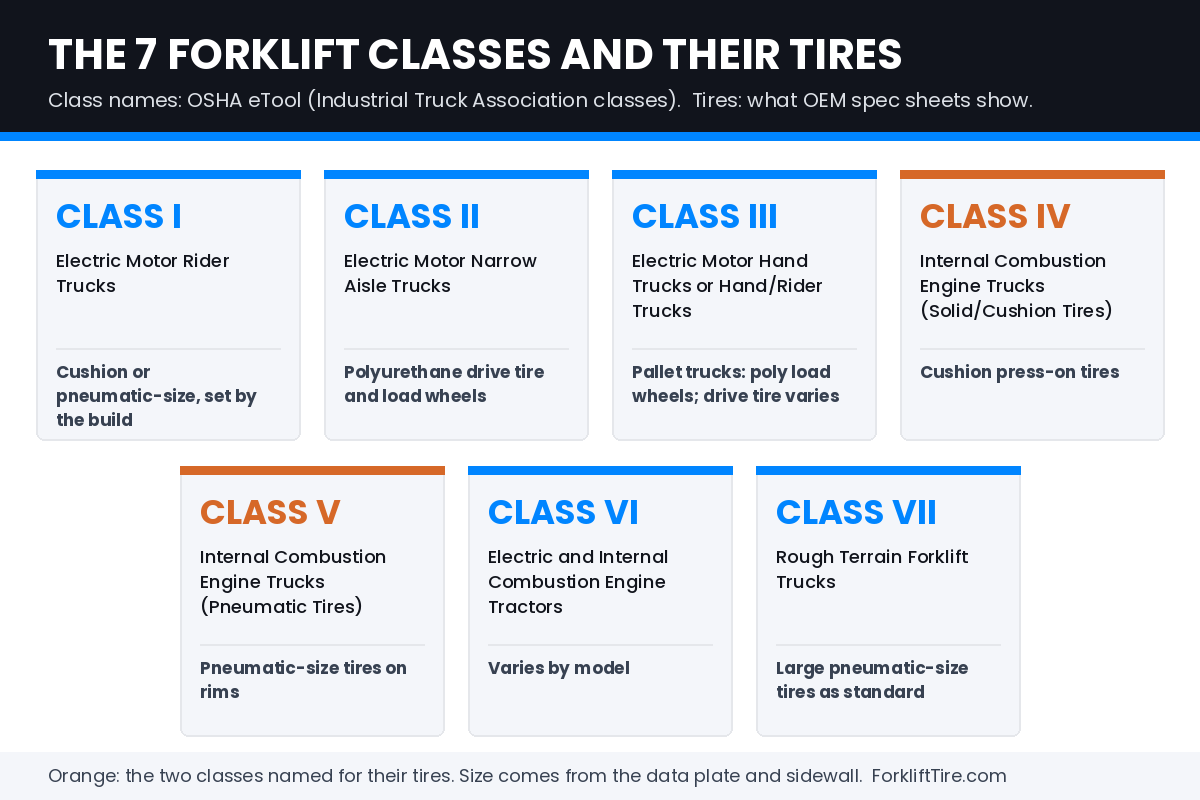
Forklifts are sorted into seven classes, Class I through Class VII. The classes are the Industrial Truck Association’s; OSHA lists them in its Powered Industrial Trucks eTool, and Toyota prints the class on its spec sheets. Two of the seven are named for their tires: Class IV is an engine-powered truck on solid/cushion tires, and Class V is the same kind of truck on pneumatic tires.
That makes the class a useful first clue when you buy tires. For Classes IV and V the class names the tire family; for the other classes, the truck’s build or model decides it. The class does not give you a size. The size comes from the truck’s data plate or literature and the sidewall of the tire you are replacing. Below, each class is matched with the tires its makers print on their own spec sheets.
- Class I, electric motor rider trucks: cushion or pneumatic-size tires, depending on how the truck was built.
- Class II, electric motor narrow aisle trucks (reach trucks, order pickers, turret trucks): polyurethane drive tires and load wheels on the spec sheets we checked.
- Class III, electric motor hand trucks or hand/rider trucks: polyurethane load wheels on the walkie and rider pallet trucks, with a rubber or polyurethane drive tire depending on the model; small tow tractors vary.
- Class IV, internal combustion engine trucks with solid/cushion tires: cushion press-on tires.
- Class V, internal combustion engine trucks with pneumatic tires: pneumatic-size tires on rims.
- Class VI, electric and internal combustion engine tractors: tires vary by model; the large tow tractors we checked run pneumatic tires.
- Class VII, rough terrain forklift trucks: large pneumatic-size tires as standard on the trucks we checked; the telehandlers also come with foam-filled and solid choices.
In this article
The Seven Classes at a Glance
| Class | Name in the OSHA eTool | Typical trucks | What the spec sheets show for tires |
|---|---|---|---|
| I | Electric Motor Rider Trucks | Sit-down and stand-up counterbalanced electric trucks, three-wheel electrics | Set by the build: see Class I |
| II | Electric Motor Narrow Aisle Trucks | Reach trucks, order pickers, turret trucks, side loaders | Polyurethane drive tire and load wheels |
| III | Electric Motor Hand Trucks or Hand/Rider Trucks | Walkie and rider pallet trucks, walkie stackers, small tow tractors | Pallet trucks: polyurethane load wheels, drive tire compound varies by model. Tow tractors vary: see Class III |
| IV | Internal Combustion Engine Trucks (Solid/Cushion Tires) | Engine-powered counterbalanced trucks | Cushion press-on tires |
| V | Internal Combustion Engine Trucks (Pneumatic Tires) | Engine-powered counterbalanced trucks | Pneumatic-size tires on rims |
| VI | Electric and Internal Combustion Engine Tractors | Sit-down tow tractors | Varies by model: see Class VI |
| VII | Rough Terrain Forklift Trucks | Vertical-mast rough terrain trucks, telehandlers, rough terrain truck-mounted forklifts | Large pneumatic-size tires as standard |
Where the Classes Come From
These forklift classifications are the Industrial Truck Association’s. OSHA’s own training material says the association “has placed powered industrial trucks into 7 classes,” and OSHA’s eTool, the agency’s online guidance on powered industrial trucks, lists them. The eTool says the list covers “commonly-used” trucks and “does not include all powered industrial trucks covered by the OSHA standard.” For Classes I to VI it shows example trucks by lift code; for Class VII it names three types. Class I, Code 5, for example, is a “Counterbalanced Rider, Cushion Tires, Sit Down.” Toyota prints the class on its literature too: it heads its engine-powered spec sheets “Class 4 Internal Combustion Engine Cushion Tire” and “Class 5 Internal Combustion Engine Pneumatic Tire.” The eTool writes the classes in Roman numerals and Toyota in Arabic ones, so a Class VII truck and a class 7 forklift are the same thing.
OSHA’s forklift standard, 29 CFR 1910.178, does not number truck classes. Three other things on a spec sheet or in the standard carry a class or type label, and none of them is the truck class:
- Hazardous-location classes. In 1910.178, Class I, II and III are locations: flammable gases or vapors, combustible dust, and easily ignitible fibers or flyings. They decide which designated truck may work there.
- Fire-safety designations. The standard lists eleven: D, DS, DY, E, ES, EE, EX, G, GS, LP and LPS. Each describes the power source and its safeguards, not the truck’s class.
- Fork carriage classes. Crown’s FC 5200 sheet lists its fork carriage as “ITA Class II” on some models and “ITA Class III” on others. That number belongs to the carriage the forks hang on, not to the truck.
Training follows the truck. OSHA requires training on “the types of truck the operator will be authorized to operate” and refresher training when an operator “is assigned to drive a different type of truck.” The standard says type, not class. OSHA Forklift Training Requirements covers the rest. The industry’s safety standards split along similar lines: ANSI/ITSDF B56.1 covers low lift and high lift trucks used “on compacted, improved surfaces,” B56.6 covers rough terrain forklift trucks, and B56.9 covers operator-controlled industrial tow tractors.
Class I: Electric Motor Rider Trucks
A Class 1 forklift, written Class I in the eTool, is the electric counterbalanced truck an operator rides: sit-down four-wheel trucks, stand-up trucks and three-wheel electrics. Unlike Classes IV and V, its name says nothing about tires, and Class I trucks are built both ways. The eTool’s own examples split it by tire: Code 5 is a counterbalanced rider on “Cushion Tires,” and Code 6 is one on “Pneumatic or Either Type Tire.” Four examples from the makers’ sheets:
- Sit-down, cushion. Crown’s FC 5200 series runs cushion tires. As standard, that means 21x7x15 drive tires on the 4,000- and 5,000-lb models, 21x8x15 on the 5,500- to 6,500-lb models, and 16x6x10 1/2 steer tires on all of them. Crown lists wide tread widths and non-marking smooth or lug rubber tires as options, and recommends wide tread drive tires with some taller masts.
- Stand-up, press-on. Crown’s RC 5500 runs press-on solid cushion tires: 16x7x10 1/2 drive and 10x5x6 1/2 steer.
- Sit-down, pneumatic-size. Toyota’s 8FBH25 electric ships with solid pneumatic tires, 21x8-9 14PR drive and 18x7-8 14PR steer, and Toyota’s option list for the series includes air-filled pneumatic tires. Hyster’s J50XN does the reverse: air-filled pneumatic 23x10-12 drive and 18x7-8 steer tires as standard, with solid pneumatic tires as an option.
- Three-wheel. Hyster’s J30-40XNT lists pneumatic-shaped solid tires as standard and rubber cushion tires as a factory option, so two trucks of the same model can carry different tire families.
For Class I, the class number cannot tell you the tire family. The build can. Start from the data plate and the tires on the truck. On a cushion build, the choice you make is the compound, such as black or non-marking rubber. On a pneumatic-size build, it is the construction: air-filled or solid. Shop Cushion Forklift tire sets or Solid & Pneumatic Forklift Tires by size.
Class II: Electric Motor Narrow Aisle Trucks
A Class 2 forklift, Class II in the eTool, is an electric truck built for narrow aisles. The eTool’s examples include the order picker, the reach type outrigger, side loaders, turret trucks and high lift straddle trucks. On the spec sheets we checked, these trucks run polyurethane drive tires and load wheels:
- Crown’s RR 5700 reach truck lists its load wheels, caster and drive tire as “Poly / Poly / Poly,” with a 13-inch drive tire. Yale’s NR and NDR reach trucks print the same “Poly/Poly/Poly” and list various drive tire compounds as options.
- Crown’s SP 3500 order picker uses a 13-inch polyurethane drive tire and tandem polyurethane load wheels. Crown lists a poly or Vulkollan non-marking drive tire and Vulkollan load wheels as options.
- Crown’s TSP turret trucks use polyurethane press-on load wheels 14 inches in diameter and 8 inches wide, and a 16-inch polyurethane drive tire. Crown calls those load wheels “high-load capacity.”
Narrow-aisle wheels and tires are model-specific. Forklift Load Wheels lists wheels by size, bore and bearing, with common OEM part numbers on many product pages, Polyurethane Press-Ons covers poly drive tires by size, and the Forklift Load Wheels & Caster Guide explains how to measure them.
Class III: Electric Motor Hand Trucks or Hand/Rider Trucks
A Class 3 forklift, Class III in the eTool, is an electric pallet truck or one of its relatives. The eTool’s examples include the low lift walkie pallet truck, the “Low Lift Walkie/Rider Pallet and End Control,” high lift straddle and counterbalanced trucks, and tractors. Toyota titles its Class 3 brochures for electric pallet jacks, stackers and tow tractors. On the pallet trucks, the tires split two ways:
- Load wheels: polyurethane on every Class III pallet truck sheet we checked, such as 3 1/4x4 1/2-inch wheels on Crown’s WP 3200 walkie and 3 1/4x6 1/2-inch wheels on Crown’s PE 4500 rider.
- Drive tire: rubber or polyurethane, depending on the model. Crown’s WP 3200 runs a solid rubber 10x4 drive tire on a 6 1/2-inch hub. Yale’s MPB045VH runs a 10x4 press-on smooth rubber tire and lists press-on and molded-on polyurethane drive tires as options. Crown’s PE 4500 rider runs a 13x4 1/2x8 polyurethane drive tire.
- Small tow tractors can be Class III too. Toyota files its Core Tow Tractor (750-lb maximum drawbar pull, rubber drive tire, polyurethane caster and load wheels) and its Mid Tow Tractor (880 to 990 lb drawbar pull on a 3-minute rating, solid pneumatic tires) under Class 3.
For walkie and rider pallet trucks, How to Use a Pallet Jack Safely covers the pre-use check, wheels included, and Forklift Load Wheels lists replacement wheels.
Class IV: Internal Combustion Engine Trucks (Solid/Cushion Tires)
A Class 4 forklift, Class IV in the eTool, is the engine-powered counterbalanced truck built for cushion tires, and the tire is in the class name. Cushion tires are press-on tires: Camso, a tire maker, notes they are “pressed on to the machines hub using a hydraulic press.” Quick Tips On How to Press a Forklift Tire walks through the job.
Toyota’s Core IC Cushion sheet, headed “Class 4 Internal Combustion Engine Cushion Tire,” lists cushion tires on every model. Its 5,000-lb 50-8FGCU25 runs a 21x7x15 drive tire and a 16x5x10 1/2 steer tire, with wide-tread and non-marking tires as options. The Toyota Forklift Tires: Fitment by Model guide and Forklift Tire Sizes by Make & Model list sizes for other models.
On a Class IV truck the tire family is settled. What you choose is the compound, such as black or non-marking rubber. Black vs. Non-Marking Forklift Tires explains the difference, and Cushion Rubber Press-Ons lists both by size.
Class V: Internal Combustion Engine Trucks (Pneumatic Tires)
A Class 5 forklift, Class V in the eTool, is the same kind of engine-powered counterbalanced truck, built for pneumatic tires: tires mounted on rims. Toyota’s Core IC Pneumatic sheet, headed “Class 5 Internal Combustion Engine Pneumatic Tire,” lists pneumatic tires on every model. Its 5,000-lb 50-8FGU25 runs 7.00x12 12PR drive tires and 6.00x9 10PR steer tires.
On forklifts, pneumatic sizes are made air-filled and as solid resilient tires of the same size, often called solid pneumatic; telehandler sheets also list foam-filled versions (see Class VII). Toyota and Hyster print both air-filled and solid tires for their pneumatic-tire electric trucks, one as standard and one as an option (see Class I). Toyota’s 50-8FGU25 sheet lists no solid pneumatic option and refers buyers to the dealer for the complete list of options, so check the truck maker’s guidance before you change construction. Lock Ring vs. Click-Style Solid Pneumatic Forklift Tires explains how solid pneumatic tires mount. Shop Pneumatic Forklift tire sets, single tires in Solid & Pneumatic Forklift Tires, or pre-mounted Solid Forklift Tire & Wheel Assemblies.
Class IV vs Class V: The Tire Is the Dividing Line
Class IV and Class V trucks do the same job, counterbalanced lifting with an engine, but they are different builds, not one truck with two tire options. Toyota makes a 5,000-lb LP truck in each class, and its spec sheets show what changes besides the tires:
| Spec | Class IV: 50-8FGCU25 (cushion) | Class V: 50-8FGU25 (pneumatic) |
|---|---|---|
| Rated capacity | 5,000 lb | 5,000 lb |
| Drive / steer tires | 21x7x15 / 16x5x10 1/2 cushion | 7.00x12 12PR / 6.00x9 10PR pneumatic |
| Overall width | 41.9 in | 45.3 in |
| Wheelbase | 58.5 in | 65 in |
| Basic right-angle stacking aisle width | 94.3 in | 105.9 in |
| Minimum underclearance, with load | 2.8 in | 3.7 in |
| Total weight | 8,000 lb | 7,840 lb |
On these two sheets the cushion truck is 3.4 inches narrower, and its basic right-angle stacking aisle is 11.6 inches less, 94.3 against 105.9 inches (Toyota’s pneumatic sheet notes that load length and clearance are added to the basic figure). The pneumatic truck sits 0.9 inches higher at its lowest point. Because the wheelbase, width and wheels all differ, moving from one tire family to the other is not a tire swap. The data plate and the tires on the truck tell you which build you have. Forklift Tire Types Explained covers each tire type.
Class VI: Electric and Internal Combustion Engine Tractors
Class VI, sometimes searched as a class 6 forklift, covers tractors: trucks that pull loads rather than lift them. The eTool’s example is a sit-down rider with a drawbar pull over 999 lb. Smaller tow tractors can sit in Class III instead: Toyota lists its Core and Mid Tow Tractors as Class 3 and its large tow tractors as Class 6. Toyota’s sheets rate drawbar pull in different ways (maximum, 3-minute and 60-minute), so compare like with like.
Tires depend on the model. Toyota’s Class 6 electric tow tractors, the 2TE15, 2TE18 and 3TE25 (3,300 to 5,500 lb maximum drawbar pull), run pneumatic tires: a 13-inch radial in front (165R13 8PR on the 2TE15, 175R13 8PR on the others) and a 7.00x12 12PR (2TE15) or 28x8-15 12PR (2TE18 and 3TE25) at the rear. Read the sidewall and the data plate before ordering; tractor tire sizes are model-specific.
Class VII: Rough Terrain Forklift Trucks
A Class 7 forklift, Class VII in the eTool, is typically intended for use on “unimproved natural terrain and disturbed terrain construction sites,” in the eTool’s words, and it adds that “rough terrain” does not mean the truck can be “safely operated on every conceivable type of terrain.” The eTool names three types: vertical mast, variable reach (a telescoping boom, usually called a telehandler), and truck/trailer mounted, and it notes that not all truck/trailer mounted forklifts are rough terrain forklifts. The makers’ sheets show large pneumatic-size tires as standard:
- Vertical mast. Sellick’s S Series lists pneumatic tires as standard: 15.5x25 12PR drive and 14x17.5 14PR steer.
- Variable reach (telehandlers). JLG’s 1055, SkyTrak’s 10054 and Genie’s GTH-1056 all list 400/75-28 as the standard size, and SkyTrak’s sheet calls its standard tire pneumatic. All three list foam-filled, solid and non-marking tires among their options.
- Truck-mounted. Moffett’s M8 range sheet lists 31x15.5-15 tires at 8PR or 12PR, depending on the model and whether the tire is front or rear, and 31.5x13-16.5 10PR front tires on some models.
Rough terrain forklift trucks have their own consensus standard, ANSI/ITSDF B56.6, and vehicle-mounted forklifts, industrial and rough terrain, have another, B56.14. For tires, see Telehandler tire sets and the Rough Terrain Forklift Tires guide.
Find Your Tire Size, Step by Step
- Read the data plate: make, model and serial number, and the tire size and type where the plate lists them. How to Read a Forklift Data Plate shows what to look for.
- Match the model to the maker’s literature. Most spec sheets list the model’s standard tire type and often its factory tire options; Toyota’s also name the class. The data plate and the tires on the truck tell you which build you have.
- Read the sidewall of the tire you are replacing and check it against the plate or literature. If they disagree, sort that out before ordering. How to Read Forklift Tire Sizes explains each number.
- Choose within the family: the compound on a press-on truck, the construction (air-filled or solid) on a pneumatic-size truck.
Know the class? Next comes the size.
Send FTC the make, model and serial number from the data plate and a photo of the tire sidewall. FTC reviews the size with you before you order. Verify exact tire size and fitment before ordering.
Email Your Truck Details Contact UsSave 7.5% on 2–3 items or 15% on 4+ items, automatic in cart. Free ground freight to commercial addresses in the contiguous U.S. Questions? Call 1 (866) 313-2180.
Frequently Asked Questions
What are the 7 classes of forklifts?
As OSHA’s Powered Industrial Trucks eTool lists them: Class I, electric motor rider trucks; Class II, electric motor narrow aisle trucks; Class III, electric motor hand trucks or hand/rider trucks; Class IV, internal combustion engine trucks with solid/cushion tires; Class V, internal combustion engine trucks with pneumatic tires; Class VI, electric and internal combustion engine tractors; and Class VII, rough terrain forklift trucks.
What is the difference between a Class 4 and a Class 5 forklift?
Both are engine-powered counterbalanced trucks. Class IV is built for cushion tires and Class V for pneumatic tires. They are different builds: Toyota’s 5,000-lb LP cushion truck, the 50-8FGCU25, has a 58.5-inch wheelbase and is 41.9 inches wide on 21x7x15 and 16x5x10 1/2 cushion tires; its pneumatic 50-8FGU25 has a 65-inch wheelbase and is 45.3 inches wide on 7.00x12 12PR and 6.00x9 10PR tires.
What class is a reach truck?
The eTool lists the reach type outrigger under Class II, electric motor narrow aisle trucks, and also under Class III, electric motor hand trucks or hand/rider trucks. Toyota prints the class on its spec sheets; if your maker’s literature names one, use it.
What class is an electric pallet jack?
Usually Class III. The eTool’s Class III examples include the low lift walkie pallet truck and the “Low Lift Walkie/Rider Pallet and End Control,” and Toyota files its electric pallet jacks under Class 3. The eTool also shows a “Low Lift Pallet” truck among its Class II narrow aisle examples.
What class is a telehandler?
Class VII, rough terrain forklift trucks. The eTool calls it the variable reach type: a truck with a telescoping boom that can place loads at different distances and heights in front of the machine.
Is a Class I hazardous location the same as a Class I forklift?
No. In OSHA’s forklift standard, 29 CFR 1910.178, Class I, II and III are hazardous locations: flammable gases or vapors, combustible dust, and easily ignitible fibers or flyings. The standard does not number truck classes. The truck classes are the Industrial Truck Association’s, and OSHA’s eTool lists them.
Does the class tell me my tire size?
No. For Classes IV and V the class names the tire family; for the other classes the truck’s build or model decides it. The size comes from the truck’s data plate or literature and the sidewall of the tire you are replacing. Verify exact tire size and fitment before ordering.
Trademarks: Crown, Toyota, Hyster, Yale, JLG, SkyTrak, Genie, Sellick, Moffett, Camso, Vulkollan and all other brand names are trademarks of their respective owners. Forklift Tire Company is an independent aftermarket supplier and is not affiliated with, authorized by, sponsored by, or endorsed by any tire manufacturer, equipment manufacturer, standards body or government agency. Names are used solely to identify products, publications and models.