 1 (866) 313-2180
 SALES@FORKLIFTTIRE.COM


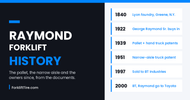
Posted by Forklift Tire Company on 12th Oct 2026
The Raymond Corporation’s story runs through two fixtures of warehouse work: the two-faced pallet and the narrow-aisle lift truck. George G. Raymond, who had bought a controlling interest in Lyon Iron Works in 1922, and William C. House patented an improved pallet and a hand truck to lift it in 1939. A Raymond engineer patented a narrow-aisle truck in 1951, and in September 2026 Raymond marked 75 years since that patent.
Company histories tell this story in round numbers and big firsts. This article dates each step to a document instead: the patents themselves, Raymond’s own histories, a 1997 SEC filing and Toyota Industries’ notices. Where the company’s account and the documents differ, it says so. It ends with what Raymond’s own tire guide shows about buying drive tires and load wheels for these trucks.
In this article
The Short Answer
Each row is a dated step and the document behind it. Where the only source is Raymond’s own history, the table says so.
| Year | What happened | Document |
|---|---|---|
| 1840 | George R. Lyon’s iron foundry and machine shop opens in Greene, New York. | Raymond history brochure (company) |
| 1922 | George G. Raymond Sr. buys a controlling interest in Lyon Iron Works. | Raymond centennial timeline (company) |
| 1939 | Patents granted November 7 to George G. Raymond and William C. House for a pallet and a lift truck, assigned to Lyon Iron Works. | U.S. Patents 2,178,646 and 2,178,647 |
| 1949 | Engineer Christian D. Gibson files a patent application for a narrow-aisle tiering truck, assigned to Lyon-Raymond Corporation. | U.S. Patent 2,564,002 |
| 1950 | The company takes the name The Raymond Corporation. | Raymond centennial timeline (company) |
| 1951 | Gibson’s patent is granted August 14. Raymond calls it the foundation of its Reach-Fork truck. | U.S. Patent 2,564,002; Raymond, 2026 |
| 1956 | Raymond becomes a public corporation in May. | Raymond history brochure (company) |
| 1979 | Raymond says it builds the first very narrow aisle (VNA) Swing-Reach truck in North America. | Raymond centennial timeline (company claim) |
| 1997 | A subsidiary of BT Industries of Sweden offers $33.00 per share for Raymond. | SEC Schedule 14D-1, June 1997 |
| 2000 | Toyota Industries, then named Toyoda Automatic Loom Works, buys 97% of BT Industries in June. | Toyoda Automatic Loom Works shareholder report, 2000 |
| 2025 | Raymond and Toyota Material Handling become one organization, Toyota Material Handling North America (TMHNA), on April 1. | Raymond release, January 8, 2025; Modern Materials Handling, April 7, 2025 |
| 2026 | Toyota Industries is taken private and delisted. Raymond now calls itself “a Toyota group company.” | Toyota Industries notices; Raymond, September 16, 2026 |
1840–1922: A Foundry in Greene
Raymond’s history brochure starts before the Raymond name: “Founded in 1840 by George R. Lyon, the Lyon Iron Foundry was a machine shop manufacturing saws, shingle and lathe mills, ensilage cutters and other agricultural equipment.” Greene is a village in upstate New York; the 2020 Census counted 1,463 people there. The company’s 1930s patents call the business Lyon Iron Works.
In 1922, by the company’s centennial timeline, George Raymond Sr. “moves upstate from Brooklyn and buys a controlling interest in Lyon Iron Works.” The older brochure says simply that he “purchased a foundry in the Village of Greene.” George G. Raymond Sr. (1890–1967) was inducted into the Logistics Hall of Fame in 2022.
1937–1939: The Pallet and the Hand Truck
Raymond’s centennial timeline says that in 1936 “George Sr. and Bill dream up the revolutionary L4P, the first hand pallet truck to transport their new double-faced pallets,” and that the pallet and the L4P were both granted patents in 1939. “Bill” is William C. House, named with Raymond on both patents. “First hand pallet truck” is Raymond’s claim; we did not find an independent ruling on it.
Two patents were granted on November 7, 1939, both naming George G. Raymond and William C. House as inventors and Lyon Iron Works as the assignee:
- U.S. Patent 2,178,646, “Pallet,” filed September 18, 1937.
- U.S. Patent 2,178,647, “Lift truck,” filed March 25, 1938. It describes “an improved lift truck” of the type in an earlier Raymond and House application filed the same day as the pallet. We did not find which patent, if any, that earlier application became, and Raymond’s timeline does not say which patent covers the L4P.
The pallet patent is careful about what it claims. It opens by placing the invention within “that type of pallet known in the art as a two faced pallet,” so the two-faced pallet already existed. It also says lift trucks for double-faced pallets already existed but “were, of necessity, cumbersome and heavily counterweighted.” Its object was “to provide in one pallet the combined advantages of both the single and double faced types, that is, a pallet which may be readily utilized with an uncounterweighted hand lift truck.” In other words, Raymond and House did not patent the idea of a pallet, or of a two-faced one. They patented a two-faced pallet that a light hand truck could pick up.
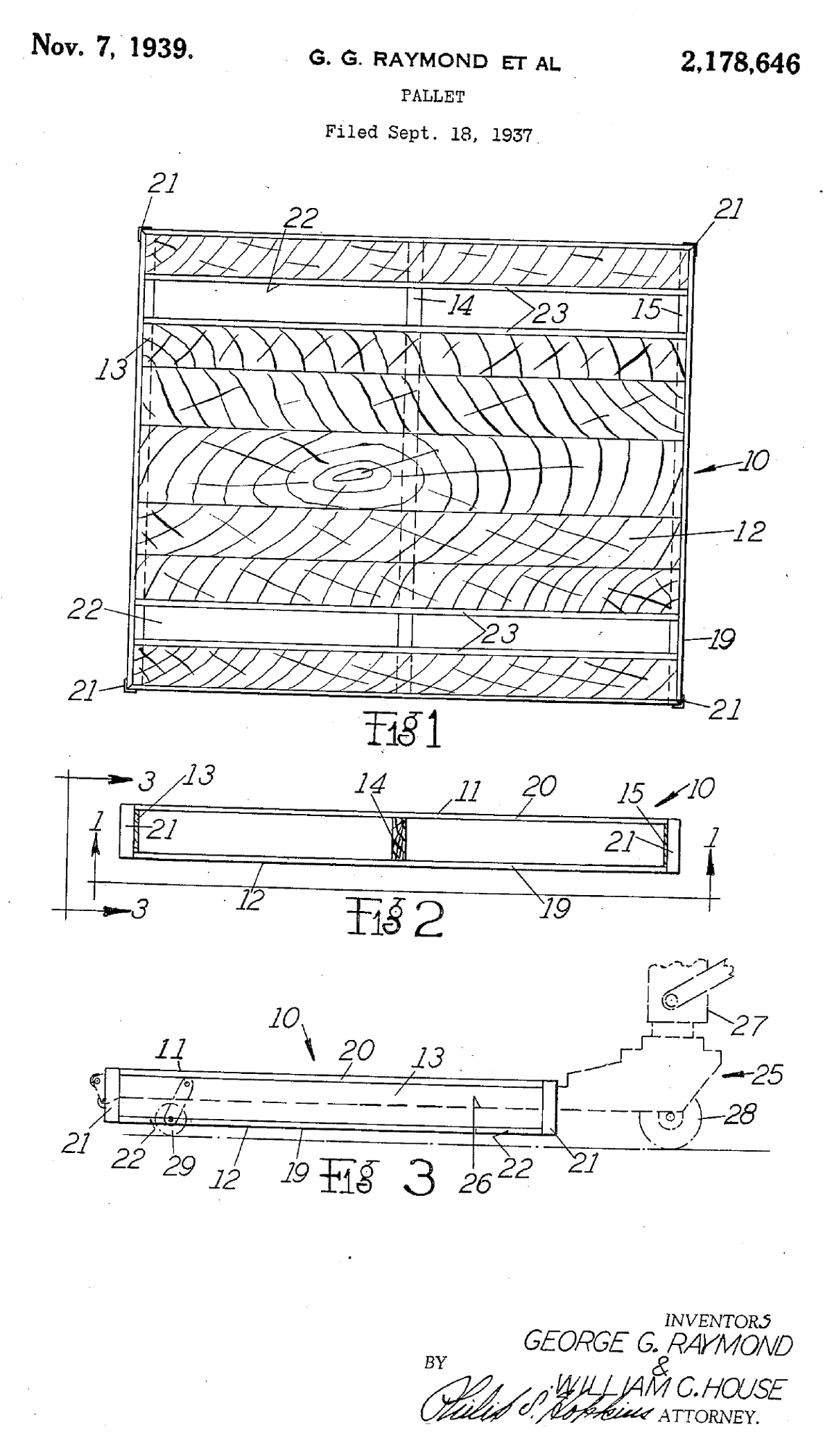
The drawing shows wood, but the text says the pallet “may be constructed of wood or other suitable material” and is reinforced with angle irons. Raymond’s centennial timeline adds that “George Sr. donates the double-faced wooden pallet patent to the material handling industry.” We found no record of a formal dedication, so treat that as the company’s account. How to Use a Pallet Jack Safely covers the rules for running a hand pallet truck today.
1949–1951: The Narrow-Aisle Truck
Christian D. Gibson, a professional engineer, joined the company in the 1940s. MH&L’s 2004 obituary says 1943; Raymond’s centennial timeline lists his hiring under 1945. Both credit him with more than 200 patents. The brochure says that in 1949 Gibson “began work designing the first narrow aisle truck,” and MH&L says he “designed, and the company manufactured, the first narrow aisle truck in North America in 1949.” Those “firsts” are those sources’ claims.
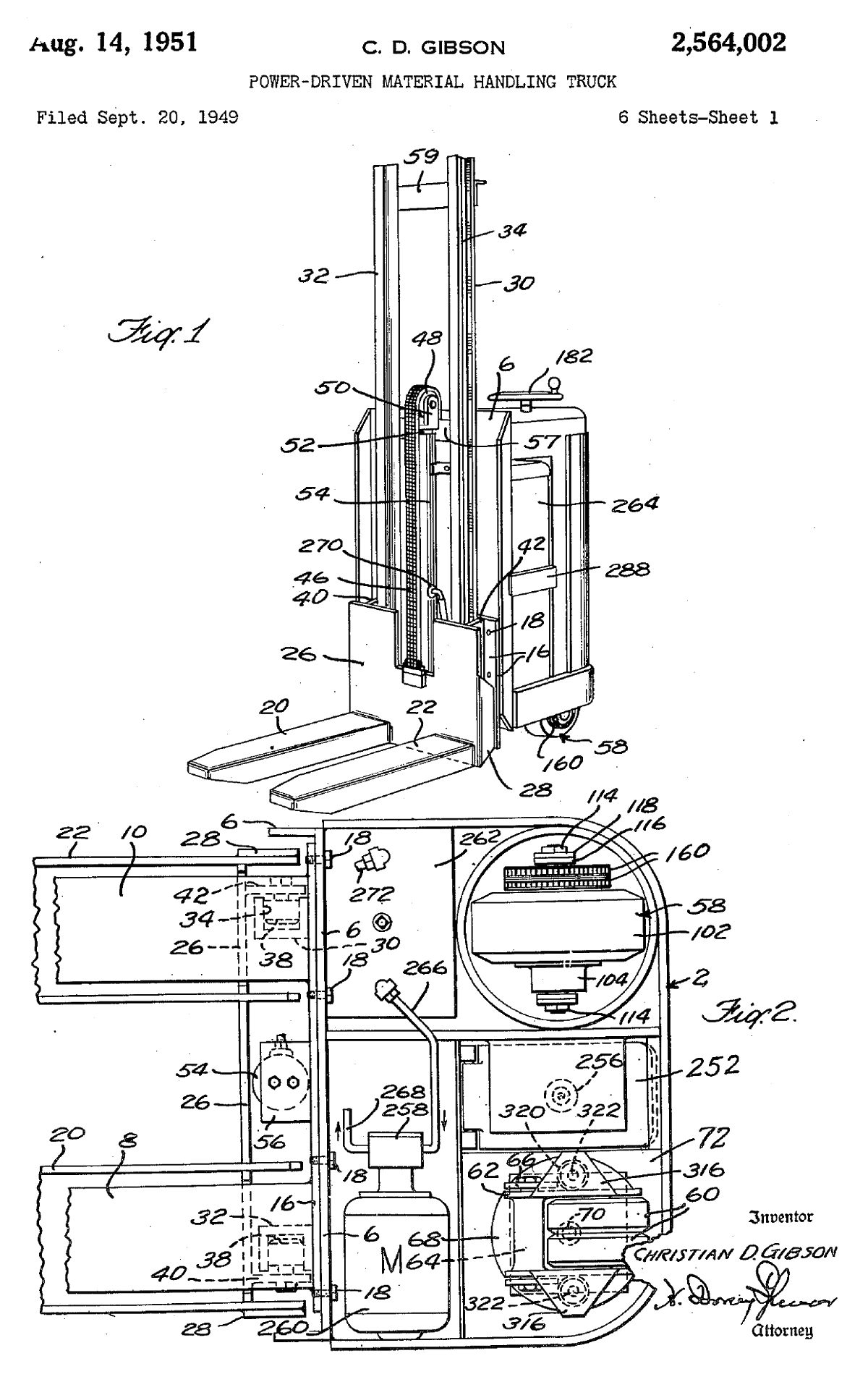
The patent is the firmer document. U.S. Patent 2,564,002, “Power-driven material handling truck,” was filed on September 20, 1949, and granted on August 14, 1951. It names one inventor, “Christian D. Gibson, Greene, N. Y.,” and assigns the patent to Lyon-Raymond Corporation. Raymond’s 2012 brochure, its 2016 and 2026 releases and MH&L’s obituary all say Raymond Sr. and Gibson were granted the patent together; the patent itself lists Gibson alone.
What the patent describes is a truck that “may be used to pile goods in tiers along the sides of the aisles of a warehouse,” built so that the width of aisle it needs “is reduced to a minimum.” Its load end is “of the tiering type designed for use with skid platforms,” with forward arms that carry “tandem supporting wheels or rollers,” and it steers by turning its drive wheel on a turret, which the patent calls fifth-wheel steering, with a castered wheel alongside for support. The text does not describe a fork that reaches forward. That link comes from Raymond: its 2016 release calls the 1951 truck “better known today as the Raymond Reach-Fork truck,” and its 2026 release calls it “the foundation for the Raymond Reach-Fork Truck.”
Raymond’s brochure describes the production truck as the “Lyon-Raymond Model 700 SpaceMaker,” which “was able to work in aisles less than seven feet wide” and, built without a counterbalancing chassis, kept its stability “by straddling the pallet with baselegs.” The brochure’s view of its impact is plain: “This truck made The Lyon-Raymond Corporation the undisputed leader in the material handling industry.” MH&L adds that by 1953 the company had built 1,000 of the trucks.
The patent also planned for tire wear. “The steering and driving wheel 58, preferably provided with a rubber tire,” can be adjusted up and down “to compensate for wear of the tire.” Raymond’s 2016 tire guide still lists replacement drive tires and load wheels for its narrow-aisle trucks.
1950–1979: The Raymond Corporation
Raymond’s centennial timeline dates the current name to 1950, when George Raymond Sr., “now the sole owner of the company, formally changes the name to The Raymond Corporation.” The 1951 patent still names Lyon-Raymond Corporation, the assignee on the 1949 application. The brochure says Raymond “became a public corporation in May 1956,” and that by 1959 George Raymond Jr. was running the company as president and CEO.
Raymond then went narrower. Its timeline says that in 1979 it built “the first very narrow aisle (VNA) Swing-Reach® truck in North America,” and adds that VNA lift trucks “operate in aisles less than 5 feet wide.” That is also a company claim. Swing-Reach and Reach-Fork are still Raymond product names.
1997–2026: BT, Toyota and TMHNA
Raymond was a public company for about four decades. In June 1997, Lift Acquisition Company, Inc., “an indirect wholly-owned subsidiary of BT Industries AB,” of Sweden, filed a tender offer for Raymond’s shares “at a price of $33.00 per Share,” according to the Schedule 14D-1 on file with the SEC. Raymond’s brochure records the result: Raymond “was acquired by BT Industries of Sweden in 1997.”
Three years later, BT changed hands. Toyota Industries, then named Toyoda Automatic Loom Works, wrote in a 2000 report to shareholders: “In June 2000, we acquired 97% of the outstanding shares of BT Industries AB.” Raymond came with BT. Raymond’s 2025 release puts it more simply, “Toyota acquired The Raymond Corporation in 2000,” but the purchase went through BT.
Raymond announced on January 8, 2025, that it and Toyota Material Handling, Inc. would become one company, Toyota Material Handling North America (TMHNA), effective April 1, and Modern Materials Handling reported that the integration was “finalized on April 1.” Raymond’s release describes TMHNA as “composed of two main group companies: Toyota Material Handling, Inc. and The Raymond Corporation.” TMHNA’s North American headquarters is in Columbus, Indiana. Raymond keeps its brand and its headquarters in Greene, New York.
The parent changed again in 2026. A tender offer for Toyota Industries by a company set up by Toyota Fudosan was completed on March 23, 2026, and Toyota Industries’ shares were delisted from the Tokyo and Nagoya exchanges on June 1, 2026, according to Toyota Industries’ own notices. In its September 16, 2026, release, Raymond describes itself as “a Toyota group company.”
Popular Claims, Checked
| The claim | What the record shows |
|---|---|
| “Raymond invented the pallet.” | The 1939 patent describes “that type of pallet known in the art as a two faced pallet” and says lift trucks for double-faced pallets already existed. What Raymond and House patented was a two-faced pallet a light, uncounterweighted hand truck could lift. |
| “Raymond Sr. donated the pallet patent to the industry.” | Raymond’s centennial timeline says so. We found no document of a formal dedication; treat it as the company’s account. |
| “George Raymond Sr. and Christian Gibson patented the reach truck in 1951.” | U.S. Patent 2,564,002 names Gibson as the only inventor, assigned to Lyon-Raymond Corporation. It describes a narrow-aisle tiering truck, not a reaching fork. Raymond calls it the foundation of its Reach-Fork truck. |
| “Toyota bought Raymond in 2000.” | BT Industries of Sweden bought Raymond in 1997. Toyota Industries, then Toyoda Automatic Loom Works, bought 97% of BT in June 2000, and Raymond came with it. |
| “TMHNA is headquartered in Greene, New York.” | Raymond is headquartered in Greene. TMHNA’s North American headquarters is in Columbus, Indiana. |
For the wider story of how the forklift came together from many companies’ parts, see Who Invented the Forklift?
What This Means When You Buy Tires
Reach trucks, order pickers and turret trucks are Class II trucks: electric, built for narrow aisles. Classes of Forklifts and Their Tires explains the class system and the tires each class runs. Raymond’s own Polyurethane Wheels and Tires Application Guide (©2016) lists its polyurethane drive tires and load wheels by truck model, and it shows two things worth knowing before you order.
One series can take several sizes. The guide lists more than one drive tire size for each of these three narrow-aisle truck families:
| Raymond trucks (as named in the guide) | Drive tire sizes listed | Durometers listed |
|---|---|---|
| 7200, 7300, 7400, 7500, 7600 and 7700 Series Reach-Fork® Trucks | 13 1/2x6x10 1/2; 10 1/2x4 1/2x8 (listed for the 7200 to 7500 Series) | 85, 90, 95 |
| 5200, 5400, 5500 and 5600 Series Orderpickers | 12x5x9; 12x5 with an 8.980 in. bore; 14x8x11 1/4; 13 1/2x6x10 1/2 (listed for the 5400 to 5600 Series) | 85, 90 |
| 9600, 9700, SA and SB Series Swing-Reach® Trucks | 15x6x11 3/4; 14x8x10 1/4; 15x6 1/2x10 3/4 | 85, 90 |
The orderpicker listing even carries a second 12x5 drive tire whose bore is printed as 8.980 inches, against 9.000 for the 12x5x9, under its own part number. Load wheels vary the same way: across its 7000-series Reach-Fork listings, the guide gives at least five load-wheel sizes, from 4x2 7/8 to 6x4, on bores of 2.047, 2.440 and 2.834 inches.
The same size comes in different hardnesses. Most part numbers in the guide end in a suffix, such as /001, /008 or /015, that the guide ties to a compound and durometer. The 13 1/2x6x10 1/2 drive tire appears at 85 and 90 durometer, and in the guide’s wheel-and-tire tables, each 7000-series Reach-Fork load wheel from 4x2 7/8 to 6x4 appears at both 85 and 95. Raymond’s troubleshooting chart suggests a softer durometer for floor debris, a rough ride or poor traction, and a harder durometer for long, high-speed runs, heavy loads, and frequent reversals, tight turns and hard braking.
So the series name on its own does not settle the size. Before ordering for a Raymond narrow-aisle truck:
- Read the data plate for the model and serial number. How to Read a Forklift Data Plate shows where to look.
- Look for the part number on the old wheel or tire. Raymond’s guide says its wheels and tires have “a unique identification code stamped into the hub indicating the part number.”
- Measure the old part: outside diameter, width and inside diameter (or bore, for a load wheel), and note the bearing. Forklift Load Wheels & Caster Guide explains how.
- Browse Polyurethane Press-Ons for poly drive tires by size and Forklift Load Wheels for wheels by size, bore and bearing. The Raymond section of Forklift Tire Sizes by Make & Model has more on Raymond trucks.
Replacing tires or load wheels on a Raymond truck?
Send FTC the model and serial number from the data plate, any part number stamped on the old wheel or tire, and a photo. FTC reviews the size with you before you order. Verify exact tire size and fitment before ordering.
Email Your Truck Details Contact UsSave 7.5% on 2–3 items or 15% on 4+ items, automatic in cart. Free ground freight to commercial addresses in the contiguous U.S. Questions? Call 1 (866) 313-2180.
Frequently Asked Questions
Who founded the Raymond Corporation?
Raymond calls George G. Raymond Sr. its founder. The business itself began as George R. Lyon’s iron foundry and machine shop in Greene, New York, founded in 1840. George G. Raymond Sr. bought a controlling interest in Lyon Iron Works in 1922, and, by the company’s account, renamed it The Raymond Corporation in 1950.
Did Raymond invent the pallet?
No. Its 1939 patent describes the two-faced pallet as already “known in the art.” George G. Raymond and William C. House patented an improved two-faced pallet that an uncounterweighted hand lift truck could lift, along with a lift truck, both granted on November 7, 1939.
Who invented Raymond’s narrow-aisle truck?
U.S. Patent 2,564,002, granted on August 14, 1951, names engineer Christian D. Gibson as the only inventor and assigns it to Lyon-Raymond Corporation. Raymond’s own releases credit George Raymond Sr. and Gibson together, and Raymond calls the truck the foundation of its Reach-Fork truck.
Who owns Raymond today?
Raymond is one of the two main group companies of Toyota Material Handling North America (TMHNA), formed on April 1, 2025, and it describes itself as “a Toyota group company.” BT Industries of Sweden bought Raymond in 1997, and Toyota Industries bought 97% of BT in 2000. Raymond is still headquartered in Greene, New York.
What tires do Raymond reach trucks use?
Raymond’s 2016 application guide lists polyurethane drive tires and load wheels for its 7200 to 7700 Series Reach-Fork trucks in several sizes and in different durometers. Check the data plate and the part number stamped on the old wheel or tire, and measure it, before ordering.
Trademarks: Raymond, Reach-Fork, Swing-Reach, Toyota and all other equipment names and model designations are trademarks of their respective owners. Forklift Tire Company is an independent aftermarket supplier and is not affiliated with, authorized by, sponsored by, or endorsed by any equipment manufacturer. Make and model references are used solely to identify equipment and its history.