 1 (866) 313-2180
 SALES@FORKLIFTTIRE.COM


Posted by Forklift Tire Company on 17th Jun 2026
Toyota runs one of the largest forklift fleets in North America, so "what tires fit my Toyota?" is one of the most common ordering questions we get. The good news: your Toyota's model number already tells you most of what you need to know — including, on most IC counterbalance models, whether the truck runs cushion or pneumatic tires. The trick is reading it correctly, then confirming the exact size before you order.
This guide shows you how to decode your Toyota model number, tell cushion from pneumatic at a glance, find the sizes commonly fitted to each type, and verify fitment so you buy the right Toyota forklift tires the first time.
In this guide

Start With Your Model Number
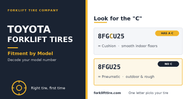
Every Toyota forklift wears a model number like 8FGCU25 or 8FGU25, and each character means something. Those two examples differ by a single letter — the C — yet they take completely different tires on different wheels. That one character is where most wrong Toyota tire orders start. Once you can read the whole code, you'll know the truck's generation, power source, usually its tire type (note the 3-wheel electric exception below), and roughly its capacity:
| Position | Example: 8FGCU25 | What it tells you |
|---|---|---|
| Series | 8FGCU25 |
Generation. The 8-Series is Toyota's current line; 7-Series and earlier are older but still common in the field. |
| Power | 8FGCU25 |
FG = gasoline/LP. FD = diesel. FB = electric battery. (The F is for "forklift.") |
| Tire type | 8FGCU25 |
"C" = cushion tires on Toyota’s IC counterbalance models; the paired model without a "C" is pneumatic. It’s the most important character for tire shopping — with one exception Toyota itself flags: 3-wheel electric (8FBE) models offer optional pneumatic tires, so on those the model number alone doesn’t settle tire type. |
| Plant | 8FGCU25 |
U = built in the U.S. (Toyota's Columbus, Indiana plant). Some models show no letter (Japan-built) or F (France). It doesn't change your tire — just don't mistake it for part of the capacity. |
| Capacity | 8FGCU25 |
A quick estimate: multiply the last two digits by 200 lbs. 25 ≈ 5,000 lbs; 30 ≈ 6,000 lbs. Always confirm the rated capacity on the data plate. |
On IC counterbalance models, one character decides your tire: look for the "C"
An 8FGCU25 is a cushion-tire truck. An 8FGU25 (no C) is a pneumatic-tire truck. Same "25" capacity, completely different tires on completely different wheels. On IC counterbalance trucks, everything about which tires you can buy follows from that one letter — so find it first. The one exception: Toyota’s 3-wheel electric (8FBE) models can be configured cushion or pneumatic, so for electrics confirm tire type on the data plate rather than from the code alone.
8FGU25). On bigger trucks Toyota moves it to the end (8FG35U, 8FG40U) — so there is no "8FGU35." On base model numbers, if the code ends in a letter, the number just before it is your capacity class — option suffixes like -BCS and -COMP hang off the end of the base model (50-8FGC35U-BCS), so read the base code first.Cushion or Pneumatic? Why It Decides Everything
Cushion and pneumatic Toyotas use different tires on different wheels — they are not interchangeable. Before you look at a single size, confirm which one you have.
| Cushion Toyota | Pneumatic Toyota | |
|---|---|---|
| Tire style | Press-on — a rubber tire bonded to a steel band, pressed onto the wheel | Pneumatic tube-type or solid resilient on a multi-piece wheel |
| Built for | Smooth indoor concrete — warehouses, docks | Outdoor and rough/mixed surfaces — yards, lumber, ports |
| Typical models | 8FGCU, 8FBC…U (electric), 7FGCU, 5FBCU | 8FGU, 8FDU, 8FG, 7FGU |
| What to shop | Cushion rubber press-ons / cushion sets | Pneumatic & solid resilient / pneumatic sets |
If you try to buy the wrong type, it simply won't mount — a cushion press-on can't go on a pneumatic wheel, and vice versa. It's the most common and most avoidable Toyota tire ordering mistake. If you're still sorting out which type your truck uses, our forklift tire buying guide walks through it step by step.
Most Popular Toyota Models: Tire Sizes at a Glance
These are the Toyota badges we're asked about most, written the way owners usually say them — Toyota's current sheets print prefixed designations (40-8FGCU25, 50-8FGU25 and similar), and the exact current models are in the model tables further down. Sizes below are the common factory drive and steer fitments for these capacity classes, consistent with Toyota's published spec sheets (see the Sources at the end of this guide). Tap any size to see tires and pricing for that position — and always confirm both sizes on your sidewalls before ordering, since drive and steer differ.
| Model | Capacity | Tire type | Drive (front) ×2 | Steer (rear) ×2 |
|---|---|---|---|---|
| 8FGCU25 | ~5,000 lb | Cushion (press-on) | 21x7x15 | 16x5x10-1/2 |
| 8FGCU30 | ~6,000 lb | Cushion (press-on) | 21x8x15 | 16x6x10-1/2 |
| 8FGU25 | ~5,000 lb | Pneumatic | 7.00-12 (12PR) | 6.00-9 (10PR) |
| 8FDU25 (diesel) | ~5,000 lb | Pneumatic | 7.00-12 (12PR) | 6.00-9 (10PR) |
| 8FGU30 | ~6,000 lb | Pneumatic | 28x9-15 (12PR) | 6.50-10 (10PR) |
Shorthand badges shown; Toyota's current sheets print prefixed designations. Specs reflect common 8-Series factory configurations (Toyota Material Handling spec sheets — see Sources). Older series, options, and re-tired trucks can differ — verify your data plate and sidewall. Running a different brand or model? See the full forklift tire sizes by make & model chart.
Cushion-Tire Toyota Models: Common Sizes
Cushion Toyotas — most badged with a "C" (8FGCU, 8FBC…U, and similar), plus the 8FBE 3-wheel electrics in their cushion-standard build — run press-on tires, sized in the press-on format OD x Width x Inside Diameter (for example, 21x7x15). Sizes scale with capacity. Here are size classes commonly equipped across Toyota's current cushion line:
The current 8-Series line first, keyed by exact model number so you can scan straight to your truck:
| Model | Drive (front) | Steer (rear) | Capacity |
|---|---|---|---|
| 50-8FGCU15 | 18x6x12-1/8 | 14x4-1/2x8 | 3,000 lb |
| 50-8FGCU18 | 18x6x12-1/8 | 14x4-1/2x8 | 3,500 lb |
| 50-8FGCSU20 (compact) | 18x6x12-1/8 | 14x5x10 | 4,000 lb |
| 50-8FGCU20 | 21x7x15 | 16x5x10-1/2 | 4,000 lb |
| 40-8FGCU20 | 21x7x15 | 16x5x10-1/2 | 4,000 lb |
| 40-8FGCU25 | 21x7x15 | 16x5x10-1/2 | 5,000 lb |
| 40-8FGCU30 | 21x8x15 | 16x6x10-1/2 | 6,000 lb |
| 40-8FGCU32 | 21x8x15 | 16x6x10-1/2 | 6,500 lb |
| 50-8FGC35U | 22x12x16 | 18x6x12-1/8 | 8,000 lb |
| 50-8FGC35U-BCS (Box Car Special) | 22x9x16 | 18x6x12-1/8 | 8,000 lb |
| 50-8FGC45U | 22x12x16 | 18x7x12-1/8 | 10,000 lb |
| 50-8FGC45U-BCS (Box Car Special) | 22x12x16 | 18x7x12-1/8 | 10,000 lb |
| 50-8FGC55U | 22x12x16 | 18x8x12-1/8 | 12,000 lb |
| 50-8FGC55U-BCS (Box Car Special) | 22x12x16 | 18x8x12-1/8 | 12,000 lb |
| 50-8FGC60U | 28x12x22 | 22x8x16 | 13,500 lb |
| 50-8FGC70U | 28x12x22 | 22x8x16 | 15,500 lb |
Toyota prints the 40- and 50- prefixed versions as separate model numbers (on these sheets, the 40- models are gasoline/LP and the 50- models are LP), so they are listed as separate rows. Toyota’s spec sheets do not state a ply rating for cushion press-ons. Note the details that catch people: the compact 50-8FGCSU20 steers on a 14x5x10 — not the 16x5x10-1/2 of the 50-8FGCU20, and not the 14x4-1/2x8 of the smaller trucks — and the 8,000 lb Box Car Special drives on a narrower 22x9x16 while the standard 50-8FGC35U drives on a 22x12x16. Toyota’s current sheets list no 40- version of the CU15, CU18 or CSU20, and no Box Car Special version of the 60U or 70U. Dual-drive, wide-tread and non-marking options are named on Toyota’s sheets without a published alternate size — call us and we’ll help you work out what’s actually on your truck.
Running an older Toyota, or one that’s not in the model table? The capacity-class chart below shows commonly seen Toyota cushion capacity classes, including legacy 4-, 5-, 6- and 7-Series trucks. Lighter classes list period-correct legacy models; the heavy classes are the current 8FGC35U–55U. Tap any size to shop it.
| Capacity class | Drive (front)* | Steer (rear)* | Example model series |
|---|---|---|---|
| 4,500 lb | 21x7x15 | 18x5x12-1/8 | 5FGC23 / 05-FGC23 / 42-FGC23 |
| 5,000 lb | 21x7x15 | 18x5x12-1/8 | 4FGC25 / 5FGC25 / 40-4FGC25 |
| 5,500 lb | 21x8x15 | 18x6x12-1/8 | FDC28 / FGC28 / 02-FDC28 |
| 6,000 lb | 21x8x15 | 18x6x12-1/8 | FDC30 / FGC30 / 3FGC30 |
| 6,500 lb | 21x8x15 | 16x6x10-1/2 | 7FGCU32 / 8FGCU32 |
| 8,000 lb | 22x12x16 | 18x6x12-1/8 | 50-8FGC35U / 8FGC35U |
| 8,000 lb | 22x9x16 | 18x6x12-1/8 | 8FGC35U-BCS (Box Car Special) |
| 10,000 lb | 22x12x16 | 18x7x12-1/8 | 8FGC45U / 8FGC45U-BCS |
| 12,000 lb | 22x12x16 | 18x8x12-1/8 | 8FGC55U / 8FGC55U-BCS |
*Rows are organized by rated capacity and list period-correct example models. Sizes shift by generation — note the current 8-Series cushion trucks in the quick-reference above use a 16x5x10-1/2 / 16x6x10-1/2 steer, while the older 4-, 5-, and 6-Series at the same capacity used the larger-bore 18x5x12-1/8 or 18x6x12-1/8. That's a generation difference, not a contradiction. Toyota offered more than one tire/wheel option on many models, so always confirm your exact size on the sidewall and data plate before ordering — drive and steer are different sizes. Box Car Special (BCS) trucks are listed as their own rows wherever their tire size differs from the standard truck of the same capacity — the 8,000 lb BCS runs a narrower drive tire. Current 8-Series trucks are listed by exact model number in the model table above.
Cushion press-ons come in black rubber and non-marking rubber. If your Toyota works on sealed, coated, or finished floors — food, pharma, retail, clean manufacturing — non-marking rubber saves you from black streaks. Shop individual sizes at cushion rubber press-ons, or matched cushion forklift sets (a 4-piece set with 2 drive + 2 steer).
Pneumatic-Tire Toyota Models: Common Sizes
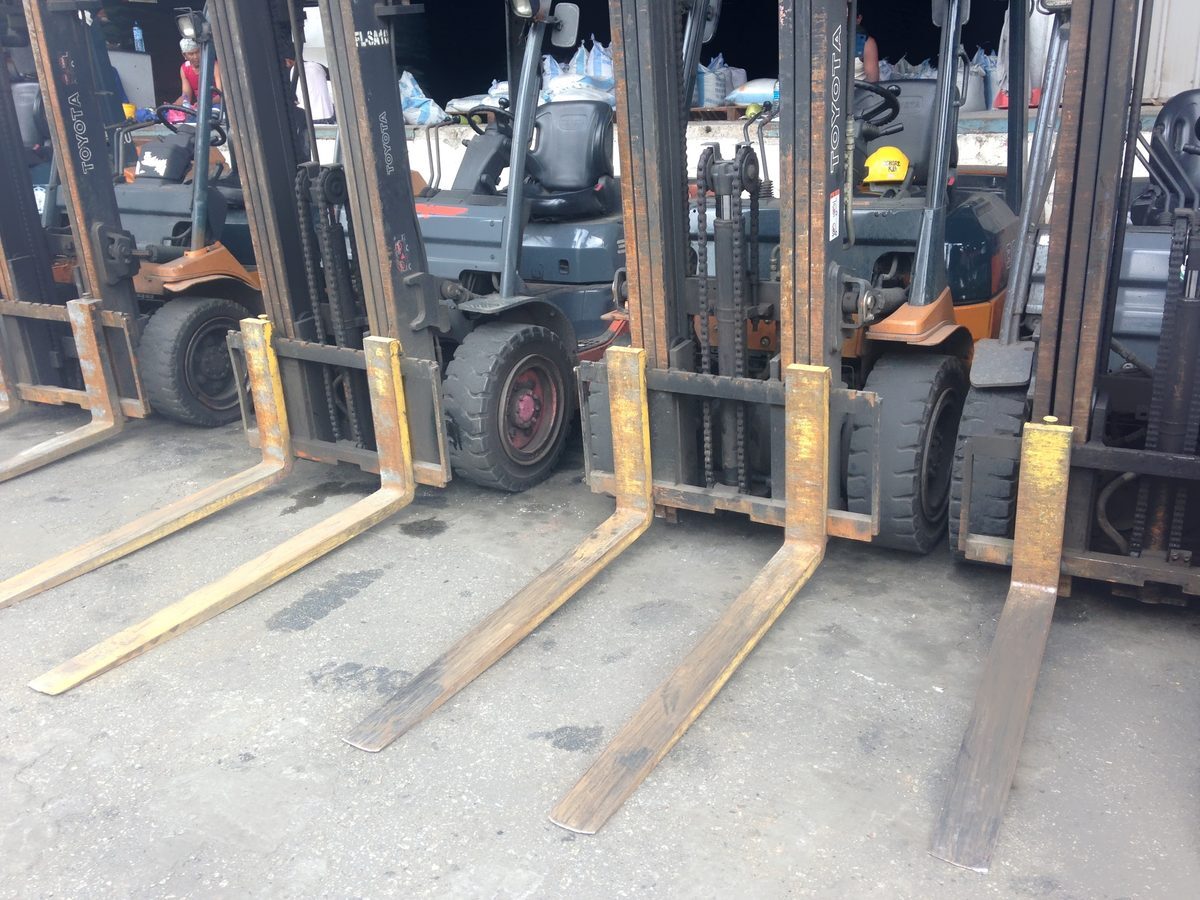
Pneumatic IC Toyotas (no "C" — 8FGU, 8FDU, and similar) run either air-filled pneumatic tube-type tires or flat-proof solid resilient tires. A popular example: the Toyota 8FGU25 commonly takes a 7.00-12 drive tire and a 6.00-9 steer tire — and we sell that drive/steer size pairing as a mounted assembly set. Before ordering a mounted assembly or changing tire construction, verify your data plate, wheel and rim details, and mounting pattern — and if the truck is being converted or the records conflict, confirm the configuration with Toyota or an authorized service provider.
- Pneumatic tube-type — best ride and shock absorption outdoors, but can go flat on debris. Tube-type tires run with a matching inner tube and liner flap — check the product page for what's included.
- Solid resilient — solid rubber molded in a pneumatic profile, sized to replace the air tire on many trucks; it can't puncture or go flat. A common upgrade for debris-heavy yards — confirm your wheel and rim details before switching construction.
If your crew is patching or replacing air tires every few weeks, the math often favors solid resilient: a higher up-front cost, but no flats, no downtime waiting on a road call, and a predictable replacement interval. Where debris keeps eating air tires, that usually works out to a lower total cost over the life of the tires — weigh ride comfort, heat, and your duty cycle for your application.
Current 8-Series pneumatic models, keyed by exact model number:
| Model | Drive (front) | Steer (rear) | Capacity |
|---|---|---|---|
| 40-8FGU15 | 6.50-10 (10PR) | 5.00-8 (8PR) | 3,000 lb |
| 50-8FGU15 | 6.50-10 (10PR) | 5.00-8 (8PR) | 3,000 lb |
| 40-8FGU18 | 6.50-10 (10PR) | 5.00-8 (8PR) | 3,500 lb |
| 50-8FGU18 | 6.50-10 (10PR) | 5.00-8 (8PR) | 3,500 lb |
| 50-8FG45U | 300-15 (20PR) | 7.00-12 (12PR) | 10,000 lb |
| 50-8FG50U | 300-15 (20PR) | 7.00-12 (14PR) | 11,000 lb |
Same prefix rule as the cushion table: Toyota prints the 40- (gasoline/LP) and 50- (LP) versions as separate model numbers, listed separately. Watch the 45U/50U pair: both drive on a 300-15 (20PR), but Toyota lists the 50-8FG45U steer at 12PR and the 50-8FG50U steer at 14PR — same size string, different tire. Toyota’s current spec sheets publish no diesel (8FDU) counterpart for these particular models — the current Core Diesel sheet covers the 40-8FDU20–32 — and they name dual-drive and solid-tire options without publishing an alternate size, so call us and we’ll help you check those configurations.
For older trucks and the rest of the range, here is the full pneumatic capacity-class chart, with period-correct example models. Tap any size to shop it; ply rating (PR) is shown for reference.
| Capacity class | Drive (front)* | Steer (rear)* | Example model series |
|---|---|---|---|
| 2,000 lb | 6.00-9 (10PR) | 5.00-8 (8PR) | 4FG10 / 02-3FD10 / 40-2FG10 |
| 2,500 lb | 6.00-9 (10PR) | 5.00-8 (8PR) | 3FD14 / 4FG14 / 42-4FG14 |
| 3,000 lb | 6.50-10 (10PR) | 5.00-8 (8PR) | FD15 / FG15 / 3FD15 |
| 3,500 lb | 6.50-10 (10PR) | 5.00-8 (8PR) | FD18 / FG18 / 4FG18 |
| 4,000 lb | 7.00-12 (12PR) | 6.00-9 (10PR) | FG20 / 4FD20 / 4FG20 |
| 4,500 lb | 7.00-12 (12PR) | 6.00-9 (10PR) | 4FD23 / 4FG23 / 02-4FD23 |
| 5,000 lb | 7.00-12 (12PR) | 6.00-9 (10PR) | FG25 / 4FD25 / 4FG25 |
| 5,500 lb | 28x8-15 (12PR) | 6.50-10 (10PR) | 3FD28 / 02-3FD28 / 52-3FD28 |
| 6,000 lb | 28x9-15 (12PR) | 6.50-10 (10PR) | 6FGU30 / 8FDU30 / 8FGU30 |
| 6,500 lb | 28x9-15 (14PR) | 6.50-10 (10PR) | 7FDU32 / 8FGU32 |
| 8,000 lb | 250-15 (18PR) | 7.00-12 (12PR) | 8FG35U |
| 9,000 lb | 250-15 (18PR) | 7.00-12 (12PR) | 8FG40U |
*Organized by rated capacity with period-correct example models. A model year or attachment package can change fitment, and some trucks were offered with more than one tire option. Note 28x8-15 (the 5,500 lb 3FD28-era drive), 28x9-15 (the 6,000 lb 8FGU30 drive) and 250-15 (the 8,000–9,000 lb 8FG35U/40U drive) are three different tires — match rim width and load rating, not just the leading number. Always verify the size molded on your tire and data plate before ordering.
For pneumatic Toyotas, shop individual sizes at pneumatic & solid resilient tires, matched pneumatic-type sets, or skip the tire press with tire & wheel assemblies. If you run an 8FGU25, the 7.00-12 & 6.00-9 solid resilient assembly set matches that common drive/steer size pairing, mounted on wheels — verify your data plate and wheel details with us before ordering.
Electric Toyota Models and Reach Trucks
Electric Toyotas (the "FB" models) split a couple of ways. Sit-down electric counterbalance trucks use the same press-on cushion tires as their gas counterparts — and on the 3-wheel line, Toyota also prints a factory pneumatic-tire specification. One naming note: Toyota's current spec sheets print the electric cushion badges with the capacity digits before the U — 8FBC25U, not "8FBCU25" — so if the shorthand you know doesn't match, check the model printed on your data plate.
The four-wheel Core Electric line, keyed by exact model number:
| Model | Drive (front) | Steer (rear) | Capacity |
|---|---|---|---|
| 8FBC15U | 18x6x12-1/8 | 14x4-1/2x8 | 3,000 lb |
| 8FBC18U | 18x6x12-1/8 | 14x4-1/2x8 | 3,500 lb |
| 8FBC20U | 21x7x15 | 16x5x10.5 | 4,000 lb |
| 8FBC20U-COMP | 21x7x15 | 16x5x10.5 | 4,000 lb |
| 8FBC25U | 21x7x15 | 16x5x10.5 | 5,000 lb |
| 8FBC25U-COMP | 21x7x15 | 16x5x10.5 | 5,000 lb |
| 8FBCH25U | 21x7x15 | 16x5x10.5 | 5,000 lb |
| 8FBC28U | 21x8x15 | 16x6x10.5 | 5,500 lb |
| 8FBC30U | 21x8x15 | 16x6x10.5 | 6,000 lb |
| 8FBC32U | 21x8x15 | 16x6x10.5 | 6,500 lb |
| 8FBCH32U | 21x9x15 | 16x6x10.5 | 6,500 lb |
The heavy-class detail worth catching: the 8FBCH32U drives on a 21x9x15 while the 8FBC32U drives on a 21x8x15 — same capacity, different drive tire. The COMP and H versions elsewhere in the line share their sibling's tire sizes but are separate Toyota model numbers.
The 3-Wheel Electric line, in its standard cushion press-on build:
| Model | Drive (front) | Steer (rear) | Capacity |
|---|---|---|---|
| 8FBE15U | 18x7x12-1/8 | 15x5x11-1/4 | 3,000 lb |
| 8FBES15U | 18x7x12-1/8 | 15x5x11-1/4 | 3,000 lb |
| 8FBE18U | 18x7x12-1/8 | 15x5x11-1/4 | 3,500 lb |
| 8FBEH18U | 18x7x12-1/8 | 15x5x11-1/4 | 3,500 lb |
| 8FBE20U | 18x7x12-1/8 | 15x5x11-1/4 | 4,000 lb |
Toyota also builds every 8FBE model in a pneumatic-tire configuration — the same spec sheet lists an 18x7-8 (16PR) drive and a 16x6-8 (10PR) steer for all five models. A pneumatic-configured 8FBE is a different factory build on different wheels — press-on and pneumatic sizes are not interchangeable on the same truck — so check your data plate to see which build your truck is before ordering either construction.
Toyota's reach trucks, order pickers, and walkie/electric pallet equipment don't use forklift tires on the load end at all — they ride on polyurethane load wheels and casters. If that's your machine, see our forklift load wheels & caster guide and shop polyurethane load wheels by size and OEM number.
How to Confirm Your Exact Toyota Tire Size
The model number points you to the tire type; the data plate and sidewalls confirm the exact size:
- Start with the data plate. On sit-down Toyotas the data plate lists the tire size and type the truck was designed to use, along with model, serial, and rated capacity — Toyota's guidance is to replace with the same size and type.
- Read the sidewall. Your current tires have the size molded into them — cushion looks like
21x7x15; pneumatic looks like7.00-12. Check both drive and steer; they're usually different. If the sidewall and the data plate disagree (a prior owner may have changed the setup), send us both before ordering — we'll review the evidence with you, and where records conflict or the construction is changing, the approved configuration should be confirmed with Toyota or an authorized service provider. - Have your serial number ready. For older or reconfigured trucks, the serial number helps pin down the build configuration — pair it with the data plate and what's actually mounted.
- Count the wheel holes (for assemblies). If you're buying mounted tire-and-wheel assemblies, the bolt-hole count has to match your hub — our 8FGU25 set, for example, comes in 5- and 8-hole (7.00-12) and 4- and 6-hole (6.00-9) patterns. Count the holes on your wheel before you order.
Drive and steer positions almost always take different sizes, so confirm both. The forklift tire size chart and our full tire sizes by make & model guide cross-reference the most common models and sizes if you want to double-check.
Not sure of your size? Send us your data plate.
Snap a photo of the metal data plate on your Toyota (usually on the dash or cowl) and send it over — it lists the model and serial we need. Our team reviews it with you and helps confirm your drive and steer tire sizes, usually the same day, so you can order with confidence.
1. Find the data plate · 2. Photo the model & serial · 3. Email or call — we review it with you and help confirm the fitment
Email Your Data-Plate Photo Call 1 (866) 313-2180Prefer to type it out? Use our contact form with your model & current tire size.
What to Verify Before You Order
Toyota model numbers point you in the right direction, but model alone does not confirm fitment — trucks get re-tired, reconfigured, and spec'd with options. Before you buy, confirm:
- Tire type — cushion press-on vs. pneumatic/solid resilient (check the data plate and the wheel style)
- Data-plate tire size/type — sit-down Toyotas list the designed tire size and type on the plate; if it conflicts with what's mounted — or you're changing construction — gather both details, check with us, and confirm the approved configuration with Toyota or an authorized service provider before ordering
- Drive tire size — molded on the sidewall
- Steer tire size — usually different from the drive size
- Compound — black vs. non-marking (cushion), or tube-type vs. solid resilient (pneumatic)
- Set vs. single — a full 4-tire set, or one position
- Wheel bolt-hole count — for mounted tire-and-wheel assemblies, match your hub's hole pattern
Verify exact tire size and fitment before ordering. Not sure? Call 1 (866) 313-2180 with your Toyota's model, serial number, and current tire sizes, and we'll help you land on the right tires before you order.
Why Buy Toyota Forklift Tires from ForkliftTire.com
- Buy direct — skip the dealer quote. Most Toyota tire results send you to a dealer parts desk, a quote request, or an account login. We're direct ecommerce: pick your construction, add to cart, done.
- Matched sets for common configurations. For the 8FGU25's common sizes, the 7.00-12 & 6.00-9 assembly arrives mounted on wheels — no tire press. Send us your data plate, current sizes, and wheel details and we'll help confirm the right match before you order.
- Every construction, both positions. Black or non-marking cushion press-ons; air tube-type or flat-proof solid resilient pneumatics; singles or matched 4-piece sets (2 drive + 2 steer).
- Real fitment help — not a marketplace listing. Talk to people who know forklifts and confirm fitment before you order, instead of guessing from a generic listing.
- Transparent savings. Save 7.5% on 2–3 items or save 15% on 4+ items, automatic in cart. Free ground freight to commercial addresses in the contiguous U.S.
Running a Toyota? Show us your setup in our Operator Gallery. Not sure of your size? Call 1 (866) 313-2180 and we'll help verify fitment before you order.
Frequently Asked Questions
What size tires fit my Toyota forklift?
It depends on your exact model and configuration. On Toyota's IC counterbalance models, a "C" in the code (like 8FGCU25) means cushion press-on tires; no "C" (like 8FGU25) means pneumatic tires — though Toyota's 3-wheel electric (8FBE) models can be cushion or pneumatic, so check the data plate. The exact size is molded on your current tires' sidewalls, and drive and steer positions usually differ. Confirm both sizes before ordering, or call us with your model and serial number.
Does my Toyota forklift use cushion or pneumatic tires?
Look for a "C" in the model number. Models like 8FGCU25 or 8FBC25U (with a C) are cushion-tire trucks built for smooth indoor floors and use press-on tires. Models like 8FGU25 or 8FDU30 (no C) are pneumatic-tire trucks for outdoor and rough surfaces. The two use different wheels and are not interchangeable. One exception: Toyota's 3-wheel electric (8FBE) models come cushion or pneumatic — confirm on the data plate.
What tires does a Toyota 8FGCU25 use?
The 8FGCU25 is a roughly 5,000 lb capacity gas/LP cushion-tire forklift, so it uses press-on cushion tires — commonly 21x7x15 on the drive (front) and 16x5x10-1/2 on the steer (rear), with some configurations differing. Confirm your exact drive and steer sizes on the sidewalls before ordering, and choose black or non-marking rubber based on your floors.
What tires does a Toyota 8FGU25 use?
The 8FGU25 is a roughly 5,000 lb pneumatic-tire forklift. It commonly takes a 7.00-12 drive (front) tire and a 6.00-9 steer (rear) tire, available as air-filled pneumatic tube-type or flat-proof solid resilient. We offer that size pairing as a mounted assembly set. Verify your sizes, data plate, and wheel details before ordering — and if you're changing tire construction, confirm the configuration with Toyota or an authorized service provider.
What tires does a Toyota 8FGU30 use?
The 8FGU30 is a roughly 6,000 lb pneumatic-tire forklift. It commonly runs a 28x9-15 drive (front) tire and a 6.50-10 steer (rear) tire, in air-filled or solid resilient. As always, drive and steer differ — read both sidewalls or send us your model and serial and we'll help confirm.
How do I find my Toyota forklift's tire size?
Read the size molded on your current tires' sidewalls — cushion sizes look like 21x7x15 and pneumatic sizes look like 7.00-12. Check both drive and steer positions, since they usually differ. Your truck's data plate lists the tire size and type it was designed for, plus the model and serial number we can use to help confirm fitment if the sidewall is worn.
Not sure which tires fit your Toyota? Call 1 (866) 313-2180 with your model, serial number, and current sizes — we'll help you confirm the right tires before you order. Verify exact tire size and fitment before ordering.
Sources
Every size in the model-keyed tables above comes from Toyota Material Handling’s own published spec sheets — the documents below, read directly. Toyota’s tables label tire sizes “Tires – Size – Front / Rear”; we gloss those as drive (front) and steer (rear).
- Toyota Core IC Cushion spec sheet, ©2024 (50-8FGCU15–32 | 50-8FGCSU20 | 40-8FGCU20–32) — toyotaforklift.com
- Toyota Core IC Pneumatic spec sheet, ©2024 (50-8FGU15–32 | 40-8FGU15–32; the ©2023 edition remains published and agrees on the sizes cited) — toyotaforklift.com
- Toyota Mid IC Pneumatic spec sheet, ©2024 (50-8FG35U–50U) — toyotaforklift.com
- Toyota Large IC Cushion spec sheet, ©2024 (50-8FGC35U–70U) — toyotaforklift.com
- Toyota Box Car Special comprehensive brochure, ©2023 (50-8FGC35U–55U-BCS; the ©2021 edition remains published and agrees on the sizes cited) — toyotaforklift.com
- Toyota Core Diesel Pneumatic spec sheet, ©2026 (40-8FDU20–32) — toyotaforklift.com
- Toyota Core Electric spec sheet, ©2026 (8FBC15U–32U including COMP and H models) — toyotaforklift.com
- Toyota 3-Wheel Electric spec sheet, ©2025 (8FBE15U–20U | 8FBES15U | 8FBEH18U) — toyotaforklift.com
- Toyota Large IC Cushion spec sheet, ©2020 (8FGC35U–70U) — Toyota’s current spec-sheet library no longer serves this edition (the original toyotaforklift.com link returns 404), so it is cited from an authorized Toyota dealer’s mirror of the original Toyota PDF (Lift Truck Center, Inc.)
- Legacy 4-, 5-, 6- and 7-Series rows in the capacity-class charts predate Toyota’s current documentation — Toyota’s published spec-sheet library offered no current (©2024–2026) sheet for those series when checked (2026-08-31). Treat those rows as archival reference data organized by rated capacity, not current Toyota publications, and verify against your truck’s data plate, serial number and sidewalls before ordering.
Fitment references are general guidance. Our tires are commonly used on certain Toyota, Hyster, Yale, Caterpillar, Mitsubishi, and Crown forklifts that use these sizes and constructions, but equipment make and model alone do not confirm fitment. Always verify exact tire size, type, and both drive and steer dimensions before ordering. ForkliftTire.com is an independent retailer and is not affiliated with, authorized by, or endorsed by Toyota. "Toyota" and all model names are trademarks of their respective owners, referenced here for fitment purposes only.