 1 (866) 313-2180
 SALES@FORKLIFTTIRE.COM


Posted by Forklift Tire Company on 1st May 2026
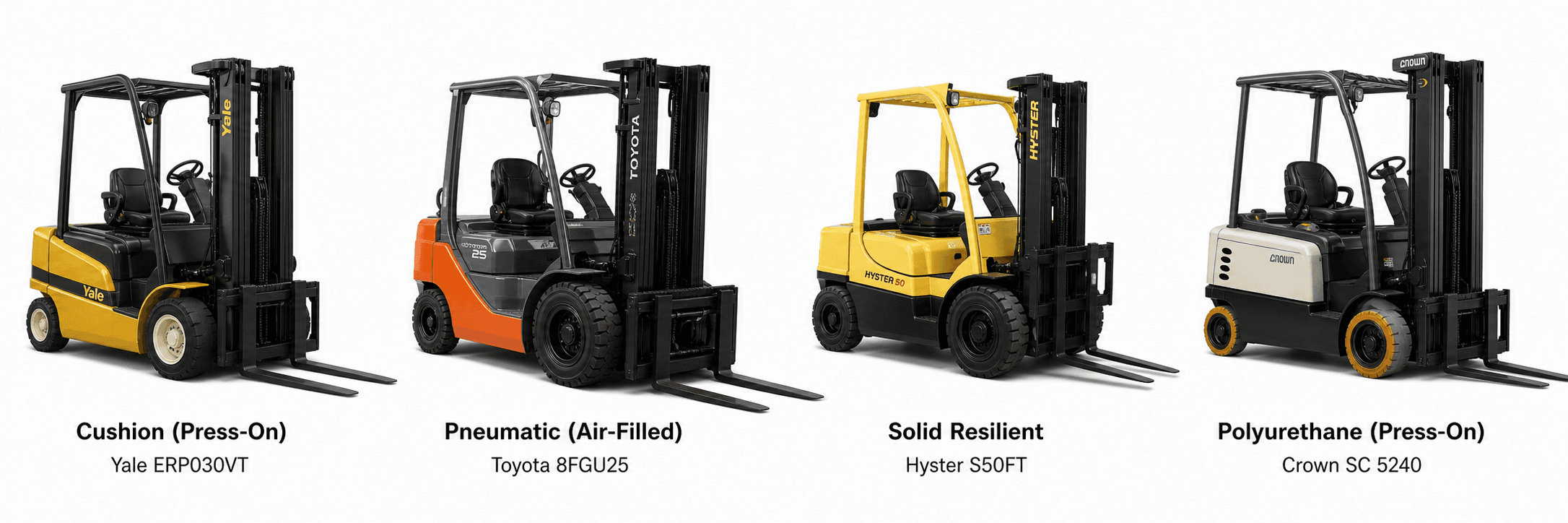
Choosing the wrong forklift tire type is one of the most common — and most expensive — ordering mistakes in material handling. The four major forklift tire categories each serve different equipment, surfaces, and operating conditions. Understanding the differences between cushion (press-on) tires, pneumatic tires, solid resilient tires, and polyurethane press-on tires is the fastest way to get the right replacement and avoid costly downtime.
This guide breaks down each tire type by construction, best applications, equipment compatibility, key tradeoffs, and expected service life so you can identify exactly which type your forklift needs.
Forklift Tire Types at a Glance
| Feature | Cushion (Press-On) | Pneumatic (Air-Filled) | Solid Resilient | Polyurethane (Press-On) |
|---|---|---|---|---|
| Construction | Solid rubber bonded or pressed onto a steel band | Air-filled rubber casing with tread, similar to automotive tires | Solid rubber molded to mimic pneumatic shape; mounts on standard pneumatic rims | Polyurethane compound pressed onto a steel band |
| Mounting | Hydraulic press required | Mounts on split or multi-piece rims | Mounts on standard pneumatic rims | Hydraulic press required (same as cushion) |
| Flat Risk | None — solid construction | Yes — punctures and blowouts possible | None — solid construction | None — solid construction |
| Best Surfaces | Smooth concrete, asphalt, warehouse floors | Gravel, dirt, uneven outdoor terrain, loading docks | Mixed indoor/outdoor, rough concrete, moderate debris | Smooth, clean warehouse floors only |
| Typical Equipment | Electric sit-downs, 3-wheel electrics, IC cushion-tire forklifts (LP/gas) | IC pneumatic-tire forklifts, outdoor yard trucks | IC forklifts used where flats are a problem | Electric forklifts, reach trucks, order pickers, AGVs |
| Ride Comfort | Firm — minimal cushioning | Best — air provides natural shock absorption | Moderate — stiffer than pneumatic, softer than cushion | Firm — varies by durometer rating |
| Tread Life | Long — consistent wear pattern | Moderate — depends on terrain and pressure maintenance | Longest — maximum rubber volume | Very long — resists chunking and tearing |
| Approx. Service Life | 2,000–4,000 hours | 1,000–2,500 hours | 3,000–5,000 hours | 3,000–5,000+ hours |
| Non-Marking Available | Yes | Limited | Yes | Inherently non-marking |
Cushion (Press-On) Forklift Tires
Cushion tires — also called press-on tires — are solid rubber tires bonded to a steel band that gets hydraulically pressed onto the forklift’s wheel. They are used on a wide range of forklifts designed for indoor and smooth-surface operation, including electric sit-down forklifts, 3-wheel electric forklifts, and IC (LP/gas) cushion-tire forklifts. Many forklift models are available in both pneumatic-tire and cushion-tire configurations — the cushion-tire version is built with a shorter wheelbase and lower ground clearance for indoor use. (Note: many electric forklifts come from the factory with polyurethane press-on tires rather than rubber cushion — see the polyurethane section below for more on the difference.)
How Cushion Tires Work
Because cushion tires have no air cavity and a smaller overall diameter than pneumatic tires, they give the forklift a lower profile and a tighter turning radius. This makes them ideal for warehouse aisles, loading bays, and distribution centers where maneuverability matters. The tradeoff is less ground clearance and no pneumatic cushioning, which limits their use on rough or uneven surfaces.
When to Choose Cushion Tires
- Indoor warehouses with smooth concrete or sealed floors
- Distribution centers where tight turns and narrow aisles are common
- Clean manufacturing facilities — non-marking rubber compounds are available to prevent floor scuffing
- Electric and IC cushion-tire forklifts commonly used on certain Toyota, Hyster, Yale, Clark, Crown, Mitsubishi, Caterpillar, Komatsu, and UniCarriers forklifts
Cushion press-on tires are available in black rubber and non-marking rubber compounds. Non-marking versions are commonly specified for food processing, pharmaceutical, and clean-room environments where black tire marks are unacceptable.
→ Shop All Press-On Forklift Tires
Pneumatic Forklift Tires
Pneumatic forklift tires are air-filled rubber tires with a deep tread pattern, designed for outdoor use on rough, uneven, or unpaved surfaces. They are the standard tire type for internal combustion (IC) forklifts — gas, diesel, and LP-powered units that operate in lumber yards, construction sites, container yards, and outdoor loading docks.
How Pneumatic Tires Work
Like automotive tires, pneumatic forklift tires use air pressure to absorb impacts and distribute load across the contact patch. This air cushion provides the best ride quality of any forklift tire type and allows the tire to conform to irregular surfaces. Pneumatic tires require inner tubes and liner flaps for proper installation on most forklift applications.
When to Choose Pneumatic Tires
- Outdoor yards with gravel, dirt, broken pavement, or uneven ground
- Loading docks where forklifts transition between indoor floors and outdoor surfaces
- Lumber yards, steel yards, and construction sites with heavy debris
- Applications requiring maximum traction on wet or loose surfaces
The main disadvantage of pneumatic tires is puncture risk. In environments with metal shavings, nails, glass, or sharp debris, flat tires can cause significant downtime. If your operation experiences frequent flats, a solid resilient tire may be a better choice. Another option is foam-filling — injecting polyurethane foam into a pneumatic casing to make it puncture-proof while retaining the pneumatic shape. Foam-fill preserves ride quality better than a solid resilient tire but adds weight and cannot be repaired once the tread wears out.
Pneumatic forklift tires are commonly used on certain Toyota, Hyster, Yale, Clark, Crown, Mitsubishi, Caterpillar, Komatsu, UniCarriers, Hyundai, and Doosan forklifts.
→ Shop Pneumatic & Solid Resilient Forklift Tires
Solid Resilient Forklift Tires
Solid resilient tires are puncture-proof alternatives to pneumatic tires. They are made entirely of solid rubber but are shaped and sized to mount on the same rims as pneumatic tires — no hydraulic press required. This makes them a practical flat-proof alternative for operations that want to eliminate puncture-related downtime without changing wheels.
How Solid Resilient Tires Work
Solid resilient tires use engineered rubber compounds (often in multiple layers) to approximate the load-bearing and shock-absorbing properties of an air-filled tire. They typically have a softer rubber tread layer for traction and a firmer base for load support. While they do not ride as smoothly as pneumatic tires, they provide significantly more cushioning than press-on cushion tires.
When to Choose Solid Resilient Tires
- Scrap yards, recycling facilities, and demolition sites where puncture hazards are extreme
- Mixed indoor/outdoor operations that need flat-proof reliability on rough surfaces
- High-throughput facilities where a single flat tire creates costly bottlenecks
- Any IC forklift application where pneumatic flats are a recurring problem
Solid resilient tires generally last longer than pneumatic tires because there is more rubber material and no air pressure to maintain. However, they are heavier, which can increase energy consumption on electric units (though they are primarily used on IC equipment).
→ Shop Solid Resilient Forklift Tires
Polyurethane Press-On Forklift Tires
Polyurethane press-on tires are a major category of press-on tires alongside rubber cushion. They are commonly found on electric sit-down forklifts, narrow-aisle reach trucks, order pickers, and automated guided vehicles (AGVs). Many electric forklifts come from the factory with polyurethane tires rather than rubber cushion, making them one of the most widely installed tire types in warehouse operations.
How Polyurethane Tires Work
Polyurethane tires are molded from engineered polyurethane compounds and pressed onto a steel band using the same hydraulic press process as rubber cushion tires. They share the same sizing conventions (OD x width x ID) and are a direct drop-in alternative on the same equipment. Polyurethane is available in several durometer (hardness) ratings — such as 88A (softer, for smoother ride and cold-storage applications) and 95A (harder, for heavy loads and multi-shift operations) — allowing the tire to be matched to the specific application.
When to Choose Polyurethane Tires
- Smooth warehouse floors where low rolling resistance extends electric forklift battery life
- Clean and food-grade facilities — polyurethane is inherently non-marking and does not shed rubber particles
- Cold-storage and freezer operations — lower-durometer compounds (e.g., 88A) retain flexibility in cold environments
- Narrow-aisle reach trucks and order pickers where precise handling and floor protection matter
- Multi-shift, high-hour operations — polyurethane resists chunking and tearing, often lasting up to twice as long as rubber cushion on smooth floors
Polyurethane Limitations
Polyurethane does not dissipate heat as effectively as rubber. On forklifts that operate at higher sustained speeds or carry very heavy loads continuously, internal heat buildup can accelerate wear. Polyurethane also provides less traction than rubber on wet or contaminated floors. For applications involving rough surfaces, outdoor terrain, debris, or frequent wet conditions, rubber cushion tires are typically the better press-on choice.
Polyurethane tires are not a replacement for pneumatic or solid resilient tires, which serve different equipment and surfaces entirely.
→ Shop Polyurethane Press-On Tires
How to Identify Which Tire Type Your Forklift Uses
If you are not sure which tire type your forklift needs, start with these identification steps:
- Check the tire currently on the machine. The size is printed or molded on the sidewall. Cushion tires show a size like 18x6x12-1/8 (three-number format: OD x width x ID). Pneumatic and solid resilient tires typically show a size like 7.00-12 or 28x9-15.
- Look at the wheel mounting. If the tire is pressed directly onto a steel band with no separate rim, it is a cushion press-on. If it mounts on a multi-piece or split rim, it is a pneumatic or solid resilient type.
- Check the forklift data plate. The data plate (usually on the instrument panel or near the mast) lists the approved tire size and type for that specific unit.
- Identify your forklift’s power source and tire configuration. Electric sit-down forklifts almost always use press-on tires — either rubber cushion or polyurethane. IC forklifts come in both pneumatic-tire and cushion-tire configurations: pneumatic-tire IC forklifts use pneumatic or solid resilient tires, while cushion-tire IC forklifts use press-on tires. Check your forklift’s model designation — it typically indicates whether the unit is a pneumatic-tire or cushion-tire model.
Always verify exact tire size and fitment before ordering. If you are still unsure, contact our team with your forklift make, model, and the size printed on your current tires. We will help you verify the correct replacement.
Which Forklift Tire Type Do You Need? Decision Guide
| Your Situation | Recommended Tire Type | Why |
|---|---|---|
| Indoor warehouse, smooth floors, electric forklift | Cushion Press-On | Tight turning radius, long wear on smooth surfaces, no flats |
| Outdoor yard, rough terrain, IC forklift | Pneumatic | Best ride quality and traction on uneven ground |
| Outdoor with frequent puncture hazards | Solid Resilient | Eliminates flat-tire downtime, mounts on same rims as pneumatics |
| Mixed indoor/outdoor, moderate surfaces | Solid Resilient or Pneumatic | Depends on puncture frequency — resilient if flats are common |
| Electric forklift, smooth warehouse floors, battery efficiency matters | Polyurethane Press-On | Lower rolling resistance extends battery life, non-marking, long tread life |
| Clean facility, no floor marks allowed | Non-Marking Cushion or Polyurethane | Both are available in non-marking compounds; polyurethane is inherently non-marking |
| Need maximum tire life, lower TCO | Solid Resilient | Most rubber volume, no pressure maintenance, longest tread life |
Tire Life and Replacement Cost
Tire life varies significantly by type, operating conditions, and load. The ranges below are general estimates for typical single-shift warehouse or yard operations. Multi-shift, heavy-load, or abrasive-surface applications will shorten these ranges.
| Tire Type | Typical Service Life | Key Factors Affecting Life |
|---|---|---|
| Cushion (Press-On) | 2,000–4,000 hours | Floor condition, load weight, turning frequency |
| Pneumatic | 1,000–2,500 hours | Terrain roughness, inflation maintenance, debris exposure |
| Solid Resilient | 3,000–5,000 hours | Surface abrasiveness, load weight, operating speed |
| Polyurethane | 3,000–5,000+ hours | Floor cleanliness, operating speed, load weight, ambient temperature |
When calculating total cost of ownership, factor in more than the tire price. A single flat tire on a pneumatic can cost $500–$1,000+ in combined downtime, labor, and lost productivity — often more than the price difference between pneumatic and solid resilient tires. Operations that experience frequent flats should calculate their true cost per incident before assuming pneumatics are the cheaper option.
When to Replace Your Forklift Tires
Worn forklift tires reduce traction, increase stopping distance, and can damage the forklift itself. Here are the key wear indicators by tire type:
- Cushion and polyurethane press-ons: Replace when the rubber reaches the wear line (a molded indicator near the steel band) or when flat spots, chunking, or bond separation between the rubber and steel band appear. If the steel band is visible through the rubber at any point, the tire must be replaced immediately.
- Pneumatic tires: Replace when tread depth is worn to the wear bars, when sidewall cracking or dry rot appears, or when the tire can no longer hold proper air pressure. Repeated slow leaks often indicate internal casing damage.
- Solid resilient tires: Replace when the tread is worn to the tire’s wear indicator line (typically marked on the sidewall) or when large chunks are missing from the tread surface. Because solid resilient tires have substantial rubber depth, they should not be run past the marked wear line — the remaining rubber below that line is the structural base, not usable tread.
Running worn tires past their service limits accelerates wear on wheel bearings, axles, transmission mounts, and other drivetrain components. Replacing tires on schedule is significantly cheaper than repairing the damage worn tires cause.
Common Mistakes When Choosing Forklift Tire Types
Putting Cushion Tires on an Outdoor Forklift
Cushion press-on tires lack the ground clearance and tread depth for gravel, dirt, or broken pavement. Using them outdoors accelerates wear and creates stability risks on uneven surfaces. If your forklift operates outdoors, you need pneumatic or solid resilient tires.
Ignoring Flat Frequency When Choosing Pneumatics
If your facility goes through multiple pneumatic tires per year due to punctures, the total cost of downtime, labor, and replacement tires often exceeds the upfront cost of switching to solid resilient tires. Calculate your true cost per flat — including operator idle time and production delays — before assuming pneumatics are the cheaper option.
Using Polyurethane on Wet or Rough Floors
Polyurethane tires are engineered for smooth, clean, dry warehouse surfaces. On wet floors, they offer less traction than rubber compounds. On rough or debris-covered surfaces, they wear faster and are more prone to damage. If your operation involves water, oil, chemicals on the floor, or any outdoor exposure, rubber cushion tires are the better press-on choice.
Ordering the Wrong Size Format
Cushion tires and pneumatic tires use different size conventions. A 18x6x12-1/8 is a cushion press-on. A 18x7-8 is a pneumatic/resilient size. These are not interchangeable. Always verify the exact size on your current tire before ordering. For help converting between size formats, see our Forklift Tire Buying Guide.
Frequently Asked Questions
What is the difference between cushion and pneumatic forklift tires?
Cushion tires are solid rubber pressed onto a steel band, designed for smooth indoor surfaces and electric forklifts. Pneumatic tires are air-filled with deep tread, designed for rough outdoor terrain and IC (gas/diesel/LP) forklifts. They mount differently, fit different equipment, and are not interchangeable.
Can I put solid tires on a forklift that came with pneumatics?
Yes. Solid resilient tires are specifically designed to mount on the same rims as pneumatic tires. They are a common upgrade for operations that experience frequent flats. The forklift’s load capacity and performance should remain comparable, though ride quality will be slightly firmer.
How do I know what size forklift tire I need?
Check the size molded into the sidewall of your current tire. You can also find the approved tire size on the forklift’s data plate, typically located on the instrument panel or near the mast. If you need help, contact us with your forklift make, model, and current tire size.
Are non-marking forklift tires available in all four types?
Non-marking compounds are most commonly available in cushion press-on tires and solid resilient tires. Polyurethane press-on tires are inherently non-marking. Non-marking pneumatic options are more limited. If your facility requires non-marking tires, polyurethane and cushion press-ons typically offer the widest selection.
How long do forklift tires last?
Service life depends on tire type, operating conditions, and load. As a general guide: cushion press-ons last approximately 2,000–4,000 hours, pneumatics 1,000–2,500 hours, solid resilient tires 3,000–5,000 hours, and polyurethane press-ons 3,000–5,000+ hours. Multi-shift operations, heavy loads, and abrasive surfaces will shorten these ranges. Always monitor wear indicators and replace tires before the rubber reaches the steel band or structural base layer.
Which forklift tire type lasts the longest?
Solid resilient tires and polyurethane press-on tires generally offer the longest tread life. Solid resilient tires contain the most rubber material and have no air pressure to maintain. Polyurethane resists chunking and tearing and can last up to twice as long as rubber cushion tires on smooth floors. Pneumatic tire life depends heavily on terrain conditions and proper inflation maintenance.
Get the Right Tire Type — The First Time
The fastest way to avoid a wrong order is to match the tire type to your forklift and operating environment. Use the comparison table and decision guide above to narrow your options, then verify the exact size before ordering.
Browse our full selection by tire type:
- Press-On Forklift Tires (cushion rubber and polyurethane)
- Solid Resilient & Pneumatic Forklift Tires
- Forklift Tire & Wheel Assemblies
- Shop By Equipment Type
Need help choosing? Contact our team or call 1 (866) 313-2180. We will help you verify fitment and find the right tire for your application.
Verify exact tire size and fitment before ordering.