 1 (866) 313-2180
 SALES@FORKLIFTTIRE.COM


Posted by Forklift Tire Company on 27th Aug 2026
If you employ anyone who drives a forklift, OSHA's training rule is yours to carry — not the operator's, not a training company's, and not OSHA's. For employers covered by federal OSHA's general-industry rules, the whole obligation lives in one paragraph of one standard, 29 CFR 1910.178(l), and it is short enough to actually read. Yet powered industrial trucks ranked #8 on OSHA's most-frequently-cited list in fiscal year 2025, and operator training, evaluation, and certification are core inspectable elements of that standard.
This guide is the employer's side of the story — what the rule requires, what the record must contain, and what it costs when either is missing. If you are an operator (or want to become one) rather than the person responsible for a program, our Forklift Operator Guide covers the career side — duties, pay, and how to get trained.
The short answer
- The employer certifies, not OSHA. There is no OSHA-issued forklift operator card and no OSHA-approved forklift operator course. Under 29 CFR 1910.178(l), the employer ensures each operator is competent and certifies the training and evaluation itself.
- Training has three required parts: formal instruction, practical (hands-on) training, and an evaluation of the operator's performance in your workplace — 1910.178(l)(2)(ii). An online course alone covers only the first part.
- The record must include four things: operator name, training date, evaluation date, and the identity of the trainer/evaluator — 1910.178(l)(6).
- "Three years" is an evaluation cycle, not a card expiration — and five trigger events (unsafe operation, an accident or near-miss, a failed evaluation, a different truck type, a changed workplace) require refresher training sooner.
- The stakes are real: as of 2026, a serious violation runs up to $16,550, and a willful or repeated one up to $165,514 — per violation.
In this guide
- The rule: 29 CFR 1910.178(l)
- The three required parts of training
- What training must cover
- Who can train and evaluate
- The certification record
- The 3-year cycle & refresher triggers
- Five myths that cause citations
- Temporary & staffing-agency operators
- What non-compliance costs
- Employer compliance checklist
- The equipment side of the same standard
- Frequently asked questions
The rule: 29 CFR 1910.178(l) — one paragraph, entirely on the employer
Federal OSHA regulates general-industry forklifts under a single standard: 29 CFR 1910.178, Powered Industrial Trucks. It covers fork trucks, tractors, platform lift trucks, motorized hand trucks, and other specialized industrial trucks powered by electric motors or internal combustion engines — which is to say, essentially every forklift, order picker, reach truck, and powered pallet jack in a warehouse or yard. The Industrial Truck Association sorts the commonly used trucks into seven classes, Class I to VII, explained in Classes of Forklifts and Their Tires. Construction and maritime work is covered by parallel OSHA rules that apply the same operator-training requirements; agriculture is excluded. The training obligation sits in paragraph (l), and its opening line sets the tone for everything else:
"The employer shall ensure that each powered industrial truck operator is competent to operate a powered industrial truck safely, as demonstrated by the successful completion of the training and evaluation specified in this paragraph (l)." — 29 CFR 1910.178(l)(1)(i)
Three words in that sentence do the heavy lifting. "Employer" — the duty belongs to the company, no matter who delivers the classroom portion. "Competent" — the goal is demonstrated ability, not attendance. And "evaluation" — a test of actual performance, in your workplace, is not optional. Before any employee operates a truck outside of training, the employer must ensure they have completed the required training (subject to the credit for prior training under (l)(5), covered below), and even trainees may operate only under the direct supervision of a qualified trainer, and only where the operation does not endanger the trainee or other employees — 1910.178(l)(1)(ii) and (l)(2)(i).
The three required parts of compliant training
1910.178(l)(2)(ii) requires training to consist of a combination of three things — and the word "combination" is why a certificate from any single one of them is not compliance:
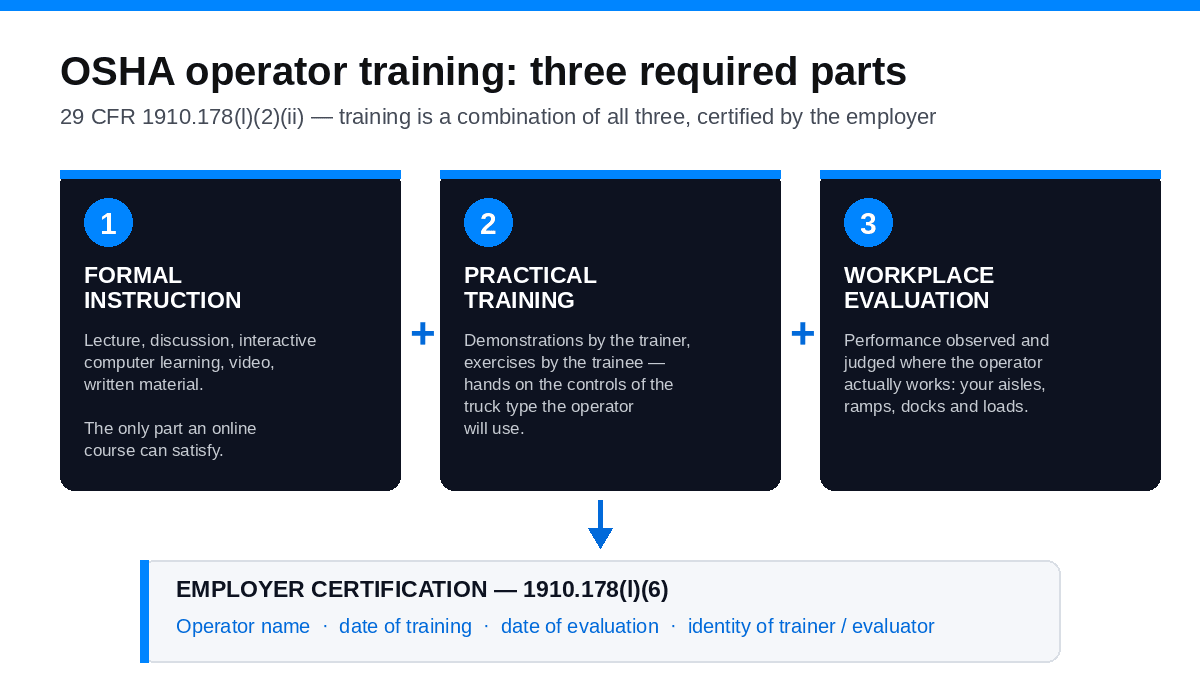
- Formal instruction. The knowledge portion — the rule's own examples are "lecture, discussion, interactive computer learning, video tape, written material." This is the only part an online course or classroom seminar can satisfy.
- Practical training. Demonstrations performed by the trainer and practical exercises performed by the trainee — on the actual type of truck the operator will use, with hands on the controls.
- Evaluation of the operator's performance in the workplace. A qualified person watches the operator run the truck where they will actually work — your aisles, your ramps, your dock, your loads — and judges them competent. Of those, the dock is the one with standards of its own — the Forklift Loading Dock Safety Guide works through how (l)(3)(ii) lands there. This is the step programs most often shortchange, and it is the only one that ties the training to your site. It also happens in person: OSHA clarified in an April 2025 interpretation that the qualified person supervising practical training and evaluating the operator must be physically present where it takes place — a live-streamed or remotely observed evaluation does not satisfy the rule.
Notice what is not on the list: a minimum number of classroom hours, a government-issued test, or a required curriculum vendor. OSHA deliberately left the format performance-based. The flip side of that flexibility is that the employer owns the result — if an operator was "trained" but performs unsafely, the training did not do its job, and the rule's refresher provisions (below) take over.
What the training must cover: truck topics and workplace topics
1910.178(l)(3) lists the required program content in two groups — topics about the truck and topics about your workplace — plus the requirements of the standard itself. An employer may omit a topic only where it can demonstrate the topic is not applicable to safe operation of its trucks in its workplace. That "demonstrate" is worth taking literally: if you skip a topic, be ready to explain why it genuinely does not apply.
| Truck-related topics — (l)(3)(i) | Workplace-related topics — (l)(3)(ii) |
|---|---|
| Operating instructions, warnings and precautions for the truck types the operator is authorized to use · differences from an automobile · controls and instrumentation · engine or motor operation · steering and maneuvering · visibility (including restrictions from loading) · fork and attachment adaptation, operation and use limitations · vehicle capacity · vehicle stability · inspection and maintenance the operator is required to perform · refueling and/or charging and recharging of batteries · operating limitations · any other instructions, warnings or precautions in the operator's manual | Surface conditions where the truck will operate · composition and stability of the loads carried · load manipulation, stacking and unstacking · pedestrian traffic in the operating areas · narrow aisles and other restricted places · hazardous (classified) locations · ramps and other sloped surfaces that could affect stability · closed environments and other areas where insufficient ventilation or poor vehicle maintenance could cause carbon monoxide or diesel exhaust buildup · other unique or potentially hazardous environmental conditions that could affect safe operation |
Two of those topics deserve special attention because they connect training to the physical truck. "Vehicle inspection and maintenance that the operator will be required to perform" means your operators must be trained to run the daily pre-operation inspection — and "vehicle capacity" and "vehicle stability" mean they must be able to read the data plate and understand the stability triangle. Pedestrian traffic is likewise a named topic; our pedestrian safety guide covers what to build into that module, and our forklift hand signals guide gives operators and spotters a shared vocabulary for it.
Who is allowed to train and evaluate
1910.178(l)(2)(iii): all training and evaluation must be conducted by "persons who have the knowledge, training, and experience to train powered industrial truck operators and evaluate their competence." That is the entire qualification requirement. There is no OSHA trainer license, no train-the-trainer card the rule demands, and no accreditation body OSHA recognizes. A veteran supervisor who knows your trucks, your site, and how to teach can be your trainer; so can an outside training company — but hiring one does not transfer the duty. OSHA has said an employer may rely on a qualified third party's training and evaluation when it has a reasonable basis to believe the trainer and program meet the standard's requirements — and any truck- or site-specific differences have been addressed (letter of interpretation, Oct. 1, 1999). Whoever teaches, the employer remains responsible for the operator being competent and for the certification record.

The practical implication cuts both ways. You do not need to buy an expensive credential for an in-house trainer — but you should be able to show why your trainer is qualified (their experience, their own training, their knowledge of the equipment), because "qualified trainer" is exactly the kind of thing an inspector asks about after an incident.
| Option | What you get | What never transfers |
|---|---|---|
| In-house trainer (e.g., a veteran supervisor) | Knows your trucks, aisles, and loads; no vendor cost; document why they qualify | The duty to ensure competence and certify stays with the employer |
| Outside training company | Turnkey formal and practical instruction | Same — reliance requires a reasonable basis to believe the program meets the standard, and certification remains the employer's act |
The certification record: the four required fields
When training and evaluation are complete, 1910.178(l)(6) requires the employer to certify that each operator has been trained and evaluated. The certification must include four items:
- The name of the operator
- The date of the training
- The date of the evaluation
- The identity of the person(s) performing the training or evaluation
| Field | Example entry |
|---|---|
| Operator name | J. Rivera |
| Date of training | March 14, 2026 |
| Date of evaluation | March 16, 2026 |
| Trainer / evaluator | M. Okafor, warehouse supervisor (conducted both) |
This is a record an OSHA compliance officer can ask to see, and the common gaps are mundane: a training date but no evaluation date (which suggests the workplace evaluation never happened), a vendor's course certificate standing in for the employer's own certification, or no record at all for a long-tenured operator "everyone knows" can drive. OSHA's enforcement directive even gives employers one break here: where operators genuinely were trained and evaluated and only the certification is missing, no citation is issued for that first omission — the requirement is explained, with penalties reserved for repeat failures (CPL 02-01-028). The certification is still required; the point is that the training itself, not the paperwork, is what an inspection probes. Note also what the rule does not say — it sets no retention period and no required format. A simple roster or database entry with the four fields satisfies the text; the sensible practice is to keep each operator's current certification available for as long as they operate, plus documentation of any refresher training and the three-year evaluations as they occur.
"Certification lasts three years" — what the rule actually says
The famous three-year figure comes from one sentence, and it is about evaluation, not expiration:
"An evaluation of each powered industrial truck operator's performance shall be conducted at least once every three years." — 29 CFR 1910.178(l)(4)(iii)
There is no card that expires on a date. What recurs is the performance evaluation — a qualified person re-verifying, at least every three years, that the operator still runs the truck safely. And three years is a ceiling, not a schedule you can always ride to the end, because 1910.178(l)(4)(ii) lists five events that trigger refresher training (with an evaluation of its effectiveness):
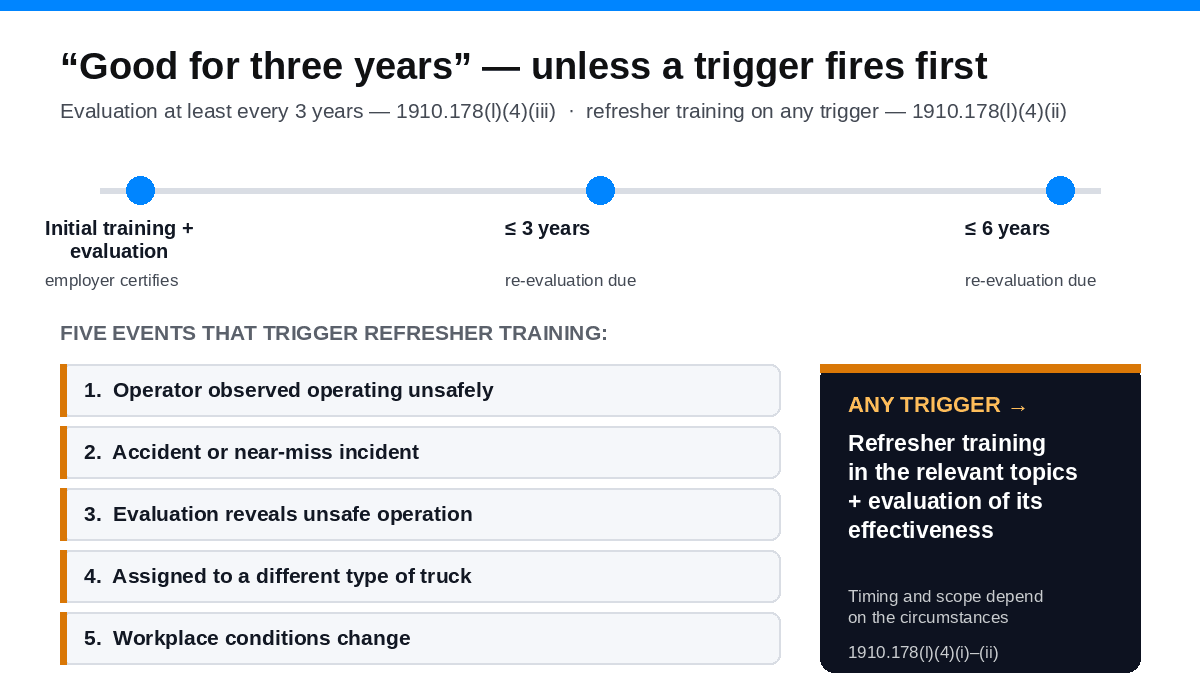
- The operator has been observed operating the vehicle in an unsafe manner;
- The operator has been involved in an accident or near-miss incident;
- The operator has received an evaluation revealing they are not operating the truck safely;
- The operator is assigned to drive a different type of truck; or
- A condition in the workplace changes in a manner that could affect safe operation of the truck.
The triggers are broader than most programs treat them. Moving a sit-down counterbalance operator onto a reach truck is trigger four. Re-racking a warehouse, adding a ramp, or switching part of the fleet from cushion to pneumatic trucks can be trigger five. A near-miss with no injury — the incident most workplaces never write down — is trigger two. If your program has no mechanism for catching these events and routing the operator to refresher training, the three-year calendar is giving you false comfort. One clarification from OSHA: a trigger does not automatically mean the operator stops work that instant — the timing and scope of the refresher depend on the circumstances, including the nature of the unsafe act and the potential for an accident (interpretation, Oct. 1, 1999).
One relief valve keeps this from becoming endless re-training: under 1910.178(l)(5), an operator who has previously received training in a topic — where that training is appropriate to the truck and working conditions they will encounter — and who has been evaluated and found competent, does not need that topic repeated. That is how you handle an experienced new hire — you need not re-run the full curriculum, but you do need to evaluate them on your trucks in your workplace and issue your own certification. Prior experience narrows the training; it never eliminates the evaluation.
Five myths that cause citations
Myth 1: "Operators need an OSHA license." Neither OSHA nor any other federal agency issues forklift operator licenses. 1910.178(l) contains no provision for an OSHA-issued card or an OSHA-approved course — certification is an act the employer performs. Any card or wallet certificate is just a convenient way to represent the employer's record.
Myth 2: "An online course makes you certified." Online delivery can satisfy formal instruction — one of three required parts. Without hands-on practical training and a workplace evaluation, there is no compliant certification, whatever the download says.
Myth 3: "Certification transfers to a new job." Training and evaluation are specific to the truck types and workplace conditions the operator will face. A new employer must ensure competence and issue its own certification — and under OSHA's interpretations, prior training and evaluation carry over where the truck type and working conditions are substantially the same, while any differences must be trained and evaluated (1910.178(l)(5); interpretations of Oct. 1, 1999 and May 13, 2005).
Myth 4: "Our training company handles compliance." A good outside trainer can deliver excellent formal and practical training. But the duty to ensure competence and certify stays with the employer — OSHA issues training citations to the employer, not the vendor. Relying on a qualified vendor is allowed when you have a reasonable basis to believe the program meets the standard and any site- or truck-specific differences are covered; handing over responsibility is not.
Myth 5: "OSHA says operators must be 18." The minimum age is real but the source is different: federal child-labor law (FLSA Hazardous Occupations Order No. 7, 29 CFR 570.58) bars workers under 18 from operating high-lift trucks in non-agricultural jobs. OSHA's standard governs training, not age. Details and the low-lift nuance are in our Operator Guide.
Temporary and staffing-agency operators: who trains, who certifies
If forklift operators reach your floor through a staffing agency, the training duty does not travel with the invoice. OSHA's Temporary Worker Initiative policy states that "in general, OSHA will consider the staffing agency and host employer to be 'joint employers' of the worker" — both have responsibilities for the temporary worker's safety and health under the OSH Act. And OSHA has addressed forklift training specifically: TWI Bulletin No. 7, Powered Industrial Truck Training, lays out how the duties typically divide.
- The staffing agency is generally responsible for the generic side — general safe-operation training that applies across worksites.
- The host employer — in the bulletin's words — "is in the best position to provide the necessary site-specific powered industrial truck training and evaluation." You know the trucks, the floor, the traffic patterns, and the loads; the agency does not.
- Neither employer can contract the duty away. The bulletin is explicit that an employer may not avoid its ultimate responsibilities under the OSH Act by requiring another party to perform them.

The practical sequence for a host employer looks just like onboarding an experienced direct hire, with one added step at the front: find out what training the agency actually provided (get it in writing), then deliver the site-specific and truck-specific training the agency could not, run the workplace evaluation on your own floor with your own trucks, and certify it. Prior agency training can reduce what you repeat — the same 1910.178(l)(5) credit that applies to any experienced hire — but the evaluation in your workplace, and the refresher triggers afterward, work exactly as they do for your own employees. A temp assigned to a different truck type mid-assignment, or working in an area of the floor where conditions have changed in a way that could affect safe operation, hits the same triggers a permanent operator would.
What non-compliance costs
Powered industrial trucks ranked #8 on OSHA's Top 10 most-frequently-cited standards for fiscal year 2025 (osha.gov) — the only vehicle standard on the list. Training, evaluation, and certification are inspectable compliance elements, but citations depend on the underlying facts — including whether the required training and evaluation actually occurred. Current maximum civil penalties (osha.gov/penalties, effective January 15, 2026):
| Violation type | Maximum penalty |
|---|---|
| Serious / other-than-serious / posting requirements | $16,550 per violation |
| Failure to abate | $16,550 per day beyond the abatement date |
| Willful or repeated | $165,514 per violation |
The dollar figures understate the real exposure. An untrained-operator citation after an injury rarely travels alone — it arrives alongside the incident itself, the workers'-compensation claim, and, where an employer knew operators were untrained and let them run anyway, the possibility of a willful classification at ten times the price. Training records are the cheapest insurance in the building.
Employer compliance checklist
A program that survives both an inspection and an incident review comes down to eight habits:
- Designate a qualified trainer/evaluator — in-house or contracted — and document why they qualify (knowledge, training, experience).
- Build the curriculum from 1910.178(l)(3) — every truck-related and workplace-related topic, minus only those you can demonstrate do not apply.
- Deliver all three parts — formal instruction, hands-on practical training, and a performance evaluation in your workplace — before unsupervised operation.
- Certify with all four fields — name, training date, evaluation date, trainer/evaluator identity — for every operator, including the veterans.
- Calendar the evaluations — every operator re-evaluated at least every three years, with the evaluation date updated in the record.
- Wire up the five refresher triggers — make unsafe-operation observations, accidents and near-misses, failed evaluations, truck-type changes, and workplace changes each generate a refresher-training action.
- Train truck-specific and site-specific — an operator certified on one truck type is not certified on all of them; new equipment classes mean additional training.
- Keep the trucks inspection-ready — daily pre-operation examinations, legible data plates, and defective trucks out of service (next section), because operator training assumes equipment worth operating.
The equipment side of the same standard
Operator training is one paragraph of 1910.178; several neighboring provisions land on the employer in the same inspection, and your trained operators are the people who carry them out day to day:
- Daily examination — 1910.178(q)(7). Trucks must be examined before being placed in service, at least daily — and after each shift where trucks are used around the clock — and must not be placed in service if the examination shows any condition adversely affecting safety. Tires, wheels, forks, hydraulics, horn, brakes — this is the inspection your operators were trained to run under (l)(3)(i). Our daily inspection checklist includes a printable form.
- Legible data plates — 1910.178(a)(6). All nameplates and markings must be in place and maintained in legible condition — that plate is where the truck's rated capacity lives — and, depending on the equipment, tire information may appear on the plate, in the operator's manual, or on the tire itself — which is why reading the data plate belongs in every training program.
- Out of service when unsafe — 1910.178(p)(1). A truck found in need of repair, defective, or in any way unsafe must be taken out of service until restored to safe operating condition. A tire worn past its limits or chunked to the point of instability is exactly this kind of condition — our guide to when to replace forklift tires shows the wear points that matter.
- Rim and wheel servicing has its own standard — 29 CFR 1910.177. A separate rule sets its own training, restraint-device, and deflation requirements for servicing multi-piece and single-piece rim wheels on "large vehicles such as trucks, tractors, trailers, buses and off-road machines" — the same kind of split-rim work found on many pneumatic forklift wheels. Either way, rim servicing is a job for trained personnel with proper equipment, not a sideline of operator training.
Keeping the fleet inspection-ready
- Fitment help from people who do this all day. Send your model, serial and current sizes — we will help confirm what your truck takes before you buy. Start with the data plate, or our tire sizes by make & model guide.
- The tires the daily inspection sends you shopping for: cushion press-on tires for indoor trucks, pneumatic and solid pneumatic tires for yard work, plus wheels and rims — or start with the forklift tire buying guide if you are not sure which construction fits your operation.
- Volume pricing built in: Save 7.5% on 2-3 items | Save 15% on 4+ items — automatic discount in cart.
- Free ground freight to commercial addresses in the contiguous U.S.
Frequently asked questions
Does OSHA require forklift operator certification?
Yes — but the certification is performed by the employer, not OSHA. Under 29 CFR 1910.178(l), the employer must train each operator (formal instruction plus practical training), evaluate their performance in the workplace, and certify that both happened. OSHA itself issues no forklift operator cards and approves no forklift operator courses.
How often does forklift training have to be repeated?
An evaluation of each operator's performance must be conducted at least once every three years (1910.178(l)(4)(iii)). Refresher training is required sooner whenever one of five triggers occurs: unsafe operation is observed, the operator has an accident or near-miss, an evaluation shows unsafe operation, the operator is assigned a different type of truck, or workplace conditions change in a way that could affect safe operation.
Is an online forklift training course enough by itself?
No. Online delivery can satisfy only the formal-instruction component. OSHA's rule requires a combination of formal instruction, practical hands-on training, and an evaluation of the operator's performance in the actual workplace (1910.178(l)(2)(ii)) — and the employer must then certify the training and evaluation.
Who can train and certify forklift operators?
Anyone with the knowledge, training, and experience to train operators and evaluate their competence (1910.178(l)(2)(iii)) — an experienced in-house supervisor qualifies, and so does an outside training company. There is no OSHA trainer license and no accreditation body OSHA recognizes. Whoever delivers the training, the certification itself is performed by the employer, who remains responsible for the operator's competence. The employer may rely on a qualified third party's training and evaluation when it has a reasonable basis to believe the program meets OSHA's requirements.
How long does forklift training take?
OSHA sets no minimum number of hours. The standard is performance-based: training is complete when the operator has received formal instruction and practical training for their truck type and passed a performance evaluation in the workplace. How long that takes depends on the operator's prior experience — under 1910.178(l)(5), topics already covered by adequate prior training do not have to be repeated.
Do you need a driver's license to operate a forklift?
No — OSHA's forklift standard requires employer-provided training, evaluation, and certification, and says nothing about holding a driver's license. A forklift is a powered industrial truck operated on a worksite, not a motor vehicle driven on public roads — which is also why a CDL is not part of the requirement (industrial pneumatic forklift tires carry an NHS, "Not for Highway Service," marking rather than a DOT symbol). An individual employer can still require a driver's license as its own hiring policy, but that is company policy, not an OSHA rule.
How much does forklift operator training and certification cost?
OSHA charges nothing and issues no card, so the cost is whatever the training itself costs: course materials or a class for the formal instruction, trainer time for the hands-on practical training, and a qualified evaluator's time on your floor. An in-house program built around an experienced supervisor mostly costs staff time; if you use an outside provider, get a current quote — published price lists go stale quickly. The prior-training credit in 1910.178(l)(5) trims the bill for experienced hires, and the one step with no shortcut is the workplace evaluation — skipping it is what turns a training "saving" into a citation.
Does a new hire's forklift certification from a previous employer transfer?
Not automatically — each employer must ensure competence and issue its own certification. Prior training does count: under 1910.178(l)(5) and OSHA's interpretations, training and evaluation need not be repeated where the truck type and working conditions are substantially the same as those already covered and the operator has been evaluated as competent. Where they differ, the new employer trains and evaluates on the differences before certifying — and verifying competence on your own floor remains the simplest way to establish that basis.
What records do employers have to keep?
The certification under 1910.178(l)(6): the operator's name, the training date, the evaluation date, and the identity of the trainer/evaluator. The rule specifies no format and no retention period; the practical standard is to keep every active operator's current certification on hand, along with refresher training and three-year evaluation dates as they occur.
How old do you have to be to operate a forklift?
Generally 18 for high-lift trucks in non-agricultural work. The rule comes from federal child-labor law — FLSA Hazardous Occupations Order No. 7 (29 CFR 570.58) — not OSHA's forklift standard, and its high-lift definition expressly excludes low-lift trucks and low-lift platform trucks. Agricultural employment is governed by separate child-labor rules, other federal, state, local, or employer restrictions may still apply, and age is only the start: the employer must still train, evaluate, and certify the operator before they drive.
This article is general educational information from Forklift Tire Company. It is not a certification course, does not by itself certify any operator, and is not a substitute for OSHA-compliant, employer-provided operator training, a formal compliance review, or legal advice. It addresses federal OSHA general-industry rules — State Plans can differ, and state or local requirements may apply in addition to OSHA. Always follow 29 CFR 1910.178, your training program, your data plate, and the tire manufacturer's specifications. Verify exact tire size and fitment before ordering. Questions on tires, wheels, or parts? Call 1 (866) 313-2180 or email sales@forklifttire.com.