 1 (866) 313-2180
 SALES@FORKLIFTTIRE.COM


Posted by Forklift Tire Company on 29th Jul 2026
Every forklift carries a small metal plate that answers the questions operators argue about most: how much this truck can actually lift, with which attachment, on which tires. That's the data plate — also called the nameplate or capacity plate — and OSHA doesn't treat it as optional paperwork. The user is required to keep every nameplate and marking in place and legible under 29 CFR 1910.178(a)(6), and a truck that's unsafe in any way must come out of service until it's made right. Reading it correctly is also part of required operator training — vehicle capacity and stability are named topics under 1910.178(l)(3) — and our employer’s guide to OSHA forklift training requirements covers the full training rule.
Yet most people read exactly one line on it — the big capacity number — and misread even that, because the number is only true at the stated load center. This guide decodes every field, shows why the capacity line means less than it seems, and explains the line almost everyone skips: the tire specification your rated capacity quietly depends on.
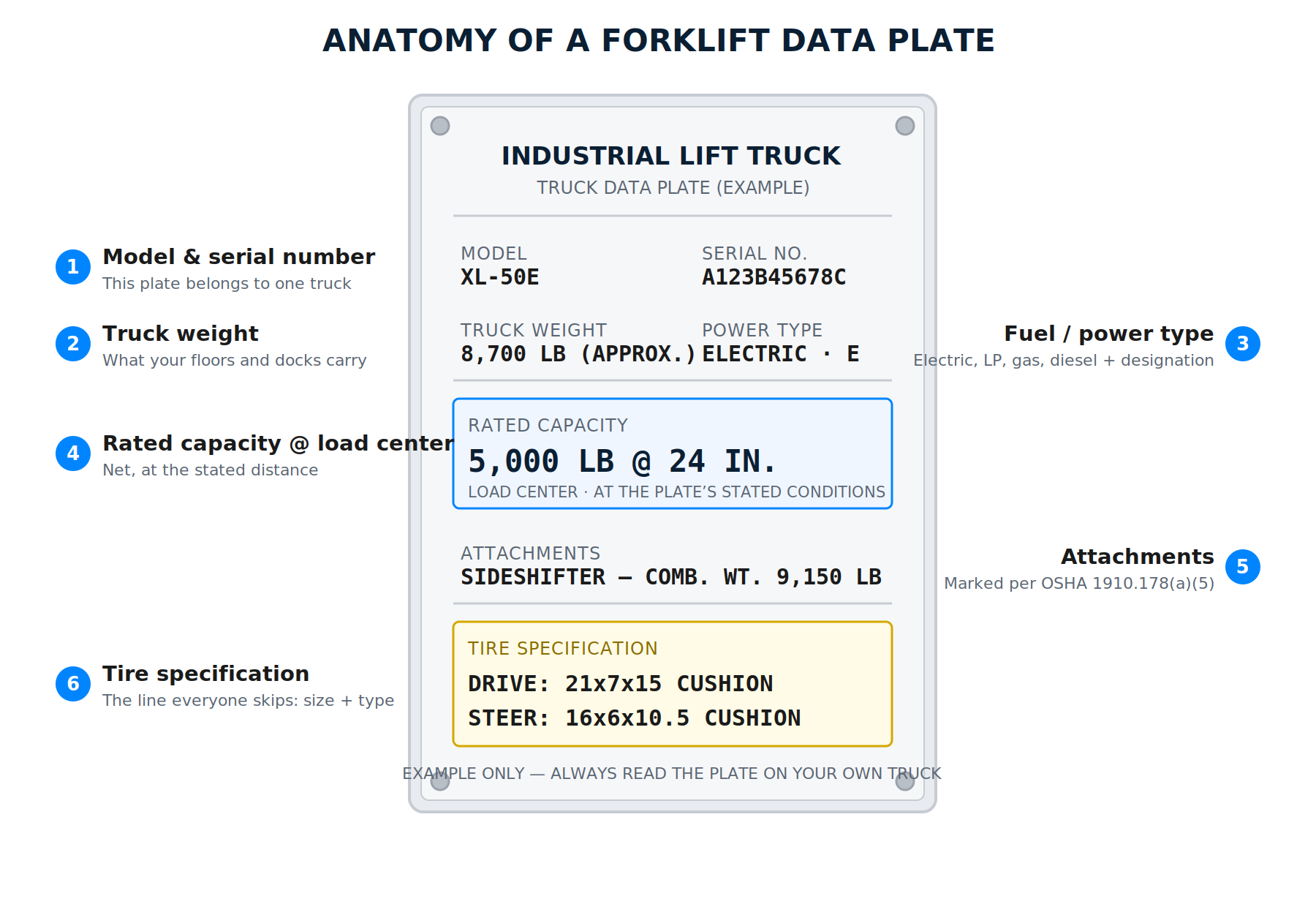
A generic forklift data plate, field by field. Layouts vary by manufacturer, but these lines appear in some form on nearly every plate.
Published 29 July 2026. Updated 4 August 2026 — added a model and serial number section, corrected the nameplate-content sourcing, and tightened the regulatory citations.
In this guide
What the Data Plate Is (and Why OSHA Requires It)
The data plate is the manufacturer's official record of what a specific truck is built to do. Per OSHA's powered-industrial-truck guidance, it lists the truck model and serial number, truck weight, a designation of compliance with ASME/ANSI B56.1, a type designation showing conformance with requirements such as those of Underwriters Laboratories or Factory Mutual, and capacity. Manufacturers routinely add more than OSHA requires — fuel or power type, the load center and maximum height the capacity applies to, approved attachments with the truck-plus-attachment weight, and on most counterbalanced trucks a tire size and type. The tire line is manufacturer practice, not an OSHA-required field — but where it appears, it is the line a replacement order starts from. Neither OSHA nor B56.1 specifies where the plate goes. In practice it is mounted where the operator can read it — most often on the cowl or dash — but placement varies by make and series, and some trucks carry the capacity plate on the overhead guard. What is fixed is that the plate is tied to that one serial number, not to the model in general.
Two OSHA rules give the plate its teeth. First, 29 CFR 1910.178(a)(6): “The user shall see that all nameplates and markings are in place and are maintained in a legible condition.” Second, 1910.178(p)(1): a truck found to be in need of repair, defective, or in any way unsafe comes out of service until it's restored to safe operating condition. A missing or unreadable data plate isn't a cosmetic problem — it removes the operator's only authoritative reference for what the truck can safely lift. Checking that the plate is present and legible belongs on your daily pre-shift inspection.
Field by Field: The Common Data-Plate Lines
| Line on the plate | What it tells you | Why it matters |
|---|---|---|
| Model & serial number | Exactly which truck this plate belongs to | Parts and service specs can change across serial ranges within one model — the serial number is what confirms which build you have. Decoded in full below |
| Truck weight | Approximate service weight of the empty truck. On electric trucks, check whether the figure includes the battery — ANSI/ITSDF B56.1-2009 §7.5.6 calls for electric-truck nameplates to show the truck weight without the battery, plus the minimum and maximum battery service weights, because the battery is part of the counterweight | Floor loading, ramps, dock plates, and trailer floors are rated in pounds — a loaded forklift is often the heaviest thing that crosses them |
| Fuel / power type | Electric, LP, gasoline, or diesel — and any designation for the environment the truck is approved for | Some work areas restrict which power types and designations are allowed |
| Rated capacity @ load center | The most misread line — net capacity at a stated load center, not a flat number | See the next section — real capacity falls as the load's center of gravity moves out |
| Attachments | Which front-end attachments the rating covers, with the combined truck-plus-attachment weight | OSHA 1910.178(a)(5): where a truck carries non-factory front-end attachments, the user must request that it be marked to identify them — an attachment changes the truck's effective capacity |
| Tire specification | The tire size and type (cushion, pneumatic, solid) the truck was rated on | The line everyone skips — and the one that starts a correct replacement order. See below |
Plates vary by manufacturer and truck type — yours may also list lift height, battery weight and voltage, fork dimensions, or a vertical load center, and some plates don't carry a tire line at all. Read what's actually there; the fields above are the core that most plates share.
Model & Serial Number: What They Actually Tell You
The top two lines of the plate look like inventory codes. They are not. The model designation is a compressed spec sheet, and the serial number is the only field on the plate unique to your machine — and it is the pair a parts or tire supplier asks for before anything else. Toyota states it plainly in its own owner guidance: the serial number is the most important number on the truck, and the model-and-serial combination is what lets a supplier provide parts that fit that particular machine.
What the model number encodes
Many manufacturers build useful information into a model designation — often some combination of power source, tire family, nominal capacity class, chassis and series. There is no industry-wide syntax: the order and the meaning change by make, by market and by generation, which is how the wrong tire gets ordered. Treat the model number as a starting point and the data plate as the authority.
| Make | What the designation encodes | Worked example |
|---|---|---|
| Hyster (North America) | Leading letter = power + tire family: H = IC engine, pneumatic; S = IC engine, cushion; E = electric, cushion; J = electric, pneumatic-profile. Number × 100 = capacity in pounds. Trailing letters (XT, FT, XN, UT) name the series family rather than the fuel or tire — though an extra trailing character (S55FTS, J30XNT) can flag a variant within a series. | H50XT = IC engine, pneumatic tire, 5,000 lb, XT series Full Hyster decode and fitment guide |
| Yale (North America) | Letter block, then capacity: E = electric, G = IC (with L for LP or D for diesel when present), R = rider, and the tire letter C = cushion / P = pneumatic-profile — and a “P” truck may ship on an air pneumatic or a pneumatic-shaped solid, so the letter names the profile, not the construction. In North America the three-digit number × 100 = pounds; Yale’s European line uses two digits for tonnes (GLP25VX = 2.5 t). | GLP050 = LP gas, pneumatic, 5,000 lb ERP040VF = electric rider, pneumatic, 4,000 lb |
| Toyota | Series digit, F = forklift, fuel letter (G = LP/gas, D = diesel, B = battery), then the tire letter: C = cushion, and no C means pneumatic. U = U.S.-built. The final digits are a nominal capacity-class code, not an exact conversion — read the published capacity, not the badge. | 8FGCU25 = 8-series, LP/gas, cushion, U.S.-built, 25-class — Toyota publishes this truck at 5,000 lb (2,250 kg), which is not 2.5 tonnes 8FGU25 = the same truck on pneumatics |
| Caterpillar / Mitsubishi | GP = LPG pneumatic, DP = diesel pneumatic, EP = electric pneumatic, GC = gas cushion. The number is a metric capacity class name, not the rating — Cat publishes the GP18N at 3,500 lb in North America, not the 1,800 kg the name implies. And Cat’s North American 2C cushion line is labeled in pounds. Both systems are in the field at once, so read the capacity off the plate, never off the model number. | GP25N = 2.5-tonne class, published by Cat in North America at 5,000 lb at a 24 in load center 2C5000 = 5,000 lb |
| Komatsu | FG = LPG/gas, FD = diesel, FB = battery. The number is a nominal class code, not an exact tonnage; the trailing -nn is the series generation. Komatsu publishes no model-number key, so interior letters such as the T in FG25T mark a variant and are not a capacity or tire code. | FG25T-16 = LPG/dual fuel, 25-class — Komatsu publishes 5,000 lb (2,270 kg) at a 24 in load center — 16th-generation series |
| Clark | On the modern C-series the number is a metric class, not hundreds of pounds, despite the American heritage. But Clark’s legacy C500 line runs the opposite convention — there the number is hundreds of pounds. Two Clarks, same capacity, two different rules. | C25 = 5,000 lb, not 2,500 lb (C20 = 4,000, C30 = 6,000, C35 = 7,000) C500-50 = also 5,000 lb — by the opposite rule |
| Linde | H = IC counterbalance; the number is a nominal tonnage class; /600 is the load center in millimeters; D = diesel, T = LPG. The separate type/series number — three digits on older trucks (351, 393, 394), four on current ones (1202) — is what parts and service literature is keyed to. | H25/600D, series 393-02 = 2.5 t at a 600 mm load center, diesel |
| Crown | The letter series names the truck class (FC, SC, RC = electric counterbalance; C-5 = internal combustion). Capacity is carried by the hyphenated suffix, in hundreds of pounds — the four-digit block is a series identifier. | FC 5245-50 = 4-wheel sit-down electric counterbalance, 5,000 lb |
| Raymond | The exception that proves the rule: Raymond model numbers name a product family, not a capacity. One designation spans a capacity range and hundreds of configurations. | 7500 = Reach-Fork family, published at 3,500–4,500 lb depending on configuration |
What the model number will not tell you is your tire size. Its tire letter names a family, not a size and not a construction. Yale’s own pneumatic spec sheet offers air pneumatic, pneumatic-shaped solid, radial and dual-drive options behind a single “P”. Caterpillar lists tire construction as a separate spec field altogether — solid, pneumatic, or solid pneumatic. And one model family routinely carries several sizes: Yale’s GC-VX cushion range runs 21x7x15, 21x8x15 and 21x9x15 across its capacities, and Crown’s C-5 pneumatic line offers a standard and a wide option at the same rating (7.00-12 or 27x10-12 at 5,000 lb; 28x9-15 or 355/45-15 at 6,000 lb). Verify exact tire size and fitment before ordering. That is why the tire-specification line on your plate, confirmed against the sidewall on the truck, outranks the model number every time.
What the serial number encodes
Less than most people expect, and it varies by make. A forklift serial number is not a VIN. The seventeen-character VIN rule at 49 CFR Part 565 applies to on-road motor vehicles — passenger cars, multipurpose passenger vehicles, trucks, buses, trailers, incomplete vehicles, low-speed vehicles and motorcycles — and powered industrial trucks are not on that list. The ISO seventeen-character machine identification number (ISO 10261) is written for earth-moving machinery as defined in ISO 6165, and ISO notes it may also be applied to other off-road work machines — but it is not the industrial-truck standard either. What industrial trucks answer to is the nameplate itself, under OSHA 1910.178 and the ANSI/ITSDF B56.1 standard it references (OSHA incorporates the 1969 edition; later editions are industry consensus). There is no single serial-number format across makes, and no public database that decodes every one of them.
Hyster and Yale are the exception — their serial number genuinely decodes, and both print the rule in their own parts manuals. It has four parts: the first letter and three numbers are the truck unit code (the build series), the next letter is the plant of manufacture, the four- or five-digit number is the production sequence, and the final letter is the year of manufacture, starting with “A” in 1957 and again in 1980. Because the letter set recycles on a twenty-three-year cycle, the year letter is only unambiguous once you know the era the model was built in.
That also explains a code owners often mistake for a model number. On a Hyster or Yale, A187, D001, F187 or A974 is the truck unit code — the build series the parts book is organized around, not the machine. A parts counter given only “A187” has been told the series, not the truck, and A187, B187 and C187 all cover the same S40XL and S50XL models in different build series, which is exactly why the full serial matters.
Other makes publish less. UniCarriers maps each chassis model to a serial prefix and leaves the rest sequential. Clark documents one market marker — an “RKF” serial identifies a Korean-built truck for the Korean domestic market from the late 1980s and early 1990s — but publishes no general format, and directs owners to email the factory with the complete serial for a ship date. Toyota publishes a full model decode and no serial decode. For Crown, Komatsu, Linde and Raymond, the serial is a lookup key into a dealer system rather than a code you read off the plate.
Where the serial number lives — and how many of them your truck has
| Make | Where the truck serial number is found |
|---|---|
| Hyster / Yale | On the nameplate, which carries the complete truck model and serial number. |
| Clark | Stamped into the serial number plate, usually in the operator’s compartment on the hood or the instrument panel. |
| Toyota | On the data plate, alongside the model. |
| UniCarriers / Nissan | Stamped on the front panel — with a separate engine serial number stamped on the engine. |
| Raymond | On the specification tag, generally in or near the operator platform. |
| Cat / Mitsubishi | The service literature identifies five separate identifiers: name plate, chassis serial number, engine serial number, mast number, and transmission serial number. |
| Crown | Varies by series — on the FC5700 the capacity plate is on the overhead guard, and it carries the truck serial number. |
Your truck carries more than one serial number. The mast, the engine and the transmission have their own, stamped in their own places. Masts in particular are modular and change independently of the truck — the mast serial is typically stamped on the outside of the driver’s-side mast channel — so a mast number will not resolve from the truck serial. If a quote depends on the mast, the mast’s own number is the one to read. Quoting the engine serial when a parts supplier asked for the truck serial is one of the more common ways an order goes sideways.
Why the serial number is what orders parts correctly
This is where the field earns its place on the plate. Manufacturers change specifications part-way through a production run, and their parts catalogs are built around those breaks. Hyster’s own parts catalog defines the notation in its front matter — one symbol for the last serial number affected by a part, another for the first serial number affected, and a third for a range between two serials — and Yale, under the same parts organization, uses the same convention. A catalog would not need three break symbols if the model designation alone were sufficient.
Both manufacturers give the same instruction: when ordering replacement parts, supply the unit serial number along with the part number, name and quantity. Toyota says it in plain language for owners. Clark’s older parts books ship without part numbers at all — you order by key number plus truck serial, so the serial is the resolution mechanism. Raymond asks for the serial before it will quote. And OSHA closes the loop at 1910.178(q)(5): the employer operating the truck must see that replacement parts are equivalent as to safety with those used in the original design — the original design of that truck, which the serial number is what identifies. That duty sits with the truck’s owner or employer, not with a parts supplier; the serial number is simply how anyone discharges it.
One honest limit: we have not found a published case of a forklift tire size changing at a serial break specifically — in the OEM catalogs we checked, tire and wheel entries are organized by model variant and capacity class rather than by serial range. That is what we found, not a guarantee — wheel and rim assemblies do change mid-production, and a rim change can carry a tire change with it. The serial number’s role for tires is confirmation: it is how a supplier or dealer verifies which variant of a model you have before a size is committed.
Reading “Rated Capacity @ Load Center” Correctly
The capacity line reads something like “5,000 lb @ 24 in. load center.” Both halves matter. Per OSHA's load-handling guidance, the load center is the horizontal distance from the vertical face of the forks to the load's center of gravity, and forklifts are commonly rated at a 24-inch load center — which matches a centered 48-inch-by-48-inch pallet, OSHA's stated reference load. The rating conditions themselves come from the industry design standard rather than from OSHA. ANSI/ITSDF B56.1-2009 §7.4.3 establishes rated capacity at a standard load center with the mast vertical, at a lift height the manufacturer sets, with the load back against the fork faces. Manufacturers publish that figure as a net capacity — the load itself, not the load plus an attachment. B56.1-2009 §7.5.4(a) requires the plate to show capacity and load center at maximum elevation, and permits — but does not require — additional capacities at other load centers and heights. Many trucks lift less at full height than the headline number, which is why manufacturers commonly publish a supplemental capacity chart for taller masts.
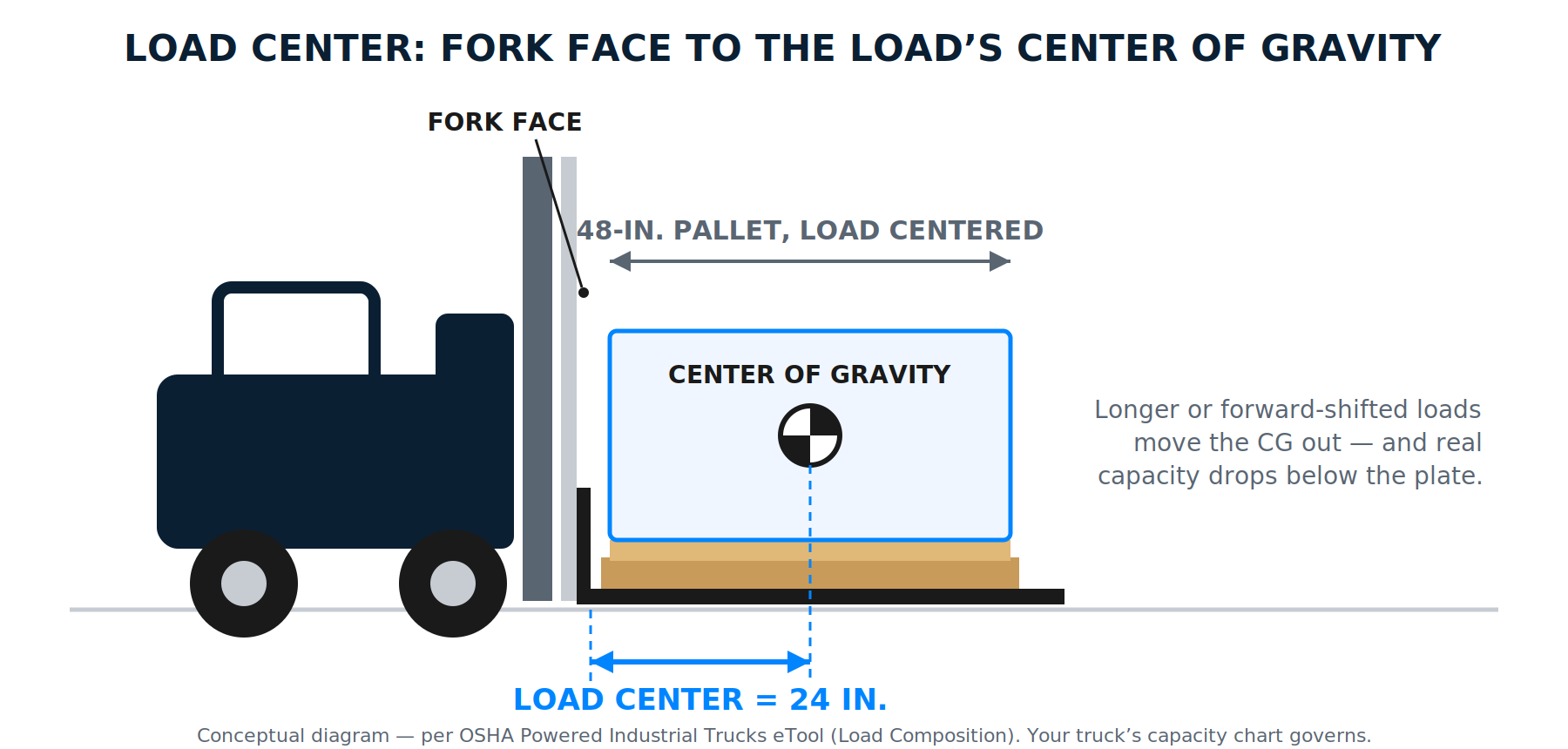
Load center is measured from the fork face to the load's center of gravity. A centered 48-inch pallet puts it at 24 inches — the distance most plate ratings assume.
Move the load's center of gravity farther out — a longer load, a deep crate, material that can't sit flush against the carriage — and the truck's real capacity drops below the plate number, because the load's leverage over the front axle grows. A load that is unusually tall or shifted forward has the same de-rating effect even at the same weight. The plate number is the ceiling under ideal conditions, not a promise for every load. When a load doesn't match the rated conditions, the manufacturer's capacity chart for that truck — not arithmetic in your head — is the authority. The physics behind that de-rating — the triangle formed by the two front wheels and the rear-axle pivot, and how the combined center of gravity moves inside it — is covered in our forklift stability triangle guide.
The Tire-Spec Line: the One Everyone Skips
Near the bottom of most plates sits a line listing the tire size and type the truck was rated with — for example a cushion (press-on) size on the drive axle and a smaller one on the steer axle, or a pneumatic size marked for its tube or solid variant. This line is not a suggestion. The rated capacity above it assumes that specified tire, in good condition, at correct inflation if it's a pneumatic. That is not just our view of it: ANSI/ITSDF B56.1-2009 bases rated capacity on the stability tests in §7.6 (§7.4.2), names tire deflection under load among the factors affecting stability (§7.6.2), and requires that tire inflation be checked against the manufacturer's recommendations for those tests to give “accurate and repeatable results” (§7.6.4(h)). The tire is part of the configuration the rating was established on. Fit a different size or type, or run tires that are badly worn or under-inflated, and you've quietly changed the assumptions behind the capacity number — without the plate changing at all.
Practically, that means three things when tires are due. First, replace with the size and type on the plate unless the manufacturer approves otherwise — our guide to reading forklift tire sizes decodes the numbers, and the size conversion chart handles the standard-to-metric cases. Second, match the load rating — two tires can share a size but carry different ply/load-range ratings, and the replacement should never be rated below the original; the tire's sidewall and the manufacturer's spec sheet are the final authority. Third, keep them in condition — worn or damaged tires undermine the plate's assumptions, which is why tire checks belong in the daily walkaround. Our guide on when to replace forklift tires covers the triggers. And if the sidewall on the truck disagrees with the plate, resolve the conflict before ordering — the tires on it now may be the wrong ones.
If the Plate Is Missing, Illegible, or the Truck Has Changed
Because the plate is required equipment, its absence is an action item, not a shrug. Under 1910.178(a)(6) the user is responsible for keeping nameplates in place and legible, and OSHA's own forklift eTool puts it plainly: do not operate a truck with an illegible or missing nameplate. The separate out-of-service rule, 1910.178(p)(1), applies to a truck that is defective or unsafe — and keeping a plate-less truck out of normal service until its replacement plate arrives is the prudent response, required outright whenever the truck is otherwise unsafe. If a plate is gone or unreadable, the fix is a replacement plate from the manufacturer or dealer for that serial number — not a guess, and not a plate borrowed from a similar truck.
The same discipline applies to changes. OSHA 1910.178(a)(4) prohibits modifications and additions that affect capacity and safe operation without the manufacturer's prior written approval — and when a change is approved, the capacity, operation, and maintenance plates must be updated to match. In a 2004 letter of interpretation, OSHA described a narrow enforcement position, and its condition is the part that matters: OSHA may treat the missing manufacturer approval as a de minimis violation (a technical finding carrying no penalty) only where the employer has obtained written approval from a qualified registered professional engineer after the manufacturer either did not respond or responded negatively. Where the response was negative, that engineer must first perform a safety analysis addressing the issues raised in the manufacturer's disapproval. Manufacturer silence on its own is not enough. That is limited enforcement guidance, not a general substitute for manufacturer approval. Adding an attachment triggers the marking rule in (a)(5): the user must request that the truck be marked to identify the attachment and show the approximate combined weight of the truck and attachment at maximum elevation, with load laterally centered. If your truck's plate no longer describes the truck in front of you, that's the thing to fix first.
From the Plate to the Right Tire
Here's the payoff for reading the whole plate: the tire-spec line, the model, and the serial number together are the starting point a tire supplier needs to match your truck correctly. Start with the size and type from the plate, confirm it against the sidewall of the tires on the truck now, then match it in the right construction: cushion press-on tires for smooth-floor trucks, pneumatic tires for outdoor work, or resilient solids where flats aren't acceptable. Our forklift tire buying guide walks the whole decision, and the tire sizes by make and model guide covers common fitments — including make-specific guides like our Hyster fitment guide, which show how we cross-check published OEM tech-guide values. Verify exact tire size and fitment before ordering.
Not sure? Send us your data plate.
Send a clear photo of the data plate and of the tire markings on both axles. We'll cross-check the size, construction and load rating that can be read from those photos, and tell you what else we need — rim width, press-on band dimensions, tube or flap requirements, or how the truck is used — before you order. Verify exact tire size and fitment before ordering.
Email Your Data-Plate Photo Contact UsSave 7.5% on 2–3 items or 15% on 4+ items, automatic in cart. Free ground freight to commercial addresses in the contiguous U.S. Questions? Call 1 (866) 313-2180.
Frequently Asked Questions
What information is on a forklift data plate?
A forklift data plate lists the model and serial number, the approximate truck weight, the fuel or power type, the rated capacity at a stated load center, information on approved attachments with the combined truck-plus-attachment weight, and, where the plate carries one, the tire specification the truck was rated with. Layouts differ by manufacturer, but those fields appear in some form on most plates.
What does “rated capacity at 24-inch load center” mean?
It means the truck can lift that weight only when the load's center of gravity is no more than 24 inches from the vertical face of the forks — the distance that matches a centered 48-inch-by-48-inch pallet. Load center is the horizontal distance from the fork face to the load's center of gravity. The rating also assumes the lift height it is stated for, and many trucks lift less at full height. When a load is longer, deeper, or shifted forward, its center of gravity moves out and the truck's real capacity drops below the plate number. The manufacturer's capacity chart governs those cases.
Can a forklift be operated without a data plate?
OSHA 29 CFR 1910.178(a)(6) requires the user to keep all nameplates and markings in place and legible, and 1910.178(p)(1) requires a truck that is in any way unsafe to be taken out of service until restored. A missing or unreadable plate removes the operator's authoritative capacity reference, so the practical answer is: get a replacement plate for that serial number from the manufacturer or dealer before the truck goes back to normal service. This is general scoping information, not legal advice.
Where is the data plate located on a forklift?
Manufacturers typically mount the data plate where the operator can read it from the seat — commonly on the cowl or dash area of the operator's compartment. The exact spot varies by make and model. If the plate on your truck is painted over, damaged, or missing, treat that as a maintenance item, not a detail.
Do new tires or an attachment change what the data plate says?
Replacing tires with the same size, type, and adequate load rating keeps the plate's assumptions intact — that's the goal. Replacement parts, tires included, must be equivalent as to safety with those used in the original design — that is OSHA 1910.178(q)(5), and ANSI/ITSDF B56.1-2009 §6.2.17 says the same, naming tires explicitly. Fitting a different size or type changes the truck's rated configuration, so confirm it with the manufacturer first. Any modification that affects capacity and safe operation does require the manufacturer's prior written approval under OSHA 1910.178(a)(4), with the capacity, operation, and maintenance plates, tags, or decals changed to match. Adding a non-factory front-end attachment triggers 1910.178(a)(5): the user must request that the truck be marked to identify the attachment and show the approximate combined weight at maximum elevation, with load laterally centered. Fitting a different tire cannot raise a truck's rated capacity — only the manufacturer can establish or restate that rating.
Why does the data plate list a tire size?
Where a plate carries a tire line, it is there because the truck's rated capacity was established on that tire. The tire specification records the size and type — cushion, pneumatic, or solid — the manufacturer rated the truck with, and the capacity number assumes that tire in good condition at correct inflation. It is also the fastest way to order correctly: read the tire line, confirm it against the sidewall of the tires on the truck, and match both size and load rating in the replacement.
What do the numbers in a forklift serial number mean?
It depends on the make — a forklift serial number is not a VIN, and no regulation sets its format. Hyster and Yale are the exception: their parts manuals document a four-part serial made up of the truck unit code (the build series), a letter for the plant of manufacture, the production sequence number, and a final letter for the year of manufacture, starting with “A” in 1957 and again in 1980. Most other manufacturers use a model or chassis prefix followed by a sequential number and treat the serial as a lookup key into their own dealer system rather than a code the owner reads. There is no public database that decodes every make.
Where is the serial number on a forklift?
On most trucks it is stamped into the data plate itself — Hyster and Yale state that the complete truck model and serial number are stamped into the nameplate, and Toyota lists both on the data plate. Clark stamps it into a serial number plate usually mounted in the operator’s compartment on the hood or instrument panel; UniCarriers stamps it on the front panel; Raymond puts it on a specification tag in or near the operator platform. Remember that the truck carries several serial numbers: Cat and Mitsubishi service literature lists the name plate, chassis serial, engine serial, mast number and transmission serial as five separate identifiers.
Can I tell what year my forklift was built from the serial number?
On a Hyster or Yale, yes — the final letter of the serial is the year code, although the letter set recycles on a twenty-three-year cycle, so it is only unambiguous once you know the era the model was built in. For most other makes the answer is no. we did not locate a public, manufacturer-issued serial-to-year key for Toyota, Crown, Komatsu, Linde or Raymond during this review (August 2026), and Clark’s published route is to email the factory with the complete serial number for a ship date. There is no public, industry-wide serial-number-to-year database — the reliable answer is the dealer for that make, given the model and serial together.
What does a forklift model number tell you?
On most makes the model designation encodes power source, tire family and capacity class. A Toyota 8FGCU25 is an 8-series LP or gas truck on cushion tires in the 25 capacity class, which Toyota publishes at 5,000 lb — and the same truck without the C, an 8FGU25, is on pneumatics. A Yale GLP050 is LP gas, pneumatic, 5,000 lb. The trap is the capacity units: Hyster, Yale and Crown label capacity in hundreds of pounds, while Toyota, Komatsu, Linde, Caterpillar’s GP and DP lines and Clark’s modern C-series label it in metric class. So a Clark C25 is a 5,000 lb truck, not a 2,500 lb one — while a legacy Clark C500-50 is also 5,000 lb, by the opposite rule. Raymond is the exception — its model numbers name a product family, not a capacity.
Does the model number tell me which tires my forklift takes?
Only the family, never the size. A model number’s tire letter distinguishes cushion from pneumatic — the C in a Toyota 8FGCU25, the C or P in a Yale designation, where P means pneumatic-profile and can be an air pneumatic or a pneumatic-shaped solid — but one model family routinely carries several sizes and several constructions. Yale’s GC-VX cushion range runs 21x7x15, 21x8x15 and 21x9x15 across its capacities, Crown’s C-5 pneumatic line offers a standard and a wide option at the same rating, and Caterpillar treats tire construction as its own spec field (solid, pneumatic, or solid pneumatic). Use the tire-specification line on the data plate, confirm it against the sidewall of the tires on the truck, and verify exact size and fitment before ordering.
Trademarks: Hyster, Yale, Toyota, Caterpillar, Mitsubishi, Komatsu, Clark, Crown, Linde, Raymond, UniCarriers, Nissan and all other equipment names and model designations are trademarks of their respective owners. Forklift Tire Company is an independent aftermarket supplier and is not affiliated with, authorized by, sponsored by, or endorsed by any equipment manufacturer. Make references are used solely to identify the equipment replacement tires are commonly used on.
One last connection worth making: the data plate tells you what the truck can safely lift — keeping people clear while it lifts is a communication job. Our forklift hand signals guide covers the standard signal set, spotter rules, and a free printable chart for the floor.
This article is general educational information from Forklift Tire Company, not a substitute for OSHA-compliant, employer-provided operator training, a formal compliance review, or your equipment's data-plate ratings and the tire manufacturer's specifications. Always follow your data plate, the tire sidewall, and 29 CFR 1910.178.