 1 (866) 313-2180
 SALES@FORKLIFTTIRE.COM


Posted by Forklift Tire Company on 5th Jun 2026
If your forklift spends its day on gravel, broken asphalt, packed dirt, or a debris-strewn yard, the tires that came on a smooth-floor truck won't last. The wrong tire for rough terrain means flats, poor traction, a punishing ride, and premature wear — every one of which costs you uptime.
This guide covers how to choose rough terrain forklift tires: what your two real options are (air-filled pneumatic vs. solid resilient), how to read the specs that matter, and how to match the tire to your specific surface so you order the right set the first time.
What "Rough Terrain" Means for a Forklift Tire
"Rough terrain" covers any surface that isn't smooth, sealed, indoor concrete. In practice that means:
- Outdoor yards — gravel, packed dirt, crushed stone, and uneven hardpack
- Broken or cracked asphalt — older lots, loading approaches, ramps
- Debris-heavy sites — recycling, scrap, demolition, lumber and pallet yards where nails, glass, and metal are part of the floor
- Mixed indoor/outdoor routes — a forklift that loads trailers at a dock, then runs out into the yard
Most forklifts working these surfaces are standard pneumatic-tire industrial forklifts — the larger-frame trucks built to take air-filled or solid pneumatic tires. That's different from a purpose-built rough terrain forklift (the masted, four-wheel-drive machines used on active construction sites), which often run oversized specialty tires. If you operate one of those, the construction choice below still applies, but call us to confirm size availability before you order.
The decision almost always comes down to two questions: How much puncture risk is in your yard? and How much does ride comfort matter for your operators and loads?
Your Two Real Options: Pneumatic Tube-Type vs. Solid Resilient
Forklifts built for pneumatic tires accept two constructions on the same style of wheel. Both handle rough terrain — they just trade off in different places.
| Factor | Pneumatic Tube-Type (TTF) | Solid Resilient (RS) |
|---|---|---|
| How it works | Air-filled tire with an inner tube and liner flap | Solid rubber, molded in a pneumatic shape — no air inside |
| Ride & shock | Best. The air cushion absorbs impacts on uneven ground | Firmer. Handles rough ground but transmits more shock |
| Puncture risk | Can go flat on nails, scrap, and sharp debris | Flat-proof — cannot puncture or go flat |
| Best for | Outdoor yards, uneven pavement, mixed surfaces where ride matters | Debris-heavy and demanding operations where downtime is the bigger problem |
| Main tradeoff | Flat risk and occasional tube/flap replacement | Higher upfront cost and a harder ride |
The simple rule: choose pneumatic tube-type when cushioning and mixed-surface flexibility matter most. Choose solid resilient (sometimes called solid pneumatic) when flats and downtime are your bigger problem. A solid resilient tire mounts on the same pneumatic-style wheel, so it's a common flat-proof swap for a yard that keeps eating air tires.
There is a third path some operators use — having pneumatic tires foam-filled with polyurethane at a tire shop to make them flat-proof. It works, but it's a service add-on, adds weight, and can't be undone. For most buyers replacing tires outright, a purpose-built solid resilient tire is the simpler, cleaner route to flat-proof uptime.
How to Read the Specs That Matter
Three numbers decide whether a tire fits and performs on rough ground.
Size. Pneumatic forklift sizes look like 7.00-12, 6.00-9, or 28x9-15. The size is molded on the sidewall of your current tires. Drive and steer positions usually take different sizes, so check both. If you need to cross-reference, the forklift tire size chart covers the most common models.
Ply rating (PR). You'll see ratings like 10PR, 12PR, or 14PR. Ply rating indicates the tire's load and durability class — a higher number means a stronger carcass and more load capacity. For rough, heavy outdoor work, ply rating matters: under-rating a tire for the load and surface is a fast path to early failure. Match or exceed the ply rating on your current tires.
Tread. Industrial pneumatic tires use traction tread to grip loose surfaces like gravel and dirt — deeper, more open tread channels water and debris and holds the surface better than the smooth profile of an indoor tire. Reading wear and tread is its own skill; our guide to forklift tire tread patterns breaks it down.
Match the Tire to Your Terrain
Gravel, dirt, and packed yards. Pneumatic tube-type is the comfortable, capable default. The air cushion smooths the ride and traction tread grips loose surfaces. Run an appropriate ply rating for your loads.
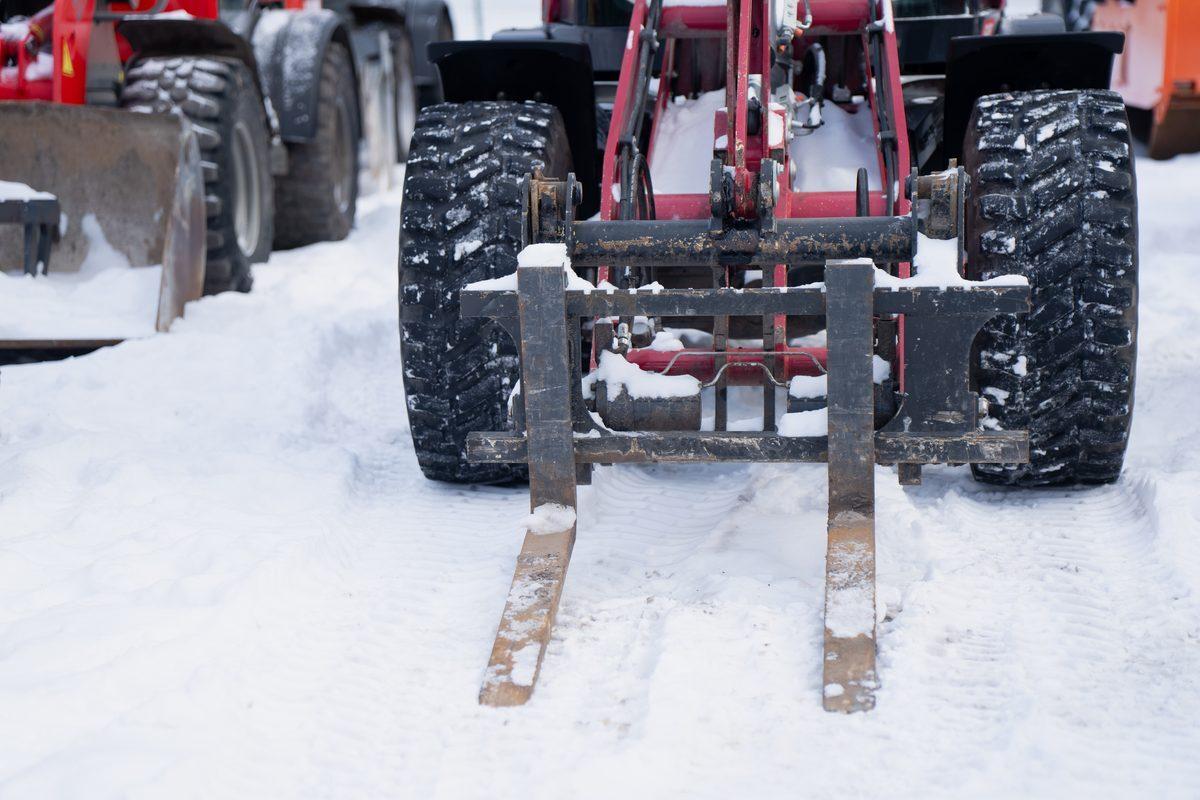
Deep, aggressive tread is what pulls a forklift through snow, mud, and broken ground — traction smooth indoor tires can’t deliver.
Debris-heavy sites (recycling, scrap, demolition, lumber). If your yard is full of nails, banding, glass, or scrap metal, flats will define your week. Solid resilient tires are the answer — they take the abuse and never go flat, which is why debris-heavy operations standardize on them.
Mixed indoor/outdoor routes. A truck that crosses dock plates and then runs into the yard needs a tire that does both. Solid resilient handles the rough transitions without flat risk; pneumatic tube-type gives a softer ride if your outdoor exposure is lighter and puncture risk is low.
Slopes, ramps, and wet ground. Prioritize traction tread and the correct ply rating. Worn tread on an incline is a safety problem, not just a wear problem — replace before the tread is gone.
What This Is Not: Indoor Smooth-Floor Tires
If your forklift never leaves a smooth concrete building, you don't want a pneumatic tire at all — the aggressive tread and air ride are wasted indoors and can mark sealed floors. That truck wants cushion press-on tires instead. Pneumatic and cushion forklifts have different chassis and wheels, so the two aren't interchangeable. If you're sorting out which type your equipment takes, start with the forklift tire buying guide, and see our warehouse tire selection guide for indoor floor-type matching.
What to Verify Before You Order
Ordering the wrong construction or size is the most common — and most avoidable — mistake on rough terrain tires. Before you buy, confirm:
- Your current drive tire size (molded on the sidewall)
- Your current steer tire size (often different from the drive size)
- Wheel/rim compatibility — pneumatic-style wheels won't take cushion press-ons and vice versa
- Construction — do you want pneumatic tube-type or flat-proof solid resilient?
- Ply rating — match or exceed your current tires for the load
- 4-tire vs. 6-tire setup — match what's installed on your truck
Verify exact tire size and fitment before ordering. If you're unsure which set matches your forklift, call us at 1 (866) 313-2180 — we'll help you match the right tire to your equipment before you buy.
Shopping Rough Terrain Tires at ForkliftTire.com
We carry pneumatic-type forklift tires in both constructions, from compact yard trucks to higher-capacity machines, in lines including Best Choice, Millennium USA, Starmaxx, and Royal.
- Replacing the whole truck? Shop matched pneumatic-type forklift tire sets — most are a 4-piece set with 2 drive + 2 steer tires, with 6-tire sets for larger forklifts.
- Need one size or one position? Browse individual pneumatic and solid resilient tires by size.
- Want them mounted and ready to bolt on? See our solid tire & wheel assemblies.
Pneumatic-type sets are commonly used on certain Toyota, Hyster, Yale, Caterpillar, Mitsubishi, Komatsu, and Doosan forklifts that use these exact sizes and constructions — but equipment make alone does not confirm fitment. Save 7.5% on 2–3 items or save 15% on 4+ items, automatic in cart. Free ground freight to commercial addresses in the contiguous U.S.
Running pneumatics on a tough job? See how other operators set up their trucks in our Operator Gallery — and for a full cost breakdown by tire type, read the forklift tire cost guide.
Frequently Asked Questions
What tires do forklifts use on rough terrain?
Forklifts working on gravel, dirt, broken asphalt, or debris-heavy yards use pneumatic-type tires in one of two constructions: air-filled pneumatic tube-type tires (a tire with an inner tube and flap) for the best ride and shock absorption, or solid resilient tires (solid rubber molded in a pneumatic shape) that are flat-proof for debris-heavy sites. Both mount on the same pneumatic-style wheels.
Are pneumatic or solid tires better for rough terrain?
It depends on your yard. Air-filled pneumatic tube-type tires give the smoothest ride and best shock absorption on uneven ground, but they can go flat on nails and scrap. Solid resilient tires ride firmer but cannot puncture or go flat, which makes them the standard choice for recycling, scrap, demolition, and other debris-heavy operations where downtime is the bigger cost.
Can I put solid tires on a pneumatic forklift?
In most cases, yes. Solid resilient tires are designed to mount on the same pneumatic-style rims as air-filled tube-type tires, so they're a common flat-proof replacement. Switching to solid eliminates puncture-related downtime but gives a firmer ride. Verify that a solid option is available in your exact tire size before ordering.
What does the ply rating (PR) mean on a forklift tire?
Ply rating — shown as 10PR, 12PR, 14PR, and so on — indicates a tire's load and durability class. A higher number means a stronger carcass and more load capacity. For heavy, rough outdoor work, match or exceed the ply rating on your current tires; under-rating a tire for the load and surface leads to early failure.
How do I stop forklift tire flats in my yard?
Switch to flat-proof solid resilient tires. Because they're solid rubber with no air inside, they can't puncture or go flat, no matter what's on the ground. They cost more upfront and ride firmer than air-filled tires, but in a debris-heavy yard they typically deliver the lowest cost per operating hour by eliminating flat-related downtime.
Not sure which construction or size fits your forklift? Call 1 (866) 313-2180 — we'll help you match the right tire to your equipment and terrain. Verify exact tire size and fitment before ordering.