 1 (866) 313-2180
 SALES@FORKLIFTTIRE.COM


Posted by Forklift Tire Company on 17th Nov 2026
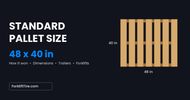
The standard U.S. pallet is 48 by 40 inches. In a survey of the U.S. wood pallet industry covering 2016, it was the most common size: about 35% of new wood pallets were 48 x 40, and the same size made up 69% of the recycled and remanufactured pallet market.[1] It is also one of the six pallet footprints in the international standard ISO 6780.[2]
This guide starts with the numbers people look up: dimensions, height, weight, capacity and how many pallets fit in a trailer. Then it tells the American story of how 48 x 40 won, from a 1939 patent in upstate New York to the grocery industry, and shows what the standard pallet means for your forklift and pallet jack. Every figure comes from a numbered source at the end.
In this article
Standard pallet dimensions
Wood pallet sizes are written stringer length first. The pallet industry’s Uniform Standard for Wood Pallets specifies a pallet’s size by the stringer or stringerboard length, followed by the top deckboard length.[3] So 48 x 40 and 40 x 48 are different pallets: since a GMA pallet has 48-inch stringers, it is a 48 x 40, not a 40 x 48.[4] By the same rule, Clarke notes, the Euro pallet is an 800 x 1200 mm design; ISO 6780 prints the footprint as 1200 x 800 and notes that its sizes do not imply a preferred length or width.[4][2] A survey of U.S. pallet firms covering 2000 listed the two separately: 48 x 40 was the most frequently produced size, made or reconditioned by 62% of responding firms, while 40 x 48 tied with 48 x 48 for third.[10]
| Footprint (mm) | Inches | Notes |
|---|---|---|
| 1219 x 1016 | 48 x 40 | Rectangular. The U.S. standard footprint.[4] |
| 1200 x 800 | 47.2 x 31.5 | Rectangular. The size of the EUR (Euro) pallet.[11] |
| 1200 x 1000 | 47.2 x 39.4 | Rectangular. |
| 1067 x 1067 | 42 x 42 | Square. |
| 1100 x 1100 | 43.3 x 43.3 | Square. |
| 1140 x 1140 | 44.9 x 44.9 | Square. |
Other U.S. sizes fill out the list. In the same survey, 48 x 42 and 40 x 40 tied for fifth, and 48 x 45 and 48 x 36 entered the top ten.[10] Beyond the common sizes, the market includes hundreds of sizes, typically tailored to specific customers.[4] In 2016, about 39% of new U.S. wood pallets were custom sizes, down from 60% in 2011.[1]
How 48 x 40 won: an American story
1939, Greene, New York. In 1937 George G. Raymond and William C. House of Lyon Iron Works applied for a patent on a two-faced pallet: a top deck held apart from a bottom deck, with openings in the lower face so a lift truck’s supporting members could pass through. It was granted on November 7, 1939, as U.S. Patent 2,178,646, the same day as their patent for a lift truck built to work with it, No. 2,178,647.[12][13] Raymond’s company history credits Lyon Iron Works with designing and building the wooden pallet, and dates the company’s start to George Raymond Sr.’s 1922 purchase of the foundry in the village of Greene.[14] For the forklift’s own beginnings, see Who Invented the Forklift?.
World War II: pallets everywhere, but not one size. In July and August 1942 the Army’s Office of the Quartermaster General ordered 1,000,000 pallets for its depots, and depots with emergency requirements were told to buy thousands more locally. The Army’s official history says that “resulted in a lack of uniformity and standardization which later plagued the Corps.”[15] By 1944 the pallet standardization program was well under way, built around four sizes: 32 by 40, 36 by 48, 48 by 48 and 48 by 60 inches.[15] None of them was 48 by 40. For the people who drove those wartime forklifts, see The Veterans Behind the Military Forklift.
The grocery aisle settles it. In his 2005 industry overview, John Clarke wrote that the U.S. grocery industry began converting to the 48 x 40 footprint in the 1960s and ’70s, and that the size became standard not only in groceries but in many other industries.[4] Pallet Enterprise’s 2006 history of pallet specifications says the Grocery Manufacturers’ Association developed its 48 x 40 GMA pallet specification during the 1970s.[16] The association was founded in 1908, and announced in 2019 that it would become the Consumer Brands Association in 2020.[17]
Standards drift. The same history says GMA pallets lost lumber over the years as the original heavy-duty specification “lost its influence,” and that the GMA exchange system had deteriorated by the late 1970s. Today, it says, a GMA pallet is often thought of as a partial four-way 48 x 40 hardwood pallet.[16] Pallet pools use the footprint too: PECO’s 48 x 40 block pallet, for example, is full four-way and rated at 2,800 pounds.[6]
The rest of the world went its own way. In Europe, what is now the EUR-pallet pool started in 1961, when European railroad authorities working through the International Union of Railways (UIC) set out to standardize pallets.[18] EPAL lists its Euro pallet at 800 mm long and 1,200 mm wide.[11] ISO’s pallet dimension standard, ISO 6780, first appeared in 1988; the current 2003 edition lists six footprints, including 1219 x 1016 mm, the 48 x 40.[2]
Stringer vs block pallets, two-way vs four-way
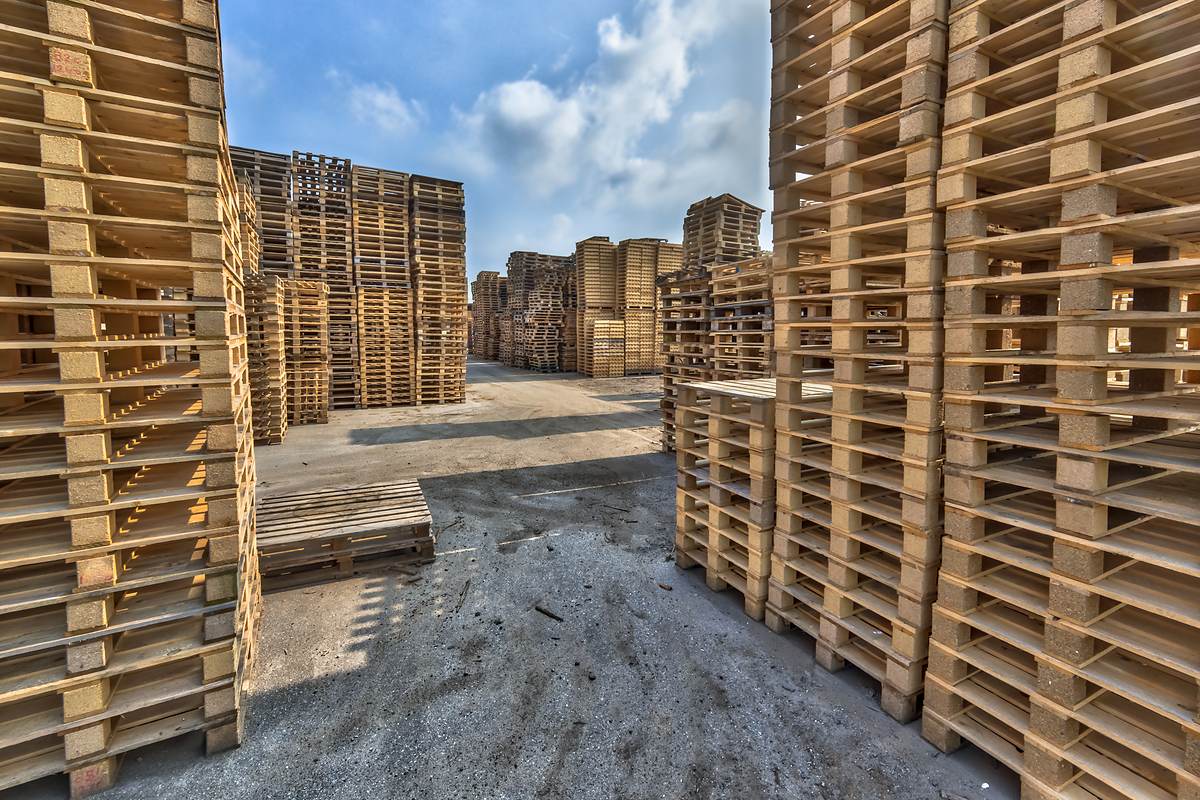
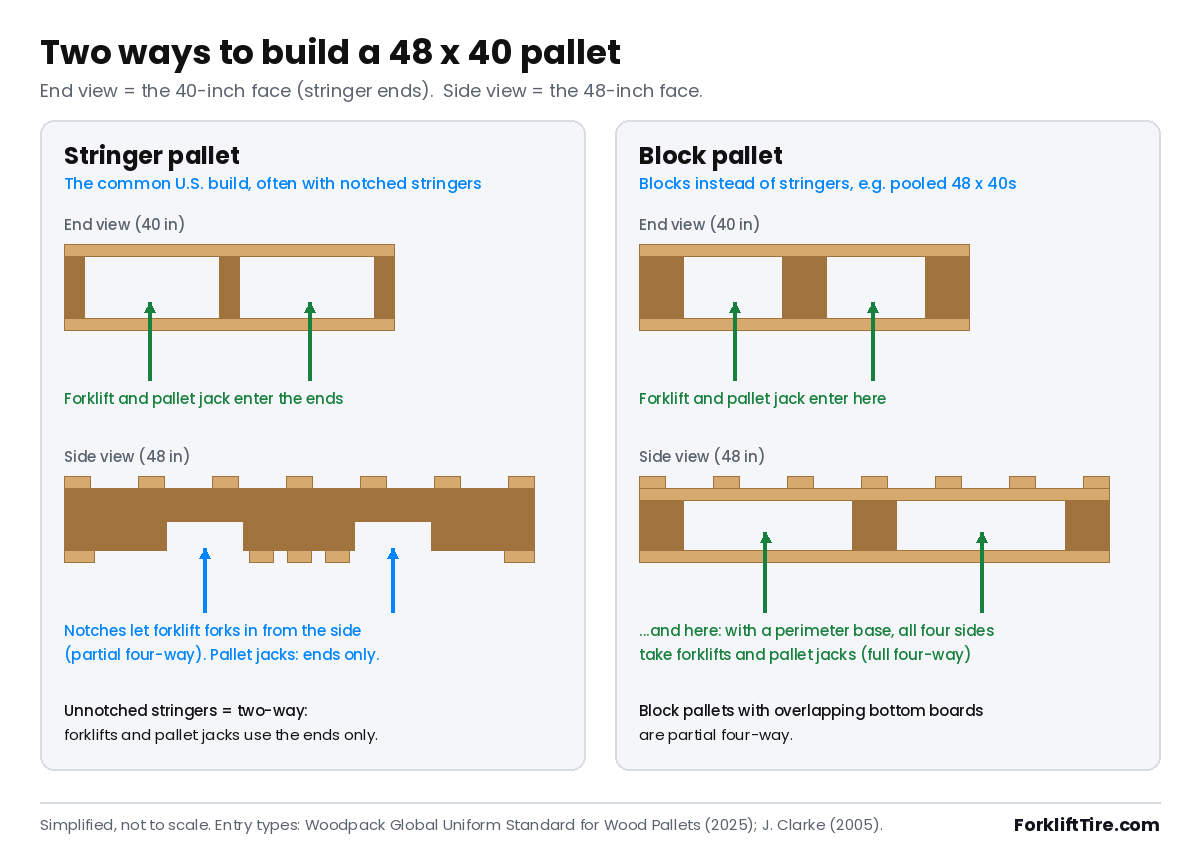
A stringer is a continuous beam that runs the length of the pallet; a block is a spacer between the decks.[3] Stringer pallets are more common in the United States: 76% of new wood pallets in 2016 were stringer pallets.[1][4] How forks get in depends on the build:
- Two-way. An unnotched stringer pallet takes forks only at its two ends, and forklifts and pallet jacks both enter there.[3][4]
- Partial four-way. Notches cut in the stringers let forklift forks in from the sides, but pallet jacks still use the ends.[4] The Uniform Standard calls this partial four-way entry.[3]
- Full four-way. A block pallet takes forklifts and pallet jacks from all four sides when its bottom deck is a perimeter frame, runs one way only, is a panel with cutouts, or is left off.[3][4] A block pallet whose bottom boards overlap in both directions counts as partial four-way.[3] PECO lists its 48 x 40 block pallet, which has a perimeter base, as full four-way.[6]
On the floor, that means a pallet jack works a stringer pallet from an end. For the safe way to run one, see How to Use a Pallet Jack Safely, and when a jack’s wheels wear out, see Forklift Load Wheels.
Height, weight and capacity
Height, weight and capacity depend on the lumber and the build, so here are three published examples:
| Pallet | Height | Weight | Published capacity |
|---|---|---|---|
| NWPCA example 48 x 40 stringer pallet (partial four-way, new)[5] | 4.75 in | 59 lb when made; 37 to 41 lb once dried to 12% to 25% moisture | 2,504 lb on forklift forks entering an end; 1,558 lb racked across its length; 5,223 lb stacked one unit high on the floor |
| PECO 48 x 40 block pallet (full four-way, pooled)[6] | 5.56 in | Not listed | 2,800 lb |
| EPAL Euro pallet, 800 x 1200 mm[11] | 144 mm (about 5.7 in) | About 25 kg (about 55 lb) | 1,500 kg safe working load |
The NWPCA example shows why one number is not enough. Under a uniformly distributed load, the same pallet is rated at 5,223 pounds sitting on the floor under one load, 2,504 pounds on forklift forks and 1,558 pounds spanning a rack across its length.[5] Ask your pallet supplier for the rating that matches how you will use the pallet.
How many pallets fit in a 53-foot trailer
Federal rules set the width standard for trucks on the National Network at 102 inches.[19] Inside, Utility Trailer lists 100 and 101 inches of width at the wearband for its dry vans, and its 4000D-X brochure shows 52 feet 6 5/8 inches (630 5/8 inches) of inside length.[7] With those numbers:
- Loaded straight: 26 pallets. The 48-inch side runs down the trailer, two pallets sit side by side in 80 inches, and 13 rows fit in 630 5/8 inches.
- Turned: 30 pallets. The 40-inch side runs down the trailer, two pallets take 96 inches across, and 15 rows fit.
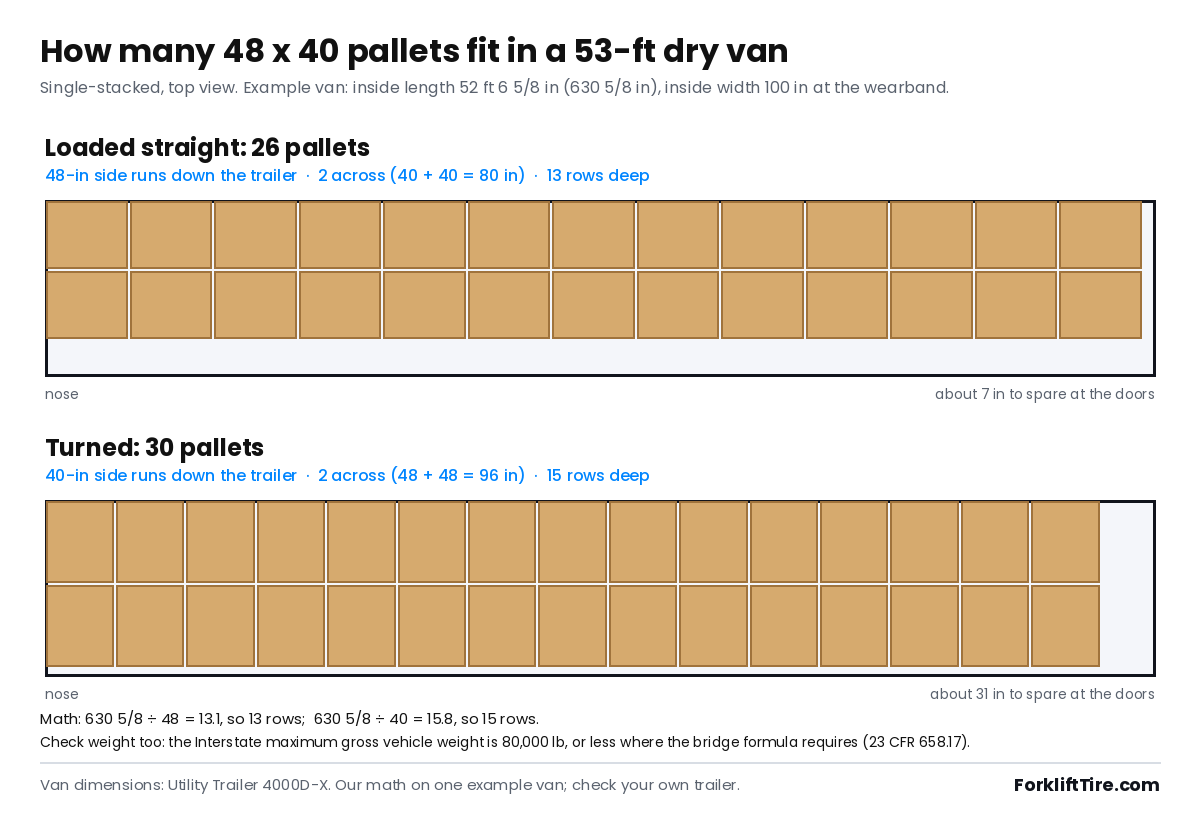
Space is only half the math. Federal rules set the maximum gross vehicle weight on the Interstate System at 80,000 pounds, or less where the bridge formula requires,[20] so dense freight can reach the weight limit before the floor is full. For working the dock itself, see Forklift Loading Dock Safety Guide.
What 48 x 40 means for your forklift
A forklift’s capacity is stated at a load center: the distance from the front face of the forks to the load’s center of gravity. OSHA says trucks with a capacity of 30,000 pounds or less are normally rated at a 24-inch load center.[21] OSHA’s forklift eTool shows a data plate with a 24-inch load center and a stated capacity of 5,000 pounds with forks, 4,500 pounds with a sideshifter attachment.[8] Toyota’s 4,000- to 6,500-pound Core Diesel Pneumatic forklifts list the same 24-inch load center.[9]
Put a uniform load on a 48-inch-deep pallet, push the pallet back against the fork face, and its center of gravity sits 24 inches out, the same point. A load longer than 48 inches puts the center of gravity past 24 inches, and the truck can carry less: in OSHA’s example, a 3,000-pound truck rated at a 24-inch load center can carry at most 2,400 pounds when the load is 60 inches long.[21] For a load like that, or one with an off-center weight, OSHA says to calculate the limit for that load, and its eTool says the capacity must be recalculated.[8][21] OSHA’s rule is short: “Only loads within the rated capacity of the truck shall be handled.”[21] For more, see How to Read a Forklift Data Plate and The Forklift Stability Triangle.
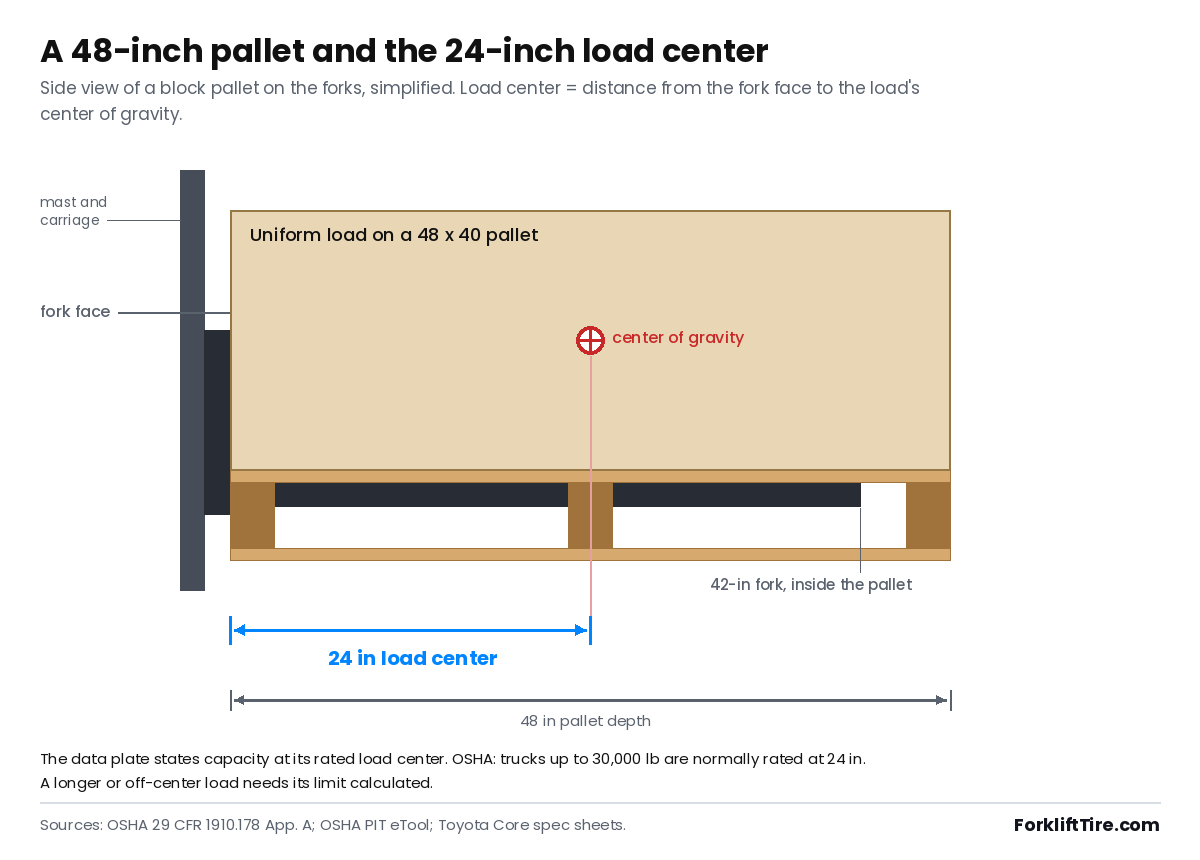
- Forks. Toyota lists 42-inch forks on those same trucks, so on a 48-inch pallet the fork tips stop about 6 inches short of the far edge.[9]
- Pallet jacks. Crown sells its PTH 50 hand pallet jack in a 27-inch-wide model with 48-inch forks, among other sizes.[22] Those numbers line up with the 40-inch end and the 48-inch depth of a standard pallet. On a stringer pallet the jack goes in from an end; on a full four-way block pallet, from any side.[3][4]
- Tires. Every one of those loads rides on the truck’s tires. When they wear out, start from the tire size on the data plate or molded on the old tire. Forklift Tire Sizes by Make & Model lists sizes by model for many makes.
Printable quick card
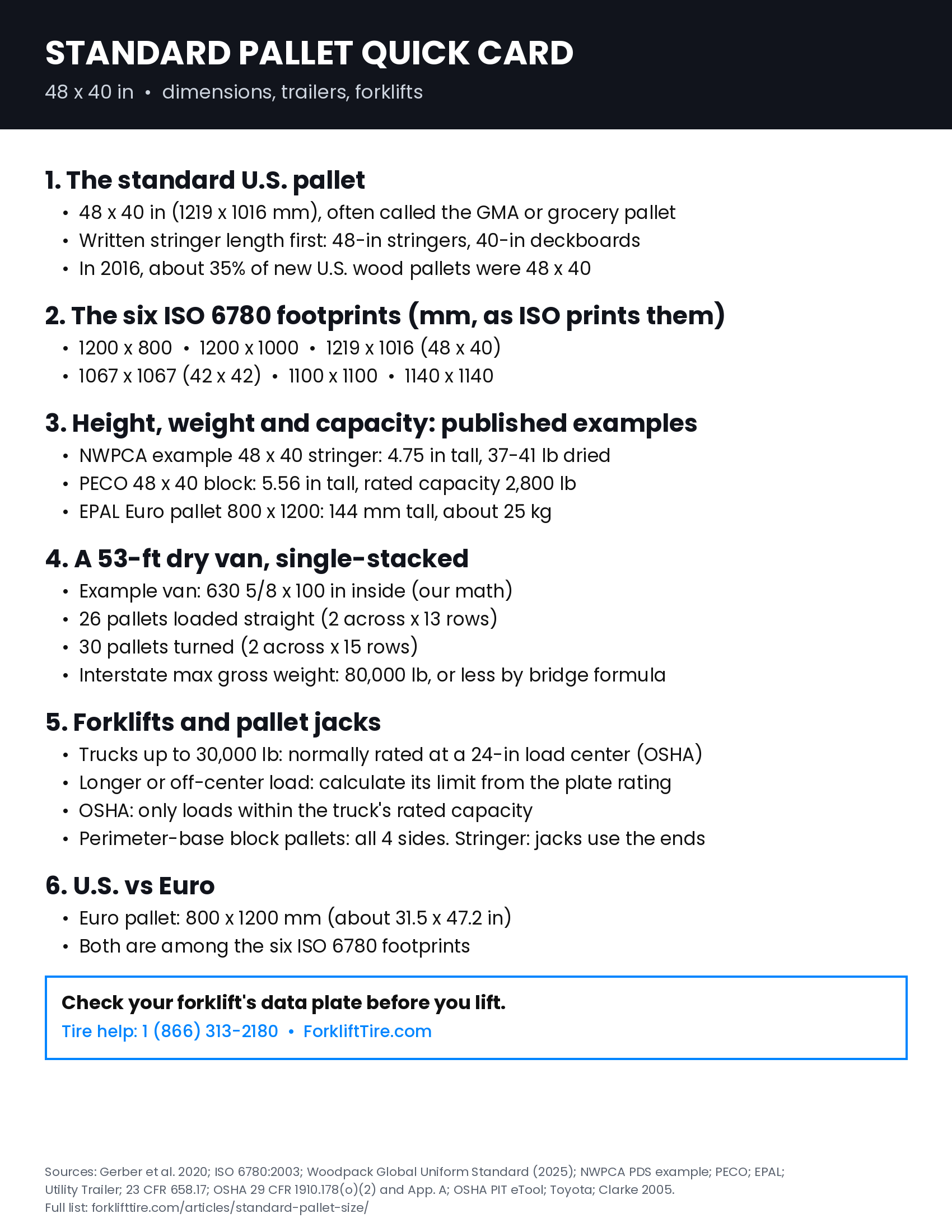
Print this one-page card for the dock office or the shop wall. It has the standard size, the six ISO footprints, the reference heights and weights, the trailer counts and the forklift reminders from this guide. Click the card to open the full-size version.
Frequently asked questions
What is the standard pallet size in the US?
48 x 40 inches (1219 x 1016 mm), often called the GMA or grocery pallet. The first number is the stringer length, so a 48 x 40 has 48-inch stringers and 40-inch deckboards. In an industry survey covering 2016, about 35% of new U.S. wood pallets were 48 x 40.
What is a GMA pallet?
A 48 x 40 pallet named for the Grocery Manufacturers Association, which developed its 48 x 40 pallet specification during the 1970s, according to Pallet Enterprise. Today a GMA pallet is often thought of as a partial four-way 48 x 40 hardwood pallet. The association, founded in 1908, announced in 2019 that it would become the Consumer Brands Association in 2020.
How tall is a standard pallet?
It depends on the build. Three published examples: 4.75 inches for an NWPCA example 48 x 40 stringer pallet, 5.56 inches for PECO’s 48 x 40 block pallet, and 144 mm (about 5.7 inches) for the EPAL Euro pallet.
How much does a standard pallet weigh?
The NWPCA’s example 48 x 40 wood stringer pallet weighs 59 pounds when it is made and 37 to 41 pounds once it dries to 12% to 25% moisture. An EPAL Euro pallet weighs about 25 kg (about 55 pounds).
How many pallets fit in a 53-foot trailer?
Single-stacked, 26 standard 48 x 40 pallets loaded straight, or 30 turned, in a van with about 630 inches of inside length and 100 inches of inside width. Weight can limit the load first: the federal maximum gross vehicle weight on the Interstate System is 80,000 pounds, or less where the bridge formula requires.
What is the difference between a US pallet and a Euro pallet?
The U.S. standard is 48 x 40 inches (1219 x 1016 mm). The EUR, or Euro, pallet is 800 x 1200 mm by the stringer-first rule (ISO 6780 prints it 1200 x 800), about 31.5 x 47.2 inches, and grew out of a pallet pool European railways started in 1961. Both are among the six footprints in the international standard ISO 6780.
What does a 24-inch load center have to do with pallets?
A uniform load on a 48-inch-deep pallet, pushed back against the fork face, has its center of gravity 24 inches out, and OSHA says trucks with a capacity of 30,000 pounds or less are normally rated at a 24-inch load center. A load longer than 48 inches, or one with an off-center weight, needs its limit calculated from the data plate rating. Do not guess.
- N. Gerber, L. Horvath, P. Araman and B. Gething, “Investigation of new and recovered wood shipping platforms in the United States,” BioResources 15(2), 2818–2838 (2020). Peer-reviewed survey of the U.S. wood pallet industry covering 2016 (mailed May–June 2017).
- ISO 6780:2003, Flat pallets for intercontinental materials handling — Principal dimensions and tolerances (International Organization for Standardization), Tables 1 and 2 and the foreword, as shown in the sample pages previewed by iTeh Standards; ISO lists the standard as last reviewed and confirmed in 2026.
- Woodpack Global (formerly NWPCA), Uniform Standard for Wood Pallets (approved November 5, 2025), Section 3 (terminology) and Section 4.3 (entry types).
- John Clarke, “Pallets 101: Industry Overview and Wood, Plastic, Paper & Metal Options,” Pallet Enterprise, July 1, 2005 (reprinted from ISTA’s PreShipment Testing Newsletter).
- National Wooden Pallet and Container Association, Pallet Design System example analysis of a 48 x 40 stringer pallet (PDS version 5.2), hosted by the Pallet Foundation.
- PECO Pallet, “PECO Pallet Specifications”, 48 x 40 block pallet.
- Utility Trailer Manufacturing Company, dry van specifications, and the Utility 4000D-X dry van brochure (copy hosted by a Utility dealer).
- OSHA, Powered Industrial Trucks eTool, “Parts » Nameplate”, Figure 1.
- Toyota Material Handling, Core Diesel Pneumatic specification sheet (4,000–6,500 lb, 2026), load center and fork size.
- Jean C. Mangun and John E. Phelps, “Expendable, 48×40 Pallets Dominate Production in U.S.,” Pallet Enterprise, April 1, 2002 (Southern Illinois University survey of 2000 production).
- European Pallet Association (EPAL), “EPAL Euro Pallet (EPAL 1)”, specifications.
- U.S. Patent 2,178,646, “Pallet,” George G. Raymond and William C. House, assigned to Lyon Iron Works, filed September 18, 1937, granted November 7, 1939.
- U.S. Patent 2,178,647, “Lift truck,” George G. Raymond and William C. House, assigned to Lyon Iron Works, filed March 25, 1938, granted November 7, 1939.
- The Raymond Corporation, company history brochure.
- Erna Risch, The Quartermaster Corps: Organization, Supply, and Services, Vol. 1 (Office of the Chief of Military History, U.S. Army, 1953), p. 351. Official Army history.
- Ed Brindley, “Pallet Standards and Specifications — The Evolution to Today,” Pallet Enterprise, December 1, 2006.
- Food Dive, “GMA will become the Consumer Brands Association in 2020,” September 26, 2019.
- Chaille M. Brindley, “A True Gold Standard: Lessons from the First Fifty Years of the Europallet,” Pallet Enterprise, July 1, 2011.
- 23 CFR 658.15, Width (eCFR), paragraph (a).
- 23 CFR 658.17, Weight, paragraph (b).
- 29 CFR 1910.178, Powered industrial trucks (OSHA), paragraph (o)(2), and its Appendix A, Stability of Powered Industrial Trucks (non-mandatory), A-5.2 and A-5.3.
- Crown Equipment Corporation, “PTH 50 Hand Pallet Jack 27 x 48”, specifications.
Trademarks and affiliation: PECO, EPAL, Toyota, Crown, Raymond, Utility and all other brand names are trademarks of their respective owners. Forklift Tire Company is an independent supplier and is not affiliated with, sponsored by, or endorsed by any pallet company, pallet association, standards body, trailer maker or equipment manufacturer named here. Names are used only to identify the published sources.
Tires for the forklift that moves your pallets?
Send FTC the make, model and serial number from the data plate, the size molded on the old tire, and a photo. FTC reviews the size with you before you order. Verify exact tire size and fitment before ordering.
Email Your Truck Details Contact UsQuestions? Call 1 (866) 313-2180.