 1 (866) 313-2180
 SALES@FORKLIFTTIRE.COM



Posted by Forklift Tire Company on 14th Sep 2026
A pallet jack is the simplest truck in the building and the one most people are handed without a word of instruction. That is the problem. The three hand pallet trucks whose manuals this guide quotes are rated between roughly 5,000 and 6,600 pounds a few inches off the floor, an electric walkie moves the same kind of load under motor power, and the two hazards that run through the manufacturer manuals on this page are the same on both: feet under the load, and a truck that gets away from its operator on a slope or a dock. This guide separates what federal OSHA actually requires from what the manufacturers tell you in the operator manual, explains why the answer changes depending on whether the jack is powered, and covers the part of the machine that decides how it rolls — the wheels.
The short answer
Electric pallet jacks (walkie, walkie-rider, and center-rider trucks) are powered industrial trucks under 29 CFR 1910.178. That brings the whole standard with them: operator training and evaluation before use, an examination before each day’s use — and after each shift where the truck runs round the clock — out-of-service rules, and the traveling, loading, and battery-charging paragraphs. Manual (hand-pumped) pallet jacks are outside the words of that standard, so no OSHA operator-certification rule reaches them — but the general materials-handling rule (1910.176), the walking-working-surfaces rule (1910.22), the General Duty Clause, and every line of the manufacturer’s manual still do.
Either way, the working rules are the same: check the truck before you use it, keep hands and feet clear of the forks and wheels, ride it only if it was built with a place to ride and you are authorized to use it, never carry anyone else on it, keep the load low and centered, stay off any slope your own manual prohibits — and where a slope is allowed, keep the forks pointed downhill unless a load requires otherwise (the binding rule, 1910.178(n)(7)(i), sends a loaded truck’s load upgrade on grades over 10 percent) — park it with the forks down, clear debris out of the load wheels and steer wheels before the next move, and replace them — in pairs — only when they are worn out of round.
On this page
- Manual vs. electric: which rules reach your pallet jack
- Training: what OSHA requires for electric pallet jacks
- The pre-use inspection (with a printable checklist)
- How to use a pallet jack: the operating rules
- Ramps, docks, and elevators
- Parking and leaving the truck
- Battery charging on electric pallet jacks
- Wheels and load rollers: when to replace them
- Common pallet jack problems and what they mean
- Required vs. good practice, side by side
- Frequently asked questions
- Getting the wheels right
- Sources
Manual vs. electric: which rules reach your pallet jack
Start with the scope sentence of the powered industrial truck standard, because everything else follows from it. 29 CFR 1910.178(a)(1) says the section covers “fork trucks, tractors, platform lift trucks, motorized hand trucks, and other specialized industrial trucks powered by electric motors or internal combustion engines.” An electric pallet jack is a motorized hand truck. The standard even writes one rule specifically for them: 1910.178(n)(13), “Motorized hand trucks must enter elevator or other confined areas with load end forward.” OSHA’s own training bulletin lists “pallet jacks” among the trucks the standard covers and notes they “can be driven by an operator or controlled remotely by a walking operator.”
When OSHA has been asked whether a machine is a powered industrial truck, it applies a design test, not a use test. In a 2011 interpretation letter, quoted again in a 2023 one, OSHA said “it is the design of the vehicle that is the determining factor of whether or not it is considered a powered industrial truck, rather than the manner in which it is utilized.” The 2023 letter applies that test: it repeats the definition OSHA took from ANSI B56.1-1969 — a “mobile, power-driven vehicle used to carry, push, pull, lift, stack, or tier material” — and holds that equipment “powered by electric motors and designed to carry, push, or pull material … is thus subject to the requirements of 29 CFR 1910.178.” Two limbs: power-driven, and designed to move material.
A hand-pumped pallet jack meets the second limb and not the first. It is powered by the person pulling it. On the words of the scope sentence and OSHA’s own test, a manual pallet jack falls outside 1910.178. Be precise about what that is: it is a reading of the regulation text and OSHA’s stated test, not a holding. OSHA’s index of interpretation letters for 1910.178(a)(1) contains two letters, and neither is about hand pallet trucks. The closest OSHA has come is the preamble to the 1998 training rule, which lists “manually propelled high lift industrial trucks” among the vehicle families that have their own consensus volume — families OSHA there describes, loosely, as falling “within the broad definition of a powered industrial truck,” which is the consensus committee’s definition and not the scope sentence of 1910.178(a)(1) — and says the rule “covers only those types of powered industrial trucks that fall within the scope of 29 CFR 1910.178(a) for general industry, construction, and shipyards.” Read it carefully, because the next sentence limits it: OSHA adds that the scope “includes some types of powered industrial trucks that have supplementary ASME volumes, such as rough terrain forklift trucks.” Having its own volume is not what puts a hand jack outside 1910.178. Not being power-driven is.
What does apply to a manual pallet jack
Outside 1910.178 is not outside OSHA. Three things reach a hand pallet jack directly:
- 1910.176, Handling materials — general. Paragraph (a): “Where mechanical handling equipment is used, sufficient safe clearances shall be allowed for aisles, at loading docks, through doorways and wherever turns or passage must be made,” and “Aisles and passageways shall be kept clear and in good repair, with no obstruction across or in aisles that could create a hazard.” Paragraph (b) requires that stored material “shall not create a hazard” and that tiered material be “stacked, blocked, interlocked and limited in height so that they are stable and secure against sliding or collapse.” Paragraph (c) is housekeeping.
- 1910.22, Walking-working surfaces. The employer must ensure that surfaces “are kept in a clean, orderly, and sanitary condition” (a)(1), that workroom floors are maintained “in a clean and, to the extent feasible, in a dry condition” (a)(2), and that surfaces are “maintained free of hazards such as sharp or protruding objects, loose boards, corrosion, leaks, spills, snow, and ice” (a)(3). Paragraph (b) requires that each surface “can support the maximum intended load,” which matters for mezzanines and dock plates under a loaded jack, and (d)(1) requires surfaces to be “inspected, regularly and as necessary, and maintained in a safe condition.”
- The General Duty Clause, section 5(a)(1) of the OSH Act: a place of employment “free from recognized hazards that are causing or are likely to cause death or serious physical harm.” Feet under a loaded pallet and a runaway jack on a ramp are recognized hazards; the Crown, Uline, and JET manuals quoted on this page name them.
The consensus standards, and a scope change with a date on it
The powered side is straightforward. ANSI/ITSDF B56.1-2020 covers “low lift and high lift powered industrial trucks controlled by a riding or walking operator,” which is a walkie pallet truck by description, and 1910.178(a)(2) incorporates the 1969 edition of B56.1 for design and construction. The manual side is where the date matters. The edition of B56.10 in force as this is written, B56.10-2019, covers “manually propelled high lift industrial trucks controlled by a walking operator” — hand stackers, not low-lift pallet jacks. The publisher’s page lists a 2025 revision, effective December 17, 2026, whose scope adds “manually propelled low lift, scissor lift pallet, and high lift industrial trucks.” So: until December 17, 2026, no B56 volume covers a hand pallet jack; after that date, B56.10-2025 does. Neither edition is incorporated into federal 1910.178.
State plans can go further. California’s Title 8, section 3650, “Industrial Trucks. General,” incorporates the B56 family by reference for trucks manufactured after March 15, 2009 — including “ANSI/ITSDF B56.10 - 2006, Safety Standard for Manually Propelled High Lift Industrial Trucks,” which federal OSHA does not — and its operating rules require that only drivers “authorized by the employer and trained” operate industrial trucks, prohibit stunt driving and horseplay, and prohibit riders unless the vehicle has “adequate riding facilities.” If you are in a state-plan state, read your state’s section; this guide is written to federal OSHA.
| Requirement | Electric pallet jack | Manual pallet jack |
|---|---|---|
| Operator training, evaluation, and certification record | Required — 1910.178(l) | Not required by 1910.178. Manufacturers still say “trained and authorized” (Crown PTH 50 rule 1; Uline rule 1); the General Duty Clause applies |
| Examination before being placed in service, at least daily — and after each shift where the truck runs round the clock | Required — 1910.178(q)(7) | Manufacturer instruction (Uline: “Daily check”; Crown: “Make sure truck is in good working order”) |
| Out of service when defective | Required — 1910.178(p)(1), (q)(1) | General Duty Clause; manufacturer instruction |
| Replacement parts equivalent in safety to the original design | Required — 1910.178(q)(5) | Manufacturer parts list |
| Aisle clearance, stable storage, housekeeping | 1910.176 and 1910.178(m)(14) | 1910.176(a), (b), (c) |
| Floor condition and floor load | 1910.22; 1910.178(n)(10), (n)(14) | 1910.22(a), (b), (d)(1) |
| Design standard | ANSI B56.1-1969 incorporated by 1910.178(a)(2); current edition B56.1-2020 | None in force until B56.10-2025 takes effect December 17, 2026; not incorporated federally |
Training: what OSHA requires for electric pallet jacks
Because an electric pallet jack is a powered industrial truck, 1910.178(l) applies to its operators exactly as it applies to a sit-down forklift operator. The employer “shall ensure that each powered industrial truck operator is competent to operate a powered industrial truck safely, as demonstrated by the successful completion of the training and evaluation specified in this paragraph (l),” and, except for training purposes, must not let an employee operate the truck until that training is complete — (l)(1)(i) and (l)(1)(ii). Training “shall consist of a combination of formal instruction … practical training … and evaluation of the operator’s performance in the workplace” (l)(2)(ii), delivered by “persons who have the knowledge, training, and experience to train powered industrial truck operators and evaluate their competence” (l)(2)(iii). The certification at (l)(6) is made by the employer, not by OSHA and not by a course provider.
The topic list at (l)(3)(i) is written for every truck type, and several items map directly onto a walkie: “(H) Vehicle capacity,” “(I) Vehicle stability,” “(J) Any vehicle inspection and maintenance that the operator will be required to perform,” “(K) Refueling and/or charging and recharging of batteries,” and “(M) Any other operating instructions, warnings, or precautions listed in the operator’s manual for the types of vehicle that the employee is being trained to operate.” That last item is why the manufacturer’s manual is quoted so heavily in this guide: OSHA’s enforcement directive for the training standard treats the operator manual’s instructions as training content that can be cited under (l)(3)(i)(M) when they are not taught (its own example is seat-belt use). The workplace topics at (l)(3)(ii) add “(A) Surface conditions where the vehicle will be operated,” “(D) Pedestrian traffic in areas where the vehicle will be operated,” and “(G) Ramps and other sloped surfaces that could affect the vehicle’s stability.” The employer may omit topics it “can demonstrate are not applicable to safe operation of the truck in the employer’s workplace.”
Two provisions matter most for a mixed fleet. First, refresher training is triggered when “(D) The operator is assigned to drive a different type of truck” (l)(4)(ii)(D). Moving a counterbalanced-forklift operator onto a walkie pallet truck is a different type of truck, so a qualified forklift operator is not automatically a qualified pallet-truck operator. The other four triggers are unsafe operation observed, an accident or near-miss, an evaluation that shows unsafe operation, and a workplace change that could affect safe operation. Second, (l)(5) avoids duplicate work, but only on a condition: a topic already covered by training that is “appropriate to the truck and working conditions encountered” need not be repeated “if the operator has been evaluated and found competent to operate the truck safely.” No evaluation, no exemption. An evaluation of each operator’s performance is required “at least once every three years” (l)(4)(iii), and the certification record must carry “the name of the operator, the date of the training, the date of the evaluation, and the identity of the person(s) performing the training or evaluation” (l)(6).
For the full walk-through of the training standard — who can train, what the evaluation looks like, how temporary and third-party-trained operators are handled — see OSHA Forklift Training Requirements.
Manual pallet jacks: 1910.178(l) does not reach them. That is not the same as “no training.” Crown’s hand pallet truck instructions open with “Do not operate this truck unless you are trained and authorized,” Uline’s with “Do not operate the pallet truck unless you are familiar with it and have been trained and authorized to do so,” and NIOSH’s manual-material-handling guidelines say to “Follow all manufacturers’ recommendations for proper equipment use.” A short, documented walk-through of the manual’s rules is the practical standard, and it is the evidence an employer would want if a hand-jack injury ever became a General Duty Clause question.
The pre-use inspection (with a printable checklist)
For a powered pallet jack, the inspection is not optional and its timing is fixed by 1910.178(q)(7): trucks “shall be examined before being placed in service, and shall not be placed in service if the examination shows any condition adversely affecting the safety of the vehicle.” The examination “shall be made at least daily,” and where trucks “are used on a round-the-clock basis, they shall be examined after each shift. Defects when found shall be immediately reported and corrected.” If the check turns up a problem, 1910.178(p)(1) takes over: a truck “found to be in need of repair, defective, or in any way unsafe … shall be taken out of service until it has been restored to safe operating condition,” and (q)(1) adds that “All repairs shall be made by authorized personnel.”
Two OSHA interpretation letters shape how this works in practice. The examination does not have to be written down: “there is no OSHA requirement that the examination be recorded in writing on a checklist,” though an employer is free to require one and OSHA calls that going “beyond OSHA’s requirements” (letter of May 9, 2000). And a truck that is stored or not used every day “would not require an examination until it is ready to be placed in service,” with the caution that trucks idle for long periods “may require some service or maintenance before being returned to use” (letter of March 3, 2005). Most fleets keep a written form anyway, because it is the only evidence that the examination happened.
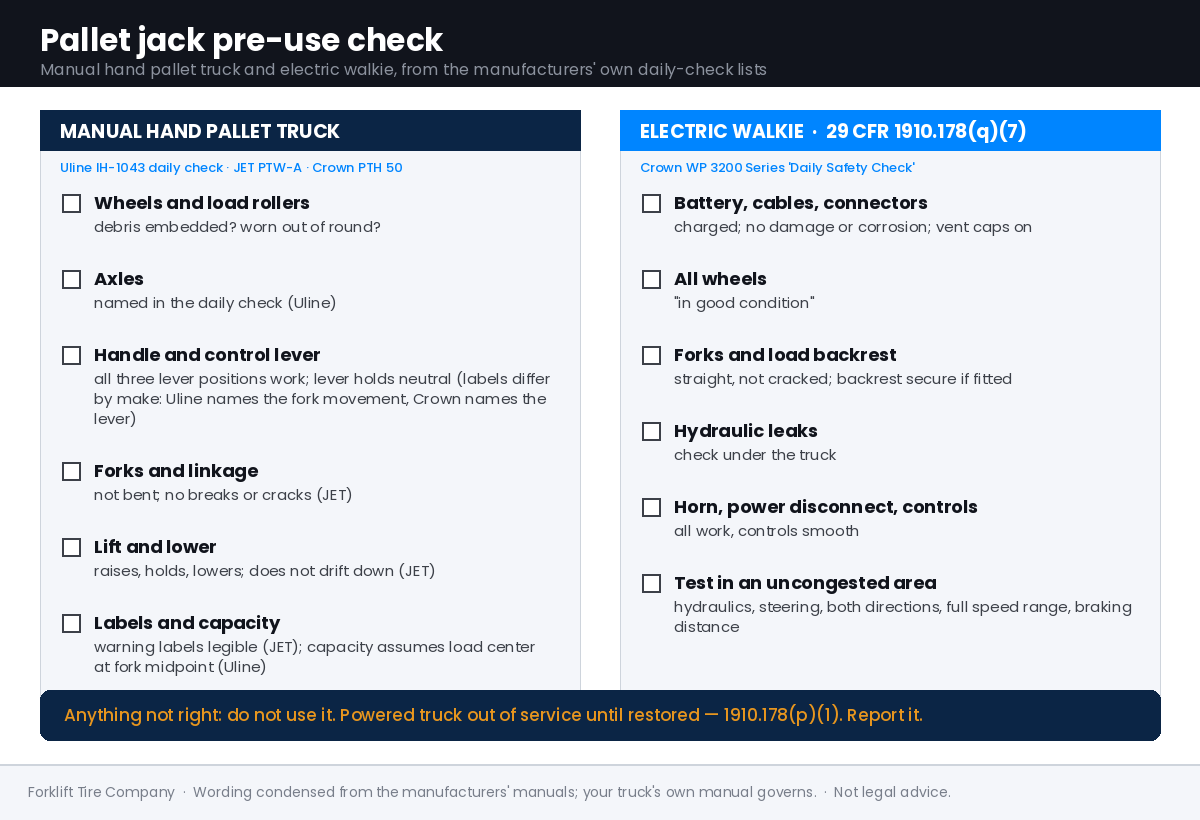
The standard says that you examine the truck; the manufacturer says what to examine. The table below puts the two manufacturer lists side by side. The manual-jack column is Uline’s daily check for its H-1043 hand pallet truck; the electric column is Crown’s “Daily Safety Check” from the WP 3200 Series operator manual, which begins “You must make sure your truck is safe to use” and ends “If anything doesn’t look, work, feel, or sound right, don’t use your truck. Notify your supervisor.” Your truck’s own manual governs if it differs.
| Manual hand pallet truck (Uline) | Electric walkie pallet truck (Crown) |
|---|---|
| “Pay special attention to the wheels, axles, handle, forks and lift and lower control.” | “Walk around your truck and check it over.” Batteries charged; water level and vent caps on serviceable batteries; no open flame near the battery. |
| Maintenance: “Use motor oil or grease to lubricate all movable parts.” | Battery cables and connectors: no damage or corrosion. |
| Air can enter the pump unit over time or after seal replacement; to expel it, lift the control lever to the DOWN (fork-lowering) position, then pump the handle up and down several times. | “See that all wheels are in good condition.” |
| Read all warning signs and instructions on the truck before use; forks lowered when not in use. | Control handle clean. “Check that both forks are straight and not cracked or badly worn.” Load backrest in place and secure, if fitted. |
| Know the capacity: it assumes “an evenly distributed load with the center of the load being at the halfway point of the length of the forks.” | No hydraulic leaks under the truck. Horn works. Power disconnect works. “Make certain all controls work smoothly.” |
| — | “Test your truck in an uncongested area”: hydraulics, steering, slow travel both directions, full speed range forward and reverse, braking distance in both directions — “If the braking distance is too long for you, don’t use your truck.” |
Notice what both lists put near the top: the wheels. On a hand jack the wheels are the first thing Uline names; on the Crown walkie, “See that all wheels are in good condition” appears in the same words across three different operator manuals (WP 3200, WP 2000, PE 4000). What “good condition” means, and what to do when it is not, is covered below.
Printable: Pallet Jack Pre-Use Inspection Checklist
One page, letter size, with a manual column and an electric column, the OSHA paragraph behind each electric-truck item, and an out-of-service line at the bottom. Post it at the charging area or clip it to the truck.
If your fleet also runs forklifts, the companion form is the Forklift Daily Inspection Checklist (OSHA Pre-Shift), which covers the same (q)(7) duty for counterbalanced trucks.
How to use a pallet jack: the operating rules
The mechanics are simple, with one trap. On a hand jack the control lever has three positions, and the manufacturers do not label them the same way. Uline names them for what the forks do — “DOWN = to lower the forks / NEUTRAL = to move the load / UP = to raise the forks” — and reaches its DOWN position by lifting the lever. Crown and JET name them for what the lever does, and on both, pushing the lever down raises the forks: “To raise forks, push the actuating lever ‘down’ to the RAISE position” (Crown), “Push the lever down” (JET). Read the label on your own truck before you touch it. Crown adds the habit that takes the pumping effort off the handle and, in its words, “reduces operator fatigue”: “Before maneuvering the truck, move the actuator lever to the NEUTRAL position …” Center the forks under the pallet and run them in as far as they go (“Position forks evenly under the load,” “Do not pick up a load with one fork” — Crown rules 11 and 12; for powered trucks, (o)(5) requires the load engaging means “placed under the load as far as possible”), pump until the pallet clears the floor, set neutral, and move. Lower it before you leave it. The rules below are what sit around those five steps.
The load
- Within capacity, centered, stable. For powered trucks: “Only loads within the rated capacity of the truck shall be handled” (o)(2); “Only stable or safely arranged loads shall be handled. Caution shall be exercised when handling off-center loads which cannot be centered” (o)(1); long, high, or multiple-tiered loads “which may affect capacity shall be adjusted” (o)(3). The manufacturers say the same for hand jacks: “Always center loads on the forks, not at the end of the forks” (Uline 7); “To prevent accidental tipping, make sure load is centered on the forks” and “Secure load before transporting” (JET); “Do not handle unstable or loosely stacked loads” (Uline 5). NIOSH: “For unstable pallet loads, wrap straps around the load.”
- Know the number. On an electric truck the capacity is on the plate — Crown lists “Capacity with Equally Distributed Load,” “Max. Grade,” and “Load Tire Tread Width” among the plate’s fields — and 1910.178(a)(6) requires that “all nameplates and markings are in place and are maintained in a legible condition.” On a hand jack the rating is on the label, and it assumes the load center is at the halfway point of the forks (Uline 8). Match fork length to the pallet load (Uline 9).
- Do not tip a load on. JET’s warning is specific: “Do not tip load pallet truck forks. This may cause damage to the forks and personal injury if the rear of the pallet truck suddenly ‘pops up.’”
Feet, hands, and riders
- Nobody under the load; nobody riding. Powered: “No person shall be allowed to stand or pass under the elevated portion of any truck, whether loaded or empty” (m)(2), and “Unauthorized personnel shall not be permitted to ride on powered industrial trucks. A safe place to ride shall be provided where riding of trucks is authorized” (m)(3). Crown’s walkie manual is blunter: “Never ride on the truck or allow anyone else to ride on the truck or load. There is no safe place to sit or stand.” A walkie is not a scooter (Crown hand-truck rule 4), and “Do not transport persons with a pallet truck” (JET).
- Feet clear of the wheels; hands clear of the linkage. Crown: “A foot or hand caught between the truck and a wall, post or any fixed object will be crushed or even cut off. Keep your feet clear of the wheels.” JET: “Do not place hands or feet under the pallet truck at any time.” Uline: “Never place any part of your body in the lifting mechanism or under the forks or load.” Uline also tells operators to “wear gloves and safety shoes.” On a powered truck, (m)(4) is the parallel rule: no arms or legs “outside the running lines of the truck.”
- Keep the load low. Manual jacks lift only a few inches (Uline’s standard models: minimum fork height 3.0 in, maximum 7.5 in; its low-profile line, 2.0 in and 5.6 in), so “low” is built in. On a powered truck there is no general height limit in the standard; the one the regulation writes is a grade rule — “On all grades the load and load engaging means shall be tilted back if applicable, and raised only as far as necessary to clear the road surface” (n)(7)(iii). Tilt does not apply to a pallet truck; the height limit does.
Traveling
- Speed and control. “All traffic regulations shall be observed, including authorized plant speed limits,” a following distance of “approximately three truck lengths,” and the truck “kept under control at all times” (n)(1); a speed “that will permit it to be brought to a stop in a safe manner” (n)(8); slow down for wet and slippery floors (n)(10); no stunt driving or horseplay (n)(9). Crown’s daily check makes you measure the stopping distance before you start — and load and floor change it.
- Look where you are going. “The driver shall be required to look in the direction of, and keep a clear view of the path of travel” (n)(6). At cross aisles and anywhere vision is obstructed, “slow down and sound the horn,” and if the load blocks the forward view, “travel with the load trailing” (n)(4). Yield to emergency vehicles (n)(2). Where pedestrians share the aisle, the rules in the Forklift Pedestrian Safety Guide apply to a pallet truck as much as to a forklift; the walkie operator is a pedestrian standing next to a moving machine.
- Elevators and tight spaces. Going in: “Motorized hand trucks must enter elevator or other confined areas with load end forward” (n)(13). The procedure itself is (n)(12): elevators “shall be approached slowly, and then entered squarely after the elevator car is properly leveled. Once on the elevator, the controls shall be neutralized, power shut off, and the brakes set.” Crown adds the two checks the regulation leaves to you: “Don’t take your truck onto an elevator unless you are authorized. Check the capacity or load limit and make sure there are no people present.”
- Debris. “Running over loose objects on the roadway surface shall be avoided” (n)(14). NIOSH, for hand jacks: “be sure the floor is smooth and free of debris.” This is a safety rule and a wheel rule at the same time; see wheels.
- Turns. While negotiating a turn, speed “shall be reduced to a safe level” (n)(15) — and on a ramp the eTool says to turn before you get there, not on it. On a walkie the tiller swings through a wide arc; keep your body outside it and, as Crown puts it on grades, “Operate the controls from the side of the truck” when the forks must lead uphill.
Push or pull? The ergonomic answer and the machine answer are not the same answer
NIOSH’s ergonomic guideline says “When there is a choice, push instead of pull,” and to use both hands when feasible — but read where that line sits. It is in NIOSH’s guidance on safer carrying (p. 31), about whether to carry a load at all; NIOSH’s own hand-pallet-truck page (p. 42) never repeats it. Crown’s hand pallet truck manual gives the machine-specific instruction, and it points the other way for long moves: “Pull, rather than push loads on long distance moves. (It is easier to see where you are going and it is easier to steer your truck!)” NIOSH is protecting the operator’s back; Crown is protecting sight lines and steering on a machine whose steer wheels sit under the handle. The workable rule is the one both would accept: pull to steer and to see — short distances, tight spaces, and any time the load blocks your view — and push on straight runs where you can see the path, using both hands — Crown keeps the long moves on the pull. NIOSH also draws the line on distance itself: hand pallet trucks “are useful for moving loads over short distances when low forces are required,” and “For moving heavy loads requiring high forces over long distances it is advantageous to use powered pallet trucks.” JET publishes the forces on its 6,600-lb truck: 88 lb to pump at maximum load and 150 lb to move the maximum load. If those numbers describe your shift, the answer is a walkie, not a stronger operator.
Ramps, docks, and elevators
A slope is where a pallet jack stops being simple. The mass that was easy to move on the flat now wants to move on its own, and on a hand jack the only brake is the operator. Read this section against your own manual, because the manufacturers do not agree with each other.
What the regulation says, and what it does not
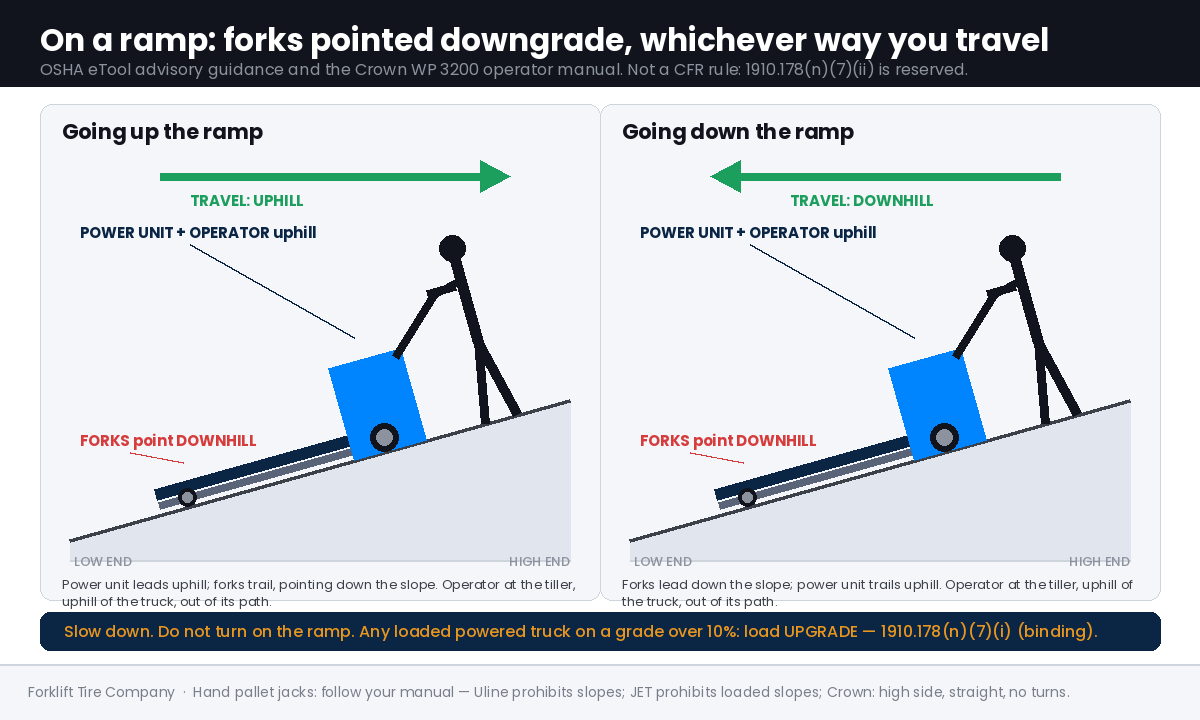
For powered trucks, 1910.178(n)(7) requires that “Grades shall be ascended or descended slowly,” and (n)(7)(i) that “When ascending or descending grades in excess of 10 percent, loaded trucks shall be driven with the load upgrade.” That is the binding text for a forklift carrying a load. The rule you may have been taught for an unloaded truck — forks downgrade — is not in the current regulation: paragraph (n)(7)(ii) is marked “[Reserved].” It lives in two other places. OSHA’s Powered Industrial Trucks eTool, which is advisory guidance and not a standard, says: “When traveling without a load, the forks should point downgrade, regardless of direction of travel,” and adds a note written for our machine: “When walking with a pallet truck with or without a load, the forks should be pointed downgrade, regardless of direction of travel.” Note what the eTool says either side of that: its general rule for a loaded truck is that “the load should point up the incline, regardless of direction of travel” — the same direction (n)(7)(i) requires. The pallet-truck note is an exception OSHA writes into its own guidance, not a rule in conflict with the regulation everywhere. The eTool also says “Never turn on a ramp or incline” and “Do not travel on ramps with slopes or other conditions that exceed the manufacturer’s recommendation.”
Crown’s walkie manual makes the eTool note a manufacturer instruction: “With or without a load, travel with the forks pointed downgrade. If a load requires that you travel with the forks upgrade, be even more careful. Operate the controls from the side of the truck. Slow down and don’t turn on ramps or grades.” And “Stay out of the path of the truck.” Follow the geometry through and the operator, standing at the tiller end, is always uphill of the truck: the power unit leads going up and trails going down.
Where the two point opposite ways — a loaded powered pallet truck on a grade over 10 percent — the regulation governs and the advisory note yields: (n)(7)(i) requires the load upgrade. Crown’s manual anticipates that case and tells you how to do it: “be even more careful. Operate the controls from the side of the truck.” That settles which way the load points, not whether the truck belongs on the grade at all: check the Max. Grade field on your capacity plate first, because neither (n)(7)(i) nor the eTool authorizes a slope the manufacturer does not.
Hand pallet jacks on a slope: three manufacturers, three answers
Uline’s rule 2 is a flat prohibition: “Do not use the truck on sloping ground.” JET prohibits it only when loaded: “Do not operate a loaded pallet truck on ramps or inclines.” Crown discourages it and then tells you how, if you must: “Avoid moving loads up or down grades, ramps or inclines,” and “When moving loads up or down grades, ramps or inclines, always work from the high side of the grade. Do not turn. Always travel straight up or down.” Crown also gives the emergency stop for a hand jack: “Should you have to make an emergency stop the truck can be stopped by rapidly lowering the load on the forks.” The strictest instruction that applies to your truck is the one that governs. If the manual says no slopes, that is the rule, whatever the truck next to it allows.
Docks and trailers
Everything in the Forklift Loading Dock Safety Guide applies to a powered pallet jack on a dock, and the manufacturers extend the same rules to hand jacks. Before anything rolls onto a trailer: “Brakes shall be set and wheel blocks shall be in place to prevent movement of trucks, trailers, or railroad cars while loading or unloading,” and the trailer floor “shall be checked for breaks and weakness before they are driven onto” (m)(7); highway trucks get chocks under the rear wheels (k)(1), and an uncoupled semitrailer may need fixed jacks “to support a semitrailer and prevent upending” (k)(3). Dockboards “shall be properly secured before they are driven over,” driven “carefully and slowly,” and “their rated capacity never exceeded” (n)(11). Keep “a safe distance … from the edge of ramps or platforms” (m)(6). Crown’s walkie manual repeats the list under “Avoid falls”: stay away from the edge, check that bridgeplates and dockboards are secure, confirm the trailer is chocked or locked to the dock, check capacities, and put jack stands under an uncoupled trailer. Crown’s hand-jack rules 7, 8, and 15 say the same thing without the paragraph numbers: keep a safe distance from dock edges and dock boards, remember that “A dock board can move or drop while you are on it,” and make sure “ramps, elevators and dock boards have sufficient capacity to handle your load and you.” That last phrase is the one a walkie operator forgets: the plate has to carry the truck, the load, and the person.
Parking and leaving the truck
For a powered pallet jack the rule is 1910.178(m)(5). When the truck is left unattended, “load engaging means shall be fully lowered, controls shall be neutralized, power shall be shut off, and brakes set. Wheels shall be blocked if the truck is parked on an incline” (m)(5)(i). “Unattended” is defined: the operator “is 25 ft. or more away from the vehicle which remains in his view, or whenever the operator leaves the vehicle and it is not in his view” (m)(5)(ii). Within 25 feet and in view, the forks still come down, controls neutralized, brakes set (m)(5)(iii). Crown’s version: “Lower the forks and turn the truck off. Avoid parking on inclines. If you must park on an incline, chock the wheels to prevent the truck from moving.”
Hand jacks have no brake, so parking is about where and how. Crown: “Park your pallet truck in a safe, level place with the handle up and forks lowered.” Uline: “Lower the forks to lowest height when the truck is not being used.” JET: “Never leave a loaded pallet truck unattended in the raised position. Always lower load to the floor.” A raised, loaded hand jack left in an aisle is the situation every one of those instructions is written to prevent. Keep it out of fire aisles and away from stairways and fire equipment, which powered trucks are required to keep clear (m)(14) and which 1910.176(a) requires of everyone.
Battery charging on electric pallet jacks
Charging is where an electric pallet jack picks up rules a hand jack never sees, and where a small truck can cause a large problem. 1910.178(g) requires that “Battery charging installations shall be located in areas designated for that purpose” (g)(1), with “Facilities … for flushing and neutralizing spilled electrolyte, for fire protection, for protecting charging apparatus from damage by trucks, and for adequate ventilation for dispersal of fumes from gassing batteries” (g)(2). Before charging, “Trucks shall be properly positioned and brake applied” (g)(8). “Smoking shall be prohibited in the charging area” (g)(10); “Tools and other metallic objects shall be kept away from the top of uncovered batteries” (g)(12); and, when batteries are being charged, “acid shall be poured into water; water shall not be poured into acid” (g)(7). Paragraph (g) does not itself require eye protection; the eTool’s advisory note is to “Always use personal protective equipment such as a face shield, rubber apron, and rubber gloves when checking electrolyte,” and eye and face protection requirements come from OSHA’s personal protective equipment standards (1910 Subpart I), not from (g). Crown’s daily check puts the operator’s hands on rules that are federal requirements: batteries charged, water level and vent caps on serviceable batteries — (g)(9) requires that “Care shall be taken to assure that vent caps are functioning” — “Don’t use an open flame to check the batteries,” which (p)(5) states as “Open flames shall not be used for checking electrolyte level in storage batteries” and (g)(11) as a duty to take “Precautions … to prevent open flames, sparks, or electric arcs in battery charging areas,” and cables and connectors free of damage and corrosion. Charging is also one of the named training topics, (l)(3)(i)(K).
Wheels and load rollers: when to replace them
A pallet jack has two sets of wheels doing two different jobs. The steer wheels sit under the handle or the power unit and take the steering and, on a walkie, the drive. The load wheels (load rollers) sit under the fork tips and carry most of the pallet. On the hand trucks cited in this guide both are polyurethane on the standard models — Uline lists 3-inch polyurethane fork wheels and 7-inch polyurethane steering wheels on its standard H-1043, and Crown’s PTH 50 brochure specifies “Tyre type Polyurethane” — while Uline’s low-profile models run 2-inch steel fork wheels under 6-inch polyurethane steer wheels. JET’s PTW-A runs 7 x 2 in steer wheels and 2-7/8 x 3-11/16 in load wheels on sealed, lifetime-lubricated ball bearings.
NIOSH treats the wheels as the variable that decides how hard a cart or pallet truck is to move. Its equipment guideline says to “Choose wheeled equipment which minimizes start forces (inertia) and reduces rolling resistance,” and lists what that depends on: the weight and shape of the load, “Type and condition of the floor surface,” the route (“slopes, obstacles”), “Type of wheels (i.e., the materials they are made of),” “Size of wheels (larger wheels a minimum of 6 inches in diameter move more easily over holes, bumps, and floor irregularities),” and — the line this section is built on — “Maintenance of wheels; it is important to clean, lubricate, and/or replace wheels on a regular basis.”
The replacement rule, from a manufacturer
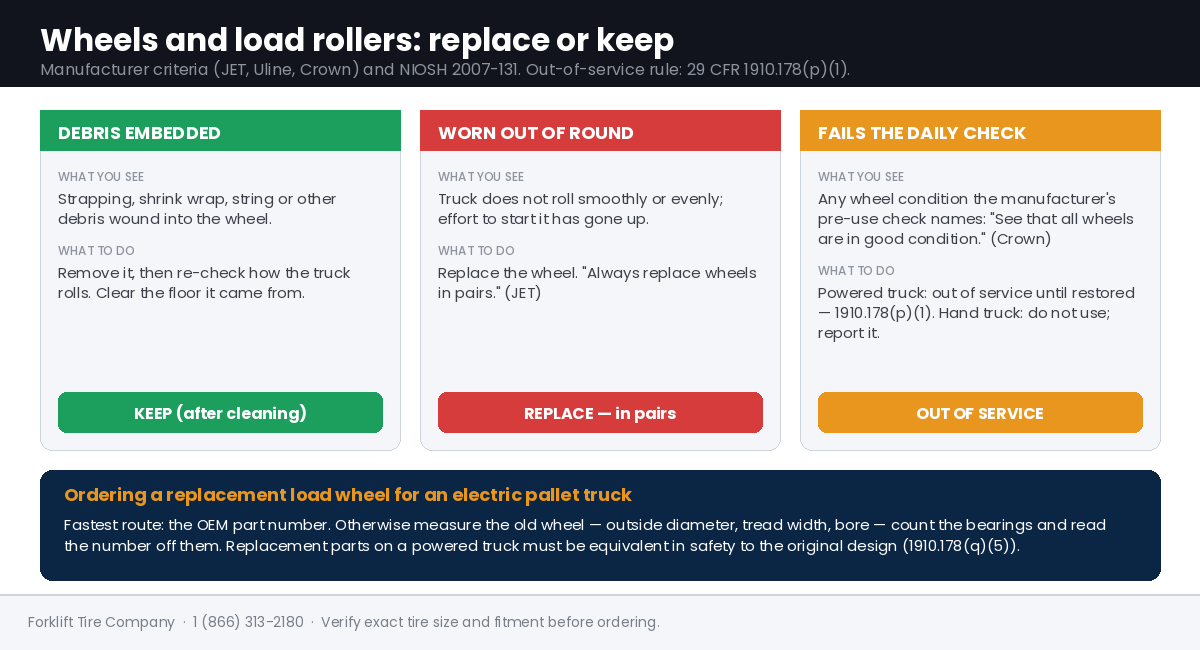
JET’s troubleshooting table gives the criterion in one row. Symptom: “Truck doesn’t roll smoothly or evenly.” Cause: “Wheels have debris embedded, or out of round due to wear.” Remedy: “Inspect and remove debris. If worn, replace wheels. NOTE: Always replace wheels in pairs.” Three things to take from that. Debris in the tread is a maintenance item, not a wear item — pick it out. A wheel worn out of round is a replacement item; it will not roll true again. And wheels are replaced in pairs, so the two load rollers (or the two steer wheels) match in diameter and the truck sits level. On a powered truck the replacement part has one more rule behind it: 1910.178(q)(5), “All parts of any such industrial truck requiring replacement shall be replaced only by parts equivalent as to safety with those used in the original design.”
| What you see or feel | What it means | What to do |
|---|---|---|
| Truck does not roll smoothly or evenly; effort to start it has gone up | Debris embedded in the wheel, or the wheel worn out of round (JET) | Remove the debris. If worn, replace — in pairs (JET) |
| Strapping, shrink wrap, string or other debris wound into the wheel or roller | Loose objects on the floor were run over (1910.178(n)(14); NIOSH p. 42) | Clear it before the next move; clear the floor it came from. Wheels: “clean, lubricate, and/or replace … on a regular basis” (NIOSH) |
| Any wheel that fails the daily check | A condition the manufacturer names in its pre-use check: “See that all wheels are in good condition” (Crown); “Pay special attention to the wheels, axles …” (Uline) | Powered truck: out of service until corrected, 1910.178(p)(1), (q)(7). Hand truck: do not use; report it |
| Replacement load wheel needed on a hand jack | Manufacturers sell the load wheel and its bearings as a kit (Uline part H-1043-WHKIT, “Replacement Fork (Load) Wheel With Bearings Kit”) | Order by the truck’s parts sheet; fit both sides |
| Unusual noise or vibration while traveling | A general operational-inspection flag, not a wheel diagnosis (OSHA eTool, advisory) | “Unusual noises or vibrations should be reported immediately” (eTool); have authorized personnel find the cause |
Finding the right replacement wheel for an electric pallet truck
On a walkie or rider pallet truck the load wheel is a machine-specific part, listed by outside diameter, tread width, and bore, and carrying a specific bearing. The OEM part number is the fastest route to the right one. Forklift Tire Company’s Forklift Load Wheels category lists polyurethane load wheels for Crown, Raymond, Yale, and Hyster electric pallet trucks by OEM part number, with the size and the bearing number on each listing — for example, Crown part 100462 is listed as “3-1/4 x 6-1/2 (2.047) Load Wheel … with bearing # 6205,” and its bearing line reads “2 x 6205 + Spacer”: a 3-1/4 in outside diameter, a 6-1/2 in tread width, a 2.047 in bore (the seat a 6205 bearing presses into — this wheel takes two of them with a spacer between), and the bearing number. If the part number has worn off the old wheel, measure it the same way: outside diameter, tread width, and bore, and count the bearings as well as reading the number stamped on them. We help confirm the match against the OEM number before you order. Verify exact tire size and fitment before ordering. For the wider family of wheels, rims, and assemblies, start at Forklift Wheels.
Where a wheel is fine but the truck still wobbles, runs hot at a hub, or wears one wheel faster than its mate, the bearing or hub is the next suspect; the same failure signs that apply on a forklift apply here, and they are covered in Wheel Hub Assembly: Components & Failure Signs.
Common pallet jack problems and what they mean
Most hand-jack complaints come down to the hydraulic unit or the wheels, and the manufacturers publish the diagnosis. The table below is condensed from JET’s troubleshooting section for its PTW-A series and Uline’s troubleshooting table and maintenance notes for the H-1043; the causes and remedies are theirs. Anything beyond adding oil, bleeding the pump, or clearing debris is a repair — on a powered truck, one that must be made “by authorized personnel” (1910.178(q)(1)).
| Problem | Likely cause (manufacturer) | Remedy (manufacturer) |
|---|---|---|
| Will not lift | Low oil in the reservoir; steel ball not seated; worn piston seals (JET). Uline adds: oil with impurities, air in the oil, or the setting screw out of position | Check for leaks at the valve and add oil; put the lever in the fork-raise position (JET: “Place the lever in the down position”) and pump the handle repeatedly to seat the ball; have seals replaced (JET). Uline: change the oil, or adjust the setting screw per its Operation section; to expel air, lift the lever to its DOWN (fork-lowering) position and pump up and down several times |
| Lowers by itself | Steel ball or relief valve not seated; worn piston seal; relief valve misadjusted; oil leaking from the valve (JET). Uline: impurities in the oil keeping the discharge valve from closing, air in the oil, worn seals, or the setting screw out of position | Bleed the pump; have seals replaced; reload within capacity and adjust the relief valve at the set screw; tighten each valve plug (JET). Uline: change the oil, expel the air, replace seals, or adjust the setting screw |
| Forks will not lower | Relief cam set screw or nut misadjusted; relief cam or chain broken; broken fork rods or linkage (JET). Uline: setting screw out of position, or a rod, cylinder, or other part deformed by a seriously unbalanced load | Adjust the relief cam per the manual; replace the broken elements; inspect linkages for breaks or cracks and replace as needed (JET). Uline: adjust the setting screw, or repair or replace the deformed part |
| Lever will not stay in neutral | Relief cam nut on the chain mispositioned (JET) | Adjust the nut on the chain assembly (JET) |
| Does not roll smoothly or evenly | Debris embedded in the wheels, or wheels out of round from wear (JET) | Remove debris; if worn, replace the wheels — always in pairs (JET) |
Neither manual publishes a “stiff linkage” diagnosis, but both put lubrication on the maintenance list. Uline’s is “Use motor oil or grease to lubricate all movable parts”; JET’s is “Lubricate pivot points on load wheel frames, as needed. Do not get oil directly on load wheels.” Uline also notes: “Do not attempt to repair the pallet truck unless you are trained and authorized to do so.”
Required vs. good practice, side by side
The left column is a federal OSHA duty for a powered pallet jack, with the paragraph. The right column is what the manufacturers and NIOSH say, which is where the rules for a manual jack live and where the powered-truck rules get their working detail. Neither column replaces your truck’s operator manual or a state-plan rule.
| Topic | Required — powered pallet jacks | Good practice — and the manual-jack rule |
|---|---|---|
| Who may operate | Trained, evaluated, and certified by the employer before operating; refresher on a different truck type; evaluation every three years — (l)(1), (l)(4), (l)(6) | “Trained and authorized” (Crown, Uline); read the manual and every label on the truck (JET) |
| Before use | Examined before being placed in service, at least daily — and after each shift where the truck runs round the clock; not used if the examination shows an unsafe condition — (q)(7) | Written checklist (not required by OSHA, but the evidence); wheels, axles, handle, forks, lift/lower (Uline); Crown’s daily safety check including braking distance |
| Defects | Out of service until restored; repairs by authorized personnel; replacement parts equivalent in safety to the original — (p)(1), (q)(1), (q)(5) | “If anything doesn’t look, work, feel, or sound right, don’t use your truck” (Crown); replace wheels in pairs (JET) |
| The load | Within rated capacity; stable or safely arranged; caution with off-center loads; long or high loads adjusted — (o)(1)–(o)(3) | Centered on the forks, not at the tips; fork length matched to the pallet; strap unstable loads (Uline, JET, NIOSH) |
| Riders and body position | No unauthorized riders; no one under the elevated portion; arms and legs inside the running lines — (m)(2)–(m)(4) | “There is no safe place to sit or stand” (Crown); feet clear of the wheels; gloves and safety shoes (Uline) |
| Traveling | Plant speed limits; three truck lengths; slow and horn at blind cross aisles; load trailing if it blocks the view; slow for wet floors; avoid loose objects; elevators approached slowly and entered squarely, then controls neutralized, power off, brakes set; load end forward into elevators — (n)(1), (n)(4), (n)(10), (n)(12), (n)(13), (n)(14) | Neutral position when maneuvering (Crown); pull to steer and see, push on straight clear runs (Crown’s pallet-truck rule; NIOSH’s push-not-pull line is carrying guidance); powered truck for heavy loads over long distances (NIOSH) |
| Grades | Slowly; on grades over 10 percent a loaded truck travels with the load upgrade; load raised only enough to clear the surface — (n)(7), (n)(7)(i), (n)(7)(iii) | Pallet truck forks pointed downgrade with or without a load, no turning on the ramp (eTool advisory; Crown WP 3200); hand jacks: no slopes (Uline), no loaded slopes (JET), or high side, straight, no turns (Crown PTH 50) |
| Docks | Trailer brakes set and wheel blocks in place; trailer floor checked; dockboards secured, crossed slowly, capacity never exceeded; safe distance from the edge — (m)(6), (m)(7), (n)(11), (k)(1), (k)(3) | Same list in Crown’s walkie manual; hand jacks: dock boards can move or drop, and capacity must cover “your load and you” (Crown PTH 50) |
| Parking | Forks fully lowered, controls neutralized, power off, brakes set; wheels blocked on an incline; 25-ft unattended rule — (m)(5) | Level place, handle up, forks down (Crown PTH 50); never leave a loaded truck raised (JET) |
| Charging | Designated area with spill, fire, ventilation, and impact protection; truck positioned and brake applied; vent caps functioning; no smoking; precautions against open flames, sparks, and arcs; no metal on open batteries; no open flame to check electrolyte — (g)(1), (g)(2), (g)(8), (g)(9), (g)(10), (g)(11), (g)(12), (p)(5) | Face shield, rubber apron, and gloves when checking electrolyte (eTool advisory); Crown repeats the open-flame and vent-cap rules at the operator’s level |
Frequently asked questions
Does OSHA require training or certification to use a manual pallet jack?
Not under the powered industrial truck standard. 29 CFR 1910.178 covers trucks powered by electric motors or internal combustion engines, and OSHA applies a design test: a powered industrial truck is a power-driven vehicle designed to carry, push, pull, lift, stack, or tier material. A hand-pumped pallet jack is not power-driven, so the operator training and certification rules at 1910.178(l) do not reach it. That is a reading of the regulation text and OSHA’s stated test; OSHA has not issued an interpretation letter on manual pallet jacks. The General Duty Clause, 1910.176 (materials handling), and 1910.22 (walking-working surfaces) still apply, and the manufacturers of hand pallet trucks tell employers to let only trained and authorized people operate them.
Do you need to be certified to operate an electric pallet jack?
Yes. An electric walkie, walkie-rider, or rider pallet jack is a motorized hand truck, which 1910.178(a)(1) names expressly, so 1910.178(l) applies in full: formal instruction, practical training, and an evaluation in the workplace before the operator is allowed to use the truck, an evaluation at least every three years, refresher training when the operator is assigned to a different type of truck, and a certification record kept by the employer with the operator’s name, the training and evaluation dates, and the trainer’s identity. The certification is the employer’s, not OSHA’s and not a course provider’s.
Does OSHA require a daily inspection of a pallet jack?
For a powered pallet jack, yes: 1910.178(q)(7) requires that the truck be examined before being placed in service, at least daily, and after each shift where trucks run around the clock, and that it not be used if the examination shows any condition adversely affecting safety. OSHA has said in an interpretation letter that the examination does not have to be recorded on a written checklist, although employers may require one. A manual pallet jack is outside 1910.178; its manufacturers publish a daily check that names the wheels, axles, handle, forks, and lift and lower control.
Should the forks point uphill or downhill on a ramp?
For a pallet truck, downhill, whether or not it is carrying a load and whichever direction you are traveling. That rule comes from OSHA’s Powered Industrial Trucks eTool, which is advisory guidance, and from manufacturer manuals such as Crown’s WP 3200 Series operator manual. It is not in the regulation: 1910.178(n)(7)(ii) is reserved. The binding regulation text for powered trucks is 1910.178(n)(7), grades ascended or descended slowly, and (n)(7)(i), a loaded truck driven with the load upgrade on grades over 10 percent. For hand pallet jacks, follow your manual; Uline prohibits use on sloping ground, JET prohibits it when loaded, and Crown says to avoid it and, if you must, to work from the high side and travel straight up or down without turning.
Can you ride on a pallet jack?
Only on a truck built for it, in the place built for it. 1910.178(m)(3) prohibits unauthorized personnel from riding on powered industrial trucks and requires a safe place to ride where riding is authorized; a rider pallet truck has an operator platform, a walkie does not. Crown’s walkie manual says never to ride on the truck or let anyone ride on the truck or load because there is no safe place to sit or stand, its hand pallet truck rules say not to use the truck as a scooter or permit riders, and JET says not to transport persons with a pallet truck.
Should you push or pull a pallet jack?
The ergonomic answer and the machine answer are different. NIOSH’s ergonomic guidelines for manual material handling say to push instead of pull when there is a choice, and to use both hands, but that line sits in the guidance on safer carrying, and the same document’s hand pallet truck page does not repeat it. Crown’s hand pallet truck instructions give the machine-specific rule: pull rather than push on long-distance moves because it is easier to see where you are going and easier to steer. A workable rule is to pull when you need to steer or see past the load, and to push on straight runs where the path is clear, keeping the lever in neutral while moving. NIOSH also says hand pallet trucks are for short distances and low forces, and that heavy loads over long distances call for a powered pallet truck.
When should pallet jack wheels be replaced?
When they are worn out of round, or when the truck no longer rolls smoothly and clearing embedded debris does not fix it. That is the criterion JET publishes in its pallet truck troubleshooting table, with the instruction to always replace wheels in pairs. NIOSH lists wheel maintenance, cleaning, lubricating, and replacing wheels on a regular basis, as one of the factors that decide how much force a wheeled truck takes to move. On a powered pallet jack, any wheel condition that fails the pre-use examination takes the truck out of service until it is corrected, and replacement parts must be equivalent in safety to the original design under 1910.178(q)(5).
Getting the wheels right
A pallet jack that is hard to start, pulls to one side, or thumps on every revolution is usually telling you about its wheels before it tells you about anything else. Forklift Tire Company lists polyurethane load wheels for Crown, Raymond, Yale, and Hyster electric pallet trucks by OEM part number, with the bearing number on every listing, and the wider range of forklift wheels, rims, and assemblies alongside them. Call 1 (866) 313-2180 with the OEM part number, or the diameter, width, and bearing number off the old wheel, and we will help confirm the match before you order. Verify exact tire size and fitment before ordering. Anything touching a powered truck’s capacity rating, a modification, or a conflict between the plate and what is fitted goes to the OEM or an authorized service provider — that is their call, not ours.
Sources
Primary sources, retrieved 14 September 2026. Regulatory text is quoted from the current Code of Federal Regulations; manufacturer text from the manufacturers’ own published manuals and specification sheets.
- 29 CFR 1910.178, Powered industrial trucks — eCFR. Paragraphs (a), (g), (k), (l), (m), (n), (o), (p), (q).
- 29 CFR 1910.176, Handling materials — general — eCFR.
- 29 CFR 1910.22, Walking-working surfaces: general requirements — eCFR.
- OSH Act of 1970, Section 5, Duties (General Duty Clause) — OSHA.
- OSHA letter of interpretation, June 27, 2011 — design, not use, determines whether a vehicle is a powered industrial truck.
- OSHA letter of interpretation, September 19, 2023, Powered Industrial Trucks — applies the design test to electric equipment; quotes the 2011 letter.
- OSHA letter of interpretation, July 13, 2006, applicability of 1910.178 to pick-up trucks.
- OSHA interpretation letters indexed to 1910.178(a)(1) — the complete list (two letters).
- OSHA letter of interpretation, May 9, 2000, pre-operation examinations need not be written.
- OSHA letter of interpretation, March 3, 2005, inspection of trucks not used for significant periods.
- Powered Industrial Truck Operator Training; Final Rule, 63 FR 66237 (December 1, 1998) — preamble: definition, truck classes, and scope.
- OSHA CPL 02-01-028, Compliance Assistance for the Powered Industrial Truck Operator Training Standards.
- OSHA 3889-09, Powered Industrial Truck Training, TWI Bulletin No. 7 (2016).
- OSHA Powered Industrial Trucks eTool, Ramps and Grades — advisory guidance.
- OSHA Powered Industrial Trucks eTool, Pre-Operation — advisory guidance.
- OSHA Powered Industrial Trucks eTool, Types — advisory guidance; Class III, electric motor hand trucks or hand/rider trucks.
- ITSDF, B56 Standards — scope statements for ANSI/ITSDF B56.1-2020, B56.10-2019, and B56.10-2025 (effective December 17, 2026).
- California Code of Regulations, Title 8, §3650, Industrial Trucks. General. — Cal/OSHA.
- Ergonomic Guidelines for Manual Material Handling, DHHS (NIOSH) Publication No. 2007-131 — pp. 31, 36, 42.
- Crown PTH 50 Series hand pallet truck, Operator Instructions — PF10140-1/-2 Rev. 12/06.
- Crown WP 3200 Series walkie pallet truck, Operator Manual — 600106-200-001 Rev. A.
- Crown PE 4000 Series, Operator Manual and Crown WP 2000 Series, Operator Manual.
- Crown PTH 50 hand pallet truck specifications and Crown PTH 50S Series specifications — polyurethane steer and load wheels.
- Uline Pallet Trucks instruction sheet IH-1043 (rev. 12/2024) and H-1043 parts sheet PH-1043 (rev. 10/2024).
- JET PTW-A Series Pallet Trucks, Operating Instructions and Parts Manual M-141170, Edition 2 (04/2020) — safety instructions, specifications, and troubleshooting.
This guide is general educational information from Forklift Tire Company, not a substitute for OSHA-compliant, employer-provided training, a compliance review, your state plan’s rules, or your equipment’s operator manual and capacity plate. Where a manufacturer’s instruction is stricter than anything here, the manufacturer’s instruction governs.