 1 (866) 313-2180
 SALES@FORKLIFTTIRE.COM


Posted by Forklift Tire Company on 23rd Jun 2026
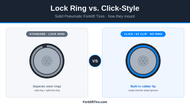
If you run solid pneumatic (resilient solid) forklift tires, there are two ways they attach to the wheel — and ordering the wrong one is one of the most common, most avoidable mistakes in industrial tire buying. A regular (standard) solid pneumatic tire is held on by separate steel hardware, including a lock ring. A click-style tire — also sold as clip, lip, EZ Clip, SIT, or LOC — has the locking feature built into the rubber, so it snaps onto the wheel with no lock ring at all.
Both are solid rubber, both are flat-proof, and both are pressed onto the wheel with a hydraulic press. The difference is the mounting system — and it decides which tire fits your wheel, how fast a tire change goes, and how many loose steel parts your technician has to handle. This guide breaks down exactly how the two differ, how to tell which one your forklift uses, and how to order the right tire the first time.
The short answer
- Standard / lock-ring tire: Pressed onto the wheel, then locked in place with separate steel hardware — a side ring and a lock ring (plus an advance band on many sizes). More parts, more steps.
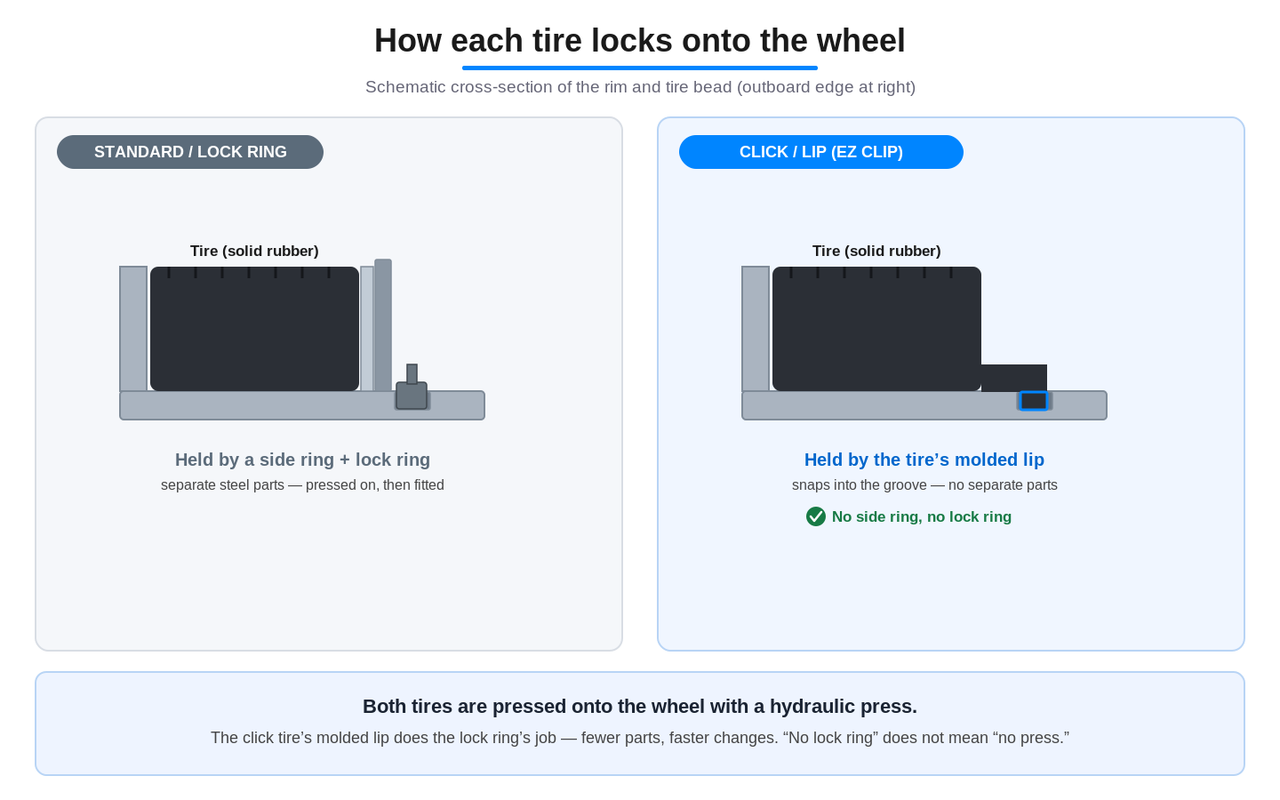
- Click / lip-style tire (EZ Clip, clip, SIT, LOC): A reinforced rubber lip is molded into the tire bead. During pressing, that lip "clicks" into the wheel's groove and holds the tire — no separate lock ring. Fewer parts, faster changeover.
- What's the same: Both are solid resilient tires, both still require an industrial tire press to install, and both deliver the same construction, toughness, and wear life.
- Why it matters: The tire has to match your wheel. Before ordering, confirm your size, your rim width, and whether you want the standard or click version for that fitment.
On this page
First, what is a solid pneumatic tire?
A solid pneumatic tire — more precisely called a resilient solid tire — is solid rubber shaped like an air (pneumatic) tire so it mounts on the same style of wheel. There is no air, no inner tube, and no possibility of a flat. The "pneumatic" in the name refers to the shape and the wheel it mounts on, not to air inside. (If you're still deciding between air-filled and solid construction in the first place, start with solid vs. pneumatic forklift tires.)
Resilient solid tires ride on multi-piece industrial wheels — the same wheel family used for air pneumatic tires. That is the key context for this whole discussion: the standard and click systems are two different ways of securing a solid tire onto that family of wheels. You can browse every size and both constructions on the solid & pneumatic forklift tire category.
The two mounting systems at a glance
Held on by steel rings
- Secured by a separate side ring + lock ring (and an advance band on many sizes)
- Pressed on, then the rings are fitted and seated
- More loose steel parts to remove, inspect, and reinstall
- Available in the full range of sizes
- Best for: standard replacement and the widest size coverage
Locks itself into the wheel
- A reinforced rubber lip molded into the tire snaps into the wheel groove
- Pressed on — the lip replaces the steel lock ring
- No separate lock ring or side ring to handle
- Offered in select sizes — confirm availability
- Best for: fleets that change tires often and want faster swaps
Regular (standard / lock-ring) solid pneumatic tires
This is the traditional mounting system, and it's still the most common. The tire is pressed onto the wheel, and then separate steel components lock it in place. On a typical multi-piece industrial wheel, that hardware is:
- Advance band — a spacer ring fitted after the tire is pressed down to the rim edge (used on many, not all, sizes).
- Side ring — the removable flange that closes the open side of the wheel.
- Lock ring — the split steel ring that seats into a groove in the wheel and holds the side ring and tire assembly together.
To install one, a technician greases the rim and tire, presses the tire onto the wheel, fits the advance band, then positions and seats the side ring and lock ring with the press and the correct tools — a multi-step sequence that ends with a careful check that every ring is fully and correctly seated.
Standard solid tires actually run on two related multi-piece wheel families, and which one a given size uses is largely a function of size: lock-ring wheels (a side ring and lock ring secure the tire) and split, or two-piece, wheels (the tire is captured between two rim halves that bolt together — the tire is pressed onto one half and the other half is drawn down to meet it, then bolted in place). Either way, the common thread is the same: separate steel components — not the tire — hold everything together.
Strengths: Standard tires and lock-ring wheels are the industrial baseline — widely stocked, available in the full range of sizes, and the wheels are reusable across many tire changes.
Trade-offs: More loose steel parts to remove, inspect, store, and reinstall on every change. More steps means more time per tire and more opportunity for an incorrectly seated ring if the work isn't done by a trained technician.
Click / lip-style solid pneumatic tires (no lock ring)
Click-style tires solve the same problem a different way: instead of a separate lock ring, the locking feature is built directly into the tire. A reinforced rubber lip is molded into the bead, and when the tire is pressed onto the wheel, that lip snaps into the wheel's groove — the same groove a steel lock ring would normally sit in. You hear and feel it "click" into place, which is where the name comes from.
Because the locking function lives in the tire, there is no separate lock ring or side ring to handle. The changeover has fewer parts and fewer steps, which is the entire point of the design: faster, cleaner tire changes and fewer loose components to lose or mis-install.
You'll see this same snap-in design sold under many names — they all refer to the same basic idea:
- Click, clip, or lip tire
- EZ Clip (Trelleborg's name for it)
- SIT (Snap-In Tire) or LOC
- Halo or Fast-fit
A quick note on names: a few manufacturers offer their own no-lock-ring solid tires under other labels — for example, Camso's Quick Heel — and the exact locking geometry can vary slightly by brand. The goal is always the same (eliminate the separate lock ring), but because the lip and groove are matched to each system, you should confirm the specific tire is made for your wheel rather than assume every "quick" or "clip" tire is interchangeable.
The #1 misconception: "no lock ring" does not mean "no press."
A click-style solid tire still has to be pressed onto the wheel with a hydraulic tire press; the built-in lip simply replaces the separate steel ring once it's pressed home. The time savings come from handling fewer parts, not from skipping the press. The only way to avoid pressing entirely is to order a pre-mounted tire-and-wheel assembly.
Standard vs. click: side-by-side comparison
| Feature | Standard / Lock-Ring | Click / Lip Style (EZ Clip, SIT, LOC) |
|---|---|---|
| How the tire is secured | Separate steel lock ring (plus side ring / advance band) | Reinforced rubber lip molded into the tire, snaps into the wheel groove |
| Separate hardware to handle | Yes — multiple loose steel rings | No separate lock ring or side ring |
| Install / changeover steps | More steps per tire | Fewer steps — faster swap |
| Hydraulic press required? | Yes | Yes (the lip still has to be pressed into the groove) |
| Construction & wear life | Solid resilient rubber | Same — identical rubber, toughness, and wear life |
| Flat / puncture risk | None | None |
| Wheel type | Lock-ring or split multi-piece wheel | Lock-ring-style wheel with a matching groove (no ring installed) |
| Size availability | Full range of sizes | Offered in select sizes — confirm your size |
| Best for | Standard replacement; widest stock and size coverage | Fleets that change tires often and want faster, lower-hassle swaps |
Three things that are often misunderstood
1. Click tires still need a press. The only mounting option that skips the press is a pre-mounted tire-and-wheel assembly (more on that below). Both standard and click resilient tires are pressed on with an industrial press.
2. Solid tires don't carry the "exploding ring" risk of air tires. The well-known danger associated with multi-piece rims comes from inflating an air tire — which is why air (pneumatic) tires are inflated inside a tire cage or safety restraint, so a sudden release of air and rings is contained. A solid resilient tire holds no air, so that specific hazard doesn't apply. With solids, the safety focus is the high-force press operation, which is why tire changes should be done by a trained technician.
3. Click tires aren't "better rubber." The compound, tread, and durability of a click tire are the same as the standard version. You are choosing a mounting system, not a different grade of tire.
How to tell which one your forklift uses
You don't need the spec sheet — you can usually tell by looking at the wheel and the current tire:
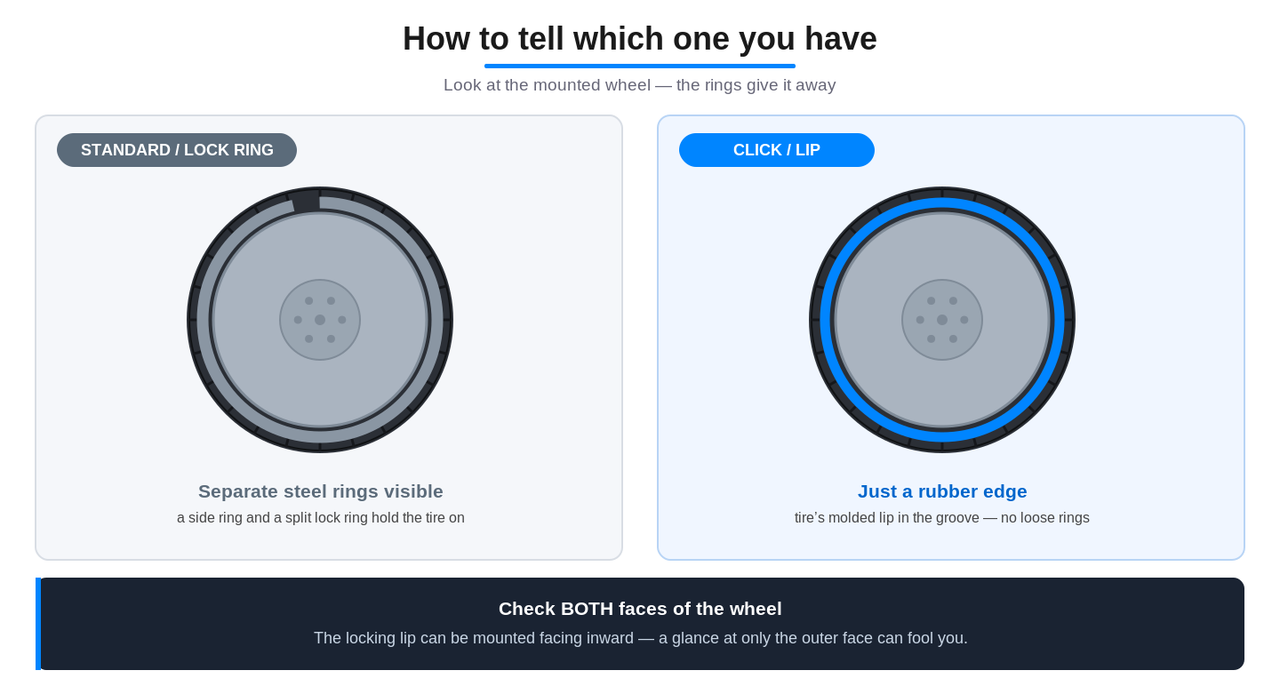
- ✓Look for steel rings. If you see a separate side ring and a split lock ring securing the tire to the wheel, you have a standard / lock-ring setup.
- ✓No rings, just a rubber edge in the groove? If the tire is held by its own molded lip seated in the wheel groove — with no loose steel rings — you have a click / lip-style tire.
- ✓Check both faces. Inspect the inside of the wheel as well as the outside. The locking feature is on one side and can be mounted facing inward, so a quick glance at only the outer face can fool you.
- ✓Read the sidewall and rim. Confirm the tire size (for example 300x15 or 28x9-15) and the rim width. Not sure how to read it? See how to read forklift tire sizes.
When in doubt, take clear photos of the wheel from both sides and have a specialist confirm it before you order.
Can you switch between standard and click?
Click-style tires are designed to seat into the lock-ring groove of a lock-ring-style wheel — the same wheel family that accepts standard tires. In practice, that means a fleet running lock-ring wheels can often move to a click tire for faster changes, and you choose one system per tire: a standard tire secured by rings, or a click tire secured by its built-in lip.
That said, fitment is specific. Before switching, confirm three things: (1) the click tire is offered in your exact size and rim width, (2) it's rated for your wheel, and (3) your wheel has the groove the lip seats into. Click versions are produced in a narrower size range than standard tires, so availability — not preference — often makes the decision. As always, verify exact tire size and fitment before ordering.
Want to skip the press entirely? Order an assembly
If you'd rather not press tires at all, the cleanest option is a pre-mounted tire-and-wheel assembly. The tire is already pressed onto an industrial wheel at the supplier, so you receive a complete, ready-to-bolt-on unit — no press, no rings, no guesswork on the shop floor. Browse solid forklift tire & wheel assemblies, or if you only need the wheel itself, see replacement forklift wheels.
For everything else — pressing a standard tire on a lock-ring wheel — see our quick walkthrough on how to press a forklift tire, and always have a trained technician do the work.
How to order the right tire the first time
Run this short checklist before you buy:
- ✓Tire size — confirm it from the sidewall (e.g., 300x15 / 3.00-15, or 28x9-15).
- ✓Rim width — solid resilient sizes are listed with the rim width (e.g., 300x15-8.00″).
- ✓Mounting system — standard (lock ring) or click/lip — match what your wheel uses, or confirm a switch is supported.
- ✓Compound — black rubber for general use, or non-marking for clean-floor environments.
- ✓Or go press-free — choose a complete tire-and-wheel assembly.
Ready to shop?
Shop Solid & Pneumatic Tires by Size Open the Forklift Tire Buying Guide
Save 7.5% on 2–3 items | Save 15% on 4+ items — automatic discount in cart. Free ground freight to commercial addresses in the contiguous U.S.
Verify exact tire size and fitment before ordering. If you're not sure whether your forklift uses a lock-ring or click-style wheel, contact our team, call 1 (866) 313-2180, or text photos of your wheel (both sides) and your tire size to (310) 341-4694 and we'll confirm the right fit before you order. Just changed your tires? Show us your machine in the Operator Gallery.
Frequently Asked Questions
What is a click-style (EZ Clip) forklift tire?
A click-style solid pneumatic tire has a reinforced rubber lip molded into the bead that snaps into the wheel's groove during pressing, holding the tire without a separate steel lock ring. It's also sold as clip, lip, EZ Clip, SIT (Snap-In Tire), or LOC. The rubber, tread, and wear life are the same as a standard resilient solid tire — only the mounting system is different.
Do click / EZ Clip tires still need a tire press?
Yes. A click-style tire still has to be pressed onto the wheel with a hydraulic tire press; the built-in lip then locks into the wheel groove instead of a separate lock ring. The advantage is fewer parts and fewer steps per change, not skipping the press. The only way to avoid pressing is to order a pre-mounted tire-and-wheel assembly.
What's the difference between a standard and a click solid pneumatic tire?
A standard tire is secured to the wheel with separate steel hardware — typically a side ring and a lock ring (plus an advance band on many sizes). A click tire replaces that hardware with a rubber lip molded into the tire that snaps into the wheel groove. Both are solid, flat-proof, and pressed on; the click system is faster to change because there are fewer loose parts.
How do I know if my forklift wheel uses a lock ring?
Look at the wheel. If a separate split steel ring (and side ring) holds the tire on, it's a lock-ring (standard) wheel. If the tire is held only by its own molded rubber lip seated in the wheel groove, with no loose rings, it's a click/lip-style tire. Check both the inside and outside faces of the wheel, because the locking feature can face inward. If you're unsure, send photos of both sides to our team before ordering.
Can I put a click tire on a lock-ring wheel?
Click-style tires are designed to seat into the lock-ring groove of a lock-ring-style wheel, so many fleets running lock-ring wheels can switch to click tires for faster changes. But fitment is specific: confirm the click tire is offered in your exact size and rim width and is rated for your wheel. Click versions are made in a narrower size range than standard tires, so availability often decides it. Verify exact tire size and fitment before ordering.
Are click tires more expensive or lower quality than standard tires?
Click tires use the same compound, tread, and construction as the standard version, so durability and wear life are the same — you're choosing a mounting system, not a different grade of tire. Pricing varies by brand and size; the real value of the click system is lower labor and downtime on each tire change.
Are solid pneumatic tires dangerous to mount like split-rim air tires?
The "exploding ring" hazard people associate with multi-piece rims comes from inflating an air tire, which is why air pneumatic tires are inflated inside a tire cage or safety restraint. Solid resilient tires — standard or click — hold no air, so that specific hazard doesn't apply. The main safety consideration with solids is the high-force press operation, which is why tire changes should always be handled by a trained technician.