 1 (866) 313-2180
 SALES@FORKLIFTTIRE.COM


Posted by Forklift Tire Company on 28th Apr 2026
Forklift tire sizes don’t look like car tire sizes. They don’t look like truck tire sizes. And to make it harder, the same physical tire can be printed in three different formats depending on the manufacturer and the era the tire was molded. The result is predictable: buyers read the sidewall, type a best guess into a search box, and order the wrong tire. This is the single most common reason forklift tires come back in a return box.
This guide shows you exactly how to decode every number on a forklift tire sidewall, in every format you’re likely to see, so you can order the correct replacement the first time. If you already know your size, skip to the size pages linked at the bottom. If you don’t, read through once and you’ll have it for the rest of your career.
The three formats you’ll see on a forklift tire
Forklift tires use three sidewall conventions:
- Three-number format — e.g.
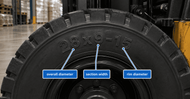
21x8-9or28x9-15. Read as overall diameter × section width – rim diameter, all in inches. - Standard dash format — e.g.
7.00-12or6.00-9. Read as section width – rim diameter, both in inches. Overall diameter is inferred from standard tables. - Metric format — e.g.
200/50-10or225/75-15. Read as section width in millimeters / aspect ratio – rim diameter in inches. Less common on forklifts, more common on warehouse equipment like scissor lifts and scrubbers.
Press-on tires add one more dimension — the band inner diameter (the ID of the steel band the rubber is bonded to) — which we’ll cover separately.
Format 1: Three-number (D × W – R)
When you see a size like 28x9-15, every number has a specific meaning:
| Position | Example | What it means | Unit |
|---|---|---|---|
| First | 28 | Overall tire diameter when new | Inches |
| Second | 9 | Section width (tire width when new) | Inches |
| Third | 15 | Rim diameter (the metal rim the tire mounts to) | Inches |
So a 28x9-15 tire is a forklift tire that stands 28 inches tall, measures 9 inches wide across the tread, and mounts on a 15-inch rim.
This format is the most buyer-friendly because every number is a measurable dimension. If you can measure a tire with a tape and you know the rim size from the wheel, you can identify a three-number size confidently. See our 28x9-15 forklift tires page for an example of how we organize the catalog by this format.
Format 2: Standard dash (W.WW – R)
When you see 7.00-12 or 6.00-9, only two numbers are printed — and neither one is the overall diameter:
| Position | Example | What it means | Unit |
|---|---|---|---|
| First | 7.00 | Section width | Inches |
| Second | 12 | Rim diameter | Inches |
The first number is the section width (not the overall diameter). The second number is the rim. You get the overall diameter from a standard table — 7.00-12, for example, has a nominal overall diameter around 27 inches.
This is the format that trips up first-time buyers the most. If you assume 7.00-12 means 7 inches tall, you’ll order a dramatically wrong part. Don’t try to infer the first number — if the tire is printed in this format, trust the format and use the rim diameter as your anchor. Our 7.00-12 forklift tires page holds every construction option at that size.
Popular standard-dash sizes in our catalog:
- 6.00-9 forklift tires — one of the most common solid pneumatic sizes for warehouse LPG and diesel lifts
- 7.00-12 forklift tires — second most common solid pneumatic size
- 5.00-8 forklift tires — common steer size for 4,000–5,000 lb lifts
- 2.50-15 forklift tires — common drive size on pneumatic-frame lifts
- 3.00-15 forklift tires — common drive size on larger pneumatic-frame lifts
- 10.00-20 forklift tires — large outdoor lift truck size
- 12.00-20 forklift tires — heavy container handler size
Format 3: Metric (W / AR – R)
When you see 200/50-10, the format is:
| Position | Example | What it means | Unit |
|---|---|---|---|
| First | 200 | Section width | Millimeters |
| Second (after slash) | 50 | Aspect ratio: sidewall height as a percentage of section width | — |
| Third (after dash) | 10 | Rim diameter | Inches |
You'll see this format more on scissor lifts, floor scrubbers, and specialty warehouse equipment than on traditional forklifts. It's readable once you know that 200 means 200 mm (about 7.9 inches) and 50 means the sidewall height is 50% of 200 mm (100 mm, about 3.9 inches). Overall diameter is (sidewall × 2) + rim diameter, so 200/50-10 is roughly (100 × 2) + 254 mm = 454 mm, or about 18 inches. (Manufacturer specs for this size typically list 456 mm / 18.0 inches — the small difference is due to rounding in the formula.)
If you need to cross-reference a metric size into a standard-format product page, our forklift tire conversion chart has every common crossover in one table.
Press-on tires: the extra dimension
Press-on tires — the rubber or polyurethane tires molded onto a steel mounting band — carry one extra number: the band inner diameter (ID). A press-on size like 18x8x12-1/8 reads as:
| Position | Example | What it means |
|---|---|---|
| First | 18 | Overall diameter (in) |
| Second | 8 | Width of tire and steel band (in) |
| Third | 12-1/8 | Band inner diameter (in) |
The band ID matters because it has to match the hub it presses onto. Even a 1/8-inch difference in band ID can be the difference between a tire that installs cleanly and a tire that won't seat at all. When you're ordering press-on tires, treat the band ID as a non-negotiable verification step.
Browse our full press-on forklift tires category to see how band IDs are organized, or go straight to the forklift tire buying guide to compare cushion rubber and polyurethane constructions.
Where to find the size on your existing tire
- Molded into the sidewall — the tire size is almost always molded raised or recessed on the outer sidewall. On worn tires, rub the sidewall clean with a rag to make it legible.
- Stamped into a white paint mark — some OE tires have a white paint marker with the size over the molded print. Confirm both match.
- On the rim tag or wheel spec — if the sidewall is unreadable, the wheel itself will have a stamped rim size that gives you the last number.
- On the forklift's data plate (nameplate) — the manufacturer's data plate typically lists the tire size and type the truck was built to use. Look near the operator controls.
- In the operator or parts manual — the last place to look, but sometimes the only readable source if you've inherited a machine with worn-out tires.
If none of the above is legible, measure the tire: overall diameter, section width, and rim diameter, all in inches, with a tape measure across a tire that is unloaded (and inflated, if it's an air pneumatic tire). Send the three numbers to the FTC fitment team and we'll translate them into a part.
Three things to verify before you order
- Match the format, not your mental picture. If the sidewall is printed in standard-dash format, don't translate it into three-number format in your head and then search on that. Search on what's actually printed.
- Verify exact tire size and fitment before ordering. Sidewall wear and molding wear can make numbers ambiguous. When in doubt, send a photo.
- Check drive vs. steer. Many forklifts run different sizes front and rear. Confirm you're ordering the size for the axle you need.
For a step-by-step walkthrough of the full order process — from identifying size to choosing construction to verifying fitment — read the forklift tire buying guide.
Know your size? Shop it directly.
We stock every forklift tire size above as a dedicated product page. Save 7.5% on 2–3 items or 15% on 4+ items (automatic discount in cart). Free ground freight to commercial addresses in the contiguous U.S.
Still not sure?
Send us a clear photo of your sidewall and we'll confirm the exact size for you. 1 (866) 313-2180 or the FTC fitment team.
Frequently asked questions
What does the first number on a forklift tire sidewall mean?
It depends on the format. On three-number sizes like 28x9-15, the first number is the overall diameter in inches. On standard-dash sizes like 7.00-12, the first number is the section width in inches, not the diameter. On metric sizes like 200/50-10, the first number is the section width in millimeters.
How do I measure a forklift tire if the sidewall is worn?
Measure three dimensions with a tape: overall diameter (top of tread to bottom of tread), section width (across the widest point), and rim diameter (across the metal rim). Call 1 (866) 313-2180 with those three numbers and the fitment team will identify the part.
Are forklift tires printed in inches or millimeters?
Most forklift tires are printed in inches (standard dash and three-number formats). Metric format (W/AR-R) is more common on scissor lifts, floor scrubbers, and specialty warehouse equipment than on traditional forklifts.
What's the band inner diameter on a press-on tire?
It's the inner diameter of the steel band the rubber is bonded to — the hole that presses onto the forklift hub. On press-on sizes written as 18x8x12-1/8, the 12-1/8 is the band ID. Even a 1/8-inch mismatch will prevent the tire from seating.
Can the drive tire and steer tire be different sizes?
Yes, very often. Forklifts routinely run one size on the drive axle and a smaller size on the steer axle. Verify both before ordering a full set.