 1 (866) 313-2180
 SALES@FORKLIFTTIRE.COM


Posted by Forklift Tire Company Inc on 14th Apr 2026
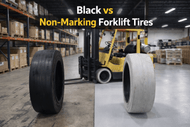
Most forklift tire orders start with a size. The compound — black rubber or non-marking — is the decision that trips up first-time buyers. The tires install identically. They look nearly identical in a spec sheet. But they don't behave the same way on sensitive floors, and the wrong choice can mean visible tire marks on the exact surfaces your facility is trying to keep clean.
If you run indoors on sealed concrete, epoxy coatings, food manufacturing floors, or anywhere floor appearance matters to customers, auditors, or plant management, the wrong compound shows up fast. This guide explains what actually differs between black rubber and non-marking forklift tires, when each one belongs in service, and how to match the right tire to your floor before you order.
What "non-marking" actually means
Non-marking forklift tires are formulated with little or no carbon black — the reinforcing filler that gives standard tires their deep black color and, when the compound scuffs or pivots, their dark streaks on concrete and epoxy. In place of carbon black, non-marking compounds typically use lighter fillers like silica. Toyota and Camso both describe their non-marking compounds this way. The result is a grey or off-white tire — you'll sometimes see it called "white non-marking" — that behaves similarly to a standard rubber tire in day-to-day use but doesn't leave visible marks when it scuffs or pivots.
Non-marking is a compound decision, not a construction decision. Manufacturers like Camso and Trelleborg build non-marking versions across cushion press-on, polyurethane press-on, and solid pneumatic lines. See our forklift tire types explained guide for how those constructions differ at the build level — this article focuses on the compound choice.
Black rubber: usually the lower-cost, more abuse-tolerant default
Black rubber is the default on most forklift fleets for one simple reason: it's usually the lower-cost, more abuse-tolerant option. Carbon black reinforces the rubber, and manufacturers including Toyota note that standard black compounds generally carry a lower purchase price and longer wear life in the budget and mid-range tiers. If your forklifts run outdoors on asphalt, move between a dock and a yard, work on rough concrete, or stack long shifts at high duty cycles, black rubber is almost always the cheaper tire to run per hour.
Black rubber also shrugs off dragged pallets, steel swarf, broken glass, and curb strikes better than most non-marking compounds at the same price point. On docks, receiving areas, scrap handling, and recycling operations, that extra abrasion and impact tolerance matters more than the floor mark.
Non-marking: built to protect clean floors
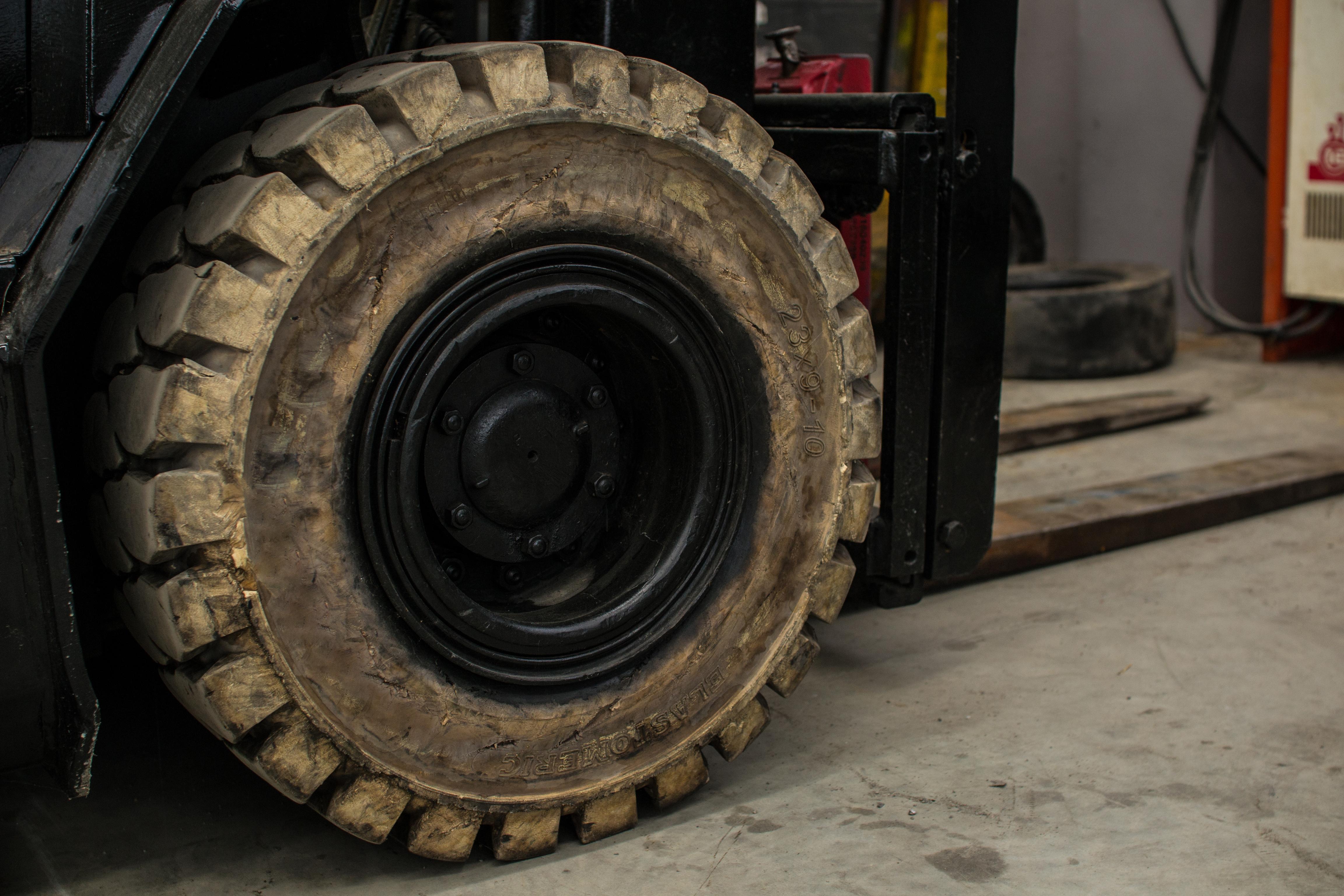
Non-marking tires exist to solve one problem: visible tire marks on floors where marks are unacceptable. That covers polished or sealed concrete in new warehouses, epoxy-coated floors in food manufacturing and clean distribution, painted aisle stripes in DCs, and any facility where an auditor, a customer, or a plant manager will judge the floor.
A secondary benefit: non-marking compounds shed less black particulate as they scuff, which matters in food manufacturing, pharmaceuticals, paper and printing, textile, and indoor agriculture — anywhere airborne black dust can contaminate product or land on surfaces that have to stay visibly clean.
The tradeoffs are real, but they aren't universal. Non-marking compounds typically cost more per tire than a comparable black rubber in the same size and construction. Entry-level non-marking lines can also wear faster on abrasive surfaces and run warmer under long continuous cycles. That said, premium non-marking compounds from manufacturers like Trelleborg and Camso are engineered specifically for high-intensity indoor use — with improved wear, rolling resistance, and heat handling — so blanket claims that "non-marking always wears faster" or "always runs hotter" don't hold up across every brand and line. The right comparison is between specific products, not categories. If you're weighing an upgrade, ask the fitment team to line up the exact black rubber vs. non-marking options in the size you need and compare spec sheets directly.
One more thing to know: static buildup
Carbon black is mildly conductive. Removing it can reduce a tire's ability to bleed static charge to the floor, and in high-intensity indoor operations or sensitive environments, non-marking tires can build up more measurable static than their black-rubber equivalents. Manufacturers including Camso offer anti-static (ESD-controlled) non-marking variants specifically for this reason. If you handle electronics, fuels, solvents, explosives, or operate in an ESD-controlled space, ask the fitment team about an anti-static non-marking compound before you order.
How to decide: a floor-by-floor walkthrough
| Your floor | Typical operation | Recommended compound | Why |
|---|---|---|---|
| Sealed or polished concrete (warehouse) | Indoor pallet handling, medium duty | Non-marking | Black rubber leaves visible aisle marks under braking and pivots |
| Epoxy-coated concrete | Food manufacturing, clean distribution, pharma | Non-marking | Epoxy is one of the most mark-sensitive floor types; helps protect the coating |
| Rough unsealed concrete | Receiving, dock work, mixed duty | Black rubber | Abrasion is hard on entry-level non-marking compounds |
| Asphalt / outdoor yard | Lumber, scrap, outdoor staging | Black rubber | Cost per hour and abuse tolerance favor carbon black |
| Painted aisle markings over concrete | DCs, paint-striped warehouses | Non-marking | Helps preserve aisle paint and 5S markings |
| Food / pharma / electronics / cleanroom | Food manufacturing, pharma, electronics | Non-marking (often anti-static in electronics) | Commonly specified by plant cleanliness standards; reduces black particulate |
| Mixed indoor/outdoor | Docks that also run inside | Black rubber, unless floor marks are a known issue | One fleet compound is easier to manage than two |
Available constructions in non-marking (and when each is right)
Non-marking cushion rubber press-on: The most common choice for indoor electric and LPG cushion-tire lift trucks on smooth floors. Installs with a hydraulic press the same way black cushion rubber does. Shop our cushion press-on tires category for sizing.
Non-marking polyurethane press-on: A durable, long-wear option for low-speed, high-duty indoor work on very hard, very flat floors. Polyurethane typically costs more up front than rubber but is widely specified where wear life and indoor flatness matter most. Actual mileage varies by load, speed, and surface. Browse the press-on forklift tires category to compare both compounds side-by-side by size.
Non-marking solid pneumatic: For lift trucks that were built for air-pneumatic tires but run indoors (common on 4,000–6,000 lb pneumatic-frame forklifts moved into warehouse duty). These drop into pneumatic rims and eliminate flats. See our solid & pneumatic forklift tires category. Two popular 4-tire bundles in stock: the non-marking 7.00-12 / 6.00-9 4-tire set and the non-marking 6.50-10 / 5.00-8 4-tire set.
If you don't have access to a tire press, consider pre-mounted solid tire and wheel assemblies — you swap them wheel-and-all and skip the press step entirely.
Before you order: four things to verify
- Confirm your floor type, not just your operation type. "Indoor" isn't enough — a rough unsealed concrete slab will still punish entry-level non-marking compound even indoors. Walk the floor and check for existing marks.
- Verify exact tire size and fitment before ordering. Non-marking part numbers are distinct from black rubber part numbers. The quickest way to waste a week is to order the right size in the wrong compound.
- Check the load rating on the specific non-marking product. Some non-marking compounds carry slightly different load ratings than their black-rubber equivalents in the same size. If you're at the top of a load range, confirm with the fitment team first.
- Flag any static-sensitive environment up front. Electronics, fuels, solvents, and ESD-controlled spaces should be specified to the fitment team so the quote comes back with an anti-static option.
Still not sure?
Our fitment team at 1 (866) 313-2180 can verify the right compound and construction for your floor, load, and equipment before you place the order. If you'd rather browse, start with the forklift tire buying guide to narrow your construction first, then pick black or non-marking based on the floor-by-floor table above.
Save 7.5% on 2–3 items | Save 15% on 4+ items. Automatic discount in cart. Free ground freight to commercial addresses in the contiguous U.S.
Frequently asked questions
What does "non-marking" mean on a forklift tire?
It means the compound is formulated with little or no carbon black, so scuffs and pivots don't leave visible dark marks on concrete, epoxy, or painted floors. Non-marking tires are usually grey or off-white.
Are non-marking forklift tires available in every construction?
Yes. Major manufacturers like Camso and Trelleborg build non-marking versions across cushion rubber press-on, polyurethane press-on, and solid pneumatic lines. Construction is a separate decision from compound.
Do non-marking tires wear faster than black rubber?
It depends on the specific compound. Entry-level non-marking tires can wear faster than black rubber on abrasive surfaces, and manufacturers including Toyota acknowledge shorter replacement cycles at lower price points. Premium non-marking lines from Trelleborg, Camso, and others are engineered to narrow or close that gap. Ask for wear data on the specific product, not just the category.
Can I run non-marking tires outdoors?
You can, but cost per hour generally favors black rubber on asphalt, gravel, and broken concrete. Premium non-marking compounds narrow the gap but rarely win outright on abrasive outdoor surfaces. Non-marking is the right call for indoor and mixed-indoor operations, especially where floor appearance matters.
Do non-marking tires cause static buildup?
They can. Removing most of the carbon black reduces a tire's conductivity, and in sensitive environments that can mean measurable static compared to a black rubber equivalent. Manufacturers including Camso offer anti-static (ESD-controlled) non-marking variants for electronics, fuel, solvent, and ESD-controlled operations.
Will non-marking tires carry the same load as black rubber?
Usually yes, but some sizes are rated slightly differently. Verify exact tire size and fitment before ordering, or call 1 (866) 313-2180 to confirm.