 1 (866) 313-2180
 SALES@FORKLIFTTIRE.COM


Posted by Forklift Tire Company on 19th Jun 2026
Most forklift tires get replaced too late. A worn tire still rolls, so it keeps working until it chunks, flat-spots, or takes the truck down with no warning. And because a forklift has no suspension, the full weight of the truck and its load rides directly on those tires — so a worn tire isn't just a tire problem, it's a stability, ride, and safety problem. The good news: you don't have to guess. Every major tire construction has a built-in wear indicator that tells you exactly when the usable rubber is gone.
This guide shows you where that indicator is on each tire type — the molded 60-J line on resilient solids, Trelleborg's Pit Stop Line, the size-line rule for press-on cushion tires, and the damage signs on pneumatics — plus how long tires should last and what wears them out early, so you can replace at the right time, on your schedule, instead of reacting to a breakdown.

Catching wear early starts with a look — checking the tires is part of the daily pre-shift inspection.
In this guide
The Short Answer: Replace at the Wear Line, Not at "Bald"
Replace a forklift tire when it reaches its molded wear indicator — the line or marker the manufacturer built into the tire — not when it looks bald or starts to fail. That line marks the end of the usable rubber. Below it, you're riding on the harder base layer: a harsher ride, more heat, less stability, and a real risk of damaging the wheel itself. Checking the tires is part of the operator's daily pre-shift inspection of the truck under OSHA 29 CFR 1910.178(q)(7), which requires examining the truck at least daily and not putting it in service with any condition that affects safety.
Find Your Tire's Wear Indicator
The right trigger depends on how your tire is built. Here's where to look on each of the four common forklift tire constructions — at a glance first, then in detail. If you're not sure which type you're running, our forklift tire types guide shows them side by side.
The wear indicator sits in a different place on each construction — here's where to look on yours.
Resilient solid tires — the 60-J line
Most solid resilient (pneumatic-shaped) tires carry a molded 60-J line — also called the safety line — on the sidewall. It marks the transition between the usable wear surface and the softer core underneath. As long as the tire is undamaged, you can run it down to that line, then replace it; wearing past the 60-J line is a safety hazard and can lead to unexpected tire failure and damage to the truck. This is the indicator Camso/Solideal calls out in its forklift tire replacement guidance.
The 60-J line marks where the usable wear rubber ends and the softer base layer begins.
Trelleborg's Pit Stop Line (and other branded indicators)
Some manufacturers make the signal even more obvious. Trelleborg molds an orange "Pit Stop Line" into the tread that stays hidden until the tire wears down to it. When the orange band appears, the tire has roughly 100 hours of service life left — about five to fifteen working days — so you can order and schedule the change before the tire is critical. That's the whole point of a good wear indicator: it keeps you from changing too early (wasted rubber) or too late (a safety risk). Treat any branded wear band the same way — when it shows, the clock is running.
Smooth press-on cushion tires — the size-line rule
Smooth press-on cushion tires don't have tread to read, so wear is judged by how much rubber is left above the bonded steel band. There are three consistent ways to call it, and they line up:
- The molded line. On many press-on cushion tires, the rubber is worn out when it reaches the top of the molded size numbers on the sidewall — that's the practical wear line to watch.
- The manufacturer spec. Camso's guidance is to replace when the rubber wears down to two-thirds of its original height (about a third gone), which protects load capacity and keeps clearance between the mast and the floor.
- The field rule. A common shop check is to replace once roughly two inches of rubber has worn away.
The well-known "50% rule" — replace once about half the usable rubber is gone — is a handy eyeball check, but the molded line, the manufacturer's spec, or your truck's minimum loaded diameter is the real trigger. When in doubt, measure against the spec for your exact tire.
Pneumatic tires — tread, casing, and damage
Air pneumatic tires follow more familiar rules: an undamaged tire can run until the tread is worn away, and you replace sooner for visible casing or bead damage, repeated punctures, or sidewall ozone cracking. Running them underinflated accelerates both wear and heat, so correct pressure is part of getting full life out of them — see our forklift tire pressure guide.
Ready to replace them? Solid and press-on tires need a hydraulic press — we offer on-site mobile pressing and installation in Los Angeles, Las Vegas, Waco–DFW, Knoxville, and Miami, and ship ready-to-bolt-on assemblies nationwide. See our Tire Installation Service.
| Tire construction | Where to look | Replace when… |
|---|---|---|
| Resilient solid | Molded 60-J (safety) line on the sidewall | Rubber is worn down to the 60-J line |
| Branded solids (e.g. Trelleborg) | Pit Stop Line / wear band in the tread | The colored band becomes visible (~100 hrs left) |
| Press-on cushion | Rubber height above the steel band (the molded size numbers) | Worn to the top of the size numbers — ~2/3 original height / ~2 in. gone |
| Pneumatic | Tread depth, casing, sidewall | Tread worn out, or casing/bead damage, repeated punctures, ozone cracking |
How Long Should Forklift Tires Last?
There's no single number — and any guide that gives you one is guessing. Forklift tire life is measured in operating hours, not calendar months or miles, and it swings widely with how the truck is used. A tire running ten hours a week can last for years; the same tire running two or three shifts a day may be due in months. Rather than chase an hour figure, watch the wear indicator — it's the reliable trigger no matter how fast you got there.
What moves the number, and the levers you can pull:
| What shortens tire life | What extends it |
|---|---|
| Multiple shifts / high hours per day | Lighter, single-shift duty cycles |
| Heavy loads near capacity (and even running empty — the counterweight still presses the drive tires down) | Loads matched to the truck, fewer max-capacity lifts |
| Rough floors: debris, broken pavement, dock plates, metal scrap | Clean, smooth, sealed concrete |
| Aggressive driving — hard braking, sharp turns, spinning the drive tires | Smooth acceleration and turns (also prevents flat spots) |
| Oil, grease, and chemical exposure; hot floors (soften rubber) | Clean, temperate working surfaces |
| Underinflation on pneumatics; the wrong compound for the floor | Correct pressure and the right compound for the job |
Compound matters too: polyurethane press-ons tend to wear longer than rubber on clean indoor floors, while non-marking compounds trade a little wear life for clean floors. If your set is wearing out faster than it should, the cause is usually on this list — fixing it is cheaper than buying tires twice.
Five Signs It's Time — Beyond the Line
The wear line is the primary trigger, but a tire can need replacing before it gets there. Take the truck out of service and replace the tire if you see any of these on your pre-shift check:
- Chunking — pieces of rubber tearing or breaking away from the tire, often from hitting a dock plate or scrap metal.
- Cracking — deep cracks in the tread or sidewall, often from age, heat, or ozone exposure.
- Flat spots — a section worn flat from hard braking or sitting loaded, which makes the truck shake.
- Exposed base or band — visible base rubber, fabric, or the steel band on a press-on. The usable rubber is gone.
- Vibration or a rough ride — new harshness through the mast and seat usually means the cushioning rubber is spent.
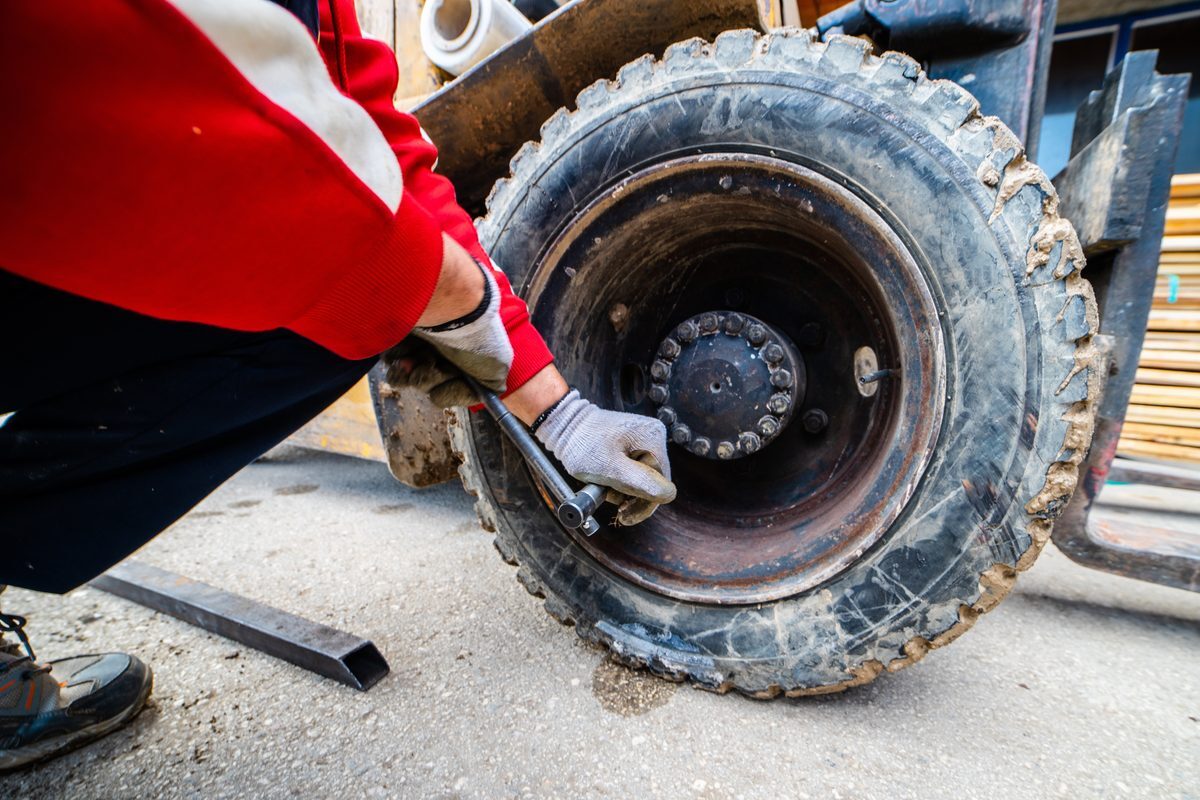
Cracking and heavy wear on an outdoor pneumatic — replace before it fails in service.
For a position-by-position breakdown of how the rear steer tires wear differently from the drive tires, see drive tires vs. steer tires.
Why Running Past the Wear Line Costs You
"Run it till it's bald" feels like saving money. On a forklift it usually does the opposite, because the wear line protects more than the tire:
- Stability margin. With no suspension, a worn or flat-spotted tire lowers the truck's ride height and shifts its center of gravity — eroding the stability margin the data plate assumes. Tire condition is part of safe load handling under OSHA's powered industrial truck rules.
- Heat and blowout in solids. Once the cushioning rubber is gone, a solid tire generates more heat per revolution, which accelerates heat separation and the risk of a blowout. That's why "bald" is a false economy on a solid.
- Operator fatigue and a rougher ride. Worn solids and press-ons transmit every bump straight to the mast and the seat, tiring the operator and shaking the load.
- Higher running cost. Worn, flat-spotted, or underinflated tires raise rolling resistance, so the truck burns more fuel or battery to do the same work.
- Collateral damage. A flat-spotted or over-worn tire hammers the mast, bearings, and electronics, shortening the life of components far more expensive than a tire.
- Unplanned downtime. A tire that fails in service stops the truck with no warning — almost always at a worse time and a higher cost than a planned change.
Replace in Matched Sets, Not One Tire at a Time
When a tire reaches the line, replace it as part of a matched set rather than swapping a single tire. For the full economics — the axle-pair rule, pairs vs. full sets, and bundles vs. wheel assemblies — see our new guide: Forklift Tire Bundles: Why Sets Save Money. Forklift tires are built to work together: a new tire next to worn mates means mismatched diameters, uneven handling, faster wear on the odd tire out, and a second round of downtime when the others reach the line a few weeks later. Drive and steer tires also wear at different rates, so check both positions when one is due.
The rule of thumb: replace both tires on an axle together. If one of the four is cut, torn, or chunked, replace at least that pair — and because all four were installed and worn together, replacing the full set is often the right call so the truck wears and handles evenly.
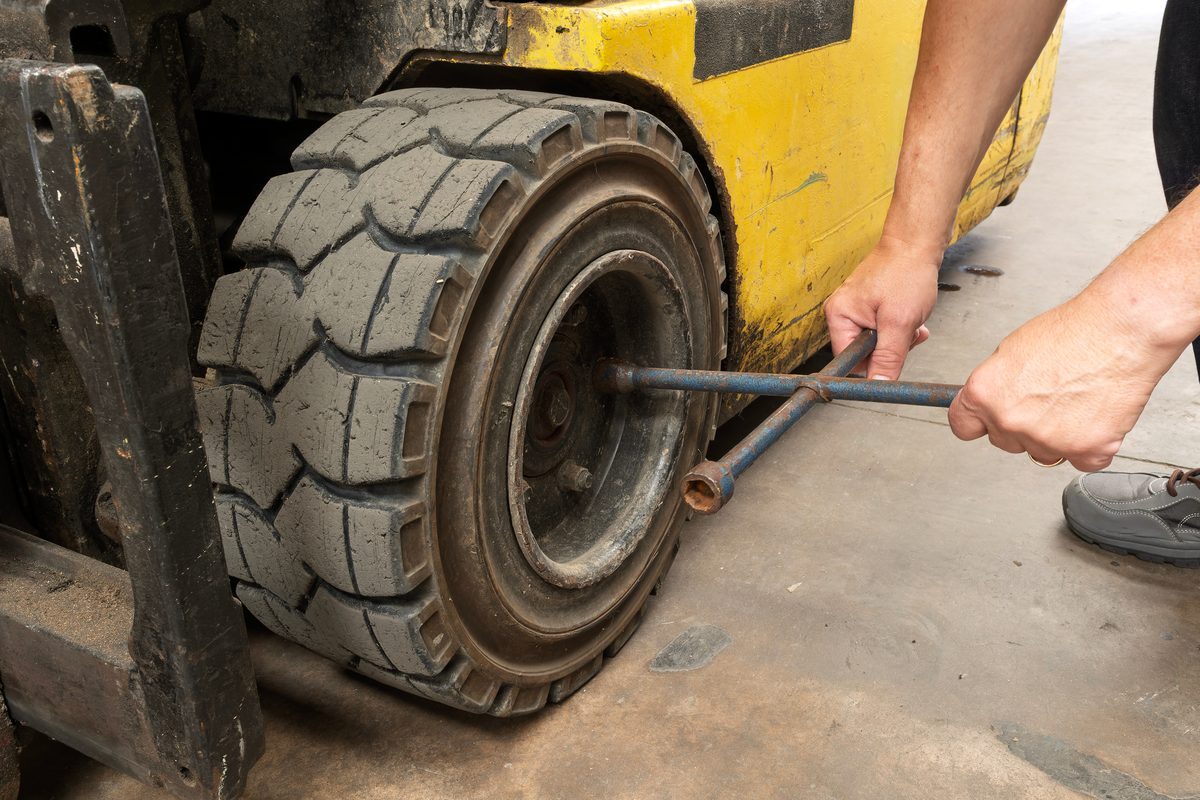
Replace at the wear line, on your schedule — and in matched sets.
Why the set wins
A 4-piece set is 2 drive + 2 steer tires, matched and replaced together. You get even wear, predictable handling, one freight charge instead of several, and one service event instead of two. The cart discount stacks on top: save 7.5% on 2–3 items or 15% on 4+ items, applied automatically. Browse matched options on the forklift tire bundles page.
What to Buy Next — and How to Choose Right
Once you've confirmed a tire is at the line, match the replacement to your construction and surface. Read both your drive and steer sizes off the sidewall first, then shop the matching category:
| If you run… | Shop |
|---|---|
| Solid resilient or pneumatic tires (rim-mounted) | Solid & pneumatic forklift tires |
| Cushion press-on trucks (full replacement set) | Cushion press-on tire sets |
| Press-on tires by size (rubber or poly) | Press-on forklift tires |
| Not sure where to start | Forklift tire buying guide |
Because Forklift Tire Company stocks every construction — resilient solids, pneumatics, and rubber and polyurethane press-ons — the right answer is the tire that fits your truck and your floor, not whatever's on one shelf. Verify exact tire size and fitment before ordering. If you're unsure, call 1 (866) 313-2180 with your forklift make, model, and the sizes on your current tires, and we'll point you to the right set.
Save 7.5% on 2–3 items or save 15% on 4+ items, automatic in cart. Free ground freight to commercial addresses in the contiguous U.S.
Frequently Asked Questions
How do I know if my forklift tires need replacing?
Check the built-in wear indicator. Solid resilient tires have a molded 60-J (safety) line on the sidewall; some, like Trelleborg, add a colored Pit Stop Line in the tread. Press-on cushion tires are worn out when the rubber reaches the top of the molded size numbers; pneumatics go by tread depth and casing condition. Replace when the tire reaches its line, or sooner if you see chunking, deep cracks, flat spots, or exposed base.
How long do forklift tires last?
There's no single number — tire life is measured in operating hours, not miles, and it depends on hours per day, load weight, floor surface, driving habits, and the tire compound. A tire running ten hours a week can last years; one running multiple shifts a day may be due in months. The reliable approach is to replace at the wear indicator rather than chase an hour figure.
What is the 50% rule for forklift tires?
It's a rule of thumb for smooth press-on cushion tires: replace once about half the usable rubber is gone. It's handy for a quick eyeball check, but manufacturers are often more conservative — Camso, for example, says replace when the rubber wears down to two-thirds of its original height (about a third gone), which lines up with replacing when the rubber reaches the top of the molded size numbers. The molded line or the manufacturer's spec is the real trigger.
How do I check forklift tires before a shift?
Tire condition is part of the operator's daily pre-operation inspection under OSHA 29 CFR 1910.178(q)(7). On your walkaround, look at each tire for wear approaching the indicator line, chunking, deep cracks, flat spots, or exposed base/band; on pneumatics, check for correct pressure and obvious leaks. If a tire is at the line or damaged, take the truck out of service until it's corrected.
Can you run a forklift on worn tires?
You shouldn't run past the wear line. A worn tire lowers ride height and erodes the stability margin the data plate assumes, and on solids the lost cushioning builds heat that can lead to a blowout. A damaged or defective tire should be taken out of service until it's corrected. Worn tires also hammer the mast, bearings, and floor — costing far more than the tire.
When are solid forklift tires worn out?
A solid resilient tire is worn out when the rubber reaches the molded 60-J line on the sidewall, or when a branded wear band (such as Trelleborg's Pit Stop Line) becomes visible. Below that point you're riding on the softer base layer, which gives a harsher ride, more heat, and risk to the wheel. Replace at the line, not when the tire looks flat.
Should I replace all four forklift tires at once?
Replace in matched sets or pairs, not one tire at a time. A single new tire next to worn ones causes mismatched diameters, uneven handling, and faster wear — plus a second downtime event soon after. Replace both tires on an axle together; a 4-piece set (2 drive + 2 steer) keeps the truck balanced and earns the volume discount and a single freight charge. See the forklift tire sets page.
This article is general educational information from Forklift Tire Company, not a substitute for OSHA-compliant operator training or your equipment's data-plate ratings and the tire manufacturer's specifications. Always follow your data plate, the tire sidewall/wear indicator, and 29 CFR 1910.178.