 1 (866) 313-2180
 SALES@FORKLIFTTIRE.COM


Posted by Forklift Tire Company on 21st Aug 2026
One of the highest-risk spots in a warehouse isn't the racking, the dock plate, or the charging station — it's the few feet around a working forklift. Federal injury data backs that up: when a forklift hurts a pedestrian, the recovery time is the longest of any forklift injury. And one of the most overlooked hazards sits directly under a raised load, in the space safety professionals call the fall zone. This guide covers what federal OSHA actually requires (and what it doesn't), how to separate people from trucks with walkways, barriers, and floor markings, the visibility tools that keep both sides seen and heard — horns, mirrors, spotters, lights — the special rules for dock areas, and the half of pedestrian safety most programs skip: whether the truck can actually stop in time.
The short answer
- Keep people and trucks apart. Separation beats every warning device — physical barriers (a true engineering control) first, then marked walkways and protected crossings, because a pedestrian who is never in the truck's path never depends on being noticed.
- No one goes under elevated forks, ever. OSHA's rule is absolute: "No person shall be allowed to stand or pass under the elevated portion of any truck, whether loaded or empty" — 29 CFR 1910.178(m)(2). That's the fall zone.
- The horn at blind corners is regulation, not courtesy. 1910.178(n)(4) requires operators to slow down and sound the horn at cross aisles and anywhere vision is obstructed.
- Blue lights and back-up alarms aren't specifically required by the forklift standard — but OSHA has said in writing that an employer who skips feasible fixes for a known struck-by hazard can be cited under the General Duty Clause.
- Stopping in time is half the equation. Every rule above assumes the truck can stop when a person steps out. On a wet or dusty floor with worn smooth tires, it may not.
- Nothing posted yet? Skip to the first ten moves — the same hierarchy, in the order to do it.
On this page
What the injury data says about forklifts and pedestrians
The Bureau of Labor Statistics counted 614 forklift-related worker deaths from 2011 through 2017 — roughly 88 per year — and 9,050 nonfatal forklift injuries with days away from work in 2017 alone. Of those, 1,850 involved pedestrians while the forklift was in transportation use — people who weren't operating the truck at all, just working near one. The problem hasn't gone away since: the National Safety Council's compilation of the latest BLS data reports forklifts were the source of 84 work-related deaths in 2024 (a category that also includes order pickers and powered platform trucks).
Here's the number that should reshape how you think about pedestrian exposure: in the 2017 BLS data, forklift injuries to pedestrians carried the highest median recovery time of any forklift injury — 20 days away from work, versus 8 days for workplace injuries overall. A several-thousand-pound machine doesn't do minor damage to a human body. When a forklift and a pedestrian collide, the pedestrian always loses — which is why every control in this guide is aimed at making sure that collision geometry never gets a chance to happen.
What federal OSHA actually requires — and what it leaves to you
The powered industrial truck standard, 29 CFR 1910.178, contains a short list of hard pedestrian-related rules, and it's worth knowing them exactly, because most of what circulates online as "OSHA forklift pedestrian requirements" is actually best-practice guidance:
- No one under elevated forks — 1910.178(m)(2): "No person shall be allowed to stand or pass under the elevated portion of any truck, whether loaded or empty." This is the fall-zone rule, covered in depth below.
- Horn and slow-down at blind spots — 1910.178(n)(4): "The driver shall be required to slow down and sound the horn at cross aisles and other locations where vision is obstructed."
- Clear view of the path — 1910.178(n)(6): "The driver shall be required to look in the direction of, and keep a clear view of the path of travel."
- No riders — 1910.178(m)(3): "Unauthorized personnel shall not be permitted to ride on powered industrial trucks." A pedestrian never becomes a passenger because it's faster than walking.
- Pedestrian traffic is a required training topic — 1910.178(l)(3)(ii)(D): operator training must cover "pedestrian traffic in areas where the vehicle will be operated" (except topics the employer can demonstrate are not applicable to safe operation of the truck in the employer's workplace).
- Marked aisles — 29 CFR 1910.176(a): where mechanical handling equipment is used, "sufficient safe clearances shall be allowed for aisles, at loading docks, through doorways and wherever turns or passage must be made," and "permanent aisles and passageways shall be appropriately marked."
Just as important is what the standard doesn't say. 1910.178 contains no blue-light requirement, no back-up-alarm mandate, no minimum pedestrian distance, and no walkway-design specification. Those controls live in OSHA's Powered Industrial Trucks eTool — agency guidance, not regulation — and in consensus standards and plain good practice. That distinction matters for two reasons: it tells you what an inspector can cite directly, and it tells you where the General Duty Clause takes over. In a 2012 interpretation letter, OSHA confirmed that warning lights and back-up alarms aren't specifically required for forklifts — and then added that an employer whose workplace presents a struck-by hazard and who "has not taken feasible steps to mitigate this hazard" may be in violation of the General Duty Clause. In other words: the absence of a specific rule is not permission to do nothing.
The fall zone: never under elevated forks
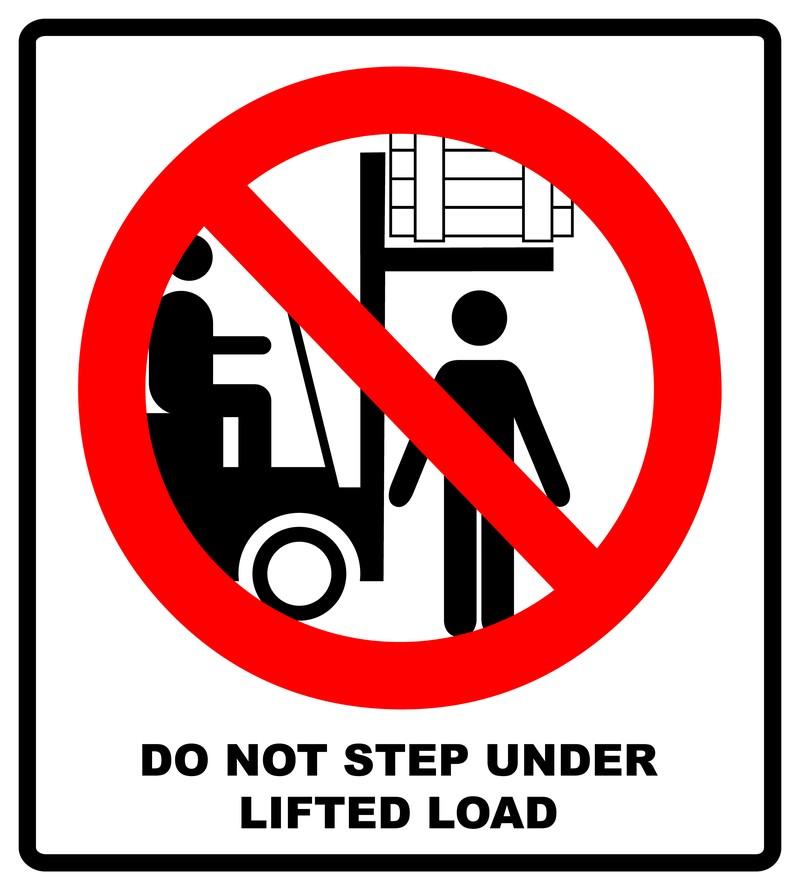
"Fall zone" isn't a term you'll find in the forklift standard — it's shorthand borrowed from rigging and crane work for the area an elevated load could fall into. But the rule behind it is OSHA-hard and absolute: "No person shall be allowed to stand or pass under the elevated portion of any truck, whether loaded or empty" — 1910.178(m)(2). OSHA's pedestrian guidance repeats it from the operator's side: "Do not allow anyone to stand or pass under the load or lifting mechanism."
Read the rule's wording carefully, because each clause closes a loophole people talk themselves into:
- "Stand or pass" — walking through quickly is prohibited exactly like standing still. There is no "careful" exception, and no "just for a second" exception.
- "The elevated portion of any truck" — the prohibition covers the forks and carriage themselves, not just the load. Hydraulics can fail, and forks can drop, with nothing on them.
- "Whether loaded or empty" — an empty raised fork is still a fall zone. So is a raised attachment, a clamp, or a rotator.
Treat the fall zone as bigger than the footprint directly beneath the forks. A load that shifts or breaks free doesn't drop straight down — cartons tip outward, banding snaps, and a pallet sliding off forks can travel laterally. Well-run facilities teach a simple habit: if the forks are up, you route around, never under, and never close enough that a falling load could reach you. The same thinking applies at the racking face — the reason to stand clear while a truck places a pallet at height is the same reason you'd never walk under it.
Separation: walkways, barriers & floor markings
Every warning device on a forklift — horn, lights, mirrors, spotter — exists to manage the moment when a person and a truck share the same space. Separation exists to make sure that moment never comes, which is why it sits at the top of the hierarchy. OSHA's pedestrian-traffic guidance tells facility managers to provide pedestrian walkways, "permanent railings or other protective barriers," and "adequate walking space at least on one side" of equipment aisles, and tells workers on foot to "use pedestrian walkways, or stay to one side of the equipment aisle."
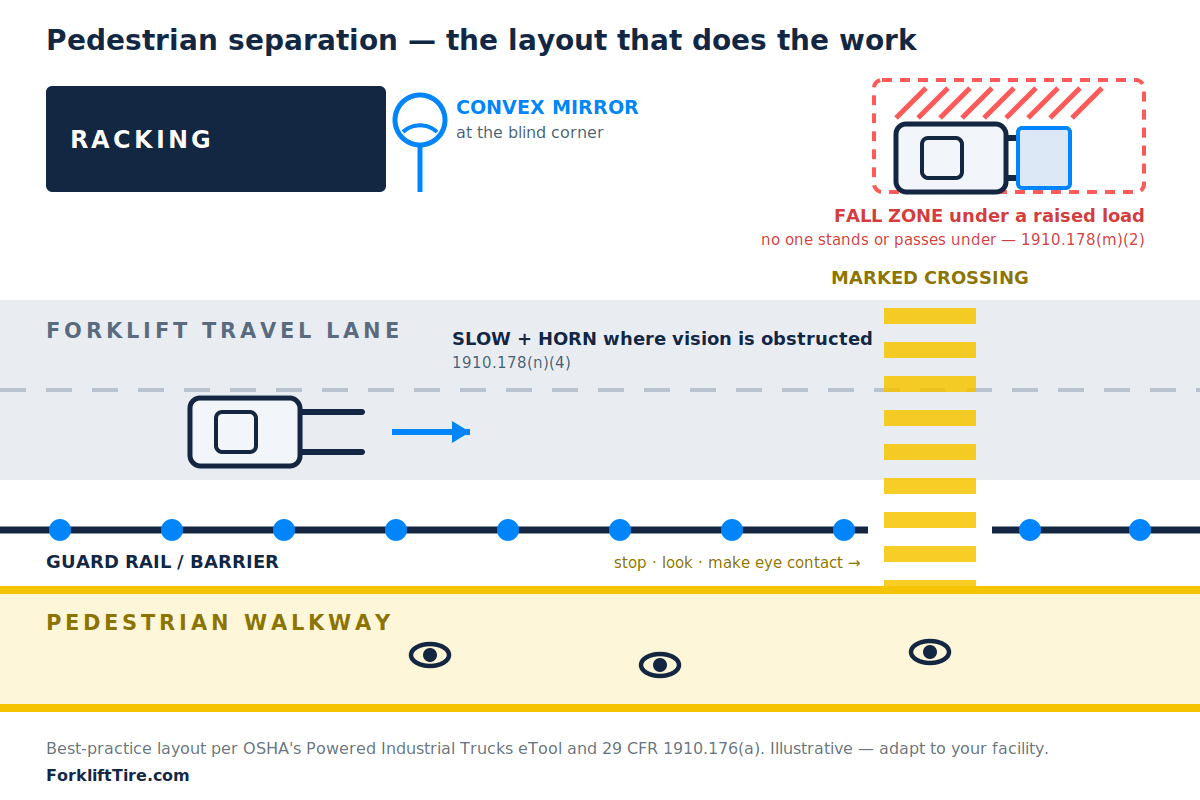
In practice, separation comes in three grades, and you apply the strongest one the space allows:
- Physical barriers — guard rail, bollards, mesh partition. The only control that works when nobody is paying attention, which is exactly when accidents happen. Use them along high-traffic pedestrian routes, at aisle ends, around workstations that sit beside truck lanes, and anywhere pedestrians emerge from doorways into travel paths.
- Marked walkways and crossings — painted or taped lanes that give pedestrians a defined route and give operators a predictable place to expect people. Federal rule 1910.176(a) requires permanent aisles and passageways to be "appropriately marked"; it does not prescribe a color scheme, so the familiar yellow pedestrian lanes and hatched keep-out zones are convention, not regulation — pick a scheme, document it, and keep it consistent across the facility. Add designated crossing points where walkways must cross truck lanes, and treat them like crosswalks: pedestrians stop and look, operators yield.
- Procedural separation — the rules that fill the gaps: pedestrians keep out of active truck aisles, nobody approaches a working truck without getting the operator's attention first, and forklift travel stops in an area while a crew works on foot there. Weakest of the three because it depends entirely on training and attention — which is why it supplements the first two rather than replacing them.
One design detail with outsized payoff: route walkways so pedestrians never emerge into a truck lane from behind racking or a wall without a protected buffer. Struck-by incidents are, at bottom, geometry problems — a person and a truck arriving at the same blind spot at the same moment. Fix the geometry and the rest of the program gets dramatically easier.
Be seen and heard: horns, eye contact, spotters, mirrors & lights
Where separation can't be absolute — intersections, shared aisles, staging areas — visibility and communication take over. OSHA's eTool gives operators a compact playbook: "Warn pedestrians of your approach by horn, hand signal, or warning light," "signal to pedestrians to stand clear," "sound the horn at blind corners, doorways and aisles," "use a spotter for blind spots," and "when possible, make eye contact with pedestrians or other forklift operators." The horn piece isn't optional guidance: 1910.178(n)(4) makes slowing down and sounding the horn at obstructed-vision locations a requirement.
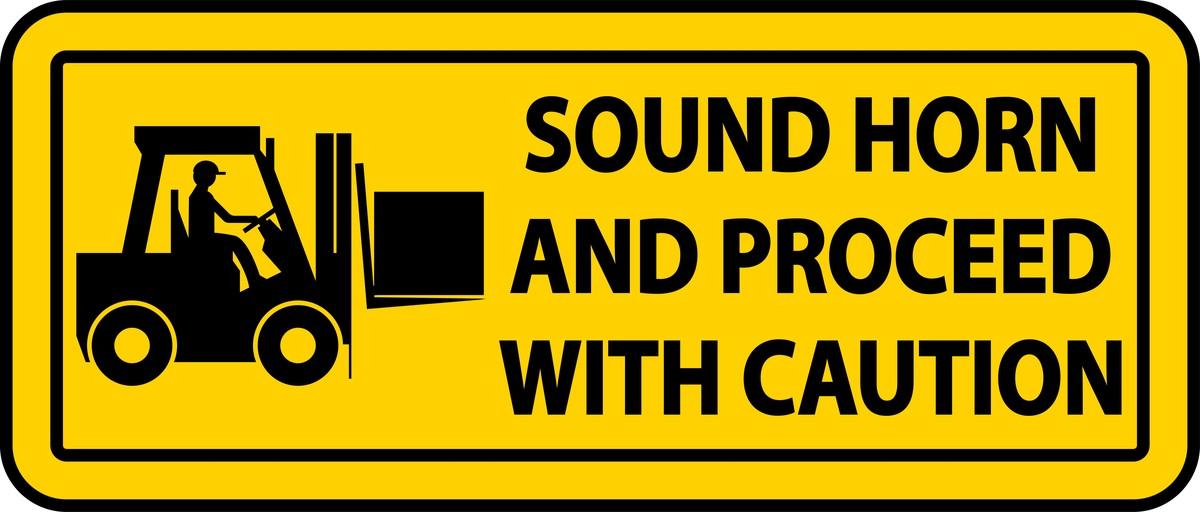
Eye contact is the cheapest control on this list and the most underused. A horn tells a pedestrian a truck exists somewhere; eye contact confirms the specific operator has seen the specific person. Teach both sides of it: pedestrians don't step into a travel lane until they've caught the operator's eye and gotten an acknowledgment, and operators treat a pedestrian who hasn't looked up as someone who has no idea the truck is there — because they usually don't.
Spotters and hand signals deserve their own system. When a load blocks the view, a trailer swallows the sight lines, or a tight maneuver happens near people, a spotter is the accepted control — and a spotter is only as good as the signal set they share with the operator. We published a complete companion guide covering a consistent, site-adoptable signal set, the spotter rules that make it work, and a free printable chart for your facility: Forklift Hand Signals: The Complete Guide + Printable Chart.
Convex mirrors fix the blind-intersection problem at the source: OSHA's guidance says to "install convex mirrors at blind aisle intersections" so operators and pedestrians can see around the corner before they reach it. We've covered mirror selection and placement in two dedicated guides — how convex safety mirrors prevent warehouse accidents and preventing blind-spot accidents with convex mirrors — including where they earn their keep and how to size them for the intersection.
Blue pedestrian lights and travel alarms round out the toolkit. A blue spot light projects a bright dot on the floor ahead of (or behind) the truck, announcing it around corners before it arrives; red side lights project a keep-out boundary along the truck's flanks; back-up alarms announce reverse travel. None of these is specifically required by 1910.178 — that's the point of the 2012 interpretation letter — but they're widely recognized, feasible controls for exactly the struck-by hazard the General Duty Clause covers, and in a loud facility a projected light reaches pedestrians a horn can't. One honest caveat: in a noisy warehouse you can't assume anyone hears an alarm, and in a facility full of alarms people tune them out. Lights and alarms supplement separation and eye contact; they don't replace them.
Dock-area pedestrian rules
Loading docks compress everything hard about pedestrian safety into the smallest space in the building: trucks entering and leaving trailers on a fixed clock, trailer interiors that swallow sight lines, dock plates that focus traffic through a single point, and — uniquely — an elevated edge. It's no accident that 1910.176(a) calls out loading docks by name when it requires sufficient safe clearances. A dock-area pedestrian program worth having looks like this (best practice, built on the same separation-and-visibility logic as the rest of this guide):
- Mark a pedestrian exclusion zone on the dock apron — the forklift's working lane between staging and trailer is no place to stand, and hatched floor marking makes that visible to visitors and new hires who haven't absorbed the site's rhythms yet.
- Never walk through an open dock door's travel path while a trailer is being worked — the operator emerging from a trailer is driving out of a dark tunnel into bright light, often with the load trailing. Assume you are invisible, because for a second or two you genuinely are.
- Keep the fall-zone rule alive at the racking and staging lanes — dock staging is where raised forks and hurried people mix most; the 1910.178(m)(2) prohibition doesn't relax because a trailer is waiting.
- Give truck drivers a designated safe waiting area — the most unpredictable pedestrian on a dock is the visiting driver with nowhere assigned to stand. A marked wait zone with a clear sight line to their trailer removes the reason to wander.
- Treat the dock edge as its own hazard — pedestrian routes should never run along the open edge, and trailer securement keeps the dock plate stable mid-load. One rule on this list is regulation rather than practice: secure the trailer against movement before a forklift enters. For highway trucks, 1910.178(k)(1) requires the truck's brakes set and wheel chocks placed under the rear wheels to prevent rolling, and OSHA's dockboard rule (1910.26) adds load-rating, dockboard-securement, and vehicle-movement provisions. One nuance: for certain commercial motor vehicles, FMCSA rules preempt OSHA's chocking requirement — so apply the governing rule and your site's compliant chock, restraint, or other securement procedure before entry.
We'll take a full pass at dock safety — plates, restraints, trailer entry, and the tires that handle dock-plate impact — in the Forklift Loading Dock Safety Guide.
Stopping in time: the part most pedestrian-safety programs skip
Every rule in this guide has a quiet dependency baked into it: when a pedestrian does step out, the truck has to be able to stop. Braking on a forklift is a contact-patch problem — the brakes can only use whatever grip exists between the tire contact patches and the floor. Two things erode that grip, and they usually erode together:
- Floor condition. Water tracked in at the dock, hydraulic-oil film, dust, and polished-smooth concrete all cut the friction available for a panic stop. Housekeeping in truck lanes is pedestrian safety, not janitorial detail.
- Tire condition and tread. A worn, smooth-surfaced tire that grips fine on clean dry concrete gives up its margin exactly when the floor is wet or contaminated . Tread and compound are one input among several — brakes, speed, load, floor condition, and tire construction and wear all set the real stopping distance — and if a truck slides or cannot stop safely, 1910.178(p)(1) requires taking it out of service until the cause is found and corrected. No tire makes a forklift "safe," and no tread substitutes for the separation and visibility rules above. What the right tire does is let those rules work the way they assume.
If your trucks are sliding on floors they used to stop on, inspect the whole system — brakes and tires both — and keep the truck out of service until it stops the way it should. On the tire side, our guide to the top 5 signs it's time to replace your forklift tires covers the wear points that erode braking grip. When it's time to replace, traction-tread options are available across cushion rubber press-on tires for indoor trucks and the pneumatic and cushion press-on tire-set categories for mixed fleets. Verify exact tire size and fitment before ordering.
Building pedestrian safety into your training program
OSHA already gives you the hook: operator training under 1910.178(l)(3) must cover "pedestrian traffic in areas where the vehicle will be operated" — along with visibility restrictions and the operating rules — except where an employer can demonstrate a topic isn't applicable to safe operation of the truck in its workplace. For any facility where people and trucks share a floor, pedestrian traffic is never that topic. Fold your site's specific system into that training slot: the walkway map, the crossing points, the horn rules, the eye-contact protocol, your signal set, and the fall-zone rule.
Then train the other half of the population. Operators get formal, evaluated training; the pedestrians they're avoiding usually get a hallway poster. Every worker on the floor — pickers, maintenance, office staff cutting through, visiting drivers — should know the four things that protect them: stay in the walkways, never under raised forks, make eye contact before crossing a truck path, and never assume the operator sees you. Round out the program with the operating habits that keep trucks predictable in the first place — our forklift operator guide covers duties and training end to end, and the daily inspection checklist is where horn, lights, and tire checks catch the failures that turn a near-miss into a hit.
Start here: the first ten moves
Everything above is the reasoning. This is the doing. If nothing formal is posted at your site yet, work this list in order — it follows the same hierarchy the guide argues for: separation first, visibility second, warning devices last. The items carrying a CFR citation are federal requirements; the rest are widely recognized practice. Nothing here is new to this page — every line is drawn from the sections above.
Pedestrian safety starter list
- Walk the floor and mark every place a person crosses a truck path. You cannot separate traffic you have not mapped. Doorways where people step into travel lanes, aisle ends, workstations beside truck lanes, and the dock apron are where to look first.
- Put a physical barrier on the busiest pedestrian route. Guard rail, bollards, or mesh partition — the only control that still works when nobody is paying attention, which is exactly when incidents happen. Start with one route, not the whole building.
- Mark your permanent aisles and passageways. This one is not optional: 29 CFR 1910.176(a) requires permanent aisles and passageways to be appropriately marked wherever mechanical handling equipment is used. The federal rule does not prescribe a color, so the familiar yellow lanes are convention — pick a scheme and apply it consistently.
- Post the fall-zone rule and enforce it with no exceptions. 1910.178(m)(2): no one stands or passes under the elevated portion of any truck, loaded or empty. There is no “careful” version and no “just for a second” version.
- Make the horn rule explicit at every blind corner and cross aisle. 1910.178(n)(4) requires operators to slow down and sound the horn where vision is obstructed. Name the specific locations in your written program rather than leaving it to judgment.
- Teach eye contact in both directions. The cheapest control on this list and the most underused. Pedestrians do not enter a travel lane until they have caught the operator’s eye and been acknowledged; operators treat anyone who has not looked up as someone who does not know the truck is there.
- Put convex mirrors at the blind aisle intersections. OSHA’s guidance calls for installing them so both sides can see around the corner before they reach it. Placement and sizing matter more than quantity — see our guides on how convex mirrors prevent warehouse accidents and preventing blind-spot accidents.
- Write down your dock rules. A marked pedestrian exclusion zone on the apron, a designated waiting area for visiting drivers, and the fall-zone rule still alive at staging. One item here is regulation rather than practice: secure the trailer before a forklift enters — 1910.178(k)(1) and the dockboard rule at 1910.26, with FMCSA rules preempting OSHA chocking for certain commercial motor vehicles.
- Fold pedestrian traffic into operator training — it is already required — then train the people on foot. 1910.178(l)(3)(ii)(D) makes pedestrian traffic a required operator-training topic. Operators get formal, evaluated training; the pedestrians they are avoiding usually get a hallway poster. Give every worker on the floor the four rules: stay in the walkways, never under raised forks, make eye contact before crossing a truck path, and never assume the operator sees you. Add the fifth while you are there — nobody rides who is not authorized to, under 1910.178(m)(3).
- Confirm the trucks can still stop — and park the ones that cannot. Every rule above assumes the truck stops when a person steps out. Check brakes and tires together, because floor contamination and worn tread erode grip at the same time. If a truck slides or cannot stop safely, 1910.178(p)(1) requires taking it out of service until the cause is found and corrected.
Two honest notes on using this list. First, it is a starting order, not a compliance audit — a site-specific hazard assessment can change the priorities, and state-plan states may impose stricter requirements than the federal citations above. Second, the list is deliberately short. A ten-item program that actually gets posted, trained, and followed protects people better than a forty-page document nobody reads.
Frequently asked questions
What is the fall zone of a forklift?
The fall zone for a forklift operation is the area an elevated load — or the raised forks themselves — could fall into. The term comes from rigging practice, but the forklift rule behind it is federal regulation: 29 CFR 1910.178(m)(2) states that "no person shall be allowed to stand or pass under the elevated portion of any truck, whether loaded or empty." Treat the zone as wider than the space directly under the forks, because shifting loads travel outward, not just straight down.
How far should pedestrians stay from a forklift?
OSHA sets no universal distance. The working rules are positional, not numeric: stay out of the truck's travel path and swing radius, never under elevated forks, and don't approach a working truck until you've made eye contact and the operator has acknowledged you. Many facilities set their own site-specific buffer distances around working trucks — a good practice, as long as everyone understands the distance is the site's rule, not a federal one.
Can someone walk under a raised forklift load if they're quick and careful?
No. The rule prohibits standing or passing under the elevated portion of any truck, loaded or empty — there is no careful exception, no quick exception, and no empty-forks exception. Hydraulics can fail and loads can shift without warning, and neither gives notice. This is one of the few pedestrian rules that is a hard OSHA requirement rather than best practice, so treat it as non-negotiable in your program.
Does OSHA require blue pedestrian lights on forklifts?
No. The forklift standard, 1910.178, does not specifically require warning lights or back-up alarms, and OSHA confirmed that in a 2012 interpretation letter. The same letter adds the catch: where a struck-by hazard exists and feasible controls like lights or alarms are recognized fixes, an employer that hasn't taken feasible steps to mitigate the hazard may be cited under the General Duty Clause. So blue lights are a supplemental control rather than a named equipment mandate; whether the General Duty Clause reaches a given site depends on the specific hazard and what abatement is feasible there.
Does OSHA require separate pedestrian walkways in a warehouse?
Not as a specific design mandate. What the rules require is that permanent aisles and passageways be appropriately marked and that sufficient safe clearances be maintained where mechanical handling equipment operates (29 CFR 1910.176(a)). Dedicated walkways, railings, and barriers are OSHA-recommended guidance — the eTool tells managers to provide pedestrian walkways and permanent railings or other protective barriers — and they're the strongest control available, because they remove the shared-space problem instead of managing it.
What color should warehouse floor markings be?
Federal rules require that permanent aisles be appropriately marked, but they don't prescribe a color scheme for pedestrian lanes. The familiar conventions — yellow for walkways and aisles, hatched patterns for keep-out and exclusion zones — are industry practice, not regulation. What matters for safety is consistency: pick one scheme, apply it identically across the whole facility, document it in training, and repaint before markings fade into ambiguity.
Can a pedestrian ride on a forklift?
Only where riding is authorized and the truck provides a safe place to ride — otherwise no. 1910.178(m)(3) prohibits unauthorized personnel from riding on powered industrial trucks. On a standard counterbalance truck there is no such place. Hitching a ride on the forks, the running board, or a pallet is a violation — and lifting a person is a different task with the same theme: never on bare forks, only in a compatible, approved personnel platform, properly secured and used within its rated limits per the truck and platform manufacturers' instructions.
Is pedestrian safety a required part of forklift operator training?
Yes. The training standard at 1910.178(l)(3) lists "pedestrian traffic in areas where the vehicle will be operated" among the required workplace-related topics, alongside surface conditions, visibility restrictions, and the site's operating rules — except topics the employer can demonstrate are not applicable to safe operation of the truck in its workplace. Anywhere people and trucks share floor space, pedestrian traffic applies. Best practice goes further and trains the pedestrians too, since half of every operator-pedestrian interaction happens outside the seat.
Do tires really make a difference for pedestrian safety?
They affect the one variable every other control assumes: stopping distance. Braking force is limited by the grip between tire and floor, and a worn smooth tire on a wet, oily, or dusty floor gives up grip exactly when a panic stop demands it. Tread and compound are one input among several: brakes, speed, load, and floor condition set the stop too, so match the tire to the truck and surface using the manufacturer's guidance. That's a stopping-performance consideration, not a safety rating — no tire makes a forklift safe, and tires never substitute for separation, visibility, and training. They determine whether those controls get the stopping distance they assume.
This article is general educational information from Forklift Tire Company, not a substitute for OSHA-compliant, employer-provided operator training, a formal compliance review, or your own site's safety procedures and equipment data-plate ratings. Where a practice is described as best practice or guidance rather than regulation, that distinction is deliberate — the specific layouts, colors, and diagrams shown here are illustrative rather than OSHA-approved designs, and this article addresses federal OSHA general-industry rules — State Plans can be stricter. Always follow 29 CFR 1910.178, your training program, your data plate, and the tire manufacturer's specifications. Verify exact tire size and fitment before ordering. Questions on tires, wheels, or parts? Call 1 (866) 313-2180 or email sales@forklifttire.com.