 1 (866) 313-2180
 SALES@FORKLIFTTIRE.COM



Posted by Forklift Tire Company on 7th Aug 2026
On most sit-down counterbalanced forklifts, the stability triangle is formed by three points: the two front drive wheels, and the pivot pin at the center of the steer axle. That holds even on a four-wheel truck, because the steer axle is attached to the frame by a single pivot in its middle rather than at each corner. Connect those three points with imaginary lines and you have the triangle that decides whether the truck stays upright.
What has to stay inside that triangle is not the load, and it is not the truck — it is the combined center of gravity of the truck and its load. This guide explains the geometry the way OSHA's stability appendix explains it, works through the load-moment math that decides forward tipping, covers what to do if a truck starts to go over, and then covers the part nobody else writes about: how tire condition quietly eats the stability margin the engineers designed in.
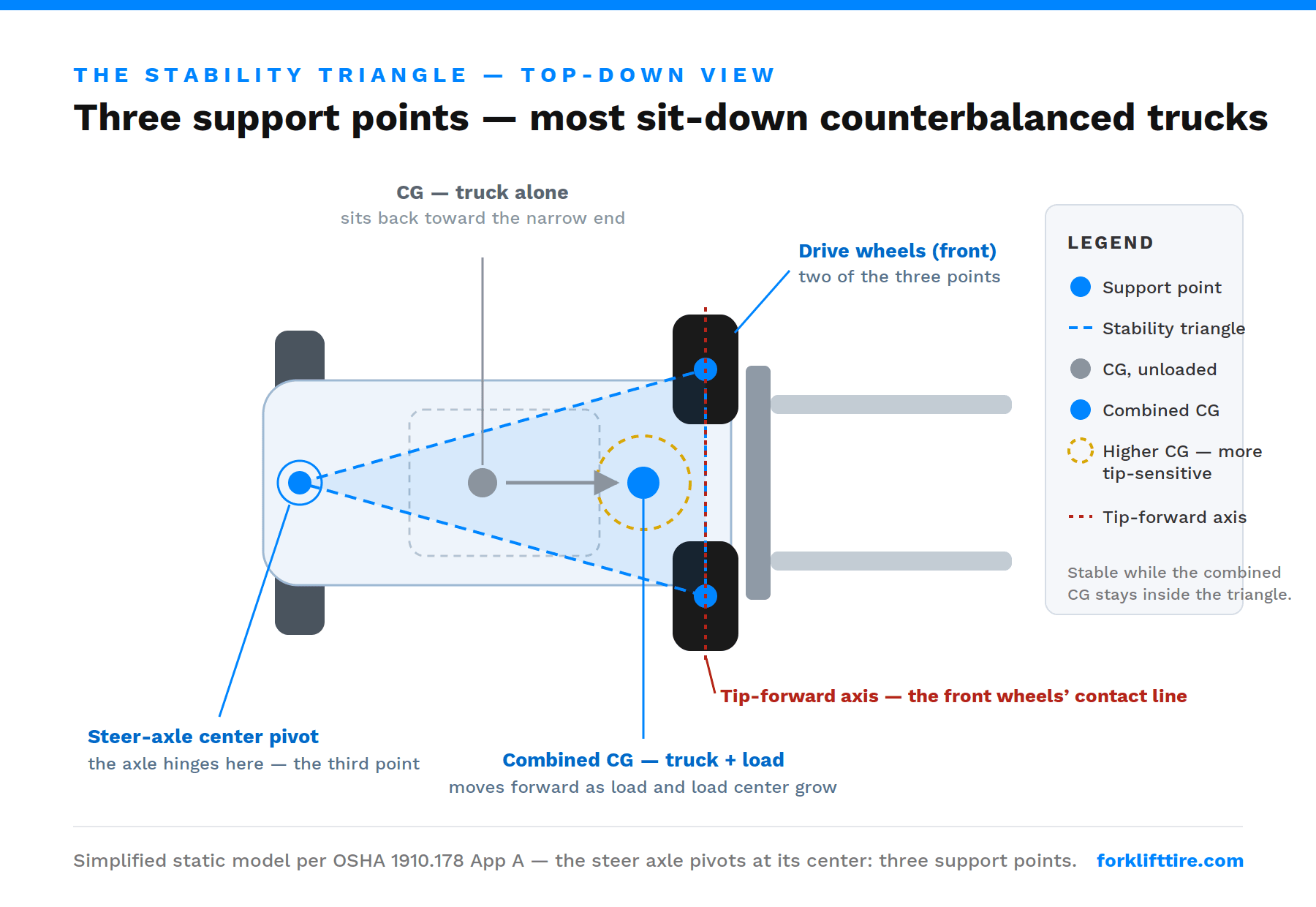
The stability triangle seen from above — a simplified static model for most sit-down counterbalanced trucks. The triangle narrows toward the steer axle, and raising a load makes the truck more sensitive to lean and dynamic forces.
In this guide
The Three Points
OSHA's stability appendix to the powered industrial truck standard puts it plainly: almost all counterbalanced powered industrial trucks have a three-point suspension system — the vehicle is supported at three points, and this is true even if the vehicle has four wheels. The truck's steer axle is attached to the truck by a pivot pin in the axle's center. When the points are connected with imaginary lines, that three-point support forms a triangle called the stability triangle.
This is the single most common thing operators get wrong, and it is a fair question to ask. A four-wheel truck looks like it should have a rectangular base. It does not, because the rear axle is not bolted rigidly at both ends — it pivots in the middle so the rear wheels can follow uneven ground without lifting a front wheel. That pivot is effectively a hinge, so it cannot brace its end of the truck the way rigid corner mounts would — functionally, the truck behaves far more like a tripod than a rectangle.
Two consequences follow immediately. The triangle is wide at the front and narrow at the back, so the truck has far more sideways stability at the drive axle than at the steer axle. And the front edge of the triangle — the line between the two front wheel contact patches — is the axis the truck rotates about when it tips forward.
What Actually Has to Stay Inside the Triangle
The thing that must stay inside the triangle is the line of action of the combined center of gravity — an imaginary vertical line dropped through the center of gravity of the truck and its load taken together. OSHA's appendix defines that line as one “that passes through the combined vehicle's and load's center of gravity,” and states the condition directly: while that vertical line of action falls within the stability triangle, the vehicle is stable and will not tip over; when it falls outside the triangle, the vehicle is unstable and may tip over. (Keep the two terms straight: the line of action is a vertical line through the center of gravity; a load center is a horizontal distance.)
Unloaded, only the truck's own center of gravity matters. Add a load and a combined center of gravity is created immediately — not only at maximum capacity — and it moves progressively as you work: forward as load weight or load center increases, up as you raise the mast, and sideways with off-center placement, side-shift, or truck lean.
Forward Tipping: The Load-Moment See-Saw
Longitudinal stability — resistance to tipping forward or backward — is a see-saw. The fulcrum is the front wheels' points of contact with the pavement. On one side is the vehicle moment: the truck's weight, including its counterweight, multiplied by the distance from its center of gravity back to that fulcrum. On the other is the load moment: the load's weight multiplied by its distance forward of the fulcrum.
The truck stays down as long as the vehicle moment is at least equal to the load moment. Two things happen when it is not, and the first one is the warning shot: if the load moment slightly exceeds the vehicle moment, the rear of the truck lifts and steering control is lost — the wheels that steer are no longer carrying weight. If it greatly exceeds it, the truck tips forward.
That is why capacity is always stated with a load center attached. Trucks with a capacity of 30,000 pounds or less are normally rated at a given load weight at a 24-inch load center; larger trucks are rated at 36- or 48-inch load centers. OSHA's own worked example is the clearest way to see what that buys you:
| Step | Figure | Where it comes from |
|---|---|---|
| Rated capacity | 3,000 lb at a 24 in. load center | The truck's data plate |
| Maximum allowable load moment | 72,000 in-lb | 3,000 × 24 |
| A 60-inch-long load | 30 in. load center | Uniformly loaded, so its center is at the midpoint |
| Maximum weight of that load | 2,400 lb | 72,000 ÷ 30 |
A 3,000-lb-capacity truck picking up a longer load is, for that load, a 2,400-lb-capacity truck. The plate number did not change; the geometry did. Treat a field calculation like this as a guideline estimate for an unusual load — the manufacturer’s guidance gives the governing numbers. OSHA notes that this load-center method is deliberately conservative — it always produces a lower load moment than the truck was designed to handle — and adds that no precise rules can be formulated to cover every eventuality. This is also why attachments matter — anything that moves the load further forward eats capacity, and the combined truck-and-attachment rating — shown on the truck’s revised data plate — is what governs. Our guide to reading a forklift data plate covers where those figures live on the plate.
Sideways Tipping: Height, Lean, and the Narrow End
Lateral stability is resistance to overturning sideways, and OSHA names three factors that determine it: the load's placement on the truck, the height of the load above the surface the vehicle is operating on, and the vehicle's degree of lean.
Height is the one operators underestimate. Raising a load raises the combined center of gravity, and a higher center of gravity needs less sideways displacement to swing its line of action past a triangle boundary. The triangle on the floor does not change shape when you raise the mast — but a raised center of gravity makes every degree of lean and every dynamic force count for more, so the margin you can actually use shrinks dramatically. That is the physics behind two rules that sound like nagging and are not: never turn with the forks elevated, and carry the load as low as practical.
The narrow rear of the triangle also explains something experienced operators report and newer ones do not expect: an empty forklift does not feel as planted in a fast turn as you would assume. OSHA's appendix establishes the starting point — when the vehicle is not loaded, the truck's own center of gravity is the only factor to consider in determining stability. Read that alongside the geometry: that center of gravity sits back toward the end where the triangle pinches to a point at the steer-axle pivot, so there is less lateral room there than there is up at the wide drive axle. This is our reading of the geometry rather than a figure OSHA publishes — but it is worth knowing before you hustle an empty truck back around a corner.
Dynamic Forces: Stability Is Never Static
Everything above describes a truck standing still. OSHA is explicit that the static picture is only the starting point: the weight's transfer and the resultant shift in the center of gravity due to the dynamic forces created when the machine is moving, braking, cornering, lifting, tilting and lowering loads are important stability considerations. A truck that is comfortably stable parked can put its line of action outside the triangle in the middle of a hard stop.
The operating rules in OSHA's powered industrial truck eTool are the practical translation of that physics:
| Situation | The rule | Why |
|---|---|---|
| Lowering a load, then traveling | Lower the load so its lowest point is 6 to 8 inches (15–20 cm) from the floor; while traveling, keep the load at a safe travel height | Keeps the combined center of gravity low, preserving lateral margin |
| Turning | Reduce speed before the turn; steer in a smooth, sweeping motion; never turn with forks elevated | Sudden steering input is a lateral dynamic force applied to a raised center of gravity |
| Ramps, loaded | On grades over 10 percent, drive with the load upgrade — forward going up, reverse coming down | Keeps the load from being carried downhill of the fulcrum |
| Ramps, unloaded | Travel with the forks pointed downgrade | The counterweight is now the heavy end and belongs uphill |
| On a grade | Never turn a forklift on a grade | A slope is a permanent degree of lean; a turn adds lateral force on top of it |
| At maximum load | Carry the load at the lowest position possible and accelerate slowly and evenly; tilt forward cautiously only when positioning the load for pickup or deposit — OSHA prohibits forward tilt with an elevated load outside those situations (29 CFR 1910.178(o)(6)) | Near rated capacity the operating margin is smaller, so dynamic forces become more consequential |
Where Tires Enter the Physics
Here is the part that gets left out of almost every article on this subject. The stability the triangle describes is not an abstract property of a shape — it is a measured property of a specific machine, verified on a tilting platform under defined conditions. The ANSI/ITSDF B56.1 safety standard for low-lift and high-lift trucks (references here are to the 2009 edition; a 2020 edition is current) lists the factors that may influence that design stability, and tires are on the list explicitly: weight, weight distribution, wheelbase, wheel tread, method of suspension, truck speed, and tire and mast deflection under load.
Three practical consequences follow.
The verified stability assumes the specified tire, at the specified pressure. B56.1-2009's tilting-platform test procedure requires that inflation of all tires on pneumatic-tire trucks be checked against the truck manufacturer's recommendations, because correct inflation is essential to provide accurate and repeatable results. A pneumatic truck running soft is not the truck that passed the test. Pre-shift checks under the same standard cover tire condition and, for pneumatics, inflation pressure — and OSHA separately requires that powered industrial trucks be examined at least daily before being placed in service. If you want the numbers by size, our forklift tire pressure guide has them.
Worn tires reduce stability, and the manufacturers say so. Yokohama Off-Highway Tires states that subpar tires affect forklift stability and increase the odds of tip-overs and lost loads. Camso, writing about the impact of tire wear, describes a kingpin subjected to excessive stresses from shocks and uneven operation, which it says can cause potential stability issues and unstable operations; separately, it notes that air tires risk blowing out, which can cause a tip-over or a lost load. Note what this is and is not — it is manufacturer guidance about condition, not a percentage you can put on a capacity chart. No tire adds rated capacity to a truck, and no worn tire subtracts a publishable number from it. What worn tires do is erode margin.
Mismatched tires build a permanent lean into the truck. Degree of lean is one of the three lateral-stability factors OSHA names. Two tires of unequal height across an axle can produce exactly that — a small, constant lean the operator never chose; how much depends on the axle and truck design. Yokohama's guidance is direct: in most instances it is unsafe to replace just one forklift tire, mismatched tires cause instability and can damage the drivetrain, and the minimum is to replace both tires on the same axle. B56.1-2009 makes the quality side of it a requirement: replacement parts, including tires, are to be interchangeable with the original parts and of a quality at least equal to that provided in the original equipment, installed per the manufacturer's procedures. Our guide to drive tires versus steer tires covers why the two positions wear differently and why that makes axle-pair replacement the practical default.
If the Truck Starts to Go Over
The instinct is to jump clear. It is the wrong instinct, and it is how operators are killed — by the overhead guard coming down on someone who left the seat. For a sit-down counterbalanced truck, OSHA's guidance is specific and worth memorising as written: don't jump; stay in the forklift; hold tight to the steering wheel; brace feet; lean away from the impact; lean forward. Have the restraint fastened before you ever need it — it sharply reduces the risk of being thrown into the tip path — but NIOSH’s instruction is the same either way: do not jump from a sit-down truck even if the restraint is not fastened.
That guidance does not transfer to every truck. OSHA notes that tip-over procedures for other types of forklifts may vary — for example, operators of stand-up forklifts with rear-entry access should step backwards off the forklift if a tip-over occurs — guidance NIOSH ties specifically to lateral tip-overs on those trucks. Procedures differ by truck type and tip direction, so know which kind of truck you are on before you need to know it, and follow your operator's manual and your employer's training over any general article, including this one.
Protecting the Margin You Were Given
Operator training and load discipline protect most of the stability margin. Tire condition protects the rest, and it is the part that degrades silently — nobody notices the day the margin got smaller. Three checks are worth building into the pre-shift walk-around: tread and rubber depth against the tire’s own wear indicator or the manufacturer’s criteria — they differ across press-ons, resilient solids and pneumatics —, sidewall and band condition for cuts, chunking or separation, and — on pneumatics — actual pressure with a gauge rather than a kick.
When it is time to replace, the default is to replace in axle pairs — per the tire manufacturers’ guidance — and match construction and size to what the truck was rated with. For press-on cushion trucks that means the cushion press-on tires in your plate size, or a matched cushion forklift tire set — a 4-piece set with 2 drive + 2 steer. For pneumatic trucks, the solid resilient and pneumatic tires in your size, or a matched pneumatic forklift tire set. If you are not sure which size the truck was rated with, the forklift tire sizes by make and model guide and the forklift tire buying guide are the starting point — a sidewall only tells you what is installed, not what the truck was rated with, so confirm against the data plate — and when and how to change forklift tires covers the replacement itself. Verify exact tire size and fitment before ordering.
Not sure your tires still match the plate?
Send us a photo of your data plate and a tire sidewall. We will tell you what the truck was rated with and what is actually on it.
Email Your Photos Contact UsSave 7.5% on 2–3 items or 15% on 4+ items, automatic in cart. Free ground freight to commercial addresses in the contiguous U.S. Questions? Call 1 (866) 313-2180.
Frequently Asked Questions
What three points make up a forklift's stability triangle?
On most sit-down counterbalanced forklifts: the two front drive wheels and the pivot pin at the center of the steer axle. OSHA's stability appendix describes almost all counterbalanced powered industrial trucks as having a three-point suspension system, which holds true even on a four-wheel truck because the steer axle attaches to the frame by a single pivot in its center.
Why is it a triangle if the forklift has four wheels?
Because on most sit-down counterbalanced trucks the steer axle is not fixed rigidly at both ends. It pivots at its center so the rear wheels can follow uneven ground, and a pivot offers little resistance to tipping. The truck is supported at three effective points rather than four, so its stability base is a triangle rather than a rectangle.
What is the purpose of the forklift stability triangle?
It shows where the combined center of gravity of the truck and its load has to stay. While the vertical line of action through that combined center of gravity falls inside the triangle, the truck is stable; when it falls outside, the truck is unstable and may tip over.
Where is the fulcrum of a forklift?
For forward tipping, the fulcrum is the front wheels' points of contact with the pavement. The truck rotates about that line when the load moment exceeds the vehicle moment. If it is exceeded only slightly, the rear lifts and steering control is lost before the truck actually goes over.
Why is an unloaded forklift sometimes unstable?
Unloaded, only the truck's own center of gravity governs stability, and it sits toward the rear of the triangle where the shape narrows to a point at the steer-axle pivot. There is very little lateral room there, so a fast turn on an empty truck can push the line of action across a side of the triangle sooner than operators expect.
Does raising a load make a forklift less stable?
Yes. Raising the load raises the combined center of gravity, and a higher center of gravity needs less sideways movement to carry its line of action past a boundary of the triangle. OSHA's guidance for handling a maximum load is to carry it at the lowest position possible and accelerate slowly and evenly; tilt forward cautiously only when positioning the load for pickup or deposit, since OSHA prohibits traveling with an elevated load tilted forward.
Can worn or mismatched tires make a forklift tip over?
Tire manufacturers warn that subpar tires affect forklift stability and increase the odds of tip-overs and lost loads, and that mismatched tires cause instability. Tire deflection under load is named in ANSI/ITSDF B56.1-2009 as one of the factors that may influence a truck's design stability, and that standard requires replacement tires to be of a quality at least equal to the original equipment. The default practice is to replace in axle pairs, unless the truck and tire manufacturers support an equivalent matched replacement.
What should you do if a forklift starts to tip over?
On a sit-down counterbalanced truck, OSHA's guidance is not to jump: stay in the forklift, hold tight to the steering wheel, brace your feet, lean away from the impact and lean forward — and NIOSH says not to jump even if a restraint is not fastened. Procedures differ by truck type and tip direction. Operators of stand-up forklifts with rear-entry access are instructed to step backwards off the machine in a lateral tip-over instead. Follow your operator's manual and your employer's training.
Trademarks: Yokohama, Camso and all other tire, wheel and equipment names are trademarks of their respective owners. Forklift Tire Company is an independent aftermarket supplier and is not affiliated with, authorized by, sponsored by, or endorsed by any tire or equipment manufacturer. Brand references are used solely to identify the source of published guidance quoted here.
Stability is half physics, half communication: a tilted mast or an elevated load is exactly when an operator most needs a second set of eyes. The forklift hand signals guide covers the standard signal set and the spotter rules that keep those moves controlled — including why tilt commands belong at creep speed, at the destination.
This article is general educational information from Forklift Tire Company, a specialty supplier of forklift and industrial tires. It is not a substitute for OSHA-compliant, employer-provided operator training, a formal compliance review, or your equipment's data-plate ratings and the tire manufacturer's specifications. Always follow your data plate, your operator's manual, the tire sidewall, and 29 CFR 1910.178.