 1 (866) 313-2180
 SALES@FORKLIFTTIRE.COM



Posted by Forklift Tire Company on 4th Sep 2026
A loading dock is the place where a forklift drives off the floor and onto something that can move. Everything that makes the dock efficient — the height match, the bridge plate, the trailer pulled tight against the bumpers — is also what raises the stakes when something moves that should not. This guide covers what federal OSHA actually requires at the dock, paragraph by paragraph, and separates it from the practices that are sound but not written into the standard.
The short answer
Secure the trailer before anything drives onto it, bridge the gap with a dockboard that is rated and secured, keep the edge and the fall zone clear of people, and put the truck itself under the same out-of-service discipline you use anywhere else. Three OSHA paragraphs carry most of the weight: 1910.178(m)(7) (brakes set and wheel blocks in place before loading or unloading), 1910.26 (dockboards rated and secured, and — for boards first placed in service on or after 17 January 2017 — protected against run-off), and 1910.178(n)(11) (dockboards secured before they are driven over, driven slowly, rated capacity never exceeded).
One more thing the movement rules do not cover: if the truck working inside the trailer burns fuel, watch the air as well. The part that is easiest to get wrong: whether OSHA can cite you for missing wheel chocks depends on what kind of vehicle is at the dock, on whether your own company owns, operates or leases commercial motor vehicles, and on which state you are in — but the duty to train your operators not to board an unsecured trailer applies either way.
On this page
- What makes a dock different from the rest of the floor
- Secure the trailer before you drive onto it
- The dockboard: rated, secured, and driven correctly
- The edge: falls, pedestrians, and the fall zone
- Engine exhaust inside the trailer
- Traction, stopping, and truck condition
- Why a trained operator may still be untrained for your dock
- Required vs. good practice, side by side
- Frequently asked questions
- Sources
What makes a dock different from the rest of the floor
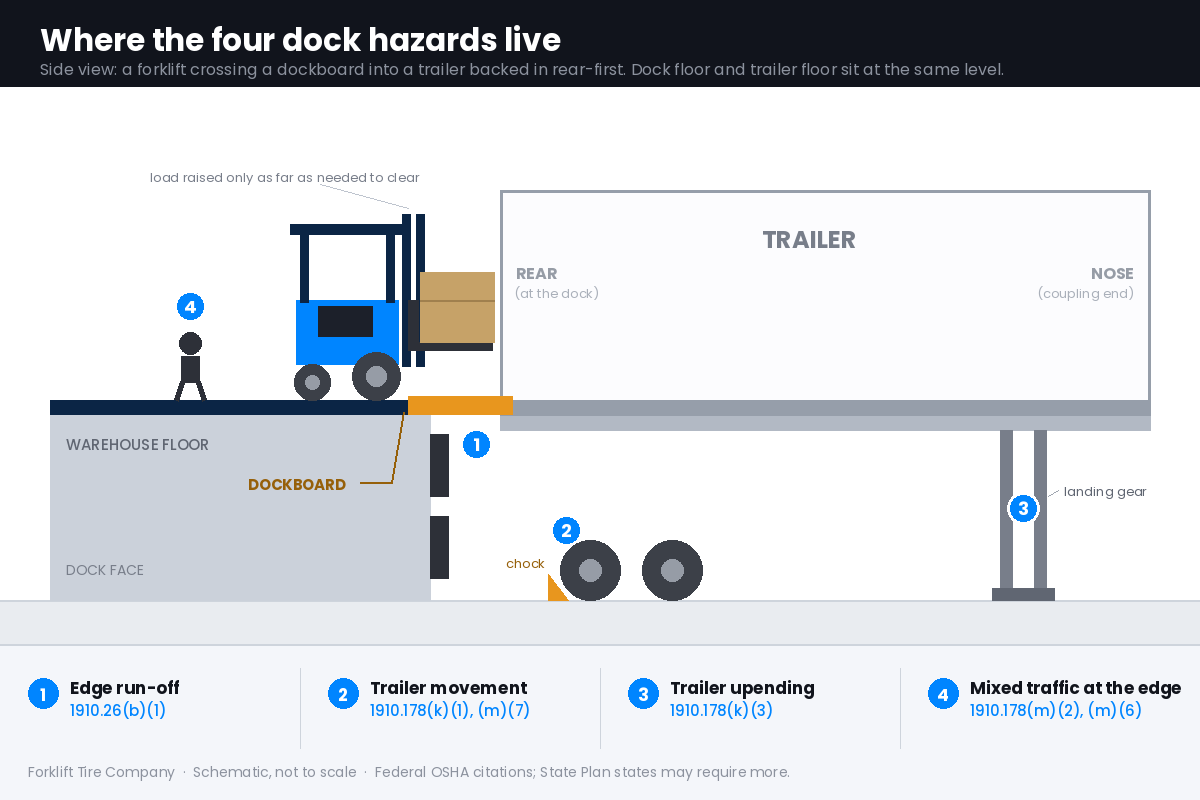
Four hazards stack on top of each other in a space that is often only a few truck lengths deep. They are worth naming separately because each one has a different control, and a site that has solved one may not have touched the others. A fifth — engine exhaust building up inside the trailer — is an atmospheric hazard rather than a movement one, so it does not appear in the cross-section below; it has its own section.
| Hazard | What actually happens | Primary control |
|---|---|---|
| Edge run-off | The truck leaves the dock or the dockboard sideways and drops to the drive below, which can cause fatal crushing injuries. | Run-off protection on dockboards placed in service on or after 17 January 2017 — 1910.26(b)(1); safe distance from the edge of an elevated dock — 1910.178(m)(6); speed that permits a safe stop — 1910.178(n)(8) |
| Trailer movement | The trailer creeps forward under repeated entries, or departs early, and the gap opens under a loaded truck. | Brakes set plus chocks or a positive restraint — 1910.178(k)(1), (m)(7); departure control |
| Trailer upending | An uncoupled semitrailer rests on its landing gear and rear axles; a heavy truck travelling between those supports can overload one or lift the trailer off it. | Fixed jacks or trailer stands — 1910.178(k)(3) |
| Mixed traffic at the edge | People stage, count and stand in the same strip where the truck reverses and where loads pass overhead. | Separation and the clear-view rules — 1910.178(m)(2), (n)(4), (n)(6) |
If you are working out which of these your dock design makes worse, the companion piece is worth reading first: Understanding the Different Kinds of Loading Docks compares enclosed, open, sawtooth and flush configurations. An open dock, for instance, gives you more edge to manage than a flush one does.
Secure the trailer before you drive onto it
This is the section worth reading twice, because the rule that everyone quotes is narrower than they think and the rule that actually protects the operator is broader.
What the standard says
Two paragraphs of the powered industrial truck standard address it. They are not identical, and the difference matters.
- 1910.178(k)(1) — “The brakes of highway trucks shall be set and wheel chocks placed under the rear wheels to prevent the trucks from rolling while they are boarded with powered industrial trucks.” Note that this one is written about highway trucks and specifies chocks under the rear wheels.
- 1910.178(m)(7) — “Brakes shall be set and wheel blocks shall be in place to prevent movement of trucks, trailers, or railroad cars while loading or unloading.” This one is broader: trucks, trailers and railroad cars, during loading or unloading generally.
Rail service adds two more: 1910.178(k)(2) requires wheel stops or other recognized positive protection to keep railroad cars from moving during loading or unloading, and 1910.178(k)(4) requires positive protection against railroad cars being moved while dockboards or bridge plates are in position.
Chocks are not the only compliant answer
OSHA settled this in a 1981 directive that is still in force. STD 01-11-007, Mechanical Means to Secure Trucks or Trailers to a Loading Dock (August 5, 1981), states that “a positive mechanical means to secure trucks or trailers to a loading dock is allowed provided the system is installed and used in a manner that effectively prevents movement of trucks and trailers during loading, unloading and boarding by handtrucks and powered industrial trucks.”
The directive goes further and addresses citation directly: where such a system is used under the stated conditions, “failure to use wheel chocks in accordance with 29 CFR 1910.178(k)(1) and (m)(7) will be deemed to be de minimis violations and will not be cited.” In plain terms, a properly installed and properly used dock lock or vehicle restraint is an accepted alternative to chocks, not a supplement you still have to back up with chocks.
The directive states its conditions, and they are operational, not paperwork. Beyond the system effectively preventing movement, “[a]ll of the mechanical equipment shall be installed, maintained and used as recommended by the manufacturer,” and “[a]ny damaged mechanical equipment will be removed from service immediately.” A restraint that is bypassed, out of maintenance, or damaged and still in service is not the thing the directive describes, and the de minimis treatment does not follow it.
Who the chocking rule applies to — the part that surprises people
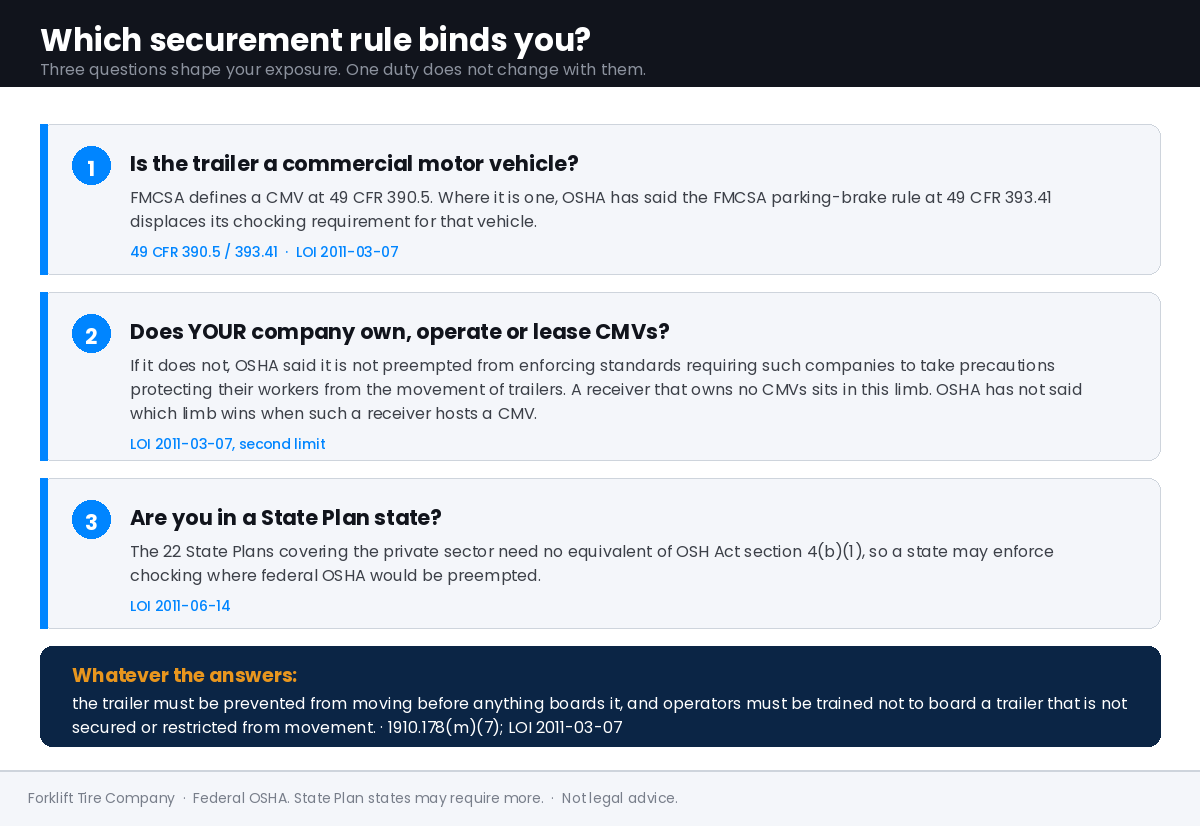
In a March 7, 2011 letter of interpretation, OSHA clarified its own authority. Because of section 4(b)(1) of the OSH Act, “FMCSA regulations preempt OSHA chocking requirements with respect to CMVs” — the Federal Motor Carrier Safety Administration parking brake rule at 49 CFR 393.41 displaces OSHA’s chocking requirement for commercial motor vehicles as FMCSA defines them. For vehicles that are not CMVs, OSHA said it “is not pre-empted from enforcing its chocking requirements with respect to those vehicles,” and it retains authority over employers who do not own, operate or lease CMVs.
A November 8, 2005 letter reached the same place on a different question. Asked about trailers docked at buildings with a downward approach, OSHA answered that if the trailer is a CMV it would not enforce its chocking requirements, and if the trailer is not a CMV it would enforce them “regardless of the dock’s downward approach.” The geometry of the dock did not change the analysis; the classification of the vehicle did.
Read that carefully, because the preemption has two limits in the same paragraph and summaries routinely carry only the first. OSHA wrote that because the FMCSA parking brake regulations “do not apply to vehicles which are not CMVs, OSHA is not pre-empted from enforcing its chocking requirements with respect to those vehicles” — that is the vehicle test. It then added a second, independent limit: because those regulations “do not apply to companies which do not own, operate, or lease CMVs, OSHA is not pre-empted from enforcing standards requiring such companies to take precautions to protect their workers, such as forklift operators, from the movement of trailers.”
So the first question is not only what is parked in your dock — it is who you are. FMCSA defines a commercial motor vehicle at 49 CFR 390.5, and whether a given trailer meets it turns on that definition rather than on anything visible from the dock. But the FMCSA parking brake rule reaches motor carriers. If you run a warehouse, plant or distribution center that does not own, operate or lease CMVs, the second limit is the one that describes you. Note how OSHA words the two limbs differently: the vehicle limb preserves “its chocking requirements,” while the company limb preserves “standards requiring such companies to take precautions to protect their workers, such as forklift operators, from the movement of trailers.” So the sound reading is that the duty to prevent the trailer moving reaches you whatever is backed into the door. OSHA has not squarely said which limb governs a chocking citation against a receiver who owns no CMVs but hosts one; the training duty below is not in doubt either way. Preemption is written for the motor carrier, not the receiver.
Two things survive that preemption, and they are the two that matter operationally.
- The training duty is untouched. In the same 2011 letter, OSHA stated that forklift operators must be trained that they cannot operate on trailers at docks unless the trailer is properly secured or restricted from movement prior to boarding. Preemption limits which agency writes the chocking citation. It does not give anyone permission to board an unsecured trailer.
- State Plan states are not bound by it. A June 14, 2011 letter addressed this directly: the 22 State Plans covering the private sector “are not required to have a provision equivalent to Section 4(b)(1) in their State enabling legislation and may have different statutory language regarding overlap of jurisdictional authority with other Federal agencies.” A State Plan state can enforce chocking where federal OSHA would be preempted. If you run docks in more than one state, this is not a detail you can generalize away.
Trailer creep, separation, and the uncoupled trailer
Creep is the slow forward walk of a trailer under the repeated push of a forklift entering and braking inside it. Nothing dramatic happens until the gap has opened far enough that the dockboard loses its purchase. Early departure is the other version of the same failure: the driver pulls out while a truck is still inside or on the plate. Both are movement, and both are what the brake-and-block rules exist to stop.
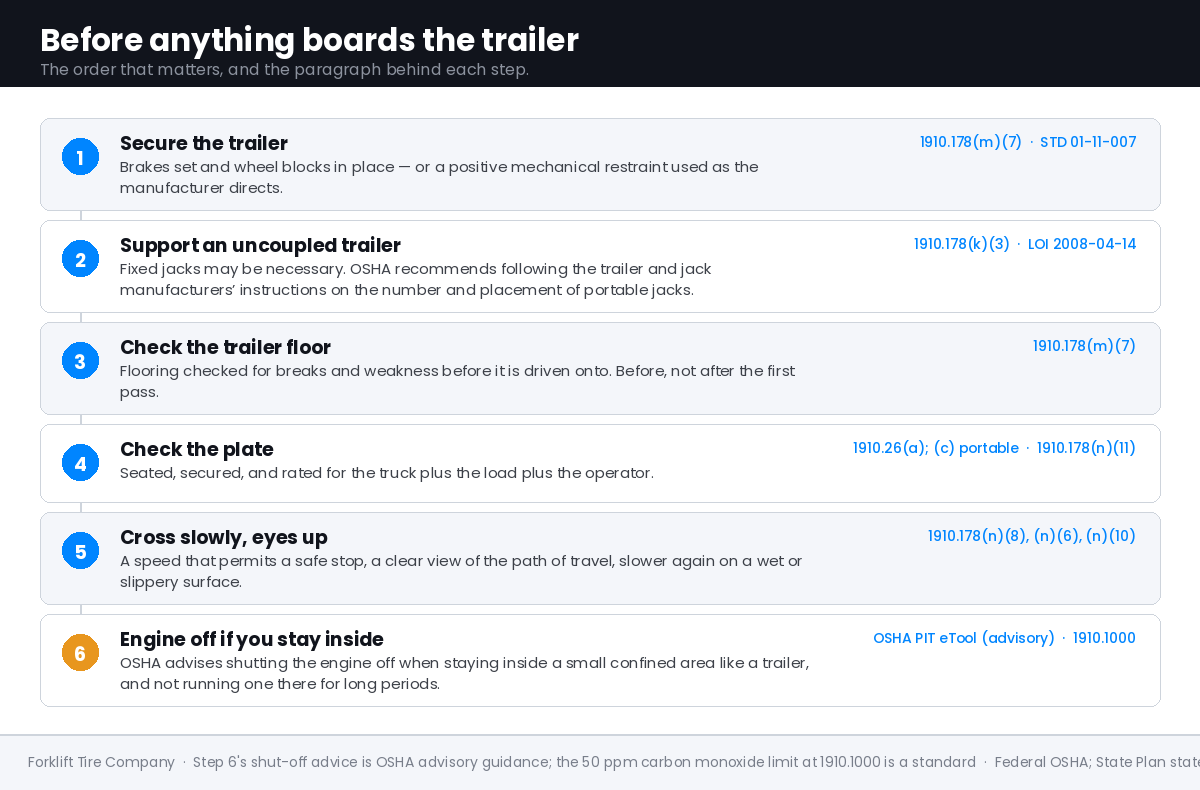
There is a third failure that chocks do nothing about. 1910.178(k)(3) states that “[f]ixed jacks may be necessary to support a semitrailer and prevent upending during the loading or unloading when the trailer is not coupled to a tractor.”
The mechanism is worth understanding rather than memorising. A trailer dropped at the dock without its tractor rests on two supports: its rear axle group, near the dock, and its landing gear, toward the nose. A forklift and its load are several tons moving between those two points, and the weight on each support changes continuously as the truck travels. Chocks hold a trailer against rolling. They do nothing about what happens when that travelling weight overloads a support or lifts the trailer off one.
OSHA addressed the supports themselves in an interpretation dated 14 April 2008. Three points from it are worth carrying: the standard “does not specify a particular type of jack, nor the number and placement of such jacks”; “when using portable jacks to support semi-trailers, OSHA strongly recommends following both the trailer and the jack manufacturer’s instructions on the appropriate number and placement of these jacks”; and OSHA describes (k)(3)’s “may be necessary” wording as advisory rather than mandatory. Be precise about what that does and does not soften. The jack sentence appears twice — at (k)(3) and again as the second sentence of (m)(7) — in the same “may be necessary” construction, so the same reading follows, though OSHA’s letter speaks only to (k)(3). Either way the supports are a judgement call you make against the manufacturers’ instructions. The first sentence of (m)(7), the duty to set brakes and place wheel blocks so the trailer cannot move while you load or unload, is not advisory at all.
Check the floor you are about to drive onto
The third sentence of 1910.178(m)(7) is a requirement in its own right and is easy to read past: “The flooring of trucks, trailers, and railroad cars shall be checked for breaks and weakness before they are driven onto.” Not after the first pass, and not only when something looks wrong — before. A soft or broken trailer floor under a loaded truck is a different failure from creep, and no amount of securement addresses it.
The dockboard: rated, secured, and driven correctly
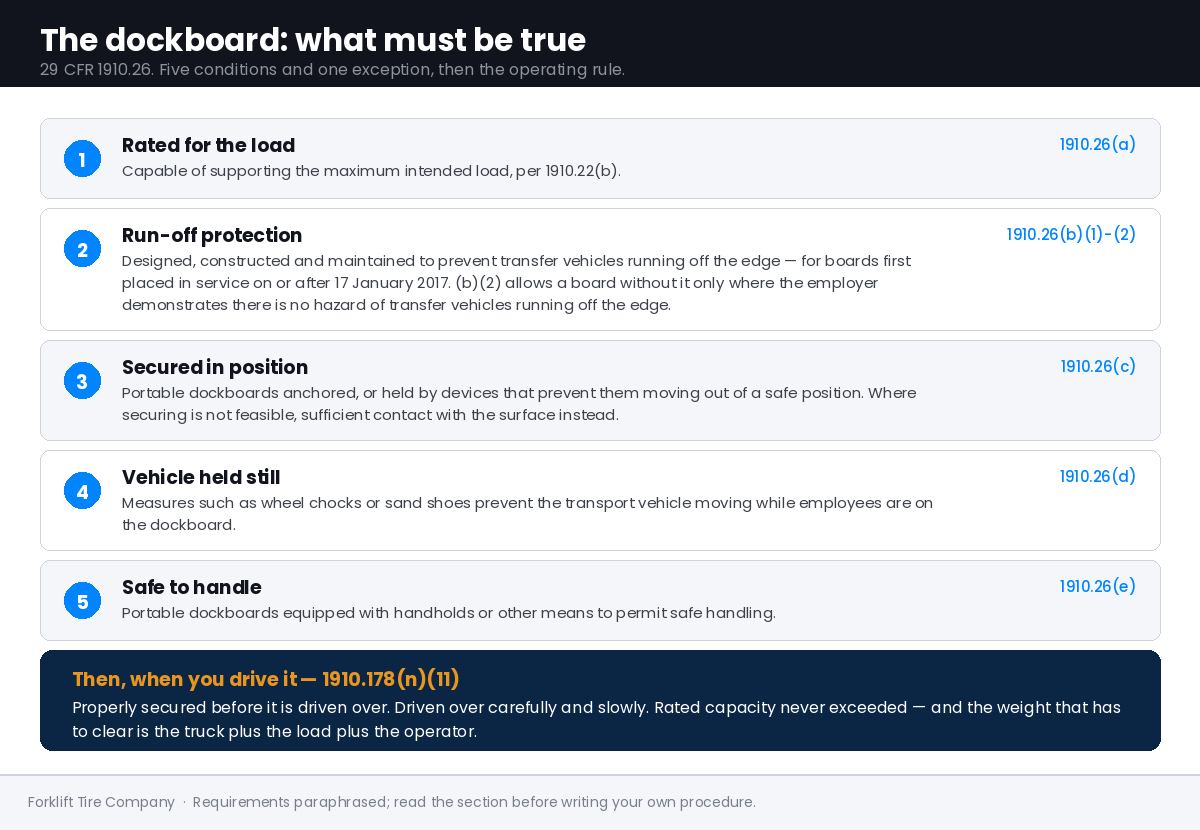
Dockboards get their own OSHA section, 1910.26, in the walking-working surfaces subpart. It is short and every clause of it is operational.
| Paragraph | What the paragraph provides |
|---|---|
| (a) | Dockboards are capable of supporting the maximum intended load, in accordance with 1910.22(b). |
| (b)(1) | Dockboards put into initial service on or after January 17, 2017 are designed, constructed and maintained to prevent transfer vehicles from running off the dockboard edge. |
| (b)(2) | An exception applies where the employer demonstrates there is no hazard of transfer vehicles running off the dockboard edge — a narrower test than “no hazard,” and a demonstration rather than an assumption. |
| (c) | Portable dockboards are secured by anchoring them in place or by equipment or devices that prevent the dockboard from moving out of a safe position. Where the employer demonstrates that securing is not feasible, there must instead be sufficient contact between the dockboard and the surface to prevent it moving out of a safe position. |
| (d) | Measures “such as wheel chocks or sand shoes” are used to prevent the transport vehicle from moving while employees are on the dockboard. |
| (e) | Portable dockboards are equipped with handholds or other means to permit safe handling. |
Two things in that table are easy to miss. The run-off requirement in (b)(1) is dated — it attaches to dockboards put into initial service on or after January 17, 2017, so an older plate still in rotation may predate it. And (d) is the second place chocks appear in the regulations, this time tied to employees being on the dockboard rather than to a forklift boarding the trailer.
The operating rule sits in the forklift standard instead. 1910.178(n)(11): “Dockboard or bridgeplates, shall be properly secured before they are driven over. Dockboard or bridgeplates shall be driven over carefully and slowly and their rated capacity never exceeded.” Rated capacity means the plate’s capacity, and the number that has to clear it is the truck plus the load plus the operator — not the load alone. If nobody at your dock can state the plate’s rating from memory, that is the gap to close this week.
The edge: falls, pedestrians, and the fall zone
Fall protection at the dock edge and on the dockboard
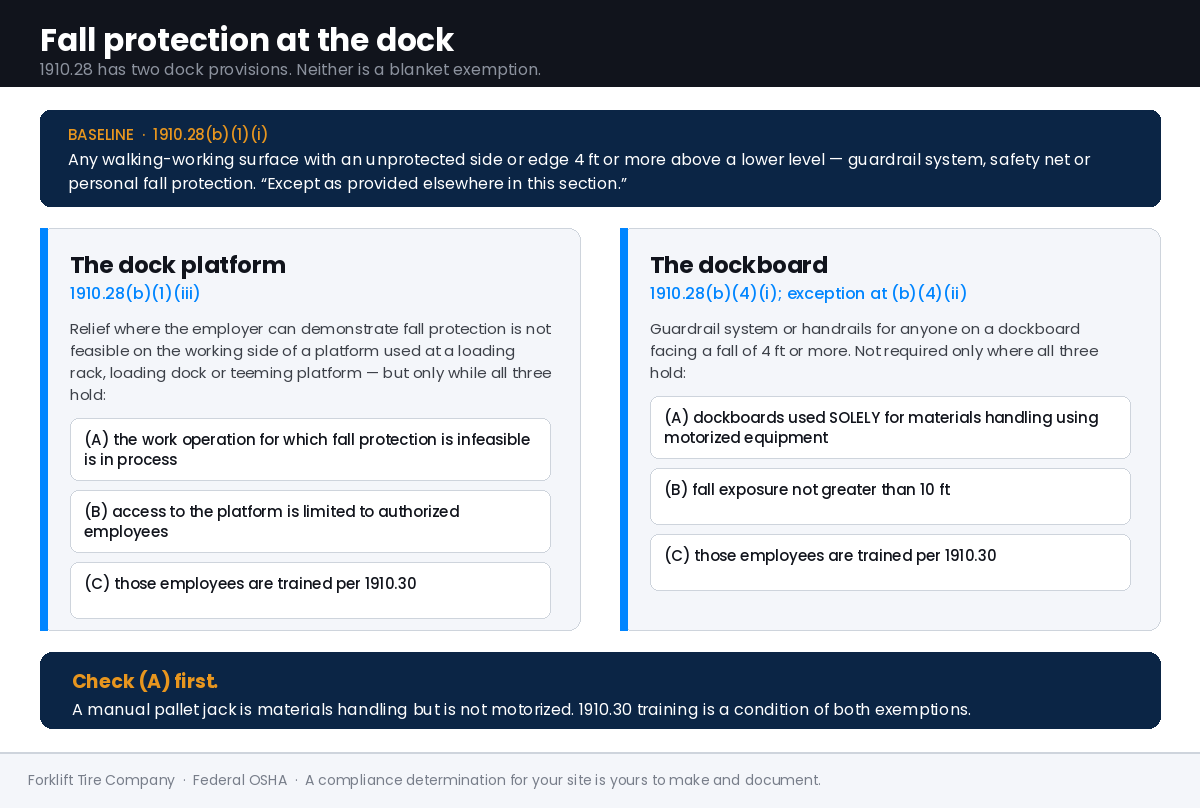
OSHA’s general fall protection duty is 1910.28(b)(1)(i): each employee on a walking-working surface with an unprotected side or edge 4 feet or more above a lower level must be protected by a guardrail system, a safety net system, or a personal fall protection system — “except as provided elsewhere in this section.” That exception clause is the important part, because two paragraphs elsewhere in 1910.28 are written about docks by name.
The dock platform — 1910.28(b)(1)(iii). Where the employer “can demonstrate that the use of fall protection systems is not feasible on the working side of a platform used at a loading rack, loading dock, or teeming platform, the work may be done without a fall protection system,” provided all three of the following hold: (A) the work operation for which fall protection is infeasible is in process; (B) access to the platform is limited to authorized employees; and (C) those authorized employees are trained in accordance with 1910.30.
The dockboard itself — 1910.28(b)(4). Each employee on a dockboard must be protected from falling 4 feet or more to a lower level by a guardrail system or handrails. A guardrail system or handrails are not required when all three of these hold: (A) the dockboards are being used “solely for materials-handling operations using motorized equipment”; (B) the employees engaged in those operations are not exposed to fall hazards greater than 10 feet; and (C) those employees have been trained in accordance with 1910.30.
Read those together and the shape is clear. Neither is a blanket exemption for docks — each is conditional relief, and in both cases one of the conditions is 1910.30 training. A site running forklifts across a dockboard is very likely relying on the (b)(4)(ii) exception. Check all three conditions, and check (A) first: the exception holds only where the dockboard is used solely for materials handling with motorized equipment. The test is what the dockboard is actually used for, so look honestly at the other traffic it carries. A manual pallet jack is materials handling, but it is not motorized — a plate that routinely carries one is not being used solely for motorized materials handling, and (A) is not met. Where the only other presence is a person working as part of the motorized operation itself, the question is closer and turns on the facts. Where the plate is also serving as a walkway, (A) fails, and no amount of operator training substitutes for it. Then check (C), the 1910.30 training. The infeasibility demonstration under (b)(1)(iii) is the employer’s to make, and worth documenting.
One caution on sources. An OSHA interpretation dated 23 March 1976 is quoted in a good deal of dock-safety material, and it says “[o]pen-sided dock areas 4 feet or more above adjacent floor or ground level where there is the danger of employee falling shall be guarded by a standard railing or the equivalent.” It was written against 1910.23(b), a standard the 2017 walking-working surfaces rule replaced — 1910.23 today is the ladders standard. You do not have to take our word for it: OSHA now serves that letter under its own banner reading “NOTICE: This is an OSHA Archive Document, and may no longer represent OSHA Policy. It is presented here as historical content, for research and review purposes only.” It is not current law and should not be cited as though it were. The paragraphs above are.
People in the same strip as the truck
The dock concentrates the two things that make pedestrian incidents happen: reversing trucks and people who have a reason to stand near them. The operating rules are unambiguous and they apply here exactly as they do in the aisles.
- 1910.178(m)(2) — “No person shall be allowed to stand or pass under the elevated portion of any truck, whether loaded or empty.”
- 1910.178(n)(6) — the driver must look in the direction of, and keep a clear view of, the path of travel.
- 1910.178(n)(4) — slow down and sound the horn at cross aisles and other locations where vision is obstructed; if the load blocks forward view, travel with the load trailing. A trailer nose and a stacked staging lane both qualify as obstructed vision. Note that this does not override the grade rules: (n)(7) requires grades to be ascended and descended slowly, and on grades over 10 percent loaded trucks are driven with the load upgrade regardless of which way that leaves you facing. And on all grades, not only steep ones, (n)(7)(iii) requires the load and load engaging means to be tilted back where applicable and raised only as far as necessary to clear the road surface. A dock approach is a grade.
- 1910.178(m)(6) — “A safe distance shall be maintained from the edge of ramps or platforms while on any elevated dock, or platform or freight car.” OSHA’s Powered Industrial Trucks eTool, which is advisory guidance rather than a standard, adds two practical items for docks: watch for tail swing — the rear of a counterbalanced truck swings wide through a turn, and at a dock edge that is how it leaves the deck — and paint the dock edges to make them visible.
- 1910.178(m)(5)(i) — when a truck is left unattended, load engaging means fully lowered, controls neutralized, power off, brakes set, and “[w]heels shall be blocked if the truck is parked on an incline.”
For the separation side of this — walkways, sight lines, and the fall zone under a raised load — see the Forklift Pedestrian Safety Guide.
Engine exhaust inside the trailer
Everything above is about things that move. This one is about the air. A trailer backed against a dock is a closed metal box with one opening, and an internal-combustion truck working inside it is running an engine in that box. Electric trucks do not produce engine exhaust; gasoline, propane and diesel trucks do.
OSHA sets a permissible exposure limit for carbon monoxide of 50 ppm as an 8-hour time-weighted average (29 CFR 1910.1000, Table Z-1). And the training standard already treats this as dock-relevant: 1910.178(l)(3)(ii)(H) makes “closed environments and other areas where insufficient ventilation or poor vehicle maintenance could cause a buildup of carbon monoxide or diesel exhaust” one of the workplace topics operator training must cover where it applies.
Read that number carefully: it is an averaged limit, not a safe ceiling. Under 1910.1000(a)(2) the duty is that exposure “shall not exceed the 8-hour Time Weighted Average given for that substance in any 8-hour work shift of a 40-hour work week” — so an 8-hour average comfortably under 50 ppm can still contain a short, dangerous excursion. That is why the practical controls below are written around shutting the engine off rather than around hitting a number. OSHA’s eTool states the consequence plainly: “Unconsciousness and death may result from carbon monoxide overexposure as the concentration in the bloodstream rises.”
OSHA’s Powered Industrial Trucks eTool — advisory guidance rather than a standard — gives the practical version, and it names the trailer specifically:
- “Do not operate a gasoline/propane/diesel engine for long periods of time in a confined area, such as a truck trailer.”
- “Shut the engine off when staying inside a small confined area like a trailer.”
- “Do not operate a combustion engine within a warehouse, plant or onboard ship without adequate ventilation.”
- “Be careful in cold weather. Doors and windows which are normally open may be closed and exhaust and other gases may concentrate.”
- “Drive sensibly. Avoid racing the engine or idling for long periods of time.”
- “Properly maintain engines and do not operate an engine requiring servicing” — which the eTool ties back to 1910.178(p)(1), the same out-of-service rule that governs a truck that will not stop on the plate.
- “Install CO monitors to detect levels.” — the only control on the list that detects the gas itself, rather than reducing it or relying on someone noticing symptoms.
- “Consider upgrading the ventilation system.”
- “Consider switching to battery-powered forklifts, if much of the work is in poorly ventilated spaces or operators may be over-exposed to exhaust byproducts.”
- “Train employees to recognize the warning signs of excessive exposure.”
Cold weather is the part worth flagging to a supervisor. The doors that ventilate a dock in July are the doors someone closes in January, and the same truck doing the same work in the same trailer is then working in a smaller volume of air.
Traction, stopping, and truck condition
A steel plate that is wet, oily or frosted is a different surface from the concrete on either side of it, and the truck crosses between them several times an hour. Four operating rules apply, and none of them mention tires:
- 1910.178(n)(8) — “Under all travel conditions the truck shall be operated at a speed that will permit it to be brought to a stop in a safe manner.” The speed is set by the conditions, not by the schedule.
- 1910.178(n)(10) — the driver must slow down for wet and slippery floors.
- 1910.178(n)(15) — reduce speed before turning, and steer smoothly. Dock work is largely turning under load.
- 1910.178(p)(1) — “If at any time a powered industrial truck is found to be in need of repair, defective, or in any way unsafe, the truck shall be taken out of service until it has been restored to safe operating condition.”
Treat a slide as a diagnostic, not an annoyance — but do not assume which thing failed. Stop the operation, secure the area, and investigate before anyone drives it again. A slide can come from the truck, from the surface, or from how it was being driven, and each routes somewhere different: a truck found defective or unsafe comes out of service under 1910.178(p)(1); a contaminated or damaged surface is corrected before reuse, or guarded until it is, under 1910.22(d)(2) — and the same paragraph, at (d)(1), requires those surfaces to be inspected regularly and as necessary in the first place; and refresher training is triggered where the operator was observed operating unsafely under 1910.178(l)(4)(ii)(A) or was involved in an accident or near-miss under (l)(4)(ii)(B). Work through contamination on the plate or floor, brake condition, speed and load, and the condition and suitability of the tires. Fix the cause you find rather than the one you expected.
On the tire question specifically, we will be straight with you rather than sell you something. This guide does not establish a stopping-distance advantage for any tread pattern or compound on a steel dock plate, and we are not going to imply one. Any traction benefit is specific to the product, the surface and the contamination present. What is worth checking is condition and suitability: tire condition and suitability are part of safe truck operation, tires should be selected for the truck and the application using the manufacturer’s guidance, and wear should be inspected against that manufacturer’s limits — worn-smooth tread, chunking, separation, or a compound that was never chosen for the surface the truck spends its day on.
Where a check belongs in a routine, it belongs in the daily one. The Forklift Daily Inspection Checklist covers the pre-shift sequence, and When To Replace Forklift Tires covers the wear indicators that decide the call. If you are working out which construction your truck is even built for, Forklift Tire Types Explained and Understanding Forklift Tire Tread Patterns are the background. The truck decides cushion or pneumatic, not the buyer — and How to Read a Forklift Data Plate is where that answer lives, with the sidewall as the cross-check.
When a tire has been assessed and does need replacing, the two starting points are Cushion Rubber Press-Ons for cushion trucks and Pneumatic Forklift tire sets for pneumatic-tire trucks. Verify exact tire size and fitment before ordering.
Why a trained operator may still be untrained for your dock
Operator training under 1910.178(l) is not a single generic certificate. 1910.178(l)(3)(ii) lists workplace-related topics that training must cover where they apply, and three of them describe a dock precisely: (A) surface conditions where the vehicle will be operated, (D) pedestrian traffic in areas where the vehicle will be operated, and (G) “[r]amps and other sloped surfaces that could affect the vehicle’s stability.” The list closes with (I), other unique or potentially hazardous environmental conditions in the workplace that could affect safe operation.
The duty sits in the standard itself, not only in guidance. 1910.178(l)(1)(i) requires the employer to ensure each operator is competent to operate safely, demonstrated by completing the training and evaluation in paragraph (l); (l)(2)(ii) makes an evaluation of the operator’s performance in the workplace a component of that training, not an optional extra; and (l)(1)(ii) requires it to be completed before the employer permits the employee to operate. And (l)(5) makes the point in the regulation’s own words: prior training in an (l)(3) topic only excuses repeat training where that training is “appropriate to the truck and working conditions encountered” and the operator has been evaluated and found competent. Put together with the (l)(3)(ii) topic list, an operator who was trained on the same model of truck at a site with no dock has a real gap, and it is the employer’s to close. (OSHA’s training directive CPL 02-01-028 also discusses briefing operators about workplace conditions. That passage belongs to the directive’s enforcement guidance for the longshoring and marine terminal industries (SIC 4491), which implements the settlement agreement reproduced at its Appendix C. Even inside that scope it reaches only an operator certified by a third-party trainer who is then exposed to hazardous workplace conditions that could not reasonably have been foreseen when the training took place. It is not a free-standing universal briefing rule for general industry, and we do not cite it as one.)
Two more triggers are easy to overlook. 1910.178(l)(4)(ii)(E) requires refresher training when “a condition in the workplace changes in a manner that could affect safe operation of the truck” — a new leveler, a new restraint system, a re-routed staging lane. And 1910.178(l)(4)(iii) requires an evaluation of each operator’s performance at least once every three years, regardless of whether anything has changed.
The employer-side requirements are set out in full in OSHA Forklift Training Requirements, and the operator-side duties in the Forklift Operator Guide.
Required vs. good practice, side by side
The left column is the duty and where it comes from. The right column is one way to discharge it — a worked example, not a requirement. Keep the distinction in mind when you read a citation: standards create the obligation; directives and interpretation letters explain how OSHA applies and enforces it, and do not themselves add duties. Where a row cites a directive or letter, it is telling you how the standard is read, not adding a new rule.
| Federal requirement, and the guidance that explains it | Example implementation practice |
|---|---|
| Brakes set and wheel blocks in place before loading or unloading — 1910.178(m)(7); chocks under the rear wheels of highway trucks — (k)(1) | A written dock procedure naming who chocks, who releases, and who confirms before the first entry |
| Dockboard secured before being driven over; driven slowly; rated capacity never exceeded — 1910.178(n)(11) | Stenciling the plate rating where the operator can read it from the seat |
| Dockboards rated for maximum intended load — 1910.26(a); run-off protection if placed in service on or after 2017-01-17 — 1910.26(b)(1); portable boards secured — (c) | Assessing older dockboards for run-off hazards and replacing or upgrading them where appropriate — the run-off design requirement reaches boards first placed in service on or after 17 January 2017, so an older plate sits outside it rather than inside the (b)(2) exception |
| Supports for an uncoupled semitrailer — 1910.178(k)(3) says fixed jacks “may be necessary”, and OSHA describes that wording as advisory rather than mandatory (interpretation, 14 April 2008); the underlying duty to prevent trailer movement under (m)(7) is not advisory | Following the trailer and jack manufacturers’ instructions on number and placement, and treating every dropped trailer as needing supports until someone has checked |
| Operators trained not to board a trailer unless it is secured or restricted from movement — LOI 2011-03-07; workplace-specific topics — 1910.178(l)(3)(ii) | Refreshing the dock walkthrough after any layout change, beyond what the (l)(4)(ii)(E) trigger strictly requires |
| Evaluation of the operator’s performance in the workplace as a component of training, completed before the employee is permitted to operate — 1910.178(l)(1)(i), (l)(1)(ii), (l)(2)(ii) | Pairing a new operator with an experienced one for the first week of dock work |
| Speed that permits a safe stop, and slowing for wet or slippery floors — 1910.178(n)(8), (n)(10) | A posted dock speed limit |
| Walking-working surfaces kept clean and orderly and free of hazards such as leaks, spills, snow and ice; workroom floors kept clean and, to the extent feasible, dry; surfaces inspected regularly and as necessary and maintained in a safe condition; hazardous conditions corrected or repaired before an employee uses the surface again, or guarded until they are — 1910.22(a)(1), (a)(2), (a)(3), (d)(1), (d)(2) | Setting the interval, naming one person accountable for clearing the plate and approach, and keeping a written record — the interval and the record are how you show (d)(1) was met |
| Guardrail system or handrails for employees on a dockboard with a 4-ft-or-greater fall, unless all three conditions of the exception are met — 1910.28(b)(4); fall protection on the working side of the dock platform unless infeasibility is demonstrated and (A)(B)(C) are met — 1910.28(b)(1)(iii); 1910.30 training is a condition of both | Marking the dockboard’s fall exposure on the plate so the 10-foot threshold is not argued about after an incident |
| Trailer, truck and railroad-car flooring checked for breaks and weakness before it is driven onto — 1910.178(m)(7) | Photographing a suspect trailer floor and refusing the load in writing |
| Employee exposure to carbon monoxide kept within the permissible exposure limit of 50 ppm as an 8-hour time-weighted average — 1910.1000, Table Z-1; closed environments where insufficient ventilation or poor vehicle maintenance could cause a carbon monoxide or diesel exhaust buildup covered in operator training where it applies — 1910.178(l)(3)(ii)(H) | Shutting the engine off rather than idling inside a trailer, CO monitors on the dock and in the trailer, and a re-brief before winter when the doors get closed |
| Unsafe or defective truck taken out of service — 1910.178(p)(1) | Logging every slide or control loss on the plate as a near-miss, whether or not the truck is tagged |
Frequently asked questions
What are the main hazards at a loading dock?
Four movement hazards, plus one atmospheric, and each needs a separate control. The four: the truck running off the dock or dockboard edge; the trailer moving, whether by creeping forward under repeated entries or by departing early; an uncoupled semitrailer upending as a loaded truck travels between its two supports; and people working in the same narrow strip where trucks reverse and loads pass overhead. The fifth is carbon monoxide from an internal-combustion truck working inside a closed trailer, which is why engine exhaust gets its own section. The dockboard sits in the middle of the four movement hazards, which is why Understanding the Different Kinds of Loading Docks is a useful companion — the dock configuration changes how much edge you have to manage.
Do you need wheel chocks for a forklift at a loading dock?
You need the trailer secured; chocks are one way to do it. 29 CFR 1910.178(m)(7) requires brakes set and wheel blocks in place to prevent movement while loading or unloading, and (k)(1) specifies chocks under the rear wheels of highway trucks. But OSHA directive STD 01-11-007 accepts a positive mechanical restraint securing the trailer to the dock as an alternative, and states that where such a system is properly installed and used, failure to use chocks will be treated as de minimis and not cited. Separately, OSHA has said its chocking requirements are preempted by FMCSA rules for commercial motor vehicles — but that preemption has a second limit people miss: OSHA is not preempted as to companies that do not own, operate or lease CMVs, which is the position of a warehouse receiving someone else’s trailer. OSHA has not squarely said which limb wins for a chocking citation there; the duty to prevent the trailer moving reaches you either way. State Plan states are not bound by the preemption either, and the duty to train operators not to board an unsecured trailer applies regardless.
What is trailer creep?
Trailer creep is the slow forward movement of a trailer away from the dock, caused by the repeated push and brake of a forklift driving in and out of it. It is gradual and quiet, which is what makes it dangerous: nothing looks wrong until the gap has opened far enough that the dockboard loses its purchase under a loaded truck. Brakes set plus chocks or a positive restraint is the control, and a restraint that mechanically holds the trailer to the dock addresses creep more directly than chocks alone.
Do loading docks require fall protection?
Yes, with two dock-specific conditional exemptions. The general duty at 1910.28(b)(1)(i) covers any walking-working surface with an unprotected side or edge 4 feet or more above a lower level. Then 1910.28(b)(1)(iii) allows work without a fall protection system on the working side of a platform used at a loading rack, loading dock or teeming platform where the employer can demonstrate fall protection is not feasible — but only while the work operation is in process, access is limited to authorized employees, and those employees are trained in accordance with 1910.30. Separately, 1910.28(b)(4) requires a guardrail system or handrails for anyone on a dockboard facing a fall of 4 feet or more, unless the dockboards are used solely for materials-handling with motorized equipment, the fall exposure is not greater than 10 feet, and the employees are trained in accordance with 1910.30. Neither is a blanket dock exemption, and both hinge on 1910.30 training.
Does OSHA require a dock plate or dock leveler to be secured?
Yes, from two directions. 29 CFR 1910.26(c) requires portable dockboards to be secured by anchoring or by equipment or devices that prevent them from moving out of a safe position — and where the employer demonstrates securing is not feasible, it requires sufficient contact between the dockboard and the surface to prevent it moving out of a safe position instead. 1910.26(a) requires them to be capable of supporting the maximum intended load. On the operating side, 1910.178(n)(11) requires that dockboards and bridgeplates be properly secured before they are driven over, driven over carefully and slowly, and that their rated capacity never be exceeded. The capacity that has to clear is the truck plus the load plus the operator, not the load by itself.
Can a forklift build up carbon monoxide inside a trailer?
Yes, if it is an internal-combustion truck. A trailer at a dock is a closed box with one opening — OSHA’s guidance calls it a confined area — and gasoline, propane and diesel engines produce carbon monoxide; electric trucks do not. OSHA’s permissible exposure limit for carbon monoxide is 50 ppm as an 8-hour time-weighted average under 29 CFR 1910.1000, Table Z-1 — an averaged limit rather than a safe ceiling — and 1910.178(l)(3)(ii)(H) makes closed environments where poor ventilation or poor vehicle maintenance could cause a buildup of carbon monoxide or diesel exhaust an operator training topic where it applies. OSHA’s eTool, which is advisory guidance rather than a standard, says not to run a gasoline, propane or diesel engine for long periods in a confined area such as a truck trailer, and to shut the engine off when staying inside one. It also warns that cold weather concentrates exhaust, because doors and windows that are normally open get closed.
How do you safely drive a forklift onto a trailer?
Confirm the trailer is secured and cannot depart before anything boards it, and confirm an uncoupled semitrailer is supported against upending under 1910.178(k)(3). Check the plate is seated, secured and rated for the truck plus the load plus the operator. Cross slowly under 1910.178(n)(11), keep a clear view of the path of travel under (n)(6), and hold a speed that permits a safe stop under (n)(8) — slower again if the surface is wet or slippery, under (n)(10). Check the trailer flooring for breaks and weakness before driving onto it — 1910.178(m)(7) requires that check, it is not optional care. If the truck slides or you cannot control it, stop the operation and investigate rather than adjusting your driving around it — a defective or unsafe truck comes out of service under 1910.178(p)(1), an unsafe surface is inspected and corrected or guarded under 1910.22(d)(1) and (d)(2), and an observed unsafe operation or a near miss triggers refresher training under 1910.178(l)(4)(ii)(A) and (B).
Getting the truck itself right
Dock work is low-speed turning under load across changing surfaces. Tire condition and suitability are part of safe truck operation — a worn or unsuitable tire is one of the conditions 1910.178(p)(1) is written about — though the dock controls above are what actually govern the hazards on this page. Wear rates depend on the tires, the loads, the operating practices and the surfaces, so inspect against the applicable manufacturer’s limits rather than against a rule of thumb.
If you want a second set of eyes on what is on your truck, Forklift Tire Company reviews the data plate and sidewall information with you and helps confirm the size and construction before you order. Call 1 (866) 313-2180. Verify exact tire size and fitment before ordering. Anything touching the truck’s configuration, its capacity rating, or a conflict between the data plate and what is fitted goes to the OEM or an authorized service provider — that is their call, not ours.
Sources
Primary sources, retrieved 3–4 September 2026. Regulatory text quoted from the current Code of Federal Regulations; every source below links to the issuing agency.
- 29 CFR 1910.178, Powered industrial trucks — paragraphs (k)(1)–(k)(4), (l)(1)(i), (l)(1)(ii), (l)(2)(ii), (l)(3)(ii), (l)(4)(ii), (l)(4)(iii), (l)(5), (m)(2), (m)(5)(i), (m)(6), (m)(7), (n)(4), (n)(6), (n)(7), (n)(8), (n)(10), (n)(11), (n)(15), (p)(1).
- 29 CFR 1910.26, Dockboards — paragraphs (a), (b)(1), (b)(2), (c), (d), (e).
- 29 CFR 1910.28, Duty to have fall protection and falling object protection — paragraphs (b)(1)(i), (b)(1)(iii) and (b)(4). Training referenced at 29 CFR 1910.30.
- 29 CFR 1910.22, General requirements (walking-working surfaces) — paragraphs (a)(1), (a)(2), (a)(3), (b), (d)(1) and (d)(2).
- OSHA Directive STD 01-11-007, 29 CFR 1910.178(k)(1) and (m)(7): Mechanical Means to Secure Trucks or Trailers to a Loading Dock, 5 August 1981.
- OSHA interpretation, Clarification of OSHA’s authority to enforce wheel chocking of commercial motor vehicles and related safety hazards at loading facilities, 7 March 2011.
- OSHA interpretation, Enforcement of wheel chocking requirements in State Plan States, 14 June 2011.
- OSHA interpretation, Chocking requirements for trailers docked to buildings with downward approaches, 8 November 2005.
- OSHA interpretation, Use of jack stands in the stabilization of semi-trailers, 14 April 2008.
- OSHA Directive CPL 02-01-028, Compliance Assistance for the Powered Industrial Truck Operator Training Standards, 30 November 2000 — cited only for its scope, see the training section.
- OSHA eTool, Powered Industrial Trucks — Loading Docks — advisory guidance, not a standard.
- OSHA eTool, Powered Industrial Trucks — Enclosed and Hazardous Areas — advisory guidance, not a standard.
- 29 CFR 1910.1000, Air contaminants — paragraph (a)(2); Table Z-1, carbon monoxide.
- OSHA interpretation, Loading docks, 23 March 1976 — cited only to explain why it is not current law; OSHA serves it as an archive document.
- 49 CFR 393.41, Parking brake system — cited as characterized by OSHA in the 7 March 2011 interpretation.
- 49 CFR 390.5, Definitions — cited directly for the definition of a commercial motor vehicle.
This guide describes federal OSHA requirements. State Plan states may impose additional or different requirements — see the securement section. It is general information, not legal advice or a compliance determination for your site.