 1 (866) 313-2180
 SALES@FORKLIFTTIRE.COM


Posted by Forklift Tire Company on 1st Oct 2026
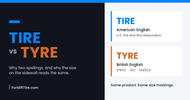
Tire or tyre? Both spellings are correct, and they name the same thing. Tire is the American spelling and tyre is the British one. Merriam-Webster lists tyre as the “chiefly British spelling of tire,” and the Cambridge Dictionary marks it “UK (US tire).” The plural follows the same rule: tires in American English, tyres in British English.
The history is less tidy than the one-line answer. The word goes back to the 1400s, the two spellings were used side by side for centuries, and Britain brought tyre back after tire had become the standard spelling. Tire standards and regulations still split by region today, though manufacturers use both. What the spelling never changes is the size on the sidewall, and that is the part that matters when you order.
In this article
The Short Answer
- Tire is the American spelling. It is also the spelling in U.S. federal tire standards, the U.S. Tire and Rim Association’s name, and Canada’s federal tire regulations.
- Tyre is the British spelling. It is also the spelling at ETRTO in Europe, at ISO, in the UN vehicle regulations, and in the Australian and Indian national standards we checked.
- Same product, same size. A forklift tire size reads the same under either spelling.
Where the Word Comes From
Dictionaries trace tire to attire: the tire as the wheel’s clothing. The first edition of the Oxford English Dictionary called the tire “originally” the “‘attire’, ‘clothing’, or ‘accoutrement’ of the wheel.” Both the OED and Merriam-Webster hedge the link with “probably.”
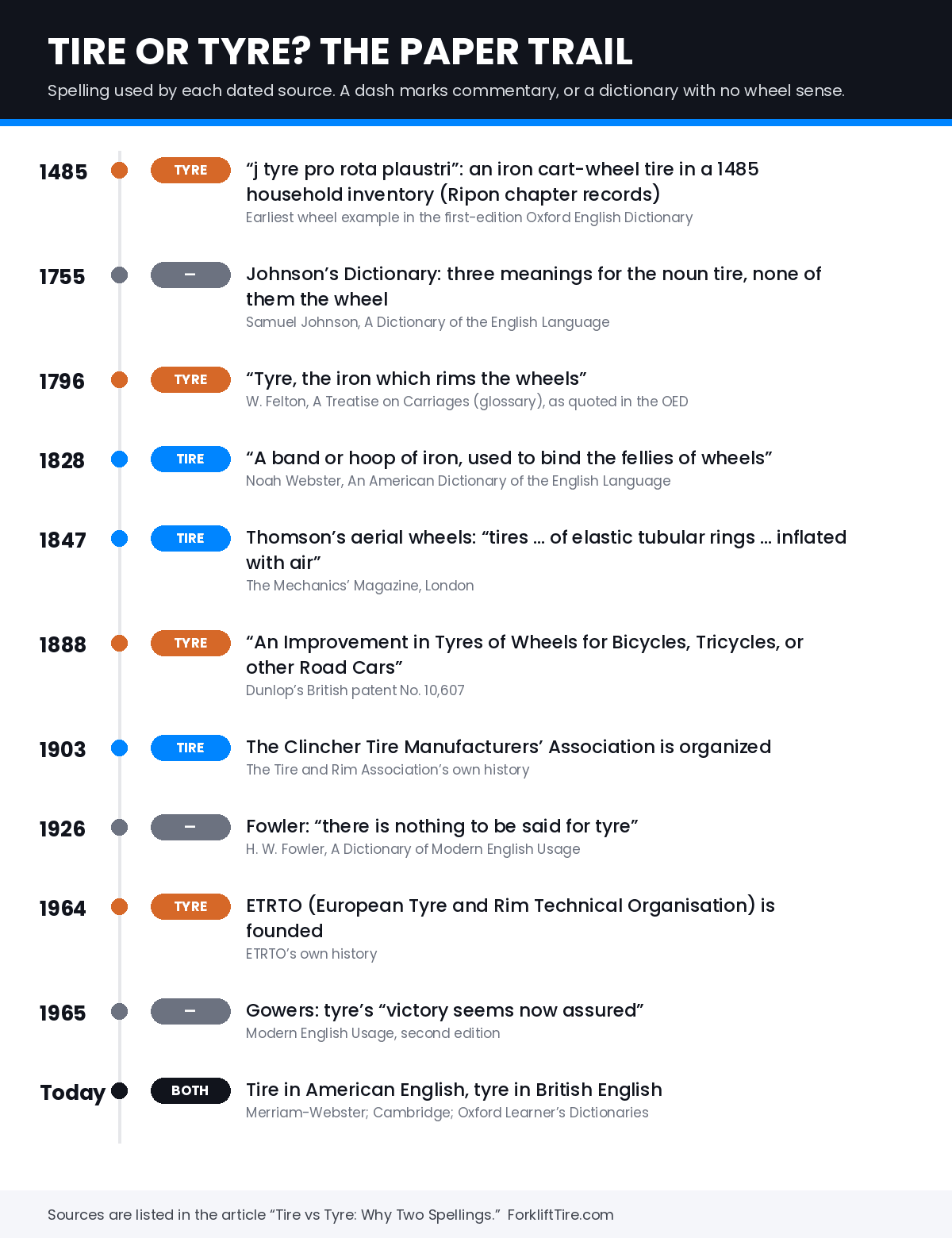
Early tires were iron, not rubber. Merriam-Webster dates the word to the 15th century in the sense of “a metal hoop forming the tread of a wheel.” The OED’s earliest wheel example is from 1485, in a household inventory printed with the records of the Ripon church chapter. It is written in Latin with the English word in the middle: “j tyre pro rota plaustri,” one tyre for a cart wheel.
Two early dictionaries handle the wheel sense differently. Samuel Johnson’s 1755 Dictionary of the English Language gives three meanings for the noun tire: a rank or row, a head-dress, and “furniture; apparatus.” None of them is the wheel. Noah Webster’s 1828 American Dictionary of the English Language includes it: “A band or hoop of iron, used to bind the fellies of wheels, to secure them from wearing and breaking; as cart-tire; wagon-tire.”
How Britain Ended Up With Tyre
The first edition of the OED set out the spelling history when it reached the letter T in the early 20th century: “From 15th to 17th c. spelt . . . tire and tyre indifferently. Before 1700 tyre became generally obsolete, and tire remained as the regular form, as it still does in America; but in Great Britain tyre has been recently revived as the popular term for the rubber rim of bicycle, tricycle, carriage, or motor-car wheels.” (The same dictionary’s separate entry for tyre puts the settling of tire in the 17th century.)
The OED’s examples of the revived British spelling include iron rims. It quotes the glossary of W. Felton’s 1796 Treatise on Carriages: “Tyre, the iron which rims the wheels.” Air-filled tires then arrived under both spellings. In 1847 London’s Mechanics’ Magazine described R. W. Thomson’s “Patent Aerial Wheels” as having “tires being formed of elastic tubular rings, made of india-rubber (vulcanized), and inflated with air.” Forty-one years later, Dunlop’s British patent No. 10,607 of 1888 was titled “An Improvement in Tyres of Wheels for Bicycles, Tricycles, or other Road Cars.”
Across the Atlantic, the spelling was tire, even for Dunlop. In 1891 the U.S. trade journal The India Rubber World listed Dunlop’s own U.S. patent, No. 453,550, as “Tire for vehicle wheels,” assigned to “the Pneumatic Tyre and Booth’s Cycle Agency, Limited, Dublin.”
Not everyone welcomed tyre. H. W. Fowler’s Dictionary of Modern English Usage (first published in 1926) concluded that “there is nothing to be said for tyre, which is etymologically wrong, as well as needlessly divergent from our own older & the present American usage.” When Sir Ernest Gowers revised the book in 1965, he kept the complaint that tyre was “needlessly divergent” but added: “Some die-hards, including The Times, made a long stand against it, but its victory seems now assured.”
Today’s dictionaries record that outcome. Merriam-Webster labels tyre “chiefly British,” and Oxford Learner’s Dictionaries lists tyre as British English and tire as North American English.
Which Spelling Is Older?
It depends on how far back you look. Fowler called tire “our own older” usage, and the OED says tire was the settled spelling from the 1600s on. But the OED’s earliest wheel example, from 1485, is spelled tyre, and the dictionary says the two spellings were used “indifferently” from the 15th to the 17th century. Both spellings are old. Neither is a modern invention, and neither is a misspelling.
Tire and Tyre in the Tire Industry
Standards and regulations split by region. The U.S. and Canadian rules we checked say tire. ETRTO in Europe, ISO, the UN vehicle regulations and the Australian and Indian national standards we checked say tyre, and so do the ISO and ETRTO standards that cover forklift tires. The split is not perfect: U.S. Federal Motor Vehicle Safety Standard No. 109 also names a “Scandinavian Tire and Rim Organization.”
| Organization or document | Where | Spelling | As published |
|---|---|---|---|
| The Tire and Rim Association, Inc. (founded 1903, per TRA) | United States | tire | “…interchangeability standards for tires, rims, valves and allied parts” |
| Federal Motor Vehicle Safety Standard No. 139 (49 CFR 571.139) | United States | tire | “New pneumatic radial tires for light vehicles” |
| SOR/2013-198 | Canada | tire | “Motor Vehicle Tire Safety Regulations” |
| ETRTO (founded October 1964, per ETRTO) | Europe | tyre | “European Tyre and Rim Technical Organisation” |
| ISO 10499-1:2019 | International | tyre | “Industrial tyres and rims — Rubber solid tyres (metric series) for pneumatic tyre rims” |
| UN/ECE Regulation No. 30 | International (UN) | tyre | “…approval of pneumatic tyres for motor vehicles and their trailers” |
| JATMA | Japan | tyre | “The Japan Automobile Tyre Manufacturers Association, Inc.” |
| Australian Design Rule 23/03 | Australia | tyre | “Passenger Car Tyres” |
| IS 15633:2022 | India | tyre | “Pneumatic Tyres for Passenger Car Vehicles” |
Industrial tires sit on both sides of the line. ETRTO’s standards manual has a section titled “Industrial And Lift Truck Tyres Solid,” and its index lists “RUBBER SOLID TYRES (Press-on Type on cylindrical base and conical base).” The U.S. Tire and Rim Association, organized in 1903 as the Clincher Tire Manufacturers’ Association, took its current name in 1933; its history says that soon after, pneumatic tires were “also being used on agricultural, earthmoving, road building and small industrial vehicles.”
Manufacturers don’t split neatly by home country. Continental, based in Hannover, Germany, uses tire in its English-language brochure for the SC20+ industrial tire: “a tire for indoor and outdoor usage on any surface.” Magna Tyres heads its size page “6.50-10 Tyres” on its global site and “6.50-10 forklift tires” on its U.S. site. The three supplier catalogs we checked on FTC’s own shelf mostly say tire. We found only tire in Trelleborg’s XP1000 brochure and the Atlas industrial tire specification book; Astro’s 2026 catalog says tyre only in its 4x4 section.
What the Spelling Means When You Order
Nothing, as long as the size matches. A tire size is a set of numbers, and it reads the same under either spelling. Magna’s “6.50-10 Tyres” page and its “6.50-10 forklift tires” page show the same forklift products, and Continental prints “6.50 - 10” under “Tire size.” FTC lists that size as 6.50x10 (6.50-10) forklift tires. This site uses the American spelling, tire, so if you searched for forklift tyres, the size is what identifies the replacement.
- Start from the truck’s data plate (make, model, serial number, and the tire size and type line where the plate has one) or its manual, then check it against the size molded on the sidewall of the tire you are replacing; if they disagree, sort that out before ordering. How to Read a Forklift Data Plate shows what to look for, and How to Read Forklift Tire Sizes explains each number.
- Whether a truck takes cushion (press-on) or pneumatic-size tires is set by how it was built at the factory. Within that, you choose the compound on a press-on truck, and air-filled or solid on a pneumatic-size truck. Forklift Tire Types Explained covers each type.
- Shop Press-On Forklift Tires or Solid & Pneumatic Forklift Tires.
Tire or tyre, the size is what counts.
Send FTC the make, model and serial number from the data plate and a photo of the tire sidewall. FTC reviews the size with you before you order. Verify exact tire size and fitment before ordering.
Email Your Truck Details Contact UsSave 7.5% on 2–3 items or 15% on 4+ items, automatic in cart. Free ground freight to commercial addresses in the contiguous U.S. Questions? Call 1 (866) 313-2180.
Frequently Asked Questions
Is it tire or tyre?
Both are correct, and they mean the same thing. Tire is the American spelling and tyre is the British one. Merriam-Webster lists tyre as the “chiefly British spelling of tire,” and the Cambridge Dictionary marks tyre “UK (US tire).”
Which spelling is older, tire or tyre?
Both are old. The first edition of the Oxford English Dictionary says the wheel word was spelled tire and tyre “indifferently” from the 15th to the 17th century, and its earliest wheel example, from 1485, is spelled tyre. Tire then became the regular spelling, which is why H. W. Fowler called tire the older English usage in 1926.
Why do the British spell it tyre?
Tire became the settled spelling in the 1600s, and the OED says Britain later revived tyre. Its examples of the revived spelling include iron wheel rims in 1796, and by the time the dictionary reached the letter T it called tyre the popular British term for the rubber rim of bicycle, carriage and motor-car wheels. Dunlop’s 1888 British patent was titled “An Improvement in Tyres of Wheels for Bicycles, Tricycles, or other Road Cars.” Fowler objected in 1926; by 1965 his reviser wrote that tyre’s “victory seems now assured.”
Do Canada, Australia and India use tire or tyre?
Going by their official titles: Canada’s federal rules are the Motor Vehicle Tire Safety Regulations, Australia’s design rule for car tires is titled Passenger Car Tyres, and India’s national standard IS 15633:2022 covers Pneumatic Tyres for Passenger Car Vehicles. Those are official titles, not a rule for everyday writing.
Are forklift tyres and forklift tires the same thing?
Yes. The spelling changes and the product does not. The size reads the same under either spelling: Magna Tyres heads its size page “6.50-10 Tyres” on its global site and “6.50-10 forklift tires” on its U.S. site, with the same forklift products on both. Verify exact tire size and fitment before ordering.
Does the tire industry use tire or tyre?
Both. Among the standards bodies and regulations we checked, the U.S. Tire and Rim Association, U.S. federal safety standards and Canada’s federal regulations use tire; ETRTO in Europe, ISO and the UN vehicle regulations use tyre. ETRTO files forklift tires under its “Industrial And Lift Truck Tyres” sections, and ISO’s standards for them are titled “Industrial tyres and rims.” Manufacturers vary: Continental’s English-language brochure says tire.
More forklift history from FTC: Who Invented the Forklift?
Trademarks: Continental, Magna, Trelleborg, Astro, Atlas, Dunlop and all other brand names are trademarks of their respective owners. Forklift Tire Company is an independent aftermarket supplier and is not affiliated with, authorized by, sponsored by, or endorsed by any tire manufacturer, equipment manufacturer or standards body. Names are used solely to identify products, publications and history.