 1 (866) 313-2180
 SALES@FORKLIFTTIRE.COM


Posted by Forklift Tire Company on 14th Aug 2026
Search for forklift hand signals and nearly every chart you'll find claims to show "OSHA's seven forklift hand signals." Here's the problem: OSHA has never published forklift hand signals. The powered industrial truck standard, 29 CFR 1910.178, doesn't contain the word "signal" anywhere in its text. The signals the industry actually uses are borrowed — adapted from OSHA's crane signal rules — and knowing that distinction matters, because it tells you what an inspector can and can't cite you for, and why your facility still needs a signal system anyway. This guide covers a full 12-signal site-use set with diagrams, the spotter rules that make signals work, what to do in loud or low-light environments, how to fold signals into your OSHA-required operator training, and a free printable chart to post where your trucks work.
The short answer
- No, OSHA does not mandate forklift hand signals. 29 CFR 1910.178 never mentions them. The "official" signals circulating online are adapted from OSHA's crane Standard Method — which legally applies to cranes, not forklifts.
- Yes, OSHA guidance recommends communicating. Its advisory Powered Industrial Trucks eTool says to warn pedestrians "by horn, hand signal, or warning light," use spotters for blind spots, and make eye contact when possible.
- A recognized hazard can still be cited. Where a site-specific struck-by hazard goes unaddressed by feasible controls, OSHA can reach it under the General Duty Clause — but no rule makes skipping a signal chart a violation by itself.
- The stakes are real. BLS counted 614 forklift-related worker deaths from 2011 to 2017, and forklift injuries to pedestrians produced the longest recovery times of any forklift injury — a median 20 days away from work.
- Signals supplement — they don’t substitute. Separate pedestrians from trucks first: walkways, barriers, sightlines, safe speeds. Where people and trucks still share space, pick one signal set, train everyone on it, post the chart. Ours is free to print below.
On this page
What OSHA actually requires — and where the signals really come from
Start with the fact almost every hand-signal chart on the internet gets wrong: there is no federal OSHA forklift hand-signal standard. (State Plan states can impose their own requirements — check yours.) The powered industrial truck rule, 29 CFR 1910.178, regulates operator training, traveling, load handling, maintenance, and daily examinations — and never once uses the word "signal." No mandated gestures, no required signalperson, no chart-posting rule. Pages that promise "the 7 OSHA forklift hand signals" are repeating a claim the regulation doesn't support.
Standardized hand signals do exist in OSHA's rulebook — for cranes. The construction crane standard devotes four sections to signaling (29 CFR 1926.1419 through 1926.1422) and publishes an official chart of 19 gestures — the "Standard Method" — as Appendix A to Subpart CC of Part 1926. That's where the familiar signals come from: hoist, lower, stop, emergency stop, dog everything. The crane rules even require the chart to be posted on the equipment or conspicuously nearby (1926.1422) — but forklifts are expressly excluded from that entire subpart unless the truck is configured to hoist and lower (by means of a winch or hook) and horizontally move a suspended load (1926.1400(c)(8)). When the industry talks about "standard forklift hand signals," it means crane signals adapted to forklift work — a sensible adaptation, but an adaptation, and this article labels it as one.
So does that make hand signals optional? Legally, no specific rule compels them — but OSHA's advisory guidance, and the duties surrounding it, are not silent. Three things fill the gap:
- ✓ OSHA's own guidance recommends them. The agency's Powered Industrial Trucks eTool tells operators to "warn pedestrians of your approach by horn, hand signal, or warning light," to "signal to pedestrians to stand clear," to "use a spotter for blind spots," and — when possible — to "make eye contact with pedestrians or other forklift operators." (The eTool is advisory guidance — it creates no new legal obligations — but it is OSHA's own recommended practice.)
- ✓ The standard requires communication-adjacent behavior. 1910.178(n)(4) requires the operator to "slow down and sound the horn at cross aisles and other locations where vision is obstructed," and (n)(6) requires keeping "a clear view of the path of travel." The same paragraph settles the blocked-load question, too: if the load being carried obstructs the forward view, (n)(4) requires the driver to travel with the load trailing. A spotter can supplement visibility at blind spots — it never waives the operator's own duties.
- ✓ The General Duty Clause backstops it all. Under Section 5(a)(1) of the OSH Act, employers must keep workplaces free of recognized hazards likely to cause death or serious harm. OSHA has stated this reasoning in writing for forklift warning equipment: a November 26, 2012 interpretation letter explains that although 1910.178 doesn't specifically require flashing lights or back-up beepers, an employer whose workplace presents a struck-by hazard "and has not taken feasible steps to mitigate this hazard may be in violation of the General Duty Clause." That letter is about warning devices, not hand signals — what transfers is the analysis: a recognized, site-specific hazard plus feasible controls the employer didn’t use, with every element established. Failure to use this (or any) signal chart is not, by itself, a violation.
And the hazard is thoroughly recognized. The Bureau of Labor Statistics counted 614 forklift-related worker deaths from 2011 through 2017 — roughly 88 per year — and 9,050 nonfatal forklift injuries with days away from work in 2017 alone. Another 1,850 cases that year involved pedestrians while the forklift was in transportation use, and those pedestrian injuries carried the highest median recovery time of any forklift injury: 20 days away from work, versus 8 for workplace injuries overall. The primary controls for that hazard are physical and procedural — separating pedestrian and truck traffic where possible, marked walkways and barriers, mirrors and warning lights at blind spots, and enforced safe speeds, all drawn from OSHA’s own pedestrian-traffic guidance. A shared signal set is the supplemental layer for the moments people and trucks still meet.
The practical takeaway: nobody will hand you a federally mandated forklift signal chart, because none exists. Separation, walkways, barriers, speed, and visibility controls come first. Where people and trucks still share space, pick one signal set, train every operator and spotter on it, post it, and validate it for your operation. The chart below is built for exactly that.
The quick-reference chart: 12 forklift hand signals
The twelve signals below are a site-use set — not an OSHA forklift standard, because none exists. The first nine adapt gestures from OSHA's crane Standard Method (Appendix A to Subpart CC of 29 CFR 1926) to forklift functions — the descriptions of the underlying gestures are built on the official chart's wording, with the forklift adaptation noted where a name changes. The last three are workplace conventions with no standardized source. Agree on the set, train it, and validate it for your operation before relying on it.
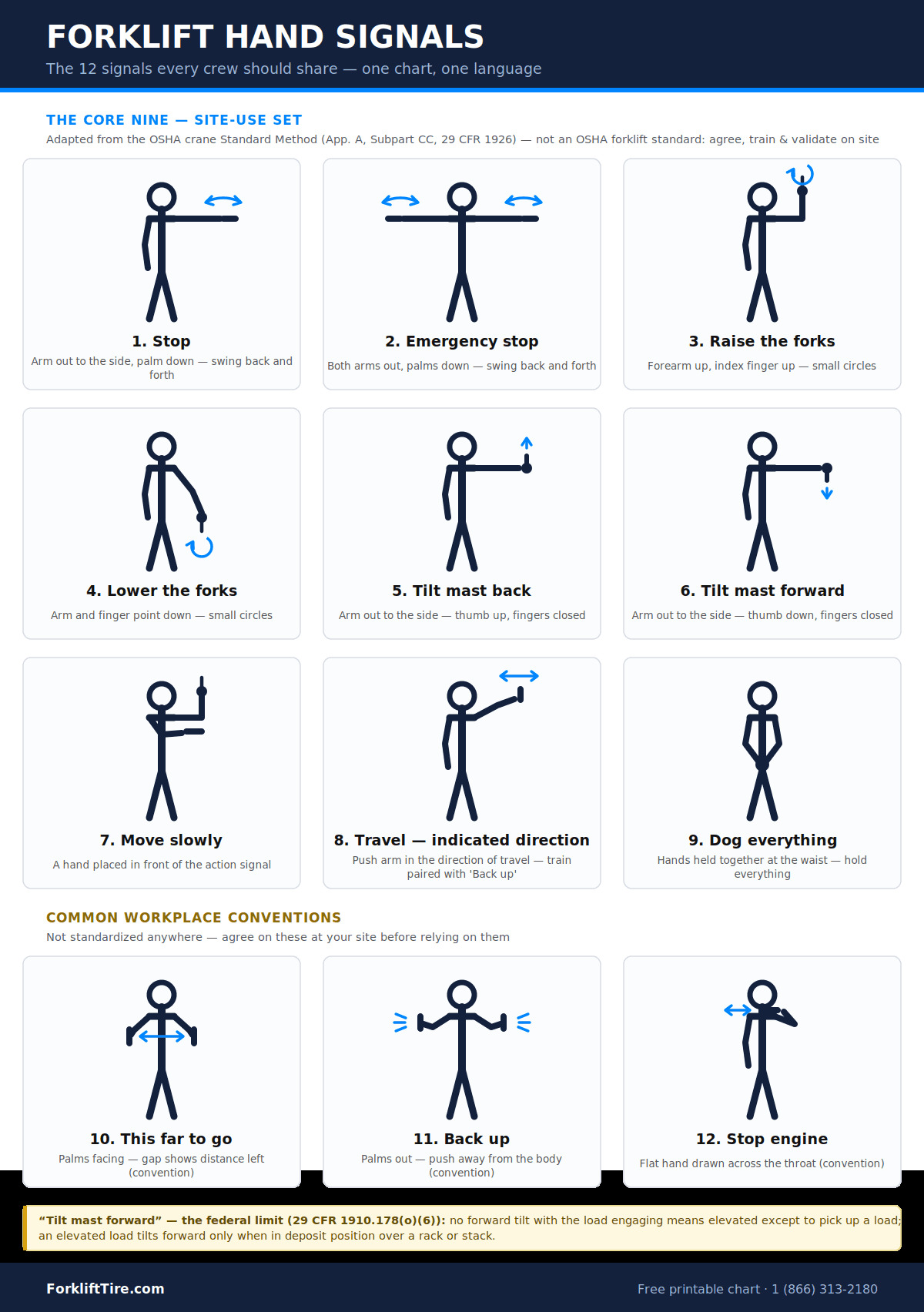
Small screen? Open the full-size chart or download the printable PDF — the table below repeats every signal in text.
| Signal | The motion | When it's used |
|---|---|---|
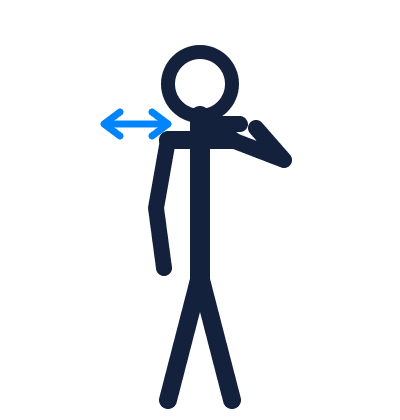
| Stop | Arm extended horizontally to the side, palm down; arm swings back and forth | Normal stop — end the current movement |
| Emergency stop | Both arms extended horizontally, palms down; arms swing back and forth | Immediate danger — anyone on site may give it |
| Raise the forks | Upper arm extended to the side, forearm and index finger pointing straight up; hand makes small circles | Lift the load or forks (crane "hoist") |
| Lower the forks | Arm and index finger pointing down; hand makes small circles | Lower the load or forks (crane "lower") |
| Tilt mast back | Arm extended horizontally to the side, thumb up, other fingers closed | Tilt load back toward the truck (adapted from crane "raise boom") |
| Tilt mast forward | Arm extended horizontally to the side, thumb down, other fingers closed | Tilt load forward for placement (adapted from crane "lower boom") |
| Move slowly | One hand placed in front of the hand giving the action signal | Modifier — do the signaled action at creep speed |
| Travel — indicated direction (train paired with "Back up") | Arm extended, fingers pointing up; arm pushes out and back in the direction of travel | Guide the truck toward the spotter's chosen direction |
| Dog everything | Hands held together at waist level | Pause — hold everything exactly where it is |
| This far to go (convention) | Hands raised, palms facing each other, gap showing the remaining distance | Final approach — docks, racking, trailer walls |
| Back up (convention) | Both hands raised, palms out, pushing away from the body | Reverse away from the spotter |
| Stop engine (convention) | Hand drawn flat across the throat | Shut the truck down — end of task or developing fault |
The 9 core signals, explained
These nine track the OSHA crane Standard Method most directly — the gesture descriptions below follow the official chart's wording, with the forklift adaptation noted where the name changes. For each: how it's given, and the mistake that most often garbles it in real use.
1. Stop
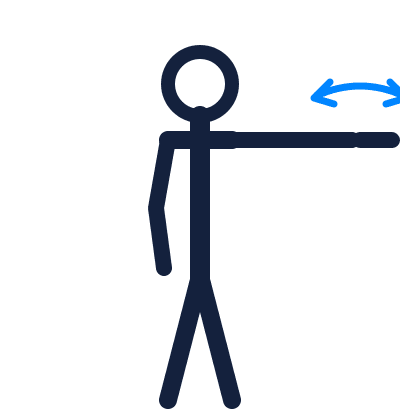
Arm extended horizontally to the side, palm down, arm swung back and forth. This is the everyday stop — end the current movement and await the next signal. Common mistake: a lazy half-raised arm that reads as a wave. The arm stays at full shoulder height and keeps swinging until the truck has actually stopped.
2. Emergency stop
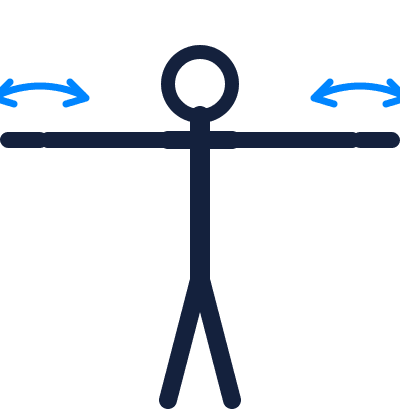
Both arms extended horizontally to the sides, palms down, both swung back and forth. This is the one signal that should never belong to the spotter alone: adopt the crane rule (1926.1419(j)) as site policy — anyone who becomes aware of a safety problem gives the stop or emergency stop, and the operator obeys it regardless of who gave it. Common mistake: reserving it for the designated signaler. The whole point of a two-arm emergency signal is that a bystander can end a developing incident.
3. Raise the forks (crane "hoist")

Upper arm extended to the side, forearm and index finger pointing straight up, hand and finger making small circles. Common mistake: pointing without the circles. The circular motion is what distinguishes an active "keep raising" command from someone pointing at the racking.
4. Lower the forks (crane "lower")
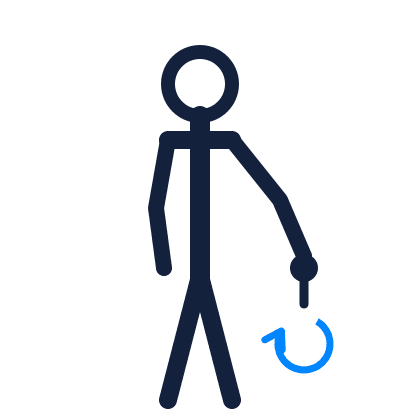
Arm and index finger pointing down, hand and finger making small circles. Same rule in the opposite direction — the circles mean "keep going," and stopping the circles plus a stop signal means halt. Common mistake: signaling from inside the truck's path while watching descending forks. Position first, signal second.
5. Tilt mast back (adapted from crane "raise boom")
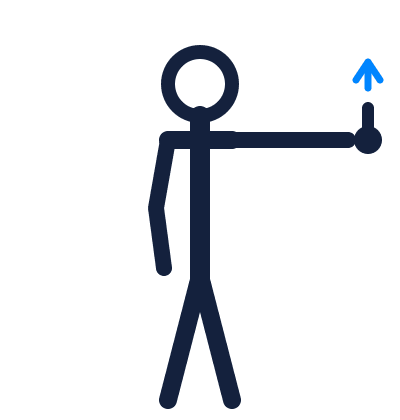
Arm extended horizontally to the side, thumb pointing up, other fingers closed. On a forklift this is read as "tilt the mast back" — cradling the load toward the truck for travel. Common mistake: confusing it with raise-the-forks. Thumb signals move the mast angle; the pointing-finger circles move the forks. If your crew mixes them up, that's a training gap, not a signal flaw.
6. Tilt mast forward (adapted from crane "lower boom")
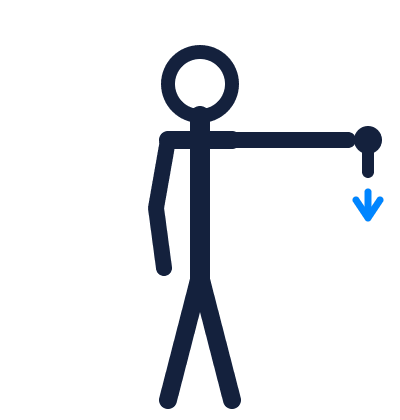
Arm extended horizontally to the side, thumb pointing down, other fingers closed. Used when placing a load — easing the mast vertical or slightly forward so the pallet sits flat. Common mistake: giving it while the truck is traveling. Mast-forward with an elevated load moves the load's center of gravity forward and works against stability — tilt commands belong to the placement phase, at creep speed, at the destination. (For why that matters, see the stability triangle guide.) And here the standard does speak: 1910.178(o)(6) prohibits tilting forward with the load engaging means elevated except to pick up a load, and an elevated load may be tilted forward only when it is in a deposit position over a rack or stack.
7. Move slowly
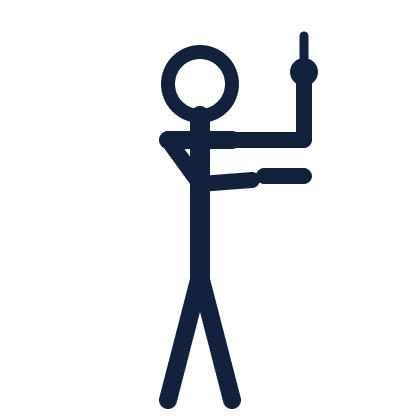
A hand placed in front of the hand giving the action signal — and in practice the placed hand stays still, so the motion the operator reads belongs entirely to the action hand. It's a modifier, not a standalone command: raise-the-forks behind a steady hand means "raise, at creep speed." Common mistake: treating it as its own signal. On its own it commands nothing — it always rides on top of another signal.
8. Travel — in the indicated direction
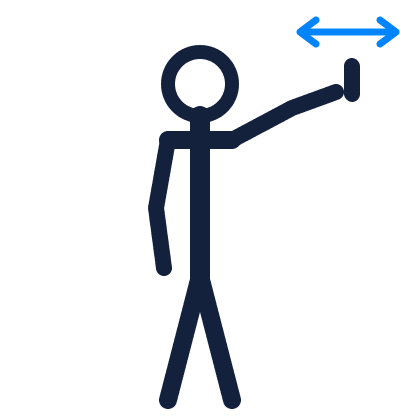
Arm extended with all fingers pointing up, arm pushed out and back in a pushing motion toward the direction of travel. The spotter steers with this one — and every direction is given from the operator's perspective, another crane rule (1926.1419(k)) worth adopting verbatim, because a spotter's "left" and a driver's "left" are opposite half the time. Common mistake: the spotter walking backward while beckoning. The spotter's feet stay planted outside the travel path; if the spotter must reposition, the truck stops first. One ambiguity to settle up front: the official crane chart calls this gesture simply "Travel" — the "come forward" reading is a workplace adaptation, and it overlaps with the "back up" convention below, so train the two as an explicit pair.
9. Dog everything
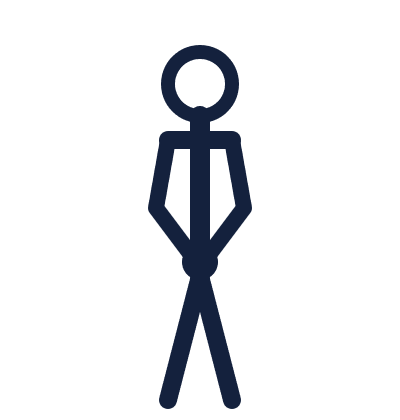
Hands held together at waist level. The name is old crane slang — "dog" as in dogging off, latching a mechanism so nothing moves — and the meaning is "pause exactly as you are": forks holding, truck stationary, while the spotter clears a pedestrian, answers a radio call, or re-checks a clearance. It's not an emergency signal and it's not the end of the task; it's a hold. Common mistake: letting the truck creep during the hold. Dogged means dogged.
3 common workplace signals (useful, but not standardized)
These three appear on many facility charts and are genuinely useful — but they come from shop-floor convention, not from any published standard, so treat them as site-specific: agree on them before the shift, and don't assume a new hire or a visiting driver knows them.
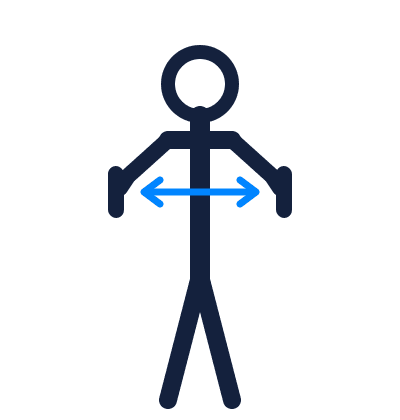 Site convention
10. This far to go
Hands raised, palms facing each other, the gap between them showing the remaining distance — narrowing as the truck closes in. The workhorse of final approaches at docks, trailers, and racking.
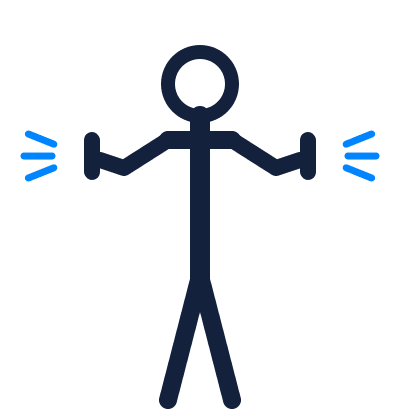 Site convention
11. Back up
Both hands raised, palms out, repeatedly pushing away from the body — reverse away from the spotter. Pair it with the operator's own over-the-shoulder check; a signal never replaces looking in the direction of travel (1910.178(n)(6)).
 Site convention
12. Stop engine
A flat hand drawn across the throat — shut the truck down. Used at task end, or when a spotter hears or sees something mechanical the operator can't: a hissing tire, a smoking brake, a leak trailing the truck. If that shutdown call was tire-related, the daily inspection checklist covers what to look at before the truck runs again.
Spotter rules: the protocol that makes signals work
A chart on the wall does nothing by itself — signals work when both ends of the conversation follow the same protocol. OSHA doesn't prescribe one for forklifts, so the practical move is to borrow the crane signaling framework (1926.1419), which has already solved these problems, and adopt it as site policy. When does a forklift operation need a spotter in the first place? OSHA's eTool answers directly: "use a spotter for blind spots," and "sound your horn in warning or use a spotter if your view is obstructed." In practice that means:
- ✓ The view is restricted — and the federal rules come first: a load that obstructs forward view means traveling with the load trailing (1910.178(n)(4)), and the operator always keeps a clear view of the path of travel ((n)(6)). A spotter supplements at blind corners, doorways, and tight routes — it never substitutes for either duty.
- ✓ Pedestrians share the space — staging areas, retail floors, shipping offices near dock doors.
- ✓ Clearances are tight — trailer interiors, racking aisles at capacity, overhead obstructions near the mast's travel.
- ✓ Either party asks for one. Borrow the crane trigger: if the operator or the person handling the load decides a signaler is needed, that settles it.
Then hold both people to the protocol — six rules cover nearly everything:
- One signaler at a time. The operator takes direction from a single designated person — competing gestures from two helpers is how loads land on dock plates. The lone exception is rule 2.
- Anyone can give the stop. Stop and emergency stop are valid from anybody, always.
- Directions are the operator's directions. The spotter signals in the operator's frame of reference, not their own mirror image.
- Lose sight, lose motion. If the operator can no longer see the spotter — or can't understand a signal — the truck stops until contact is re-established. An invisible spotter is a stop signal.
- The spotter stands out of the path. Off to the side of the travel line in a position with an escape route — never between the truck or its load and a trailer wall, rack, dock edge, or any other pinch zone, and never walking backward in front of a moving truck. High-visibility clothing if the area is busy.
- Agree before you move. Thirty seconds of "here's the route, here's who signals, here's the hold point" prevents the improvised-gesture problem entirely — and any non-standard signal gets agreed on before the task, not invented mid-move.
Docks, trailers, and tight spaces: where signals earn their keep
Most facilities that use forklift signals daily use them at the dock, because the dock stacks every visibility problem at once: reverse approaches, a dock edge, trailer walls a few inches off each fork tip, and a driver whose entire view of the trailer interior may be the spotter's hands. A workable dock routine built from the chart above: the spotter takes position beside the dock door — outside the truck's line — guides the approach with travel, narrows it with this far to go, holds the truck with dog everything while checking the dock plate and trailer floor, then finishes the placement with move slowly stacked on each command — all from a fixed, safe position with an escape route, outside the paths of both truck and load, never in the gap between a load and a trailer wall, rack, or dock edge. Signals stay large and unambiguous; if tight quarters make clear visual contact impossible, the truck stops and the crew switches to an agreed radio method rather than shrinking the gestures.
Two cautions specific to dock work. First, trailer restraint is its own federal requirement, not a courtesy: 1910.178(k)(1) requires that “the brakes of highway trucks shall be set and wheel chocks placed under the rear wheels” before a forklift boards — OSHA enforcement policy accepts a positive mechanical dock restraint in place of chocks where it provides equivalent protection and is installed, maintained, and used per its manufacturer. (Uncoupled semitrailers may also need fixed jacks under (k)(3), and State Plan rules can add requirements.) A hand signal cannot hold a trailer against creep. Second, watch the floor line: dock plates and trailer floors are where debris, board fragments, and dropped fasteners collect, and they end up in tires. A truck that starts pulling to one side or riding rough after dock duty has a tire conversation coming — the five signs it's time to replace forklift tires covers what to look for, and worn or chunked-out tires also lengthen stopping distances, which quietly undermines every stop signal on this page.
Loud environments, low light, and the alternatives
Hand signals exist because sound fails. OSHA's Traveling & Maneuvering eTool page says it plainly: "Consider the noise level in your workplace. Do not assume pedestrians or bystanders are able to hear a back-up alarm." In a facility running compressors, conveyors, and a dozen trucks, the horn is one more note in the noise — which is exactly when a visual channel matters most. But hand signals have their own failure modes, and an honest signal program plans for them:
- ✓ Two-way radios work where sight lines don't — opposite ends of a long trailer, around racking. Borrow the crane voice-signal discipline (1926.1421): each instruction carries three parts in order — function and direction, distance or speed, then stop. "Coming back, ten feet… five… stop" beats "keep coming, keep coming, whoa."
- ✓ Low light: the crane world solves night signaling with lighted wands and lighted gloves; they work identically for yard and cold-storage forklift work. High-visibility gloves sharpen daytime signals for free.
- ✓ Eye contact remains the floor. OSHA's eTool: "When possible, make eye contact with pedestrians or other forklift operators." No signal has been received until the receiver shows it — a nod, a stop of foot traffic, a returned gesture.
- ✓ Lights, mirrors, and marked walkways reduce how often a signal conversation is needed at all — OSHA's pedestrian-traffic page recommends warning lights, mirrors at blind corners, and marked pedestrian walkways alongside the horn-and-signal habits.
Adding hand signals to your operator training program
Here's where signals reconnect with the regulation. While 1910.178 never names hand signals, it does require formal operator training under 1910.178(l) — and two of the required topics (employers must cover each listed topic unless they can demonstrate it doesn't apply to their workplace) are precisely where a signal system belongs: "visibility (including restrictions due to loading)" among the truck-related topics (l)(3)(i)(F), and "pedestrian traffic in areas where the vehicle will be operated" among the workplace-related topics (l)(3)(ii)(D). An employer who trains a signal set under those headings isn't gold-plating; they're filling the topics OSHA already requires with the site's actual practice.
The practical build-out is short: put the chart in the training packet and on the wall where trucks and pedestrians mix; train spotters and regular pedestrians on the signal set too, not just operators (half of every signal conversation happens outside the seat); have each operator demonstrate the signals during their practical evaluation; and note the signal content in the training certification you already keep under (l)(6). Two accuracy points worth keeping straight, because they're widely misstated: the standard requires an evaluation of each operator at least once every three years — not automatic re-training on a calendar — and refresher training is triggered by events (unsafe operation, an accident or near-miss, a failed evaluation, a new truck type, or changed workplace conditions), a list that a signal miscommunication incident can easily land on. And none of this training paperwork makes a chart "OSHA-approved" — no chart is, ours included; OSHA doesn't approve or certify signal charts for forklifts at all.
Hand signals are one layer of a bigger system. Our forklift pedestrian safety guide covers the rest — the fall zone, walkway separation, floor markings, and what OSHA actually requires when people and trucks share the same floor.
Download the free printable hand signals chart
One page, Letter-size, built from the chart above: all 12 signals with diagrams, the standard-method signals labeled apart from the workplace conventions, and the six spotter rules along the bottom. Print it for the training room, the dock office, and the battery-charging bay — anywhere operators and pedestrians share floor.
Post the chart where your trucks work.
Download the printable hand signals chart (PDF)
Free to print and share within your operation. It's a best-practice tool adapted from the OSHA crane Standard Method and OSHA's forklift guidance — OSHA doesn't require (or approve) any forklift signal chart, ours included.
While you're standardizing the safety routine, give the trucks themselves a look: worn tires stretch stopping distances and unsettle loads — exactly what your new stop signal can't fix. We stock pneumatic tires, solid & pneumatic tires, cushion press-ons, and parts. Verify exact tire size, construction, and fitment before ordering — check the tire sidewall and your truck's data plate (here's how to read it), or call 1 (866) 313-2180 and we'll help you verify the right fit. You can also contact our team online.
Frequently asked questions
Does OSHA require hand signals for forklifts?
No — not under federal OSHA. The powered industrial truck standard, 29 CFR 1910.178, contains no hand-signal requirement — the word "signal" doesn't appear in it. OSHA's standardized hand signals belong to the crane rules (29 CFR 1926 Subpart CC), which exclude forklifts unless the truck is configured to hoist and lower (by winch or hook) and horizontally move a suspended load. OSHA's advisory forklift guidance still recommends warning pedestrians "by horn, hand signal, or warning light" and using spotters for blind spots, and an unaddressed, recognized struck-by hazard can support a site-specific General Duty Clause citation — though skipping a signal chart is not, by itself, a violation. State Plan states can add their own requirements.
How many forklift hand signals are there?
There's no official count, because no standard defines forklift signals. Most charts — including ours — build on the core gestures of OSHA's crane Standard Method (stop, emergency stop, hoist, lower, raise/lower boom, move slowly, travel, dog everything) adapted to forklift functions, then add a few workplace conventions like "this far to go" and "back up." Our chart covers 12. What matters isn't the count; it's that everyone on your floor uses the same set.
Does OSHA require a spotter for forklifts?
There's no forklift-specific spotter rule. OSHA's Powered Industrial Trucks eTool recommends one — "use a spotter for blind spots" and "sound your horn in warning or use a spotter if your view is obstructed" — and 1910.178(n)(4) and (n)(6) require slowing, sounding the horn, and keeping a clear view where vision is obstructed. A spotter supplements the operator's own duties — traveling with an obstructing load trailing, keeping a clear view of the path — it never replaces them. And where a recognized struck-by hazard goes unaddressed by feasible controls, OSHA can reach it under the General Duty Clause, though no rule makes a signal chart itself mandatory.
What does "dog everything" mean?
Pause everything and hold position. The signal is hands held together at waist level, and the name comes from crane practice — "dogging" a mechanism means latching it so it can't move. On a forklift it means: stop movement, hold the forks where they are, and wait for the next signal. It's a hold, not an emergency stop.
What is the hand signal for "move slowly"?
A hand placed in front of the hand giving the action signal — held steady, so the motion the operator reads belongs to the action hand. It's a modifier: it always accompanies another signal and tells the operator to perform that action at creep speed — raise slowly, come forward slowly. By itself it commands nothing.
Who can give hand signals to a forklift operator?
Best practice — borrowed from the crane rules — is one designated signaler per task, so the operator never has to arbitrate between competing gestures. The exception is the stop: adopt the crane convention that anyone who sees a safety problem may give the stop or emergency stop signal, and the operator obeys it no matter who gave it.
Are forklift and crane hand signals the same?
Largely, yes — by inheritance. The forklift signals in common use are adapted from OSHA's crane Standard Method: hoist becomes raise-the-forks, lower stays lower, raise/lower boom become tilt-mast-back/forward, and stop, emergency stop, move slowly, travel, and dog everything transfer unchanged. The legal status differs completely, though: for cranes those signals are regulation (29 CFR 1926 Subpart CC); for forklifts they're best practice.
Do hand-signal charts have to be posted in a warehouse?
For forklifts, no — no rule requires posting a signal chart. The posting requirement people half-remember is the crane rule, 29 CFR 1926.1422, which requires hand signal charts on the equipment or conspicuously nearby during hoisting operations. Posting a forklift chart anyway is cheap, useful, and standard practice at well-run facilities — it just isn't federally mandated.
Can two-way radios replace hand signals?
They can, and where sight lines fail they're the better tool. Structure radio calls the way the crane voice-signal rule does: function and direction first, then distance or speed, then stop — "coming back, ten feet, five, stop." Test radios in the actual noise environment before relying on them, keep a dedicated channel for the move, and remember OSHA's caution that you can't assume pedestrians hear alarms in a loud facility — the visual channel still matters for everyone not wearing a radio.
Are hand signals part of OSHA forklift operator training?
Not by name — but the required training topics under 1910.178(l)(3) include visibility restrictions and pedestrian traffic in the areas where the truck operates, which is exactly where a site's signal system belongs. Employers who use signals should train them under those topics, have operators demonstrate them in the practical evaluation, and cover spotters and pedestrians too — half of every signal conversation happens outside the operator's seat.
This article is general educational information from Forklift Tire Company, not a substitute for OSHA-compliant, employer-provided operator training, a formal compliance review, or your own site's safety procedures. Hand signals shown are best-practice adaptations of the OSHA crane Standard Method and workplace conventions — no forklift signal chart is required or approved by OSHA. Always follow 29 CFR 1910.178, your training program, and your equipment's data-plate ratings. Verify exact tire size and fitment before ordering. Questions on tires, wheels, or parts? Call 1 (866) 313-2180 or email sales@forklifttire.com.