 1 (866) 313-2180
 SALES@FORKLIFTTIRE.COM


Posted by Forklift Tire Company on 14th Oct 2026
Linde Material Handling, the forklift maker, traces its roots to an engine works founded in Munich in 1904. One of its founders was Carl von Linde, the refrigeration pioneer whose company built ice machines for breweries. The engine works grew into Linde Material Handling, and in 2006 Linde AG put it, STILL and OM into the new KION Group and sold the group. Linde forklifts and Linde, the industrial-gases company, have been separate companies ever since.
Company histories tell this story in round dates and big firsts. This article dates each step to a document instead: a patent, Linde’s and KION’s own histories and annual reports, a 2006 press release and a European Commission decision. Where the sources disagree, it says so. It ends with what Linde’s own spec sheets show about the tires on its trucks.
In this article
The Short Answer
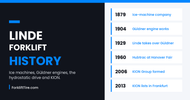
Each row is a dated step and the document behind it. Where Linde’s own sources give different years, the row shows both.
| Year | What happened | Document |
|---|---|---|
| 1879 | Linde’s Eismaschinen AG, an ice-machine company, is founded in Wiesbaden on June 21. | City of Wiesbaden press office, 2026 |
| 1880 | U.S. Patent 228,364 is granted on June 1 to “Charles P. G. Linde, of Munich” for a refrigerating and ice-making apparatus. | U.S. Patent 228,364 |
| 1904 | Hugo Güldner, Carl von Linde and Georg von Krauss found the Güldner-Motoren-Gesellschaft in Munich. | Linde Material Handling; LHY Powertrain; IHK Aschaffenburg |
| 1907 | Güldner moves its production to Aschaffenburg. | IHK Aschaffenburg; Linde Material Handling |
| 1929 | Linde’s ice-machine company takes over the Güldner works. | Linde Material Handling; IHK Aschaffenburg |
| 1955–1956 | The Hydrocar, a small vehicle with a hydrostatic drive. Linde Material Handling dates it to 1955; LHY Powertrain dates its production to 1956. | Linde Material Handling; LHY Powertrain |
| 1958–1960 | The first Linde hydrostatic forklift. LHY Powertrain dates the start of production to 1958; Linde Material Handling dates the Hubtrac to 1959 and its public debut to the 1960 Hanover Fair. | LHY Powertrain; Linde Material Handling (company claim) |
| 1968–1969 | Tractor production ends and the Aschaffenburg works turns to forklifts. | IHK Aschaffenburg (1968); Linde Material Handling magazine (1969) |
| 1971 | Linde’s first electric forklift premieres at the Hanover Fair. | Linde Material Handling |
| 1973 | STILL, of Hamburg, becomes part of Linde AG. | STILL |
| 1977 | Linde takes over the U.S. industrial truck maker Baker Material Handling Corporation. | Linde Material Handling |
| 1984 | Linde acquires the French forklift maker Fenwick. | Linde Material Handling |
| 2006 | Linde AG puts its Linde, STILL and OM forklift brands into the KION Group and sells it to KKR and Goldman Sachs Capital Partners at an enterprise value of €4 billion. | Linde AG release, November 5, 2006; European Commission case M.4478 |
| 2012 | Weichai Power takes a 25% stake in KION and 70% of Linde Hydraulics. | Weichai Power and KION release, December 28, 2012 |
| 2013 | KION lists on the Frankfurt Stock Exchange on June 28, at an issue price of €24.00 a share. | KION interim report, Q2 2013 |
| 2025 | Weichai holds 46.5% of KION, and KION’s annual report names Weichai’s Luxembourg holding company as its parent company. | KION Annual Report 2025 |
| 2026 | KION marks 20 years and calls itself “The Supply Chain Solutions Company.” | KION |
1879–1904: Ice Machines
Carl von Linde (1842–1934) was a professor of mechanical engineering in Munich and a pioneer of refrigeration. The City of Wiesbaden’s press office dates the founding of “Linde’s Eismaschinen Aktiengesellschaft” (roughly, Linde’s Ice Machine Company) in Wiesbaden to June 21, 1879; today’s Linde plc calls it the Gesellschaft für Linde’s Eismaschinen. Breweries were early buyers. By 1890, according to the International Directory of Company Histories, “over 700 of his machines were employed in 445 breweries across Western Europe.”
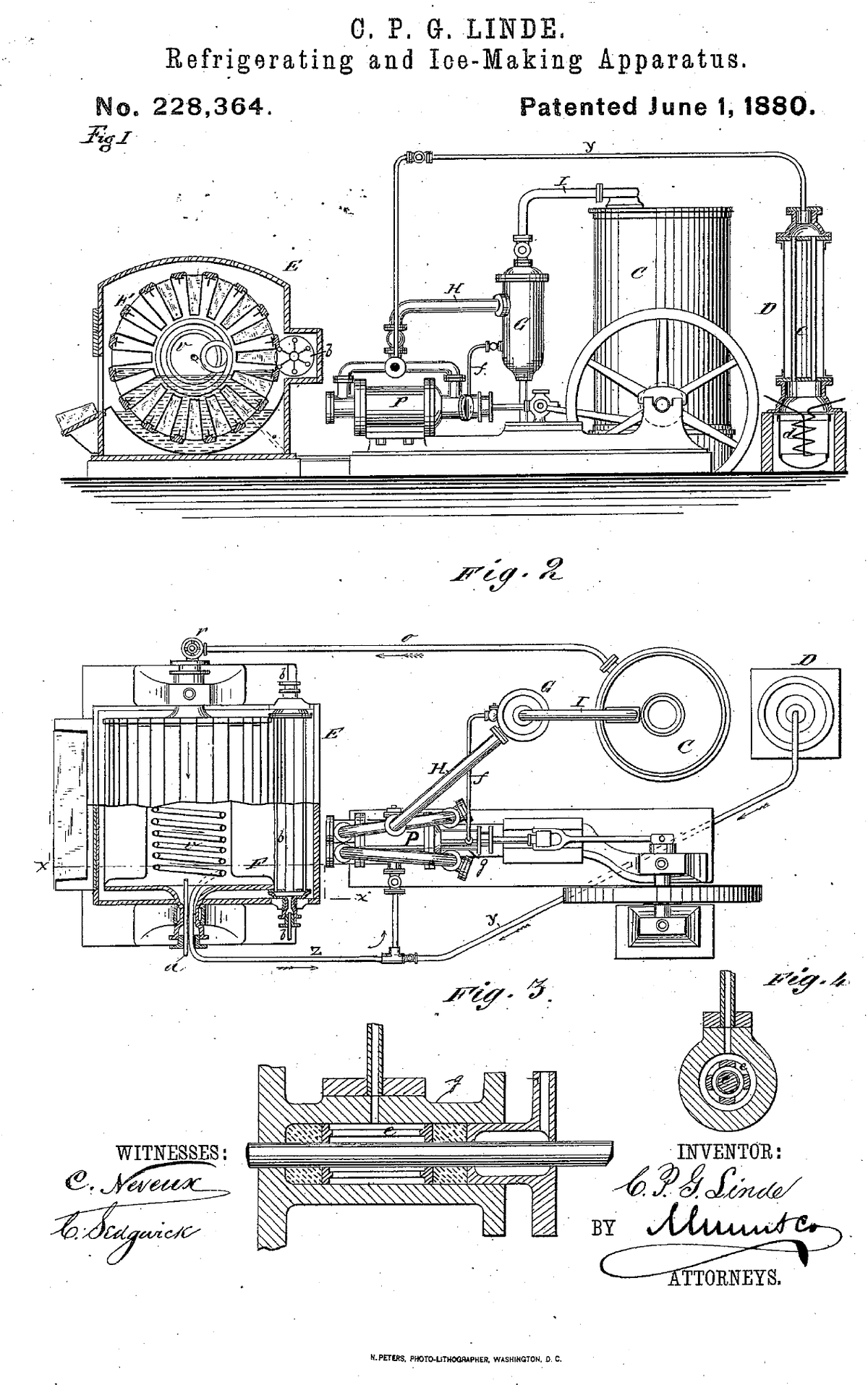
Less than a month after the company’s founding, Linde applied for a U.S. patent. U.S. Patent 228,364, “Refrigerating and Ice-Making Apparatus,” was filed on July 14, 1879, and granted on June 1, 1880, to “Charles P. G. Linde, of Munich, Germany.” It covers a machine in which “the refrigerating effect is obtained by the evaporation of a volatile liquid, the vapors of which are compressed by a pump into a condenser, and then liquefied ready to be again subjected to the process of evaporation.” The link from cold to forklifts came later, through engines.
1904–1929: The Güldner Engine Works
Hugo Güldner was an engine designer. A German-language biography published by the Aschaffenburg Chamber of Commerce and Industry (IHK) says he joined the Allgemeine Gesellschaft für Dieselmotoren in Augsburg in 1899 as chief engineer and chief designer and worked beside Rudolf Diesel on the design of the four-stroke engine, until the two parted ways three years later. Later, after an engineering professor in Munich tested his own prototype engine and rated it very good, Güldner presented it to Carl von Linde and the locomotive builder Georg von Krauss. In February 1904 the three men and other partners founded the Güldner-Motoren-Gesellschaft in Munich, and Güldner brought most of his patents into it. LHY Powertrain, which says it was set up in 1958 as a department within Linde Material Handling, gives the date as February 15, 1904.
Production soon outgrew Munich. In 1907, on Linde’s initiative, the IHK says, it moved to a 42,000-square-meter site in Aschaffenburg. Linde Material Handling’s own history agrees: “Three years later the company moved to Aschaffenburg.” When the Güldner company ran into financial trouble in 1925, the IHK says, Linde took a larger stake, and in 1929, in Linde Material Handling’s words, “the Gesellschaft für Linde’s Eismaschinen AG, founded by Carl von Linde in 1879, took over the Güldner-Motoren-Gesellschaft.” Hugo Güldner did not live to see it. He died on March 12, 1926, at 59.
Through the 1930s the works turned more and more to tractors, and the IHK records the 100,000th Güldner tractor in 1958. One Linde Material Handling magazine page says the company “was founded in 1903 in Munich as Linde’s Eismaschinen Aktiengesellschaft.” That conflicts with the 1904 date in Linde’s own chronicle and with the 1879 date of the ice-machine company it names.
1955–1969: The Hydrostatic Drive
Linde Material Handling describes the turning point in its own words: “In 1955, Güldner had created an invention that would rewrite technological history: the hydrostatic drive for mobile machinery.” A later patent assigned to the Güldner works, filed in the United States in 1961 for a four-wheel-drive vehicle, describes “a hydraulic power system comprising at least one variable speed hydraulic pump and a plurality of variable speed hydraulic motors.” In Linde’s description of the drive, “This technology provided seamless acceleration, both forwards and backwards, with full engine power and without the need for a transmission.”
Linde’s sources name the Hydrocar as the first vehicle to get the drive. Linde’s chronicle dates it to 1955 and calls it “the first transport vehicle with Linde’s patented hydrostatic drive”; the International Directory of Company Histories calls it “a platform truck with hydrostatic transmission.” LHY Powertrain dates the “production of the first hydrostatically driven vehicle, the so-called Hydrocar” to 1956. A Linde magazine page calls the Hydrocar a forklift; Linde’s chronicle gives that title to the next machine.
That machine was the Hubtrac. Linde’s chronicle, under 1959: “The ancestor of all Linde Material Handling forklift trucks is produced in Aschaffenburg. The Hubtrac is the first forklift truck with hydrostatic transmission. Powered by a diesel engine, the first hubtrac can carry loads of 2 tonnes before later increasing to 2.5 tonnes. At the Hanover Fair in 1960, the series is officially presented to the public.” Linde’s own sources do not agree on the year. LHY Powertrain says “Production of the first forklift truck with hydrostatic transmission began” in 1958, and Linde Material Handling’s company introduction speaks of “the development of the first truck with this drive concept” in 1960. “First” is Linde’s claim; we did not find an independent source that settles it.
By the end of the 1960s the works had stopped building tractors. The IHK dates the end of tractor production to 1968. Linde Material Handling’s magazine says the plans were “finalised in 1969, and within just a few weeks Güldner is focusing all production on forklift trucks,” and its chronicle notes that in 1968 “The 314 series replaces the Hubtrac.” The drive is still on Linde’s spec sheets: the H20–H35 sheet on Linde’s North American website lists “Linde Hydrostatic Drive” and “Standard dual pedal travel control.”
1971–2005: STILL, Baker and Fenwick
Linde’s chronicle records its first electric forklift at the 1971 Hanover Fair, the takeover of the U.S. industrial truck maker Baker Material Handling Corporation in 1977, and the 1984 purchase of Fenwick, which it calls “the largest French forklift manufacturer.” Fenwick is still the name Linde trucks are sold under in France, according to KION.
STILL, another German brand in today’s group, came from Hamburg. STILL’s own history says Hans Still, “At just 22 years old and with only two employees by his side,” set up a business repairing electric motors there in 1920. STILL launched its first forklift, the EGS 1000, in 1949. Under 1973 its timeline reads: “STILL becomes part of Linde AG.”
In 1989 Linde bought the British maker Lansing Bagnall, which its chronicle calls “the inventor of the reach truck.” That is Linde’s description; other makers tell the narrow-aisle story their own way. See Raymond Forklift History: The Narrow Aisle.
2006–2013: KION
In 2006 Linde AG bought the British industrial-gas company The BOC Group. KION’s account of its own founding says that deal “was financed by the sale of Linde AG’s material handling division to financial investors.” Linde first put its three forklift brands, Linde, STILL and the Italian OM, into a new holding company of their own. KION says a small team at Linde developed its brand in the summer of 2006, with an agency proposing names; until then the division had been known internally as the “Industrial Trucks Group.” KION says the name comes from “Kiongozi,” a word from “the language of the Maasai in East Africa” that “roughly translates as ‘taking the lead’.”
On November 5, 2006, Linde announced the sale of KION to a consortium of Kohlberg Kravis Roberts & Co. (KKR) and Goldman Sachs Capital Partners. Linde’s German-language press release puts the enterprise value at €4 billion: €3.6 billion of net equity value plus €400 million of net financial liabilities taken on by the buyers. KION then had just over 20,000 employees and about €3.6 billion in 2005 revenue, the release says. The European Commission’s decision of December 20, 2006 describes KION as “the entire material handling business of Linde AG” and says KKR and Goldman Sachs would each hold 50% of the voting rights in its holding company.
That split is why there are two Lindes today. Linde AG kept the gases business, and in 2018 it combined with Praxair in what Linde plc calls a “Merger of Equals”; the combined company took the name Linde plc. Its timeline says the material handling business “becomes part of KION, which is still using Linde as a brand name.”
KION went public on the Frankfurt Stock Exchange on June 28, 2013. The issue price was €24.00 a share, according to KION’s report for the second quarter of 2013.
2012–2026: Weichai and KION Today
KION’s largest shareholder is Chinese. In December 2012, Weichai Power, “a leading Chinese automotive and equipment manufacturer and part of the Shandong Heavy Industry Group,” closed a deal that gave it a 25% stake in KION through a capital increase and a 70% majority stake in Linde Hydraulics, the hydraulics business carved out of Linde Material Handling. LHY Powertrain’s history records the same 70% stake. Immediately before KION’s 2013 offer closed, Weichai bought 13.7 million new shares at €24.00, and after the placement it held 30.0%. KION’s annual reports put Weichai’s stake at 46.5% at the end of both 2024 and 2025, and the 2025 report states: “The parent company of KION GROUP AG is Weichai Power (Luxembourg) Holding S.à r.l.”
By KION’s own figures, it had more than 42,000 employees and revenue of about €11.3 billion in 2025, and more than 2.0 million of its forklift trucks and warehouse equipment were in use at the end of that year. Its brands are Dematic (part of KION since 2016), Linde Material Handling, STILL, Baoli, Fenwick and OM, which KION now describes as “a leading supplier of forklift trucks and warehouse equipment in India.” KION moved its headquarters from Linde’s old offices in Wiesbaden to Frankfurt in 2017. In North America, KION North America, headquartered in Summerville, South Carolina, sells Linde equipment in the United States, Canada and Mexico.
How big is that? KION’s 2025 annual report calls it “the world’s second-largest supplier” based on its 2024 revenue, citing Modern Materials Handling’s August 2025 ranking, which puts Toyota Industries first. It also calls KION “the market leader in the EMEA region” (Europe, the Middle East and Africa) by units sold in 2024, citing the research firm Interact Analysis. Counted in trucks shipped, the picture changes: the same Modern Materials Handling list reports 263,114 trucks for KION in 2024, against 288,262 units for Toyota Industries, 280,012 for Hangcha Group and 340,218 for Anhui Forklift Group.
In 2026 KION marked its 20th anniversary and began calling itself “The Supply Chain Solutions Company.”
Popular Claims, Checked
| The claim | What the record shows |
|---|---|
| “Linde forklifts are made by Linde, the gas company.” | Not since 2006. Linde AG sold its forklift business, which became the KION Group. Linde plc, the gases company, says that business “becomes part of KION, which is still using Linde as a brand name.” |
| “KION is the world’s second-largest forklift maker.” | By 2024 revenue, according to Modern Materials Handling’s 2025 ranking as KION’s annual report cites it. Counted in units, the figures in the same ranking put Anhui Forklift Group, Toyota Industries and Hangcha Group ahead of KION. |
| “Linde built the first hydrostatic forklift in 1959.” | Linde dates the Hubtrac to 1959 and calls it the first forklift truck with hydrostatic transmission. LHY Powertrain dates the start of production to 1958, and Linde Material Handling’s company introduction says 1960. All three are Linde-family sources. |
| “Every Linde forklift has a hydrostatic drive.” | Not according to Linde’s own spec sheets. The H20–H35 sheet lists “Linde Hydrostatic Drive,” but the HT20CT–HT32CT cushion-tire sheet lists a torque converter as its drive unit, and the E18S–E20S electric sheet lists AC drive motors (its hydrostatic system is for steering). |
| “Lansing Bagnall invented the reach truck.” | That is how Linde’s chronicle describes the company it bought in 1989. We did not find an independent ruling, and other makers’ histories make their own narrow-aisle claims. |
For the wider story of how the forklift came together from many companies’ parts, see Who Invented the Forklift?
What This Means When You Buy Tires
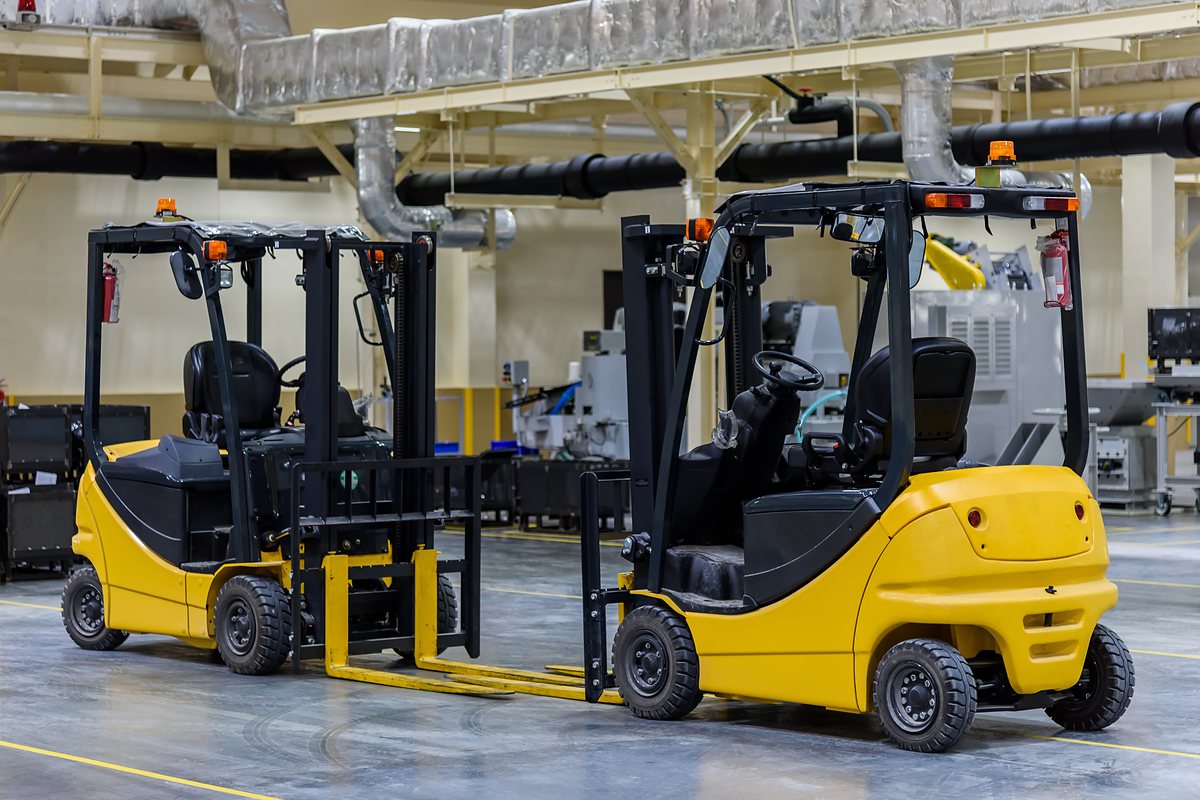
Linde sells both cushion-tire and pneumatic-tire forklifts in North America, and its spec sheets list the tires on numbered lines: 3.1 for the tire type, 3.2 for the front tire size and 3.3 for the rear. Here is what three spec sheets on Linde’s North American website list (two dated February and August 2020, one marked version 1.5). A spec sheet lists a model’s standard equipment when it was printed, so check the truck in front of you before you order.
| Linde model (series) | Capacity (line 1.5) | Front tire | Rear tire (line 3.3) |
|---|---|---|---|
| HT20CT (8962) | 4,000 lb | 21x7x15 | 16x5x10 1/2 |
| HT25CT (8962) | 5,000 lb | 21x7x15 | 16x5x10 1/2 |
| HT30CT (8962) | 6,000 lb | 21x8x15 | 16x6x10 1/2 |
| HT32CT (8962) | 6,500 lb | 21x9x15 | 16x6x10 1/2 |
| E18S (1346) | 3,500 lb | 18x7x12 1/8 | 10x5x6 1/2 |
| E20S (1346) | 4,000 lb | 18x7x12 1/8 | 10x5x6 1/2 |
| Linde model (as named on the sheet) | Capacity (line 1.5) | Front tire (line 3.2) | Rear tire (line 3.3) |
|---|---|---|---|
| H20/600D and H20/600T | 4,500 lb | 23x9-10 | 6.50x10 |
| H25D and H25T | 5,000 lb | 23x9-10 | 6.50x10 |
| H25/600D and H25/600T | 5,500 lb | 250/75x12 | 23x9-10 |
| H30D and H30T | 6,000 lb | 250/75x12 | 23x9-10 |
| H35D and H35T | 7,000 lb | 250/75x12 | 23x9-10 |
Linde prints the 23x9-10 both ways, “225/75-10 (23x9-10),” a metric name followed by the inch size. Three more things stand out on these sheets.
- The same model family can take different tires. On the H20–H35 sheet, the H25 and the H25/600 take different front tires, and the 23x9-10 is the front tire on the smaller trucks and the rear tire on the larger ones.
- On this sheet, “SE” is a solid tire, not air. The H20–H35 sheet lists the tire type as “SE, Solid Pneumatic”: a solid tire in a pneumatic size. The same sheet also advertises a “Large variety of tires,” so a truck may have left the factory on something else. On pneumatic-size trucks like these, the choice after size is construction: solid or air-filled.
- On cushion trucks, the choice after size is compound. Both cushion sheets list non-marking tires as optional equipment.
Cushion or pneumatic is decided by the truck: Linde sells separate cushion-tire and pneumatic-tire models. Classes of Forklifts and Their Tires explains which trucks run which tires. Before ordering for a Linde truck:
- Read the data plate for the model and serial number. How to Read a Forklift Data Plate shows where to look.
- Read the size molded on the sidewall of the old tire, and note whether it is a cushion tire pressed onto a steel band or a pneumatic-size tire on a rim, and whether that tire is solid or air-filled.
- Browse Press-On Forklift Tires for cushion sizes and Solid & Pneumatic Forklift Tires for pneumatic sizes. FTC has no product page for 250/75x12. The Linde section of Forklift Tire Sizes by Make & Model has more on Linde trucks.
Replacing tires on a Linde truck?
Send FTC the model and serial number from the data plate, the size molded on the old tire’s sidewall, and a photo. FTC reviews the size with you before you order. Verify exact tire size and fitment before ordering.
Email Your Truck Details Contact UsSave 7.5% on 2–3 items or 15% on 4+ items, automatic in cart. Free ground freight to commercial addresses in the contiguous U.S. Questions? Call 1 (866) 313-2180.
Frequently Asked Questions
Who founded Linde forklifts?
Linde Material Handling traces its roots to the Güldner-Motoren-Gesellschaft, founded in Munich in 1904 by engine designer Hugo Güldner, refrigeration pioneer Carl von Linde and locomotive builder Georg von Krauss. Linde’s ice-machine company, founded in 1879, took over Güldner in 1929, and the Aschaffenburg works later turned to forklifts.
Is Linde Material Handling part of Linde, the gas company?
No. Linde AG sold its forklift business in 2006, and it became the KION Group. Linde plc, the industrial-gases company formed when Linde combined with Praxair in 2018, says KION still uses Linde as a brand name.
Who owns Linde forklifts today?
Linde Material Handling is a brand of the KION Group, whose shares trade on the Frankfurt Stock Exchange. Weichai Power of China held 46.5% of KION’s shares at the end of 2025 through a Luxembourg subsidiary, which KION’s annual report names as its parent company. In North America, Linde equipment is sold by KION North America of Summerville, South Carolina.
Did Linde invent the hydrostatic forklift?
Linde says so. Its chronicle calls the 1959 Hubtrac the first forklift truck with hydrostatic transmission and dates its public debut to the 1960 Hanover Fair. Linde-family sources give 1958, 1959 and 1960 for that first truck, and we found no independent source that settles it.
What tires do Linde forklifts use?
It depends on the model. Linde’s North America spec sheets list cushion tires, such as a 21x7x15 front and 16x5x10 1/2 rear on the HT20CT, and solid pneumatic (SE) tires, such as a 23x9-10 front and 6.50x10 rear on the H20/600. Check the data plate and the size on the old tire before ordering.
Trademarks: Linde, STILL, KION, Fenwick, Baoli, OM, Dematic, Hubtrac and all other equipment names and model designations are trademarks of their respective owners. Forklift Tire Company is an independent aftermarket supplier and is not affiliated with, authorized by, sponsored by, or endorsed by any equipment manufacturer. Make and model references are used solely to identify equipment and its history.