 1 (866) 313-2180
 SALES@FORKLIFTTIRE.COM


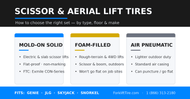
Posted by Forklift Tire Company on 26th Jul 2026
The wrong aerial lift tire is an expensive mistake. Mold-on solid tires are cured permanently onto one exact steel wheel — once they ship, they can't be exchanged. Order the wrong size, the wrong hub, the wrong hole count, or a marking compound for a finished floor, and you've bought a set you can't return and a machine that's still down.
The good news: choosing the right tire comes down to four questions you can answer before you order — tire type, floor surface, your machine make and model, and the hub details that trip people up. This guide walks through all four for both scissor lifts and boom lifts (cherry pickers), whether you run a Genie, JLG, Skyjack, Snorkel, or a similar aerial work platform.
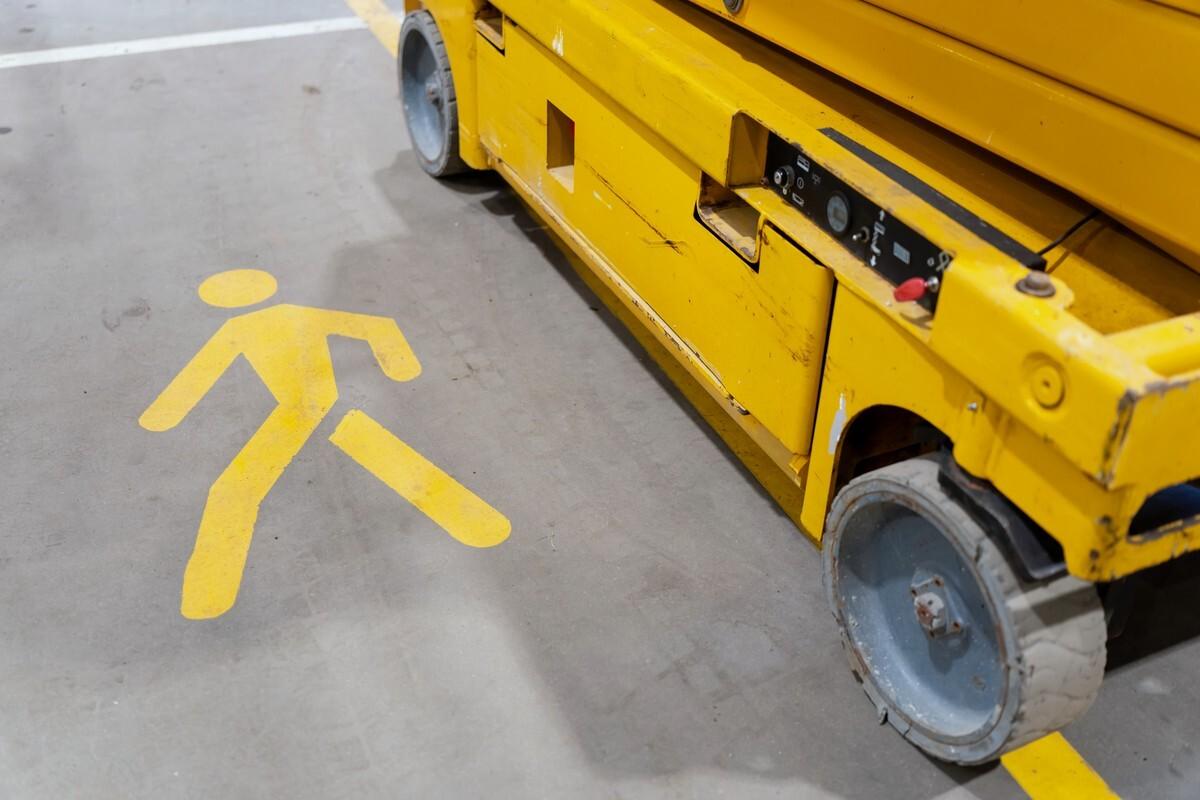
A mold-on solid aerial lift tire: the rubber is cured directly onto the steel wheel and ships as a ready-to-bolt assembly.
In this guide
Start Here: The Three Aerial Lift Tire Types
Before anything else, identify how your machine's tires are built. Aerial work platforms run one of three constructions, and they are not interchangeable — the right one depends on whether your lift works indoors on slabs or outdoors on rough ground.
Worth knowing first: scissor lifts and boom lifts are both mobile elevating work platforms (MEWPs) under the current ANSI/SAIA A92 standards suite, and the tire-and-wheel assembly is part of a MEWP's engineered stability footprint — which is why equipment makers publish specific tire and rim replacement requirements.
| Tire type | How it's built | Best for | Trade-off |
|---|---|---|---|
| Mold-on solid also called cured-on |
Solid rubber cured directly onto a steel wheel; ships as one bolt-on assembly | Electric and slab scissor lifts, narrow electric boom lifts, and vertical mast lifts on smooth, finished floors | Not built for rough outdoor terrain |
| Foam-filled pneumatic | An air-tire casing filled with polyurethane foam so it can't go flat | Rough-terrain (RT/4WD) scissor lifts and larger telescopic or articulating boom lifts on job sites | Heavier; firmer ride than air |
| Air pneumatic | Standard air-filled tire with a tube or tubeless casing | Lighter-duty outdoor use where punctures are unlikely | Can go flat and strand the machine |
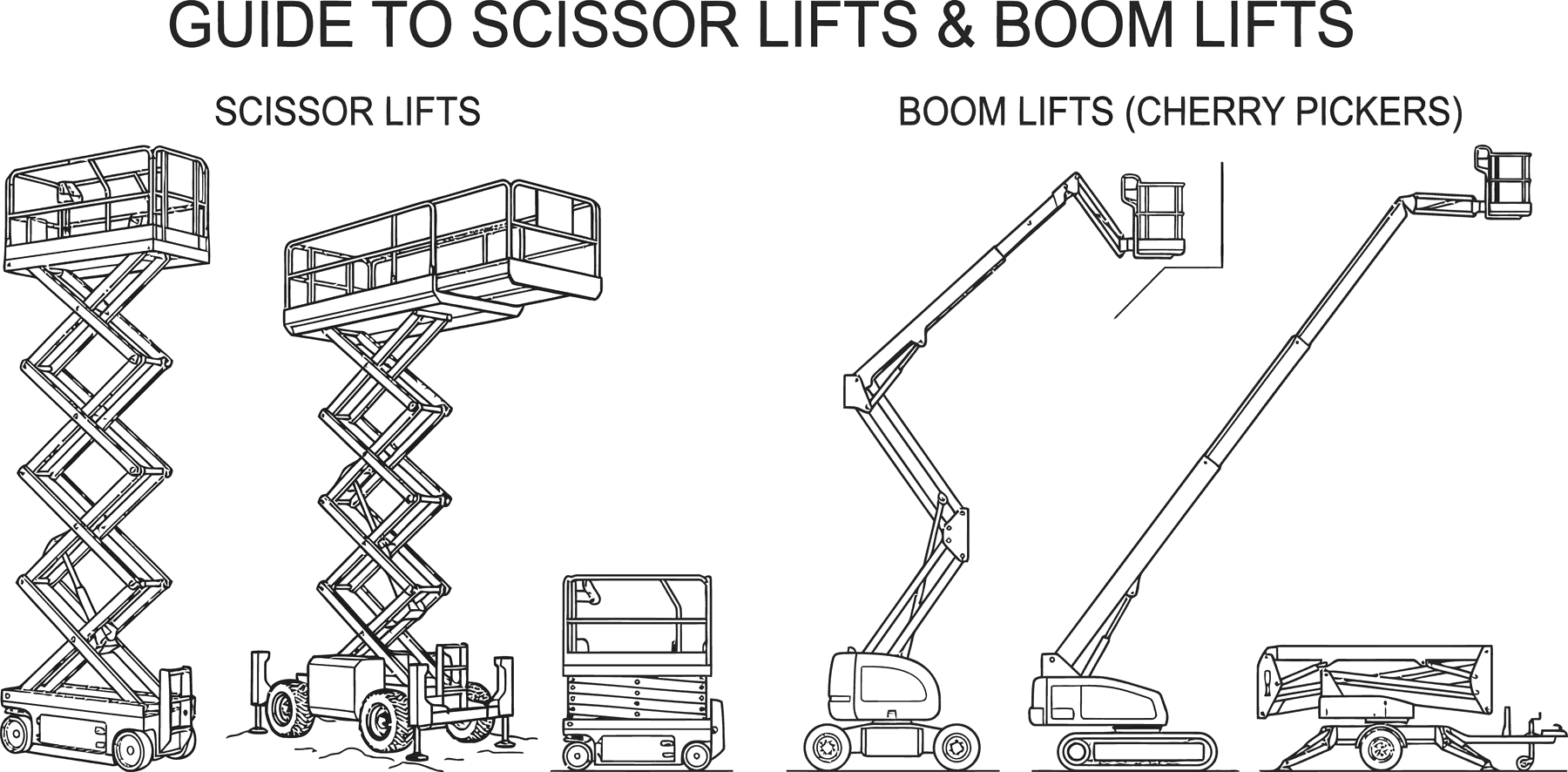
Machine type drives tire construction: slab scissor lifts and narrow electric boom lifts run mold-on solids, while rough-terrain scissors and the larger telescopic and articulating booms run foam-filled pneumatics.
Most electric scissor lifts — the kind that work indoors and on paved slabs — run mold-on solid tires, and so do the narrow electric boom lifts built for indoor work. The rubber is cured onto the steel wheel during manufacturing, creating a durable bond that resists slippage and ships ready to bolt on. Solids are flat-proof and need no pressure checks, which suits the constant-repositioning, puncture-prone reality of an aerial lift. Not sure how solid and pneumatic construction differ? Our guide to forklift tire types breaks down the same constructions side by side, and our guide to cured-on and mold-on tires covers how the rubber-to-steel bond is made.
If your machine is a rough-terrain or 4WD model, or a larger telescopic or articulating boom that works on dirt and gravel, you're more likely running foam-filled pneumatics — a different construction entirely, so confirm before you order. The polyurethane fill cures to a resilient elastomer and is offered in multiple durometers to balance ride against load, per fill maker Carlisle TyrFil. Construction is a spec, not a preference: JLG's published tire and rim requirements say not to replace a foam-filled tire assembly with a pneumatic tire unless JLG specifically approves it. Our aerial line is mold-on solid, so if your machine runs foam-filled or air pneumatics, send us your machine details and we'll source the right construction rather than sell you the wrong one. For background on the fill itself, see our post on the advantages and disadvantages of foam-filled tires.
Non-Marking vs. Marking: Why It Matters on Finished Floors
Aerial lifts spend much of their life indoors — warehouses, retail build-outs, airports, arenas, food and pharma facilities — on floors someone paid to seal and polish. Standard black rubber can leave dark scuff marks on those surfaces. Non-marking compounds don't, which is why they're the standard choice for indoor aerial work.
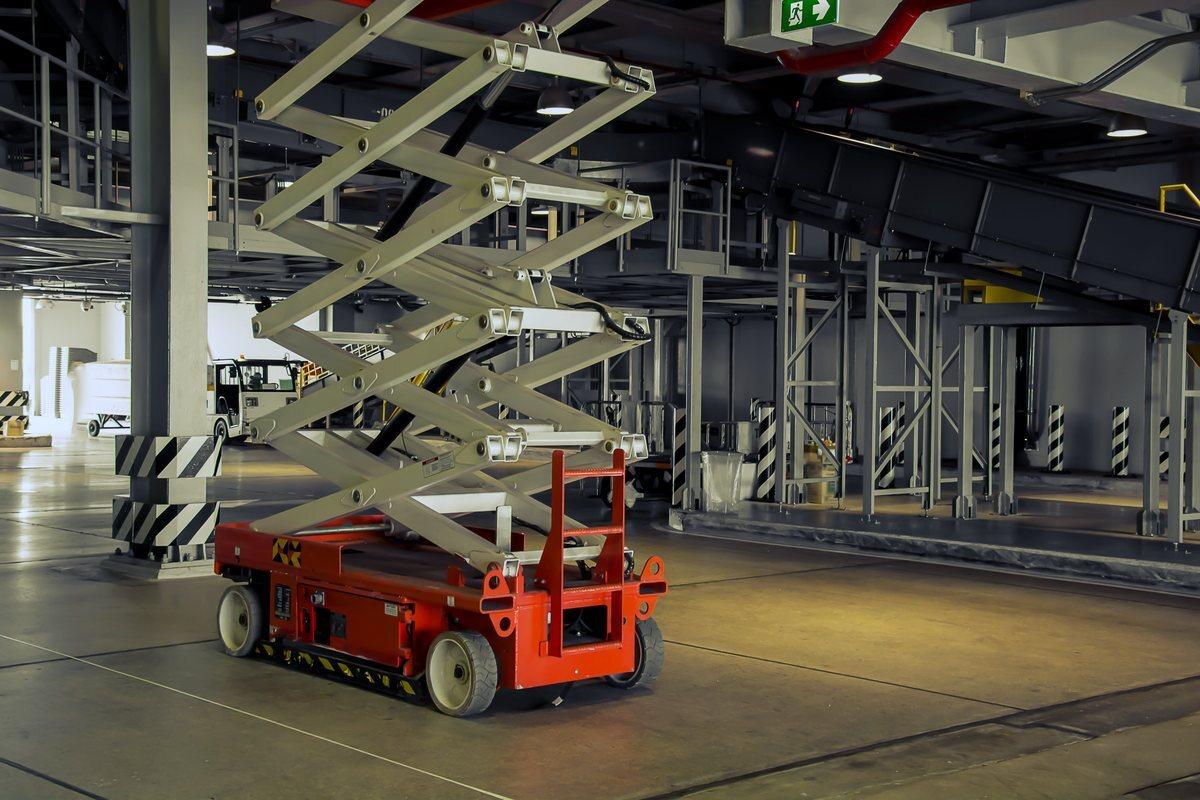
Indoor work on sealed floors is where non-marking compounds earn their keep — this lift is running a mix of light gray non-marking and black tires.
Non-marking is a compound property, not a color. Black tires get their color and much of their reinforcement from carbon black; non-marking compounds substitute silica as the reinforcing filler, with only a trace of carbon black as a stabilizer, per tire maker Camso — the light gray shade is a byproduct, so don't shop by color alone. It's also the equipment maker's default rather than an upgrade: Genie's and Skyjack's spec sheets list solid non-marking tires as standard equipment on their slab scissor models.
That's reflected in how these tires are sold. Every mold-on solid aerial assembly we list — scissor, boom, and vertical mast — is a non-marking compound; there is no black rubber option for this line, because the machines were specified that way from the factory. The compound we currently stock is a high natural-rubber tread engineered for low rolling resistance and long wear life, formulated so it won't streak finished floors; you can read the detail in our guide to CON-Series scissor lift tires. If your facility's flooring is sealed, coated, or customer-facing, non-marking isn't a nicety; it's a spec. For the full picture on how compound color affects floors, see black vs. non-marking forklift tires.
Scissor Lift Tires by Make
Once you know the construction and compound, the fastest path to the right tire is your equipment make and model. Aerial manufacturers encode the platform height and machine width into the model number, and most machines in a family share one tire size — so the model number does a lot of the fitment work for you. Find your make below, then confirm the exact size on your sidewall.
| If you run a… | Commonly used on certain models | Sizes to look for | Shop |
|---|---|---|---|
| Genie scissor lift | GS-1530, GS-1532, GS-1930, GS-1932; GS-2032, GS-2632, GS-3232, GS-2046, GS-2646, GS-2646AV, GS-3246, GS-4047; X-14 | 12x4.5x8 · 14x4.5 · 15x5x11 | Shop Genie aerial lift tires |
| JLG scissor lift | 1230ES, 1930ES; 2030ES, 2630ES, 2646ES, 3246ES; 2148RS | 323x100 · 406x125 · 16x5 | Shop JLG aerial lift tires |
| Skyjack scissor lift | SJ III 3215, 3219, 3220, 3226, 4626 and similar slab models | 12x4 · 16x5 | Shop Skyjack aerial lift tires |
| Snorkel scissor lift | S3219E, S3226, S4726, S4732 | 12x4 · 15x4 · 15x5 | Shop Snorkel aerial lift tires |
| A make not listed | Other aerial work platforms | Read your sidewall, then call | Shop all scissor & aerial lift tires |
How model numbers tell you the size
Genie's GS line encodes platform height and machine width into the model — a GS-2646 is a 26-ft platform height on a 46-inch-wide machine, and every model in the GS-2032 through GS-4047 group shares the same 15x5x11 tire, which simplifies fleet maintenance. Skyjack's SJ III models likewise map to set sizes such as 12x4 and 16x5 (sizes per Genie's and Skyjack's published spec sheets). JLG splits by series: the ES machines use metric sizes like 323x100 and 406x125, while the RS uses 16x5. Our product pages list the machine-fitment table for each size — but model ranges and serial numbers vary, so always confirm against your sidewall. Verify exact tire size and fitment before ordering.
Boom Lift & Cherry Picker Tires
Boom lifts — also called cherry pickers, man lifts, or aerial boom platforms — reach out as well as up, which changes the tire problem. A scissor lift puts its load straight down through four corners. A boom lift swings a weighted platform out over one side, so the tire and wheel on the loaded side carry a much higher share of the machine's mass, and they carry it while the machine is turning and repositioning. That's why boom lift tire and wheel specs are less forgiving than scissor specs, and why the hub hardware matters even more.
The split is roughly by size and duty. Larger telescopic and articulating booms that work outdoors on dirt, gravel, and uneven ground run foam-filled pneumatics. Narrow electric boom lifts built to work indoors on finished floors run mold-on solid non-marking assemblies — the same construction as a slab scissor lift, in a bigger diameter. If you're still working out which machine class you have, our guide to the key differences between scissor lifts and boom lifts lays out the two side by side.
| Boom lift type | Typical construction | Where it works |
|---|---|---|
| Narrow electric articulating boom e.g. Genie Z-series 30–34 ft |
Mold-on solid, non-marking — tire cured to the steel wheel | Indoors and on finished slabs; tight-access work |
| Mast boom lift e.g. Snorkel MB |
Mold-on solid, non-marking; front and rear hubs often differ | Indoor maintenance and stock-picking |
| Rough-terrain telescopic & articulating boom the large outdoor machines |
Foam-filled pneumatic | Job sites, dirt, gravel, uneven ground |
| Towable & tracked booms | Varies widely — trailer tires, pneumatics, or rubber tracks | Specialist access work |
Genie Z-series boom lifts: the 22x7 assembly
The most common indoor boom lift tire we're asked for is the 22x7 non-marking mold-on assembly, commonly used on certain Genie Z-series machines in the 30-to-34-foot class — Z-30/20N, Z-30/20N RJ, Z-33/18, and Z-34/22N. It's a lug-tread solid in a non-marking gray compound, cured onto an 18.625-inch steel wheel. The wheel is supplied in two different bolt patterns — which is the detail that matters most, and the next paragraph explains why.
Here's the detail that causes wrong orders on this machine: the two axles do not take the same wheel. One axle uses an 8-hole wheel and the other uses a 9-hole wheel. The tire is identical; the wheels differ in hole count and pilot bore diameter — and they are not interchangeable. Order four of one pattern and half of them won't mount. That's why the complete four-tire set for these machines ships as two 9-hole plus two 8-hole. Before you order a pair rather than a set, confirm which pattern that axle takes — count the holes on the wheel you're replacing, or call us with your serial number.
Our current boom lift coverage is focused on the indoor electric machines — the Genie Z-series 22x7 assemblies and the Snorkel MB mast boom. If you run a larger rough-terrain telescopic or articulating boom, we don't list those sizes online, but we do source them: send us the machine make, model, and serial number and we'll quote the correct foam-filled or pneumatic assembly. Verify exact tire size and fitment before ordering.
Don't Forget Vertical Mast Lifts
There's a third machine class that gets mistaken for a small scissor lift, and ordering for it as though it were one is a common error. Vertical mast lifts — single-person machines that go straight up on a mast rather than a scissor stack — use their own small-diameter mold-on solids, and they very often use different tires front and rear.
Sizes commonly used on certain vertical mast machines include 10x3 and 12x3, and on the 12x3 the front and rear hub specs differ — so a "set of four" is really two pairs. Check which end you're replacing before you order. Mast boom lifts sit in the same family and behave the same way: the Snorkel MB rear assembly is its own part — a 13.5x4 (96) — and is not shared with the front. We list the rear, so call us for the front. If your machine badge says GR, TM, or MB rather than GS, SJ, or S-something, you're probably in this category — and our guide to the key parts of a scissor lift covers the components these platforms share.
Brakes, Hubs & Hole Counts — the Details That Trip People Up
This is where most wrong orders happen. Because a mold-on tire is cured to its wheel, the wheel hardware has to match your machine exactly — and on an aerial lift, not every corner is the same. Four things to check:
- Brake vs. non-brake. Some scissor lifts use a braked wheel assembly at one axle position and a plain wheel at the other. On the Skyjack SJ III machines we list, that's exactly the case — which is why the complete four-tire set ships as 2 with brake + 2 without brake, and ordering four of one kind leaves you unable to mount half of them. Equipment makers' own parts lists make the split explicit, cataloging the same machine family under separate with-brake and no-brake part numbers.
- Hub spec. Two tires can share a size and still not share a wheel. A 16x5 comes in more than one hub specification, and the number in parentheses on our listings — 16x5 (86) versus 16x5 (186.4), for instance — is what distinguishes them. Same tire, different wheel. Match the number, not just the size.
- Hole count and pilot bore. On the Genie Z-series 22x7 boom assemblies, one axle takes an 8-hole wheel and the other a 9-hole, with different pilot bore diameters. Count the holes before ordering, and buy the complete set if you're doing all four corners.
- Front vs. rear, and serial-range variation. Vertical mast and mast boom machines frequently use different assemblies front and rear. And wheel specs can change across serial ranges within the same model — the model number gets you close; the serial number confirms it.
None of this is hard to get right — it just has to be checked before the order, because mold-on assemblies can't be exchanged once they ship. If anything is unclear, call 1 (866) 313-2180 with your machine make, model, and serial number and we'll confirm the correct hub and tire before you buy. If it helps to understand what you're looking at, our wheel hub assembly guide covers the components and how they fail.
Why Your Tire Diameters Have to Match
Aerial lifts depend on every tire being the same diameter to keep the platform level and the drive system tracking straight. Mix a new full-height tire with worn ones and you change ride heights corner to corner — which can make the machine pull to one side and affect platform leveling and drive behavior. On a boom lift the stakes are higher still, because the machine is designed to hold a level platform while reaching out over one side. Matched diameters aren't a preference here; they're how the platform stays level and tracks true.
The equipment makers' guidance points the same way. JLG's published tire and rim requirements call for replacements of equal or greater ply/load rating and size, tread contact width equal or greater than original, and wheel diameter, width, and offset equal to original — and recommend tires the same size, ply, and brand as originally installed. Rim changes without written factory approval, JLG warns, may create an unsafe condition regarding stability.
That's why aerial lift tires are sold as pairs (2) for a single axle or complete sets (4) for the whole machine. When tires are due, replace them by the axle pair at minimum, and as a full set when the wear is even — it keeps the platform true and earns the volume discount. Browse matched options on our tire bundles and sets page, or read more about why tires are sold in sets.
When to Replace Your Aerial Lift Tires
Solid aerial tires don't go flat, so they're easy to ignore — but they do wear out, and a worn set degrades platform stability the same way a mismatched diameter does. One myth worth retiring here: solids are flat-proof, not wear-proof — and no tire adds rated capacity to your machine. Pull a tire from service and plan a replacement when you see any of these on a walkaround:
- ✓ Flat spots — sections worn flat from braking or from sitting loaded in one position, which makes the machine shake and ride unevenly.
- ✓ Chunking — pieces of rubber tearing or breaking away from the tire.
- ✓ Cracking — deep cracks in the rubber from age, heat, or sun exposure.
- ✓ Worn to the indicator — rubber worn down to the wear line or to the steel wheel beneath it.
- ✓ Rubber-to-steel separation — on a mold-on tire the bond to the wheel is the tire; any sign of the rubber lifting or shifting on the steel means that assembly is finished.
- ✓ The machine pulls or rides unevenly — uneven diameters from mismatched wear can affect leveling and drive behavior.
Because matched diameters matter, the moment one tire is clearly worn is the moment to plan the pair or the set — not to swap a single tire and leave the others to fail a few weeks later.
How to Order the Right Set the First Time
Run this checklist before you buy, and a mold-on order becomes low-risk:
- ✓ Machine class — scissor lift, boom lift, or vertical mast lift? They don't share tires.
- ✓ Tire size — read it off the sidewall (for example, 12x4, 15x5x11, 16x5, 22x7, or a metric 323x100). Don't go by the model number alone.
- ✓ Construction & compound — confirm mold-on solid, and non-marking if your floors are finished.
- ✓ Brake vs. non-brake — know which corners need a braked wheel; a complete set usually covers both.
- ✓ Hub spec, hole count, pilot bore — match the number in parentheses, and count the holes on a boom lift wheel.
- ✓ Front or rear — on mast and mast boom machines the two ends often differ.
- ✓ Quantity — pair for one axle, full set of four to keep all diameters matched.
We stock non-marking mold-on tire-and-wheel assemblies for Genie, JLG, Skyjack, and Snorkel scissor lifts, Genie Z-series boom lifts, the Snorkel MB mast boom, and vertical mast lifts, shipped as ready-to-bolt assemblies. Sizes outside our listed range are available to order — tell us the machine and we'll source it. Verify exact tire size and fitment before ordering. If you're unsure on any line above, we'll confirm it for you before you commit to a set.
Save 7.5% on 2–3 items or 15% on 4+ items, automatic in cart. Free ground freight to commercial addresses in the contiguous U.S. Questions? Call 1 (866) 313-2180.
Frequently Asked Questions
What kind of tires do scissor lifts use?
Most electric and slab scissor lifts use mold-on solid tires — solid rubber cured directly onto a steel wheel, flat-proof and maintenance-free. Rough-terrain and 4WD scissor lifts more often use foam-filled pneumatic tires for outdoor traction. Confirm which construction your machine runs before ordering, because the two are not interchangeable.
What tires do boom lifts and cherry pickers use?
It depends on the machine's size and duty. Narrow electric boom lifts and mast boom lifts designed for indoor work on finished floors use non-marking mold-on solid tire-and-wheel assemblies — the same construction as a slab scissor lift, in a larger diameter. Larger telescopic and articulating boom lifts that work outdoors on dirt and gravel typically use foam-filled pneumatic tires. Because a boom lift reaches out over one side, the loaded wheels carry a higher share of the machine's weight than on a scissor lift, so matching the wheel hardware exactly matters even more.
What is the difference between 8-hole and 9-hole boom lift wheels?
On the Genie Z-series 22x7 assemblies, the tire is the same but the wheel comes in two patterns: one axle takes an 8-hole wheel and the other takes a 9-hole wheel, and they differ in hole count and pilot bore diameter. They are not interchangeable, so ordering four of one pattern leaves half of them unmountable. The complete four-tire set is supplied as two 9-hole plus two 8-hole. Count the holes on the wheel you are replacing, or call with your serial number to confirm.
Are scissor and boom lift tires non-marking?
For indoor machines, yes — non-marking is the factory specification, not an upgrade. Every mold-on solid aerial assembly we list uses a non-marking compound that won't streak sealed or finished floors while still providing reliable traction; there is no black rubber option for this line. If your facility has coated or customer-facing flooring, non-marking is what you want. See our guide to black vs. non-marking forklift tires.
How do I know what size tire my aerial lift needs?
Read the size molded on the sidewall of your current tire — for example, 12x4, 15x5x11, 16x5, or 22x7. Some are printed in metric, such as 323x100 or 406x125. Your machine make and model narrow it down (most models in a family share one size), but model ranges and serial numbers vary, so the sidewall is the final word. You also need to confirm brake vs. non-brake wheels, the hub specification, the hole count on boom lift wheels, and whether the front and rear assemblies differ. Verify exact tire size and fitment before ordering.
Why are aerial lift tires sold in pairs and sets?
An aerial lift needs all of its tires at the same diameter to keep the platform level and the drive tracking straight — mismatched diameters can affect leveling and drive behavior and make the machine pull to one side. Selling tires as axle pairs (2) and complete sets (4) keeps diameters matched, and on machines with mixed hardware the set also gets you the right combination of brake and non-brake wheels, or 8-hole and 9-hole wheels. Replacing all four together also earns the 15% quantity discount and ships on one freight charge.
Can I replace just one aerial lift tire?
It's not recommended. A single new tire next to worn ones creates a diameter mismatch that affects platform leveling and drive behavior, and the remaining worn tires will be due again soon after. Replace by the axle pair at minimum, and as a full set when wear is even, to keep the lift balanced and avoid a second round of downtime.
Does OSHA have a rule for scissor lift tires?
No — there is no tire-specific OSHA rule, and no tire is OSHA-approved. In OSHA's construction framework, scissor lifts are not aerial lifts under 29 CFR 1926.453; an OSHA standard interpretation classifies them as mobile scaffolds covered by 1926.451 and 1926.452(w). Boom lifts, by contrast, do fall under the aerial lift standard at 1926.453. The forklift standard, 29 CFR 1910.178, does not apply to aerial platforms either. Tire requirements reach these machines through OSHA's expectations for stability, maintenance, and following the manufacturer's instructions — which is where the equipment maker's tire and wheel specifications bind. This is general scoping information, not legal advice.
Can I swap foam-filled tires for air pneumatics — or does foam-filling add capacity?
No on both counts. JLG's published tire and rim requirements state that a foam-filled tire assembly must not be replaced with a pneumatic tire unless specifically approved by JLG — the fill is part of how the machine was engineered for stability. And foam-filling does not increase rated platform capacity: that rating is fixed by the manufacturer's design, whatever tire construction is fitted. If you are unsure which construction your machine was designed for, check the operator manual or call us with your serial number.
Trademarks: Genie, JLG, Skyjack, Snorkel, and all other equipment names and model designations are trademarks of their respective owners. Forklift Tire Company is an independent aftermarket supplier and is not affiliated with, authorized by, sponsored by, or endorsed by any of these manufacturers. Make and model references are used solely to identify the equipment these replacement tires are commonly used on.
This article is general educational information from Forklift Tire Company to help you select replacement tires. It is not a substitute for your aerial lift's operator manual, the equipment manufacturer's specifications, or applicable operator-training and inspection requirements. Always confirm tire size, wheel and hub configuration, hole count, and load ratings against your machine, and follow the manufacturer's guidance for safe operation. Operating an aerial lift with incorrect or worn tires can affect platform stability.