 1 (866) 313-2180
 SALES@FORKLIFTTIRE.COM


Posted by Forklift Tire Company on 21st Oct 2026
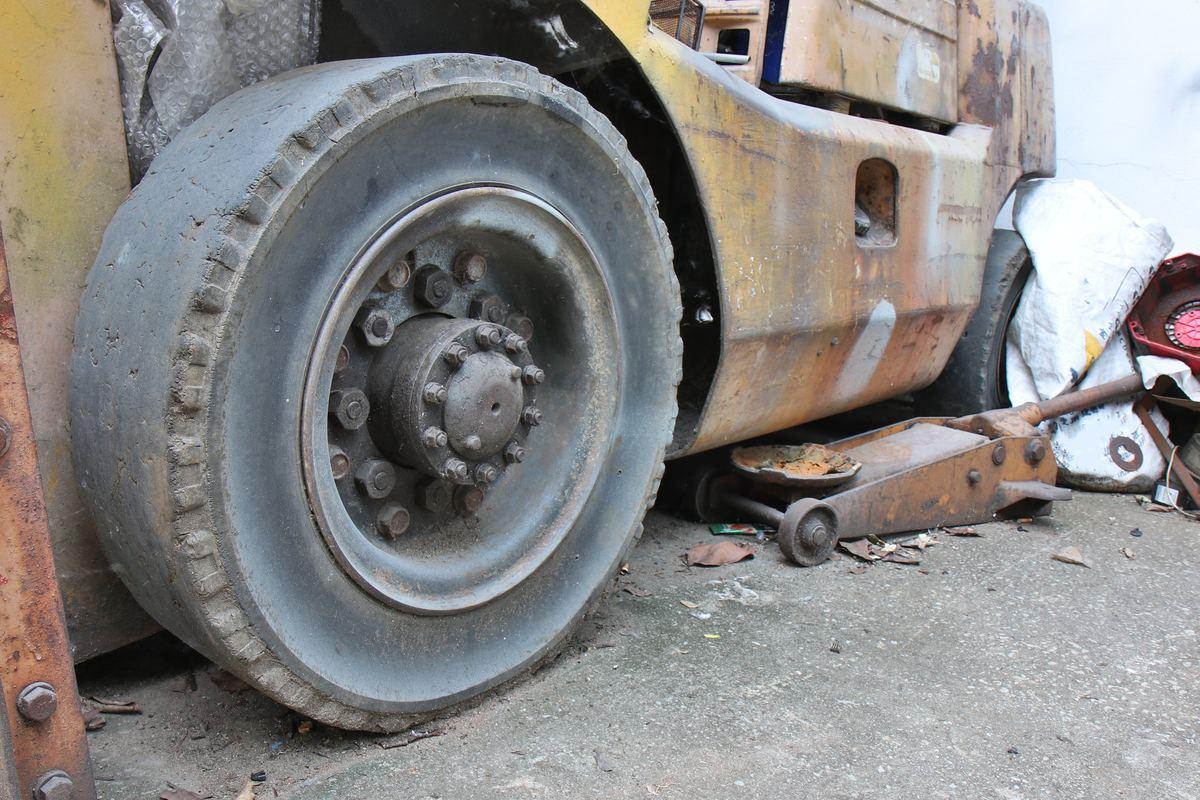
A damaged forklift tire usually tells you what happened to it. Chunks torn out of the tread point to debris, rough floors or overload. Cracks mean different things depending on where they are and how they run. A flat spot says the truck sat loaded or skidded. On a press-on tire, rubber lifting off the steel band and the band letting go of the wheel are two different failures with two different causes.
This guide takes each kind of damage in turn: what it looks like, what tire makers say causes it, and what to do about it. Where makers disagree, it shows both. Read the cause and you can fix the problem, not just the tire. For the wear-line side of the question, how far each tire type can wear before it is done, see When To Replace Forklift Tires.
In this article
- Damage at a glance
- First, know which tire you have
- Chunking, chipping and cuts
- Cracking: three different causes
- Flat spots
- Heat damage and blowouts
- Press-on: band separation vs walk-off
- Worn to the line or past it
- Uneven wear and cupping
- Pneumatic tires: air, pressure and beads
- Vibration, pulling and a rough ride
- Age and storage
- What OSHA requires
- Replacing a damaged tire
- FAQ
Damage at a Glance
Find the damage you are looking at, then read its section below for the detail. In the last column, a call marked (OSHA) comes from an OSHA interpretation letter and a call with a maker’s name comes from that maker’s guidance; unmarked calls are FTC’s suggestions. Adamas’s guides are written for solid tires, so its calls do not apply to pneumatics. Your own inspection and the tire maker’s guidance decide the call.
| Damage | What it looks like | Usual causes named by makers | What to do |
|---|---|---|---|
| Chunking and chipping | Pieces of rubber torn out of the tread, from small chips to large chunks | Debris and broken floors, dock leveler lips and expansion joints, overload, speed over obstacles, wrong compound for the surface | Large pieces missing: out of service (OSHA). Any visible chunking: replace (Adamas). Either way, fix the floor or the duty |
| Radial sidewall cracks | Cracks radiating around the sidewall | Overloading beyond the tire’s rated capacity (MAXAM) | Check loads against the tire’s rating. Deep or into the tread: replace (Adamas) |
| Surface crazing | A fine web of shallow cracks | Ozone, sunlight, age, chemicals, cold | Deep or into the tread: replace (Adamas). Shallow, above the wear line: Adamas’s guides differ, from monitor to replace |
| Heat cracking and separation | Cracks across the tread, glossy or hard rubber, bulges, a layer lifting | Speed, long runs, heavy loads, no time to cool down | Layer separation: out of service (Adamas). Cut speed, load or run length |
| Flat spots | A flattened patch; the truck thumps once per wheel turn | Parking loaded or for long periods, hard braking, skidding, spinning the tires | Replace (Adamas replacement guide). Mild spots in warm rubber may ride out (Adamas failure guide) |
| Band separation (press-on) | Rubber lifting off the steel band; a gap at the band | Rubber: heat, long heavy duty cycles, or a curing defect (MAXAM). Polyurethane: manufacturing (Stellana) | Out of service; replace |
| Walk-off (press-on) | The band has moved on the wheel | Band too big, hub undersized or worn, a cracked band, a tire pressed on incorrectly (Stellana) | Out of service; check the wheel and the fit |
| Worn to the line | Resilient solid at the 60-J line (the molded wear line); smooth press-on at two-thirds of its original rubber height; pneumatic at the end of the tread (Camso), or at 1 mm of the original pattern across the central three-fourths (Solideal) | Normal end of life | Replace. Camso calls wearing past the 60-J line or the tread pattern a safety hazard |
| Uneven wear, cupping | One edge worn faster; dents or cups in the tread | Misalignment, an overloaded steer axle, bearing problems (MAXAM, Adamas) | Fix the truck, then judge the tire |
| Bead damage (pneumatic) | Torn, burned or chafed rubber where the tire meets the rim | Mounting tools, poor seating, brake heat, wrong or damaged rim, under-inflation | Have a trained tire technician inspect it |
First, Know Which Tire You Have
The same damage can mean different things on different tires, so start with the construction. Forklifts run on four main kinds:
- Press-on rubber tires (also called cushion tires): rubber bonded to a steel band that is pressed onto the wheel. They come smooth or with a traction tread. A smooth press-on has no tread to read, so wear is judged by the rubber left above the band; the latest Solideal press-ons also carry a safety line like the 60-J line on a resilient solid.
- Polyurethane press-on tires: the same band-and-press design with a polyurethane tread, used on many electric warehouse trucks. Their failures differ from rubber’s, especially heat damage.
- Resilient solid tires: solid rubber in a pneumatic-tire shape, mounted on a rim. Camso and Solideal mark the end of the usable rubber with a molded 60-J line on the sidewall.
- Pneumatic tires: air-filled tires on a rim, with or without an inner tube. They also need checks for punctures, pressure and bead damage.
If you are not sure which you have, Forklift Tire Types Explained shows them side by side, and on most counterbalanced trucks the data plate lists the tire size and type the truck was built with.
Chunking, Chipping and Cuts
What it looks like: pieces of rubber missing from the tread, from small chips to large chunks, with torn, jagged edges. Cuts are clean slices into the rubber; OSHA’s sample generic daily checklist asks whether there are “large cuts that go around the circumference of the tire.”
What causes it: MAXAM reads chips and chunks as a sign the truck is running over debris, broken floors and other things that should not be on the floor. Adamas, a solid-tire maker, adds sharp floor transitions (dock leveler lips, expansion joints, grating and metal edge strips at loading bays), overloading, speed over obstacles, and a compound that is wrong for the surface, such as a standard indoor compound on a rough yard or a floor covered in metal swarf. On a resilient solid worn past its 60-J line, the inner compound is exposed, and Adamas notes it chunks rapidly because it is not made for surface contact.
What to do: OSHA has said that “tires that are missing large pieces of rubber would present a risk to the truck operator, thereby making the truck unsafe,” and that such conditions are repaired before the truck goes back in service. On smaller chips, Adamas lists visible chunking among damage that calls for immediate replacement. MAXAM does not say whether to replace; it treats chips as a sign of debris and broken floors, fixed with floor maintenance and operator training. Either way, fix the cause: clean the floor, fix or ramp the transitions, check loads, slow down over obstacles, and ask about a tougher compound for the surface when you replace.
Cracking: Three Different Causes
Not every crack is cosmetic, and not every crack is a failure. The pattern tells you which kind you have.
Radial cracks around the sidewall: overload
MAXAM says cracks radiating around the sidewall are a sign of overloading, when loads exceed the rated capacity of the tire. Check what the truck is actually lifting against its data plate and the tire’s rating. Steer tires are a special case: the rear steer tires on a counterbalanced truck carry the counterweight, and Continental notes that an unloaded forklift already puts a latent overload on the steer axle.
A fine web of surface cracks: ozone, sunlight and age
Ozone attacks rubber and leaves a network of fine surface cracks, often called crazing. Adamas lists ozone and UV, age, chemical exposure (solvents and fuels), and a standard compound used in cold storage, where it stiffens and becomes brittle. Adamas says to replace a tire with cracks more than 2 mm deep or into the tread right away. On shallow crazing its two guides differ: its replacement guide lists sidewall cracking among damage that calls for immediate replacement, while its failure guide calls shallow crazing on a tire still above its 60-J line cosmetic, to monitor, with no immediate replacement needed. Michelin’s earthmover (pneumatic) tire guide calls sidewall crazing a normal effect of rubber and storage, and says to leave the tire in service unless the casing ply is damaged.
Cracks across the tread with glossy, hard rubber: heat
Adamas describes heat cracking as cracks across the tread surface, often in the base of the tread grooves, with rubber in the contact patch that looks glossy or hardened, and sometimes a smell of burning rubber. It is the outside sign of heat building up inside the tire, covered in the next sections.
Flat Spots
What it looks like: a visibly flattened patch on the tread. Adamas describes the feel: the truck vibrates rhythmically, once per wheel revolution, even at low speed, and operators call it thumping or bouncing.
What causes it: makers name different causes. MAXAM says flat spots are a sign that operators are spinning the tires and skidding to stop. Adamas lists a truck parked for many hours, overnight or over a weekend, with weight on the tires (cold makes it worse), parking with a load on the forks, hard braking on smooth epoxy or polished concrete, and a tire run at the top of its load rating.
What to do: Adamas’s replacement guide lists flat spots among damage that calls for immediate replacement. Its failure guide adds that mild flat spots in warm rubber often ride out once the tire warms up in normal work, while severe or permanent flat spots do not. By that guide, a flat spot that has not ridden out once the tire is warm needs replacing. To prevent them: lower the forks and take the load off before parking, move the truck a short distance after a long park, stop gradually on smooth floors, and stop spinning the drive tires.
Heat Damage and Blowouts
Solid and press-on tires build heat as they flex under load, and heat that cannot escape breaks the tire down from the inside. You may see bulges, a layer lifting, cracks across the tread, or, at the end, a blowout.
Rubber solids and press-ons
MAXAM says even solid material handling tires can blow out, often from heat built up by high duty cycles, heavy loads and long runs, and describes base and cap separation on a resilient solid the same way, adding that the cause can also be a tire that was not cured properly. Adamas calls heat from sustained speed the most common cause of delamination (layer separation), and adds running past the 60-J line, pressing a tire onto the wrong bore size, and poor bonding between layers in a badly made tire. Its guidance on a tire with visible layer separation: replace it immediately and take the forklift out of service, because there is no safe way to keep running on it.
Continental says solid tires are designed for a maximum speed of about 25 km/h or 16 mph, but that the permitted average speed is far lower, 5 to 10 km/h, with the exact figure depending on many factors such as load, break times, number of shifts and tire size; above that the tire risks thermal damage. Adamas gives its own figure, a maximum of 15 to 25 km/h for most solid resilient tires, and says to check the tire’s datasheet. Continental also advises letting forklift tires cool down for a whole shift whenever possible, and Trelleborg notes that long runs keep heat from escaping and can cause dangerous separation inside the tire.
Polyurethane press-ons: melting from the inside
Polyurethane is a good insulator, so it stores the heat it makes. Stellana, a polyurethane tire maker, explains that when heat builds faster than it escapes, the polyurethane melts internally and the pressure inside the tire rises as the material expands. The signs are a powder-like substance, bumps on the tire, or molten material. The most common causes, per Stellana, are overloading and too much speed; tread thickness, tire size, length of run, a tire that is out of round, metal embedded in the tread, and a hub rubbing on another metal part all add heat. The fix is to cut speed, load or run length, or move to a compound built for the duty.
Stellana also warns that this heat damage is commonly mistaken for bond failure. Its test: a true bond failure leaves the adhesive on the metal band, while heat damage burns the adhesive off the polyurethane, the metal, or both.
Press-On Tires: Band Separation vs Walk-Off
Both failures happen at the steel band, and both can look like “the tire came loose.” Stellana uses “walk-off” for both: the tread releasing from the band, and the band releasing from the hub. This guide calls the first band separation and the second walk-off, because the causes and fixes differ.
Band separation: the rubber lets go of the band
The band stays tight on the wheel, but the rubber separates from it. For rubber press-ons, MAXAM says this happens when a press-on tire’s rubber separates from the steel band because of heat buildup and long or high duty cycles, and that the cause can also be a production issue, a tire that was not cured properly. For polyurethane press-ons, Stellana puts bond failure down to manufacturing: improper surface preparation, contamination or a machine malfunction. OSHA’s sample generic daily checklist asks, “Is there bond separation that may cause slippage?” Treat a visible gap between rubber and band as a tire that should not keep running.
Walk-off: the band lets go of the wheel
Here the rubber is still bonded to the band, but the band has lost its grip on the wheel. Stellana, writing about polyurethane press-ons, names four possible causes for the band releasing from the hub: a band that is too big, a hub that is too small because it was machined undersize or has worn, a crack in an exposed band that lets the tire release from the hub, and pressing done incorrectly, such as using the new tire to press off the old one. Stellana warns that a walk-off can wreck the transmission system if the wheel turns in, or drop a load if the truck comes to a sudden halt. It cites a general industry rule of thumb: reuse a hub no more than three times, and do not reuse bands.
Adamas describes a related failure on its solid tires, rim slippage: the tire turning on its rim, which chalk or paint marks across tire and rim will show. Its causes are a tire worn past the 60-J line (the most common), the wrong bore size when pressing, oil or grease on the rim, or a damaged rim bore. Its call: replace the tire and check the bore dimension.
A walk-off is a wheel and fit question as much as a tire question. Have the wheel checked before a new tire goes on, and have the tire pressed by a shop with a press and the correct tooling; Tire Installation Service shows FTC’s pressing options.
Worn to the Line, or Past It
Wear is not damage, but running past the end of the usable rubber causes damage. Camso’s guidance by construction: run an undamaged resilient solid down to the 60-J line on the sidewall; replace a smooth press-on when the rubber is down to two-thirds of its original height; and run an undamaged pneumatic tire until the tread layer is worn away. Solideal’s 2026 guide sets a stricter line for pneumatics: keep at least 1 mm of the original tread pattern across the central three-fourths of the tread, all the way around. Camso says wearing past the 60-J line or past the tread pattern is a safety hazard that can lead to unexpected tire failure and damage to the truck.
On a resilient solid, a smooth tread is not by itself the limit. Solideal notes that a resilient solid whose original tread pattern is worn away has reached just 40 to 60 percent of its service life; the 60-J line is the limit. If you can see the steel band through the rubber on a press-on, or the fabric or steel plies on a pneumatic, the tire is past its limit. Solideal’s 2026 replacement guide says a forklift with exposed plies on a pneumatic tire should be taken out of service immediately. For how to find each wear indicator, see When To Replace Forklift Tires.
Uneven Wear and Cupping
When one edge of a tire wears faster than the other, or the tread shows dips and cups, MAXAM and Adamas trace the wear to the truck, the floor or how it is driven. Adamas says to check and correct alignment at every tire change, rather than assume it is unchanged from the previous set.
- Misalignment. MAXAM says uneven wear is caused by misaligned axles. Adamas names incorrect toe-in or camber, which makes the tire track at an angle and wear one edge.
- Steer axle overload. MAXAM lists steer tire overload as its own failure, caused by loads above the tire’s rated capacity.
- Cupping and dents. MAXAM says cupping and dents on the tread are the result of bearing problems. See Wheel Hub Assembly: Components & Failure Signs.
- Floors and habits. Adamas adds a sloped or cambered floor, a tire on the wrong rim, and operators who consistently turn the same way or load from the same side.
Fix the alignment, bearings or loading first, then replace. Drive and steer tires wear at different rates, and Drive Tires vs. Steer Tires on a Forklift explains why.
Pneumatic Tires: Air, Pressure and Bead Damage
Air-filled tires have failures tied to the air they hold: punctures and leaks, wrong pressure, and damage at the bead, where the tire seats against the rim.
Pressure
Trelleborg’s material handling manual, in its port-tire section, says most tire damage is due to, or made worse by, incorrect inflation pressure. Under-inflation overheats the tire and can cause irregular wear, internal damage and in the end tire break-up; over-inflation makes the tire more open to impact damage and, in extreme cases, rim deformation or a burst. Use the pressure your tire maker and truck maker specify; Forklift Tire Pressure Guide has more on pressure.
Bead damage
The bead is the edge of the tire that seats against the rim. Damage there is easy to miss and can cost the tire. The causes makers describe:
- Torn or broken bead from mounting. Michelin’s earthmover tire guide shows bead damage from a tire lever or mounting machine, from tools in poor condition or used wrongly, and says such a tire should be examined by a repair expert and scrapped if it cannot be repaired. A badly seated tire (a mismount) also damages the bead. Starmaxx, a forklift tire maker, says to use tools that won’t damage the rim or the beads.
- Burned bead from the brakes. Starmaxx says burned beads usually come from heat: frequent hard braking, brakes that are badly adjusted or faulty, or too little air flow around the brakes.
- Chafing at the bead. Starmaxx lists improper bead seating, a wrong rim size, overload, under-inflation, impact or a manufacturing condition as causes of chafer separation. Michelin adds a dirty or damaged rim or flange.
- Damaged rims. Starmaxx warns against mounting a tire on a cracked, smashed, deformed, or repaired or welded rim.
Rim and bead work is a job for trained tire technicians. Starmaxx calls mounting and dismounting very dangerous for any tire application, and says the work belongs with authorized service points using appropriate tools and machinery and experienced technicians. Have any bead damage inspected before the tire goes back on the truck.
Vibration, Pulling and a Rough Ride
A new vibration, a pull to one side, or harshness through the seat and mast is a symptom, not a diagnosis. Work through the likely causes:
- A flat spot: a thump once per wheel revolution (see above).
- Worn-out cushioning: Solideal says timely press-on replacement keeps down vibration and shock, which reduces wear on lift components; Camso lists ride quality and shock transmission among its reasons to replace at the wear limit.
- Mismatched tires on one axle: Adamas says a new tire next to a worn one leaves two diameters, so the truck pulls toward the worn side, and on the drive axle the differential works constantly to compensate. Replace tires on an axle as a pair; Forklift Tire Bundles covers sets.
- A tire slipping on its rim: Adamas says the tire can feel loose and the truck can pull to one side under acceleration or braking.
- Not the tires at all: worn wheel bearings or hubs. If the tires check out, have the hub assembly inspected.
Age and Storage
Rubber ages even when a tire is not used. Adamas says unused solid tires degrade if stored badly, and advises storing them indoors, in a cool, dark place, away from UV and ozone sources such as electric motors and welding equipment, and using them within the maker’s recommended shelf life. The maker documents cited here set no fixed age limit in years for forklift tires, so judge an older tire by its condition: cracking, hardening and the damage signs above. Trucks that have sat unused deserve a close look; OSHA notes that trucks stored for long periods may need some service or maintenance before they go back to work.
What OSHA Requires, and What It Does Not
Federal OSHA’s powered industrial truck standard, 29 CFR 1910.178, sets the rules. It does not mention tires at all, so the duties come from its general language about the truck:
- Examine before use, (q)(7). “Industrial trucks shall be examined before being placed in service, and shall not be placed in service if the examination shows any condition adversely affecting the safety of the vehicle. Such examination shall be made at least daily.” Trucks used around the clock are examined after each shift, and defects are reported and corrected immediately.
- Take an unsafe truck out of service, (p)(1). A truck found “in need of repair, defective, or in any way unsafe” is taken out of service until it has been restored to safe operating condition. Under (q)(1), repairs are made by authorized personnel.
- Replace with equivalent parts, (q)(5). Replacement parts are to be “equivalent as to safety with those used in the original design.” The standard does not say how that applies to tires.
OSHA’s interpretation letters fill in the detail. In 2004 OSHA said tires missing large pieces of rubber make a truck unsafe, and that it weighs the totality of the circumstances in deciding whether a truck is in need of repair or defective. A truck that is stored or not used every day does not need an examination until it is ready to be placed in service (2005). And the examination does not have to be written down on a checklist (2000), though the employer is still responsible for making sure trucks are properly inspected (2004).
OSHA’s sample generic daily checklist asks about the tires: large cuts around the circumference, large pieces of rubber missing or separated from the rim, missing lugs, and bond separation that may cause slippage. OSHA says its sample checklists are a guide, not a substitute for its standards. For a full pre-shift routine, see the Forklift Daily Inspection Checklist (OSHA Pre-Shift). Some states and territories run OSHA-approved State Plans, which have to be at least as effective as federal OSHA; seven of them cover just state and local government workers.
Replacing a Damaged Tire
Fix the cause first: the floor, the loads, the speed, the alignment, the brakes or the pressing. Then replace with the size the truck was built for, in the tire family it was built for. Most counterbalanced trucks list a tire size and type on the data plate; start there and check it against the sidewall of the tire you are replacing. How to Read a Forklift Data Plate shows where to look.
After the size, the choice depends on the tire family. On a press-on truck, the choice is the compound: standard black rubber or non-marking rubber in Cushion Rubber Press-Ons. Trucks built for polyurethane tires use Polyurethane Press-Ons. On a pneumatic-size truck, the choice is the construction: air-filled pneumatic or solid resilient in the same size, in Solid & Pneumatic Forklift Tires. If the data plate names a tire type, match it, or check with the truck’s maker or dealer before switching between air-filled and solid. Replace tires on an axle together, and check the wheel while the tire is off.
Replacing a damaged tire?
Send FTC a photo of the tire sidewall and the make, model and serial number from the data plate. FTC reviews the size with you before you order. Verify exact tire size and fitment before ordering.
Email Sidewall and Data Plate Photos Contact UsQuestions? Call 1 (866) 313-2180.
Frequently Asked Questions
What are the signs of bad forklift tires?
The common ones are chunks or chips of rubber missing, cracks, flat spots, rubber worn down to the wear line or past it, uneven wear, rubber coming away from the steel band on a press-on tire, and a truck that suddenly vibrates or rides rough. On pneumatic tires, add low pressure, punctures, exposed fabric or steel plies, and damage around the bead. Each sign has a usual cause, so it tells you what to fix as well as what to replace.
What causes chunking on forklift tires?
Tire makers name these causes: debris and broken floors, sharp floor transitions such as dock leveler lips and expansion joints, overloading, speed over obstacles, and a compound that is wrong for the surface. Rubber worn past the 60-J line on a resilient solid also chunks quickly, because the inner compound is not made to run on the floor. OSHA has said that tires missing large pieces of rubber make a truck unsafe, and Adamas, a solid-tire maker, lists visible chunking among damage that calls for immediate replacement.
Why is my forklift tire cracking?
It depends on the pattern. Cracks radiating around the sidewall point to overloading, according to MAXAM. A fine web of surface cracks usually comes from ozone, sunlight and age. Cracks across the tread, often in the base of the grooves, with glossy or hardened rubber, point to heat. Adamas, a solid-tire maker, says to replace a tire with cracks deeper than 2 mm or into the tread right away. Its two guides differ on shallow crazing: one calls it cosmetic on a tire still above its 60-J line, the other lists sidewall cracking among damage that calls for immediate replacement.
What causes flat spots on forklift tires, and do they go away?
Flat spots come from a truck parked for a long time with weight on the tires, parking with a load on the forks, hard braking on smooth floors, and spinning the tires or skidding to a stop. The replacement guide from Adamas, a solid-tire maker, lists flat spots among damage that calls for immediate replacement. Its failure guide adds that mild flat spots in warm rubber often ride out once the tire warms up in normal work, while severe ones do not.
What is the difference between band separation and walk-off on a press-on tire?
This guide uses band separation for the rubber coming away from its steel band while the band stays tight on the wheel, and walk-off for the band itself letting go of the wheel. Stellana calls both of these walk-offs. On rubber press-ons, MAXAM blames band separation on heat and long, heavy duty cycles, or a tire that was not cured properly. On polyurethane press-ons, Stellana puts true bond failure down to manufacturing and warns that heat damage is often mistaken for it. For the band letting go of the wheel, Stellana, writing about polyurethane press-ons, names four causes: a band that is too big, a hub that is undersized or worn, a cracked band, or a tire pressed on incorrectly, such as using the new tire to press off the old one.
Why does my forklift vibrate or ride rough?
Start with the tires. A flat spot thumps once per wheel revolution, and worn-out press-on tires pass more vibration and shock to the truck. Two tires of different heights on one axle make the truck pull toward the worn side. If the tires look sound, have the wheel bearings and hubs checked; MAXAM ties cupping and dents on the tread to bearing problems.
What causes tire bead damage on a pneumatic forklift tire?
Makers name several causes. Michelin’s earthmover tire guide shows bead damage from mounting tools in poor condition or used wrongly, and from a tire that does not seat properly on the rim; Starmaxx, a forklift tire maker, says to use tools that won’t damage the rim or the beads. Heat from frequent hard braking or a faulty brake can burn the bead area. Chafing at the bead can come from improper bead seating, a wrong-size rim, overload or under-inflation. Have a trained tire technician look at any bead damage before the tire goes back on the truck.
Does OSHA require taking a forklift out of service for tire damage?
Federal OSHA’s standard, 29 CFR 1910.178, does not mention tires. It requires a truck that is in need of repair, defective or in any way unsafe to be taken out of service until it is restored to safe operating condition, under paragraph (p)(1), and it requires an examination before the truck is placed in service, under paragraph (q)(7). OSHA has said that tires missing large pieces of rubber make a truck unsafe, and that it weighs the totality of the circumstances in deciding whether a truck is in need of repair or defective.
This article is general educational information from Forklift Tire Company. It is not a substitute for OSHA-compliant operator training, a formal compliance review, your equipment’s data-plate ratings or the tire manufacturer’s specifications. Follow your data plate, the tire sidewall and 29 CFR 1910.178. Trademarks: Camso, Solideal, Michelin, MAXAM, Adamas, Stellana, Continental, Trelleborg, Starmaxx and all other brand names are trademarks of their respective owners. Forklift Tire Company is an independent aftermarket supplier and is not affiliated with, authorized by, sponsored by, or endorsed by any tire manufacturer, equipment manufacturer or government agency.