 1 (866) 313-2180
 SALES@FORKLIFTTIRE.COM


Posted by Forklift Tire Company on 19th Jul 2026
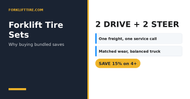
When a forklift tire wears out, it's tempting to replace just that one and move on. But on a counterbalanced forklift, the tires work as a system — two drive tires up front, two steer tires in back — and replacing them as a matched set almost always costs less per tire, ships in one freight, and keeps the truck handling the way it should. Here's why buying forklift tires in sets usually wins, and how to choose the right one.
In this guide
What a Forklift Tire Set Actually Is
A forklift tire set — also called a bundle — is the full complement of tires for one truck, sold together: a 4-piece set with 2 drive tires and 2 steer tires. On almost every counterbalanced forklift the drive and steer positions take different sizes, so a proper set isn't four identical tires — it's the correct two-and-two pairing for your machine.
That pairing matters. The drive tires (front) carry the load and do the work; the steer tires (rear) are smaller and handle steering. If you're unsure why they differ, our drive vs. steer tires guide explains it. Buying a set means the two sizes are matched for you, which removes one of the most common ordering mistakes — getting the right drive tire but the wrong steer, or vice versa.
A set = 2 drive + 2 steer
A complete forklift tire set is a 4-piece set: 2 drive tires + 2 steer tires, matched to your truck. Drive and steer are usually different sizes — the set pairs them correctly so you don't have to.
Why Sets Save Money (and Downtime)
Buying the set instead of one tire at a time pays off in four ways:
| Buying as a set... | What you save |
|---|---|
| Automatic quantity discount | Save 7.5% on 2–3 items, or 15% on 4+ items — applied automatically in the cart. A 4-piece set lands you in the 15% tier. |
| One freight shipment | Four tires on one order ship together instead of paying to bring the truck down twice. Free ground freight to commercial addresses in the contiguous U.S. |
| Matched wear | Fresh tires in all four positions wear evenly and keep the truck balanced — no mismatched grip or ride between an old tire and a new one. |
| One service event | Change everything in a single visit instead of taking the truck out of service again in a month when the next tire goes. |
The discount is the obvious win, but the quieter savings — one freight, one service event, no mismatched handling — are usually bigger over the life of the truck. If the drive tires are worn, the steer tires that have run the same hours usually aren't far behind.
The Safety Case for Matched Tires
The bigger reason to replace tires together is safety. Tire manufacturer Yokohama's guidance is blunt: in most instances it's unsafe to replace just one forklift tire — at a minimum, replace both tires on the same axle. A new tire beside a worn one means two different diameters on one axle, tilting the truck, undermining stability, and stressing the drivetrain.
Per OSHA 1910.178 App A (the non-mandatory stability appendix), the front wheels' contact points are the axis the truck rotates around when it tips forward — the drive tires are its fulcrum. Worn or mismatched tires lower ride height and shift the center of gravity, quietly eroding the stability margin the data plate assumes — and nothing on the dash warns you as it shrinks. It's also why OSHA 1910.178(q)(5) requires replacement parts "equivalent as to safety with those used in the original design." A matched set clears that bar by default.
Bundle vs. Assembly: Two Ways to Buy a Set
There are two formats for a set, and the right one depends on whether you want to press the tires yourself:
| Tire bundle (loose) | Tire & wheel assembly | |
|---|---|---|
| What you get | Four matched tires, no wheels | Tires already pressed onto wheels — bolt-on ready |
| You'll need | A tire press to mount them | Just hand tools to swap the wheels |
| Best when | You have press equipment or a local shop | You want to skip the press and minimize downtime |
| Shop | Forklift tire sets | Tire & wheel assemblies |
Assemblies cost more up front because you're buying the wheels too, but they turn a tire change into a bolt-on job — no press, no shop appointment, far less downtime. For operations without a press on site, an assembly set is often the cheaper option once you count the labor and the truck's time out of service.
Which Set Fits Your Truck
Sets are organized by truck type. Match yours, then confirm your exact sizes:
- ✓ Cushion (press-on) trucks — smooth-floor warehouse forklifts. Shop cushion forklift sets (black or non-marking rubber).
- ✓ Pneumatic trucks — outdoor and rough-surface forklifts. Shop pneumatic-type sets in air or solid resilient.
- ✓ Want it mounted — skip the press with tire & wheel assemblies.
- ✓ Not sure of your type — start at the forklift tire buying guide or browse all forklift tire sets.
Every set is built as a 4-piece, 2-drive-plus-2-steer configuration matched to common trucks in that class. If you run a fleet, see our Operator Gallery for how other operators have their machines set up.
The Cost Math, Quickly
Here's the shape of it. Say a single drive tire runs $200 and a steer runs $150. Bought one at a time across two visits, you pay full price plus freight twice. Bought as a 4-piece set — two of each — the 15% quantity discount comes off automatically, it all ships on one freight, and the truck comes down once. The per-tire price drops and the soft costs (freight, labor, repeat downtime) drop further.
Before You Order
A set only saves you money if it fits. Confirm these before checkout:
- ✓ Tire type — cushion press-on vs. pneumatic/solid resilient
- ✓ Drive tire size — molded on the sidewall (front)
- ✓ Steer tire size — usually different from the drive (rear)
- ✓ Compound — black or non-marking (cushion); air or solid resilient (pneumatic)
- ✓ Bundle or assembly — loose tires, or mounted on wheels
- ✓ Wheel bolt-hole count — for assemblies, match your hub's hole pattern
One sizing tip: a press-on size like 21x7x15 reads outside diameter x width x band (hub) ID, per tire manufacturer Maxam. The band ID is the press-fit dimension — all three numbers must match.
Verify exact tire size and fitment before ordering. Not sure what your truck takes? Call 1 (866) 313-2180 with your model and current sizes, and we'll build the right set before you buy. The forklift tire size chart also cross-references common models and sizes.
Save 7.5% on 2–3 items or save 15% on 4+ items, automatic in cart. Free ground freight to commercial addresses in the contiguous U.S.
Frequently Asked Questions
What's in a forklift tire set?
A complete forklift tire set is a 4-piece set: 2 drive tires and 2 steer tires, matched to your truck. Drive and steer positions usually take different sizes, so the set pairs the correct two sizes together rather than giving you four identical tires.
Is it cheaper to buy forklift tires in a set?
Usually, yes. A 4-piece set qualifies for the automatic 15% quantity discount (4+ items), ships on one freight instead of two, and lets you change everything in a single service event. The per-tire price and the soft costs — freight, labor, repeat downtime — both drop compared with buying one at a time.
Should I replace all four forklift tires at once?
In most cases it's the better value. The drive and steer tires run the same hours, so when the drives reach the wear line the steers usually aren't far behind. Replacing all four keeps the truck balanced and saves you a second service visit a month later. If one tire is damaged while the others are nearly new, manufacturer guidance is still to replace at minimum both tires on that axle, in matching size and compound.
Can you replace just one forklift tire?
In most instances, no. Tire manufacturer Yokohama advises replacing at minimum both tires on the same axle — a new tire next to a worn one puts two different diameters on one axle, hurting stability and stressing the drivetrain. OSHA 1910.178(q)(5) requires replacement parts equivalent in safety to the originals.
What's the difference between a tire bundle and a tire-and-wheel assembly?
A bundle is four loose tires you press onto your own wheels; an assembly comes with the tires already mounted on wheels, so you just bolt them on. Assemblies cost more up front but skip the tire press and minimize downtime — often the cheaper choice once you count labor and the truck's time out of service.
Do drive and steer tires come together in a set?
Yes. A forklift tire set includes both — 2 drive and 2 steer — matched for your truck. Because the two positions take different sizes, buying the set ensures you get the correct pairing instead of ordering the wrong steer size to go with the right drive.
When should forklift tires be replaced?
The trigger is the wear line, not a set number of hours — life varies too much by application. Solid resilient tires carry a molded 60J safety line; per Camso, undamaged tires can run down to that line, but past it is a safety hazard. Smooth press-on cushion tires are done when about one-third of the original rubber height is gone (Camso and Yokohama publish the same limit); air pneumatics when the tread is gone. Don't scrap early, either — Trelleborg reports industrial solid tires are typically replaced with 25% of usable life still remaining.
Do drive and steer tires wear at the same rate?
No. Drive tires carry the load and drive torque, so they usually wear fastest, mostly across the center of the tread. Steer tires scrub in tight pivot turns and wear at the edges — in tight-rotation duty they can wear out first. Which axle goes first is application-specific, which is why OSHA 1910.178(q)(7) requires forklifts to be examined at least daily — check both axles.
Ready to price a set for your truck? Browse forklift tire sets or call 1 (866) 313-2180 and we'll build the right 4-piece set for your model. Verify exact tire size and fitment before ordering.
Set contents and savings are general guidance. Sets are 4-piece (2 drive + 2 steer) matched to common trucks; equipment make and model alone do not confirm fitment. Always verify exact tire size, type, and both drive and steer dimensions before ordering.