 1 (866) 313-2180
 SALES@FORKLIFTTIRE.COM


Posted by Forklift Tire Company on 5th May 2026
Why Drive and Steer Tires Are Different Sizes
If you've looked at a forklift tire bundle and noticed two different tire sizes, that's not a mistake. Every counterbalanced forklift uses larger tires on one axle and smaller tires on the other. These sizes are not interchangeable — ordering the wrong pairing means tires that won't mount on your equipment.
This guide explains which tires go where, why they differ, how each position wears, and how to order the correct set.
Which Axle Is Which?
On a standard counterbalanced forklift, the drive axle is at the front — directly beneath the mast and forks. The drive axle is powered by the engine or electric motor and propels the forklift forward and backward. The steer axle is at the rear, behind the operator seat, and handles directional control.
This is the opposite of cars and trucks, where front wheels steer. On a forklift, the rear wheels pivot — up to 90 degrees on some models — to allow tight turning in narrow aisles. The front wheels drive and bear the load.
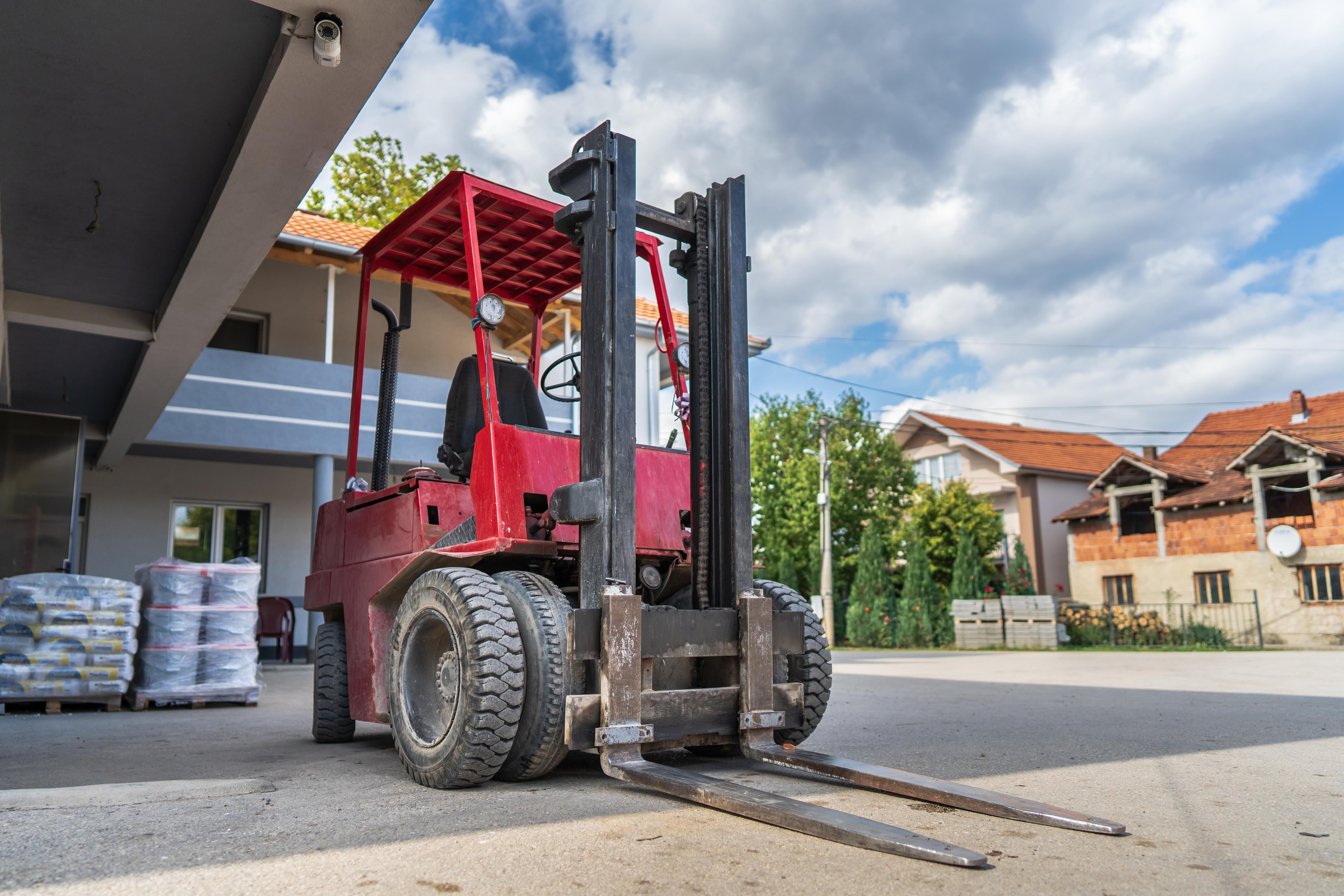
This rear-steer design exists because the forklift pivots around its front axle, which serves as the fulcrum for the entire load-counterweight balance system. The counterweight at the rear offsets whatever load sits on the forks at the front. Placing the powered drive wheels at the fulcrum point gives the truck maximum traction under load.
Note: This guide covers four-wheel counterbalanced forklifts (the most common configuration). Three-wheel electric forklifts use the same front-drive / rear-steer layout, but with a single rear steer tire instead of two — making the standard bundle 2 drive + 1 steer.
Drive Tires: Larger, Load-Bearing, Higher Wear Demand
Drive tires are the larger pair. When a forklift picks up a load, approximately 85% of the combined vehicle-plus-load weight concentrates on the front (drive) axle. Because of this loading, drive tires:
- Have a larger outside diameter and wider cross-section to distribute weight across a bigger contact patch
- Carry the majority of the truck's weight whether loaded or unloaded
- Provide all traction for acceleration, braking, and ramp travel
- Mount on the front (powered) axle beneath the mast
- Are built with thicker tread compounds and deeper rubber to absorb repeated high-load cycles
For reference, a 21x7x15 cushion press-on drive tire is rated at 4,596 lbs per tire at speeds up to 15 mph. Its paired steer tire (16x5x10-1/2) is rated at 1,973 lbs — less than half the capacity. That difference reflects how much more weight the front axle handles.
Steer Tires: Smaller, Directional, Lateral-Stress Exposure
Steer tires are the smaller pair. They support the rear counterweight and absorb all turning forces. Steer tires:
- Have a smaller outside diameter and narrower cross-section
- Support roughly 15% of the combined weight in standard operating conditions
- Experience high lateral (side-load) stress from tight turning and pivoting
- Pivot through warehouse turns, dock maneuvering, and aisle positioning
- Mount on the rear (steering) axle
Although steer tires carry less vertical weight, they face a different kind of stress. Repeated tight turns scrub rubber off the sidewall edges, especially in operations with narrow aisles or frequent 90-degree dock approaches. In some applications, steer tires wear out sooner than drive tires due to this lateral abrasion — even though they carry far less load.
How Each Position Wears
How your tires wear depends on your operation. Knowing the patterns helps you inspect the right things and catch problems early:
| Operating Condition | Drive Tire Wear Effect | Steer Tire Wear Effect |
|---|---|---|
| Heavy loads, long runs | Accelerated center-tread wear | Normal |
| Tight aisles, frequent turns | Normal | Accelerated edge and sidewall wear |
| Rough floors, debris | Chunking, flat spots | Cuts, sidewall damage |
| Outdoor or ramp use | Faster overall wear from traction demand | Moderate — less load stress |
| High-speed travel (empty) | Moderate | Increased — counterweight bears down on rear |
What to Check by Position
Drive tires: Look for flat spots, center-tread depletion, and chunking. On cushion press-on tires, replace when rubber wears down to the top of the molded size numbers. On resilient solid tires, replace at the 60-J safety line marked on the sidewall. On pneumatic tires, replace when the tread pattern is no longer visible.
Steer tires: Look for edge chunking, sidewall cracking, and uneven wear from scrubbing. The same wear indicators apply (size numbers for cushion, 60-J for resilient, tread for pneumatic), but check the sidewall edges specifically — that's where steer-position damage appears first.
Different wear modes at each position may mean you replace drive and steer tires at different intervals.
Common Drive + Steer Size Pairings
Most counterbalanced forklifts use a specific drive/steer size pairing determined by the equipment manufacturer. Here are common pairings with load capacity ratings based on manufacturer spec sheets:
| Drive Tire (Front) | Steer Tire (Rear) | Tire Type | Drive Capacity | Steer Capacity |
|---|---|---|---|---|
| 21x7x15 | 16x5x10-1/2 | Cushion Press-On | 4,596 lbs | 1,973 lbs |
| 7.00x12-5.00" | 6.00x9-4.00" | Solid Resilient | 6,437 lbs* | 3,197 lbs* |
| 28x9-15-7.00" | 6.50x10-5.00" | Solid Resilient | 8,311 lbs* | 3,968 lbs* |
| 8.15-15 (28x9-15) 14PR | 6.50-10 12PR | Pneumatic | 8,600 lbs* | 3,640 lbs* |
| 7.00-12 14PR | 6.00-9 10PR | Pneumatic | 6,075 lbs* | 2,822 lbs* |
| 6.50-10 12PR | 5.00-8 10PR | Pneumatic | 4,730 lbs* | 2,405 lbs* |
*Load capacity per tire from manufacturer spec sheets for counterbalanced forklift trucks up to 15 mph. Actual capacity varies by manufacturer, ply rating, inflation pressure, and operating conditions. Cushion press-on values from product specifications. These pairings are from common forklift tire bundle configurations — your forklift may use a different combination. Verify exact tire size and fitment before ordering — check your forklift’s data plate or contact us at 1 (866) 313-2180.
How to Find Your Drive and Steer Sizes
The fastest way to confirm your sizes by position:
- Check the data plate — mounted on the forklift body, usually near the operator seat or on the instrument panel. It lists front and rear tire sizes separately.
- Read the sidewall — the size is molded into the tire. See our guide to reading forklift tire sizes for help decoding the numbers.
- Measure the existing tire — if sidewall markings are worn, measure outside diameter x width x rim diameter. Our forklift tire conversion chart cross-references between size formats.
- Record the position — note which size is on the front (drive) and which is on the rear (steer). These will be different sizes.
Not sure what size format you're looking at? Our forklift tire types guide explains how cushion, solid resilient, and pneumatic tires are measured differently.
When to Replace by Position
You don't always need to replace all four tires at once. Position-based replacement lets you manage cost and minimize downtime.
Replace all four (full set) when:
- Both positions are past the wear indicator or show significant damage
- You're switching tire types (pneumatic to solid, for example)
- The forklift runs heavy shifts and all four tires are approaching end of life within the same service window
Replace drive tires only when:
- Front tires are worn past the safety indicator, but rear tires still have usable life
- Drive tire flat spots or chunking create vibration or instability under load
Replace steer tires only when:
- Edge wear or sidewall cracking from tight turns, but drive tires are still serviceable
- Steering feels loose, wanders, or is unresponsive due to worn steer tires
When you replace a pair, always replace both tires on that axle at the same time. Mismatched wear on the same axle creates uneven load distribution and accelerates wear on the new tire. And when replacement time does come, replace at minimum by the axle pair — our guide Forklift Tire Bundles: Why Sets Save Money covers the axle-pair safety rule and when a full 4-tire set makes better economics.
Tire Condition and Forklift Stability
Worn tires affect more than ride quality — they affect the forklift's stability triangle. The stability triangle is formed by the two front (drive) wheels and the center pivot of the rear (steer) axle. Worn or damaged tires at either position reduce the effective contact patch, which narrows the stability margin.
Specifically:
- Worn drive tires reduce traction under load and increase stopping distance
- Worn steer tires reduce directional control, especially during turns with elevated loads
- Uneven wear across positions can shift the truck's center of gravity unpredictably
OSHA requires that forklifts be inspected before each shift. Tire condition at both positions should be part of that pre-shift check.
Why 4-Piece Tire Sets Save Time and Money
Ordering drive and steer tires together as a matched 4-piece set has clear advantages for operations that replace all positions together:
- Correct pairing included — every set ships with 2 drive + 2 steer in sizes configured for your forklift
- 15% volume discount — save 15% on 4+ items, applied automatically
- Free shipping — free ground freight to commercial addresses in the contiguous U.S.
- One downtime event — replace all four tires in a single service window instead of scheduling two separate change-outs weeks apart
- Even wear from day one — all-new tires across the truck give predictable handling and consistent wear rates
Shop forklift tire sets — each bundle includes 2 drive + 2 steer tires. Available by type:
- Cushion press-on tire sets — for smooth-floor warehouse forklifts
- Pneumatic and solid resilient tire sets — for indoor/outdoor and mixed-surface use
- Tire and wheel assemblies — pre-mounted for faster installation
Need Help Identifying Your Tire Positions?
If you're unsure about your drive and steer sizes — or whether you need a full set or just one pair — call 1 (866) 313-2180 or email sales@forklifttire.com. We help customers match the correct tires to each position daily.
You can also browse individual tires by construction type: cushion press-on tires | solid and pneumatic tires
Verify exact tire size and fitment before ordering.