 1 (866) 313-2180
 SALES@FORKLIFTTIRE.COM



Posted by Forklift Tire Company on 28th Sep 2026
Ask who invented the forklift and you will usually get a company and a year: Clark in 1917, or Yale in 1923. Neither answer survives a look at the documents. Clark’s 1917 machine had no forks. The Yale trucks written up in 1923 were platform trucks. And the first machine we could find sold under the name “fork lift truck” came from a third company.
No single person invented the forklift. It was put together, one part at a time, by several companies between 1906 and the 1930s: a powered truck, a way to lift the load, a mast tall enough to stack, forks, a counterbalance and hydraulics. This article puts a date and a document on each part, using patents, company histories and the trade journals of the time, and it flags the popular claims that don’t hold up.
In this article
The Short Answer
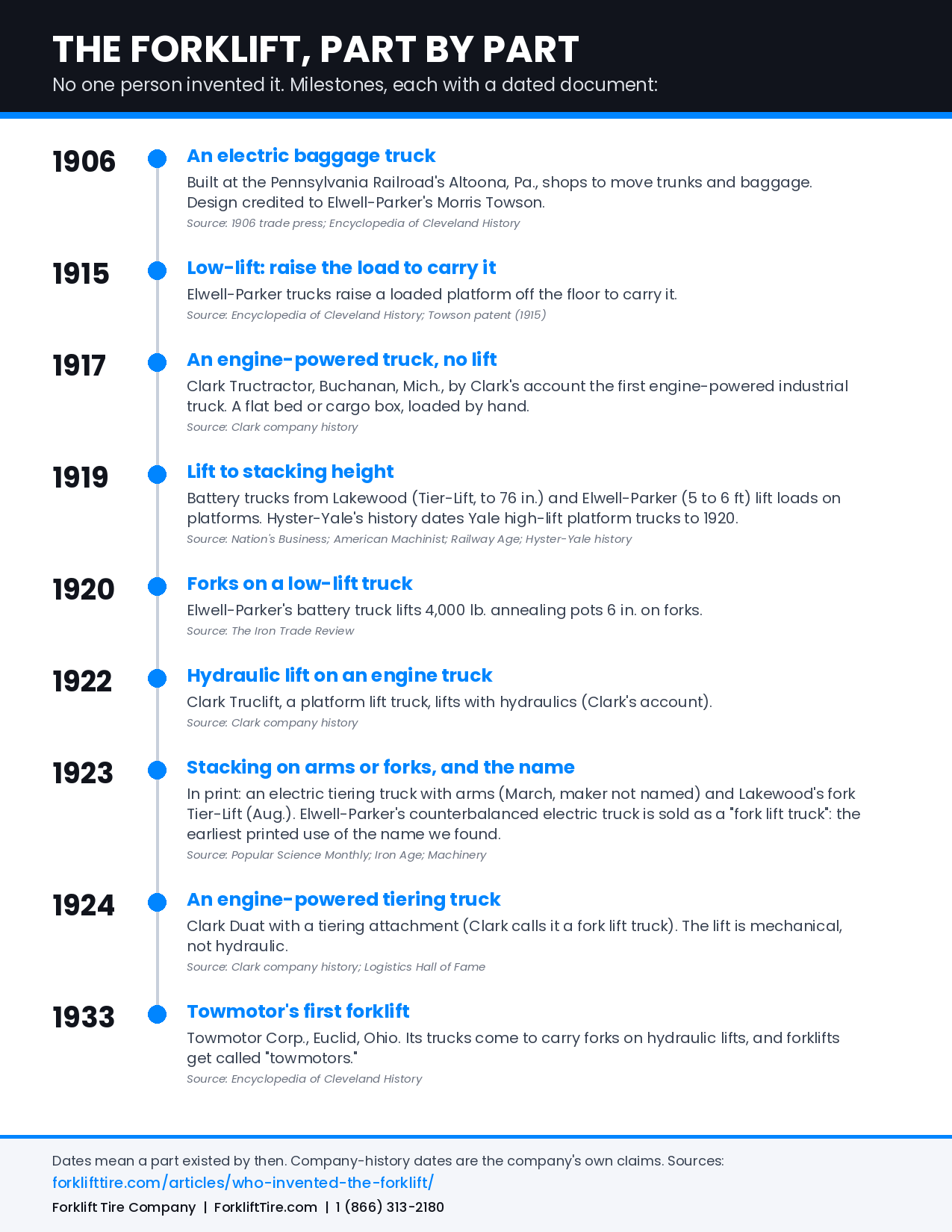
Each row is a milestone and a dated document behind it. A date means the part existed by then, not that nobody did it sooner; researching this article turned up earlier examples more than once. Where the only source is the company’s own history, the table says so.
| Milestone | Who | Date | Evidence |
|---|---|---|---|
| An electric truck for moving trunks and baggage (carried, did not lift) | Pennsylvania Railroad at Altoona, Pa.; design credited to Elwell-Parker’s Morris Towson | 1906 | 1906 trade press; Encyclopedia of Cleveland History |
| A powered truck that raises its load to carry it (low-lift) | Elwell-Parker Electric Co., Cleveland | By 1915 | Encyclopedia of Cleveland History; Towson patent filed 1915 |
| An engine-powered industrial truck (no lift) | Clark Tructractor, Buchanan, Mich. | 1917 (Clark’s account) | Clark company history |
| Battery trucks that lift loads to stacking height (on platforms) | Lakewood “Tier-Lift” (to 76 in.) and Elwell-Parker tiering truck (5 to 6 ft), Cleveland | By 1919 | Nation’s Business; American Machinist; Iron Age; Railway Age |
| Forks on a powered lift truck (low-lift) | Elwell-Parker annealing-pot truck, Cleveland | By 1920 | The Iron Trade Review |
| Hydraulic lift on an engine-powered truck (platform) | Clark Truclift | 1922 (Clark’s account) | Clark company history; Clark patent filed 1922 |
| Arms or forks on a truck that stacks | An electric tiering truck, maker not named (March); Lakewood fork “Tier-Lift” (Aug. 9) | By 1923 | Popular Science Monthly; Iron Age |
| The name “fork lift truck,” on a truck carrying a counterbalanced load on forks | Elwell-Parker (electric) | 1923 (earliest use of the name we found) | Iron Age; Machinery |
| An engine-powered tiering truck (Clark calls it a fork lift truck) | Clark Duat with tiering attachment | 1924 (Clark’s account) | Clark company history |
| Towmotor’s first forklift | Towmotor Corp., Euclid, Ohio (Cleveland area) | 1933 | Encyclopedia of Cleveland History |
Why There Is No Single Inventor
A sit-down forklift of the kind most warehouses run combines several ideas: a truck that drives itself, a mechanism that lifts the load, a mast tall enough to stack one load on another (the old trade word was “tiering”), forks that slide under a load instead of a platform the load has to be set on, a counterbalance (today a heavy counterweight at the rear) so the load can ride ahead of the front wheels, and, on most trucks, hydraulic lift.
Several companies built machines with some of those parts before any one machine had all of them. So the name you get depends on which part the person answering treats as the defining one. That is why the same question produces four or five different answers online, each stated with confidence.
1906: A Truck That Carries, but Doesn’t Lift
In January 1906 The Horseless Age reported that an electric truck had been built at the railroad company’s upper machine shops at Altoona, Pennsylvania, to transfer trunks and baggage. That June the Railway and Engineering Review described the Pennsylvania Railroad’s electric baggage truck at Altoona as an experiment. By 1907 the Railroad Gazette reported electrically propelled trucks in service at Broad Street station in Philadelphia as well as at Altoona.
The Encyclopedia of Cleveland History credits the design to Morris S. Towson, an engineer at Cleveland’s Elwell-Parker Electric Company, who “designed an electric truck in 1906 to help the Pennsylvania Railroad move luggage.” The railroad press says the railroad built it; the encyclopedia says Towson designed it. The sources we found don’t settle how the work was split.
Either way, the 1906 truck carried baggage. It did not lift anything. You will often read that it was the world’s first powered industrial truck. That label shows up in later histories; we did not find it in the reports from the time.
1915–1921: Lifting the Load
Elwell-Parker took the next step. According to the Encyclopedia of Cleveland History, a 1914 innovation “equipped the trucks with a platform that enabled them to raise and carry cargo,” and these low-lift trucks were produced beginning in 1915. Towson’s patent, filed in June 1915, describes a power-operated elevating support that slides under a loaded platform and raises it. Low-lift trucks raised the load only a short way: Yale’s 1921 catalog, for example, lists its lift truck at 4,000 pounds raised four inches. That is enough to pick up a loaded skid and move it, not enough to stack.
Stacking came next, and by late 1919 two Cleveland makers had battery trucks that lifted to stacking height. Lakewood Engineering was advertising “storage battery tier-lift trucks” in August 1919, and American Machinist reported on November 6, 1919, that Elwell-Parker “has placed on the market a combination truck for transporting and lifting,” with a “lifting height, 5 to 6 ft.” Both lifted a platform. In January 1920 Iron Age wrote up Lakewood’s machine: “the new machine is called the ‘tier-lift.’” A few weeks later Railway Age reported that it could “elevate a two-ton load to a maximum height of 76 in.” Lakewood’s patent, filed in 1919, describes a self-propelled truck “which may be used as a lifting truck and as a tiering truck.”
Yale & Towne of Stamford, Connecticut, was working on the same problem. A Yale patent filed in January 1921 describes a battery truck whose load platform rises on “vertical column guides” that “may be of any height desired,” lifted by a motor through a worm gear and chains. Hyster-Yale’s own company history says that in 1920 Yale launched “a new battery-powered low-lift platform truck, range of high-lift platform trucks, tow tractors and one of the first lifting trucks with tilting forks.”
Forks appear in these years too, on a low-lift truck. In December 1920 The Iron Trade Review described an Elwell-Parker storage-battery truck for handling annealing pots in malleable iron foundries: the forks were “inserted beneath pot stool,” and “the stool and pot are lifted 6 inches off the floor.” Each pot weighed 4,000 pounds, per the report. It lifted on forks, but only far enough to carry the pot to the next oven.
Apart from that truck and the company-history mention of tilting forks, every lifting truck we could document from these years lifted a platform. The load was set on the platform, or the platform went under a skid that already held the load.
1917: Clark’s Tructractor, an Engine Truck With No Forks
Clark is the name you’ll see most often. Clark Material Handling Company’s history says the first Tructractor was built in 1917 in Buchanan, Michigan, “by employees of the CLARK Equipment Company,” and calls it “the world’s first internal combustion-powered industrial truck.” The same history says the Tructractor “was originally configured with a flat bed or cargo box and was manually loaded and unloaded.” It hauled materials between Clark’s axle, drill and wheel departments. Visitors asked Clark to build Tructractors for them; Clark built eight in 1918 and more than 75 in 1919.
So the Tructractor was an engine-powered truck, by Clark’s account the first, but no forks, mast or lift are described. The Logistics Hall of Fame’s profile of Eugene Bradley Clark describes the Tructractor as “the forerunner of the modern forklift truck.” Forerunner is the accurate word. Clark’s trucks today are covered in our Clark forklift tires by model guide.
1922–1928: Clark Adds the Lift
Clark’s next machines are where its “firsts” get more specific:
- 1922, Truclift. An engine-powered platform lift truck. Clark calls it “the world’s first internal combustion lift truck that used hydraulics, not mechanical gears and linkage, to lift a load.” A Clark Tructractor patent filed in May 1922 describes a lift truck of this kind: a platform raised by a cylinder and piston, worked by oil pressure from a gear pump, with the power supplied by the truck’s internal combustion motor.
- 1924, Duat with a tiering attachment. Clark says this “modified Duat became the world’s first internal combustion fork lift truck.” Its lift was mechanical. The Logistics Hall of Fame describes a mechanically driven lifting device for loads of up to 455 kilograms, a 1925 Clark advertisement says the attachment “tiers 1,000 lbs” by power take-off, and a Clark tiering-machine patent filed in 1925 lifts with hoisting chains driven by the tractor’s engine, carrying the load on a platform supported on forward-extending arms.
- 1928, Tructier. Clark calls it the first internal combustion fork lift truck “that used hydraulics, not chains and cables, to lift a load.” A 1929 Clark advertisement lists the Tructier with a 30 in. by 26 in. platform, so read “fork” here with care.
Notice the qualifier in every one of those claims: internal combustion. Clark’s firsts are claims about engine-powered trucks. Electric trucks were already lifting loads by then. A line you’ll often see online, that Clark built the first truck with a hydraulic lifting mechanism in 1924, gets two things wrong: Clark’s hydraulic first was the 1922 Truclift, and the 1924 Duat lifted mechanically.
1923: Stacking Forks, and the Name “Fork Lift Truck”
Forks had already appeared on Elwell-Parker’s 1920 low-lift truck. Trucks that picked up a load on arms and then stacked it were in print by March 1923, when Popular Science Monthly described “a small electric storage battery tiering truck” (it doesn’t name the maker) whose operator “lowers the two arms and inserts them under the pile by moving the truck forward,” then raises the load “to any elevation up to six feet.” On August 9, 1923, Iron Age reported a fork version of Lakewood’s machine: “The new machine is known as the fork ‘tier-lift’,” “designed to pick up its load without the use of platform skids.” The report says it could stack material three high in 2,000 lb. units.
Elwell-Parker’s new fork truck followed within weeks, and with it the name. The earliest use of the words “fork lift truck” we found in the trade press is Elwell-Parker’s. Machinery’s September 1923 issue listed a “FORK LIFT TRUCK” from the Elwell-Parker Electric Co. of Cleveland: “a one-man electric truck which provides for carrying the load beyond the front axle,” “equipped with arms or forks.” Iron Age’s write-up on August 30, 1923, adds the detail that makes it a forklift in today’s sense: the load “balances an equal weight of the truck back of the axle,” and the forks can be stopped “at any height between upper and lower limits.”
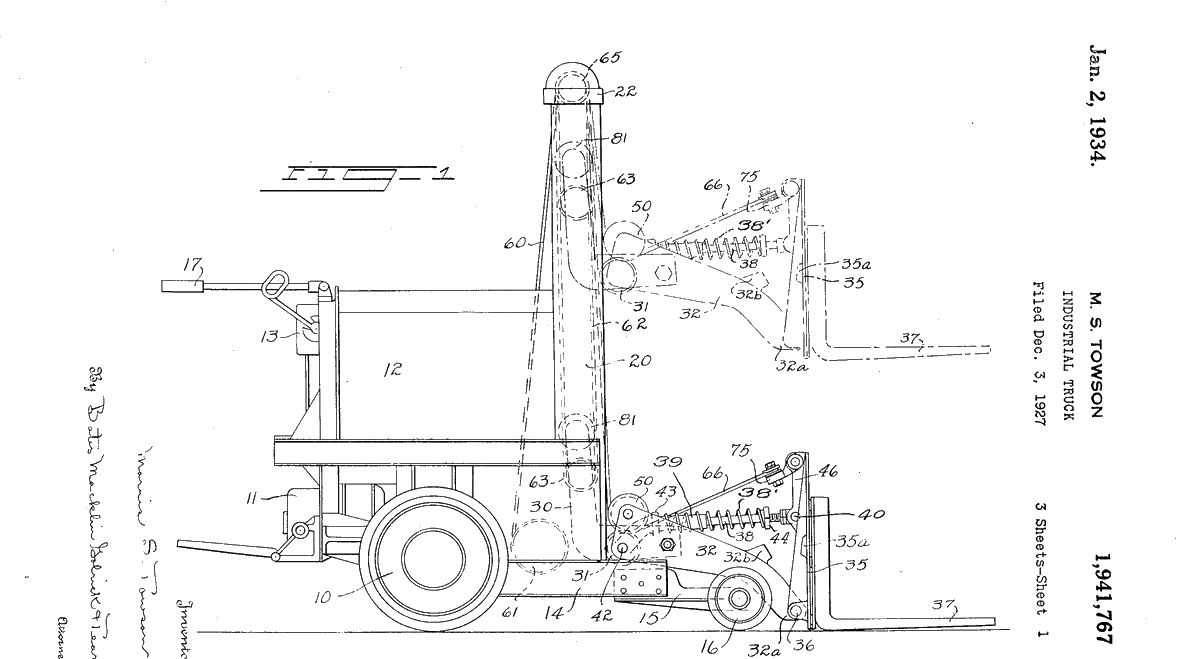
That is the counterbalance principle every sit-down forklift still uses: the load rides ahead of the front axle and the truck’s weight behind it holds the balance. The 1923 notices don’t say how high the forks lifted, so it may not have been a stacking machine. The Encyclopedia of Cleveland History dates Elwell-Parker’s high-lift fork truck to 1927, and an Elwell-Parker patent filed that December shows a mast with “L-shaped fork members.”
And Yale? The August 9, 1923, Iron Age that carried the Lakewood report also reported that Yale & Towne had “placed on the market a high platform general utility truck and an elevating platform truck,” the K-20 and K-22. A Yale patent filed that June does describe “forks or load supporting arms” that pass under stacks of sheet metal, but as an attachment fitted to an elevating platform, not as a mast-and-fork truck. See our Yale forklift tires by model guide for the trucks Yale builds today.
1933: Towmotor, and Why Forklifts Were Called “Towmotors”
Towmotor Corporation of Euclid, Ohio, near Cleveland, was founded in 1919 by Lester M. Sears, who, according to the Encyclopedia of Cleveland History, unveiled a prototype gasoline-powered industrial tractor that year. For its first fourteen years Towmotor built small tractors that pushed or towed loads through plants. In 1933 it “introduced the first forklift industrial truck.” Over the years the design was streamlined into a compact unit with “a pair of forward forks on hydraulic lifts, and a carefully balanced rear end.”
Towmotor’s trucks were so popular that, the encyclopedia says, “all industrial forklift trucks were generally referred to as ‘towmotors.’” Towmotor became a wholly owned subsidiary of Caterpillar on November 10, 1965. For today’s Cat trucks, see Caterpillar forklift tires by model. For the other names people use for these machines, see What Else Is a Forklift Called?
Read “the first forklift industrial truck” as Towmotor’s first. Trucks with forks were on sale a decade earlier. What the Towmotor story marks is the combination most people picture today, an engine with forks on hydraulic lifts and a balanced rear end, becoming common enough that one company’s name stood for the machine.
Popular Claims, Checked
| The claim | What the record shows |
|---|---|
| “Clark’s 1917 Tructractor was the first forklift.” | Clark’s own history describes a flat bed or cargo box, “manually loaded and unloaded.” No forks, mast or lift are described. |
| “Yale built the first electric truck with forks and a mast in 1923” (some versions say 1925). | We found no period document for it. Yale’s 1923 trucks in the trade press are platform trucks; the fork trucks named in the 1923 coverage we found were Lakewood’s and Elwell-Parker’s. Hyster-Yale’s own history dates a Yale tilting-fork truck to 1920 instead. |
| “Clark built the first truck with a hydraulic lifting mechanism in 1924.” | Clark’s hydraulic first was the 1922 Truclift, a platform truck. The 1924 Duat attachment lifted mechanically. |
| “William T. Harris patented a hydraulic lift in 1913.” | That patent (U.S. 1,086,529, granted in 1914) is a hydraulic lock mechanism for canals, not a lift truck. |
| “An 1887 ‘portable elevator’ patent is an early forklift.” | That patent (U.S. 373,648) is a ladder substitute: the user cranks himself up to working height. An 1867 patent (U.S. 62,098) is a closer ancestor: a wheeled platform raised by a windlass, for stores and warehouses where boxes “have to be piled up in tiers.” |
| C.W. Hunt Co. was “the developer of the industry’s first battery-powered low-lift platform truck (1919)” (Hyster-Yale’s history). | The Encyclopedia of Cleveland History says Elwell-Parker was producing low-lift trucks from 1915, four years earlier. The two histories conflict. |
| “The Pennsylvania Railroad built the world’s first powered industrial truck in 1906.” | The railroad did run an experimental electric baggage truck at Altoona in 1906. The “world’s first” label came later; we did not find it in the reports from the time. |
So Who Gets the Credit?
Credit the parts, not one person:
- Elwell-Parker and the Pennsylvania Railroad for putting an electric truck to work moving baggage (1906), and Elwell-Parker again for making it lift (by 1915), with forks on a battery truck by 1920.
- Clark for the engine-powered industrial truck (1917), hydraulic lift on an engine truck (1922) and an engine-powered tiering truck (1924), each by Clark’s own account.
- Lakewood Engineering and Elwell-Parker for battery trucks that lifted loads to stacking height (by 1919). Hyster-Yale’s history dates Yale & Towne high-lift platform trucks to 1920, and a Yale patent filed in 1921 describes one.
- An unnamed maker’s tiering truck with arms (in print by March 1923) and Lakewood’s fork Tier-Lift (August 1923) for stacking on arms or forks, and Elwell-Parker for the earliest truck we found sold under the name “fork lift truck,” with its load counterbalanced ahead of the axle (1923).
- Towmotor, from 1933, whose trucks came to carry forks on hydraulic lifts and became so common its name stood for the machine.
In one sentence: the forklift was invented by an industry over roughly a quarter century, and the earliest printed use of the name we found is from 1923.
What This Means When You Buy Tires
The same problem, one word covering very different machines, can lead to wrong tire orders today. “Forklift” can mean an electric three-wheel truck on press-on tires or a sit-down LP truck on pneumatic tires. Whether a truck takes cushion (press-on) or pneumatic-size tires is set by how it was built at the factory. Within that, the buyer chooses the compound on a press-on truck, and air-filled or solid on a pneumatic-size truck.
Tires were already part of the published spec by 1919: American Machinist noted of Elwell-Parker’s tiering truck that “All the wheels have rubber tires.” By 1920 there was a choice: the Elwell-Parker annealing-pot truck could run on rubber tires on all wheels where ovens were charged at low temperatures, or on steel wheels (a smooth steer wheel and a pair of herringbone steel drive wheels) when the ovens were hot, according to The Iron Trade Review. Tires have their own “firsts,” too. Hyster-Yale’s history says the 1939 Hyster “Jumbo,” a 15,000 lb. capacity truck used by lumbermen to load ships and rail cars, “was the first lift truck with pneumatic tires and a telescoping mast”: another company claim that rests on combining two features. Two habits help when you replace tires on any truck, old or new:
- Start from the data plate. It gives the model and serial number that identify the truck; How to Read a Forklift Data Plate shows what else to look for.
- Read the size molded on the sidewall of the tire you are replacing and cross-check it against the truck’s data plate or manual; if they disagree, sort that out before ordering. Forklift Tire Types Explained covers cushion, pneumatic, solid and polyurethane, and Forklift Tire Sizes by Make & Model lists common sizes for Clark, Yale, Hyster, Caterpillar and other makes. Shop press-on forklift tires or solid and pneumatic forklift tires.
Replacing tires on a forklift of any age?
Send FTC the make, model and serial number from the data plate and a photo of the tire sidewall. FTC reviews the size with you before you order. Verify exact tire size and fitment before ordering.
Email Your Truck Details Contact UsSave 7.5% on 2–3 items or 15% on 4+ items, automatic in cart. Free ground freight to commercial addresses in the contiguous U.S. Questions? Call 1 (866) 313-2180.
Frequently Asked Questions
Who invented the forklift?
No single person. The forklift was put together from parts that show up in the record at different times between 1906 and the 1930s: an electric baggage truck for the Pennsylvania Railroad (1906), trucks that lifted their loads (Elwell-Parker, by 1915), Clark’s engine-powered Tructractor (1917, by Clark’s account), battery trucks that lifted loads to stacking height (Lakewood and Elwell-Parker, by 1919), low-lift forks on an Elwell-Parker battery truck (by 1920), Clark’s hydraulic Truclift (1922, by Clark’s account), and, in 1923, stacking trucks with arms or forks and an Elwell-Parker electric truck sold as a “fork lift truck.” Towmotor introduced its first forklift in 1933.
Was the Clark Tructractor the first forklift?
No. Clark’s own history calls the 1917 Tructractor the world’s first internal combustion-powered industrial truck and says it had a flat bed or cargo box that was loaded and unloaded by hand. It had no forks and no lift. Clark dates its first engine-powered fork lift truck, a Duat tow tractor with a tiering attachment, to 1924.
Did Yale invent the forklift in 1923?
We found no document from the period that shows a Yale mast-and-fork truck in 1923. Trade journals that year describe Yale’s new K-20 and K-22 as platform trucks. Hyster-Yale’s own history instead dates a Yale lifting truck with tilting forks, “one of the first,” to 1920.
When was the term fork lift truck first used?
The earliest printed use we found is from 1923, in trade-journal notices for an electric truck made by Elwell-Parker of Cleveland. It carried its load on forks ahead of the front axle, balanced by the weight of the truck behind the axle.
When did forklifts get hydraulic lifts?
Clark says its 1922 Truclift, a platform lift truck, was the first internal combustion lift truck to lift with hydraulics, and that its 1928 Tructier was the first internal combustion fork lift truck to do so. Towmotor, which introduced its first forklift in 1933, came to build its trucks with forks on hydraulic lifts.
Why were forklifts called towmotors?
Towmotor Corporation of Euclid, Ohio, near Cleveland, built forklift trucks that were so popular that, according to the Encyclopedia of Cleveland History, all industrial forklift trucks were generally referred to as “towmotors.” Towmotor became part of Caterpillar in 1965.
Trademarks: Clark, Yale, Hyster, Hyster-Yale, Towmotor, Caterpillar, Cat and all other equipment names and model designations are trademarks of their respective owners. Forklift Tire Company is an independent aftermarket supplier and is not affiliated with, authorized by, sponsored by, or endorsed by any equipment manufacturer. Make and model references are used solely to identify equipment and its history.