 1 (866) 313-2180
 SALES@FORKLIFTTIRE.COM


Posted by Forklift Tire Company on 5th Aug 2026
The prefix at the front of your Cat model number already tells you which kind of tire the truck takes. GC and 2C trucks run press-on cushion tires. GP and DP trucks run pneumatic tires. EC and EP are the electric versions of the same two families. Get that far and you have already eliminated half the catalog — the rest is matching the size on your data plate to the right part.
This guide decodes the Cat lift truck naming system, then lists drive and steer tire sizes by model, taken from Cat's own published specification sheets rather than from cross-reference guesswork. Where a size has a page on our site, we link straight to it. Where it does not, we say so and give you the phone number instead of a dead end.
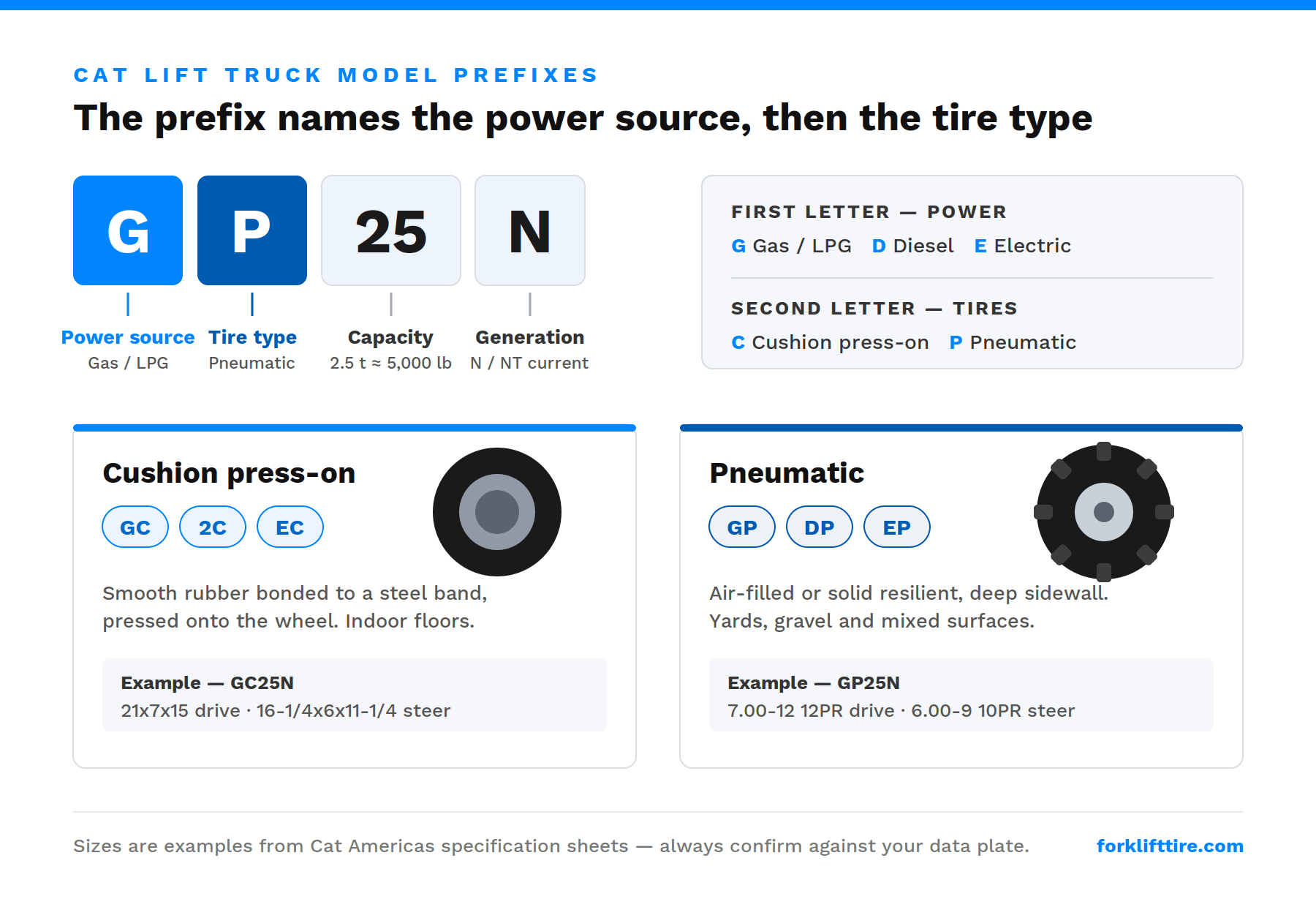
The Cat model prefix names the fuel or power source first and the tire architecture second. Sizes shown are examples — always confirm against your data plate.
In this guide
Who Builds Cat Forklifts Today
The lineage runs through Towmotor. Towmotor Corporation was founded in 1919 by Lester M. Sears, operating out of Euclid, Ohio, and introduced what the Encyclopedia of Cleveland History calls “the first forklift industrial truck” in 1933 — which is why an older generation of operators still calls any forklift a towmotor. On November 10, 1965, Towmotor became a wholly owned subsidiary of Caterpillar Tractor Company; production moved to Mentor, Ohio in 1971, the trucks were rebranded Caterpillar, and the Towmotor name was retired in the early 1970s.
In 1992 Caterpillar joined Mitsubishi Heavy Industries and Mitsubishi Corporation to form Mitsubishi Caterpillar Forklift America, headquartered in Houston. Caterpillar exited that venture's equity in 2021. Today Cat lift trucks are designed, built and sold by Logisnext Americas — renamed from Mitsubishi Logisnext Americas in 2026 — under a trademark license from Caterpillar Inc. The company's own Cat brand site carries the license line: “CAT, CATERPILLAR… are trademarks of Caterpillar Inc., used under license.”
Decode the Model Prefix
Cat's naming convention puts the power source first and the tire architecture second. Once you can read it, the model number on the cowl narrows your tire search before you have measured anything.
| Prefix | Power | Tire type | Typical use |
|---|---|---|---|
| GC | Gas / LPG | Cushion (press-on) | Smooth indoor floors, docks |
| 2C | Gas / LPG | Cushion (press-on) | Same as GC; capacity coded in pounds |
| GP | Gas / LPG | Pneumatic | Yards, gravel, mixed surfaces |
| DP | Diesel | Pneumatic | Outdoor, heavier duty |
| EC | Electric | Cushion (press-on) | Indoor warehouse, food and beverage |
| EP | Electric | Pneumatic | Indoor / outdoor mixed, ramps |
The numbers work two ways depending on generation. Older and metric-coded models use tonnes — a GC25 is a 2.5-tonne truck, roughly 5,000 lb. Newer US-market cushion models encode capacity in pounds directly, so a 2C5000 is a 5,000 lb truck. Suffixes distinguish model series and variants rather than production years: N, NT and K mark different model series — the K-series remains in Cat’s current catalog — while STR and SWB denote short-turning-radius and short-wheelbase variants. Do not infer an exact production year from a suffix alone.
Cat Cushion Tire Sizes by Model
Every size below is transcribed from a Cat lift truck specification sheet, with the document code noted under each table. These are the sizes commonly used on certain Caterpillar forklifts of each model designation — generations and factory options vary, so treat the table as a starting point and your data plate as the authority. Cushion tires are press-ons: the rubber is bonded to a steel band that is pressed onto the wheel, so the size is written as outside diameter × width × band diameter.
Current internal-combustion cushion trucks — GC15N through GC40CN:
| Model | Drive tire (front, ×2) | Steer tire (rear, ×2) |
|---|---|---|
| GC15N, GC18N, GC20CN | 18x6x12-1/8 | 14x5x10 |
| GC20N, GC25N | 21x7x15 | 16-1/4x6x11-1/4 |
| GC28N, GC30N, GC33N | 21x8x15 | 16-1/4x6x11-1/4 |
| GC30EN | 22x8x16 | 18x6x12-1/8 |
| GC35CN, GC40CN | 22x9x16 | 18x6x12-1/8 |
Sizes above are as printed in Cat specification sheet CECT0302-03. The 2C series, per Cat specification sheets CECT0201 and CPCT0302, covers the same capacity band with slightly different steer sizes: 2C3000 and 2C3500 use 18x6x12-1/8 drive with 14x5x10 steer; 2CC4000 uses 18x7x12-1/8 with 14x5x10; 2C4000 and 2C5000 use 21x7x15 with 16x6x10-1/2; 2C5500, 2C6000 and 2C6500 use 21x8x15 with 16x6x10-1/2; and 2C7000 and 2C8000 step up to 22x9x16 with 18x6x12-1/8. Verify exact tire size and fitment before ordering.
Larger K-generation cushion trucks — GC35K through GC70K:
| Model | Drive tire (front, ×2) | Steer tire (rear, ×2) |
|---|---|---|
| GC35K, GC40K, GC40K STR, GC45K SWB, GC45K STR | 22x9x16 | 18x7x12-1/8 |
| GC55K, GC55K STR | 22x12x16 | 18x8x12-1/8 |
| GC60K, GC70K, GC70K STR | 28x12x22 | 22x8x16 |
Sizes above match Cat’s GC35K–GC70K specification literature, verified against the current Logisnext Americas GC35K–GC70K brochure (CECT0300-01). Note the detail that trips people up: 22x9x16 does not always pair with the same steer tire. On the K-generation trucks it pairs with 18x7x12-1/8; on the GC35CN, GC40CN and 2C7000/2C8000 trucks it pairs with the narrower 18x6x12-1/8. Same drive tire, different rear. Check the plate, not the drive size.
If your truck takes the 22x9x16 and 18x7x12-1/8 combination, that is the pairing we sell as a matched 22x9x16 and 18x7x12-1/8 cushion press-on set — a 4-piece set with 2 drive + 2 steer. The 28x12x22 and 22x8x16 combination on the GC60K/GC70K class is available the same way as a 28x12x22 and 22x8x16 press-on set. Verify exact tire size and fitment before ordering.
Cat Pneumatic Tire Sizes by Model
GP and DP trucks take pneumatic-type tires, written the traditional way: section width, then rim diameter. The ply rating listed alongside is a separate load-and-inflation specification — match both, together with the approved rim. Most of these sizes are available either as an air-filled pneumatic or as a solid resilient tire in the same dimensions — the solid version trades ride quality for the end of flat tires, which is usually the right trade in a scrap yard or on a debris-heavy site.
| Model | Drive tire (front, ×2) | Steer tire (rear, ×2) |
|---|---|---|
| GP15N, GP18N | 6.50-10 10PR | 5.00-8 10PR |
| GP20CN | 6.50-10 on a 5.00 rim, solid | 5.00-8 on a 3.00 rim, solid |
| GP20N, GP25N, DP20N, DP25N | 7.00-12 12PR | 6.00-9 10PR |
| GP28N, GP30N, DP28N, DP30N | 28x9-15 12PR | 6.50-10 10PR |
| GP33N, GP35N, DP33N, DP35N | 250-15 16PR | 6.50-10 12PR |
| GP40NT, DP40NT | 8.25-15 14PR | 7.00-12 |
| GP45NT–GP55NT, DP45NT–DP55NT | 300-15 18PR | 7.00-12 |
Sizes above are as printed in the Americas Cat specification sheets CECV0310-01 (GP15N–GP35N / DP20N–DP35N) and the Americas GP40NT–GP55NT spec sheet. Ply ratings on the NT-series rear tires vary between the LPG and diesel builds within the same model number, so the rear size is listed without one — confirm yours against the plate or send us the model and serial number and we will confirm it.
A practical note on availability. Our 250-15 page carries 16PR and 20PR pneumatics plus a full range of solid resilient options, so the 16PR that Cat specifies for the GP33N/GP35N class is stocked. Our 300-15 page currently lists 20PR pneumatics and solid resilients, while Cat specifies 18PR for these models. Do not substitute on ply rating alone — tire size, load and inflation capacity, and the approved rim must all agree with the truck’s specification. Call 1 (866) 313-2180 and we will confirm the right fit for your exact truck before you order. Verify exact tire size and fitment before ordering.
One piece of history that still shows up in the yard: Cat and Mitsubishi lift trucks were built alongside each other under the Mitsubishi Caterpillar Forklift America joint venture from 1992, and the two lines share chassis heritage. That makes a Mitsubishi FG or FD truck a close cousin of its Cat contemporary — but close cousin is not the same as identical, and published steer sizes do diverge between the two lines at the same capacity. Do not assume a Cat size transfers to a Mitsubishi truck or the reverse; read each machine's own plate.
Electric Cat Trucks: EC and EP
Electric Cat trucks split the same way the engine-powered ones do. The EC series is electric cushion — the EC25N runs 21x7x15 drive with 16x6x10-1/2 steer, and the EC30N runs 21x8x15 with the same 16x6x10-1/2 steer, per Cat specification sheet CECM0307. Both pairings are stocked as individual sizes: 21x7x15 or 21x8x15 drive tires with 16x6x10-1/2 steer tires. If you would rather buy them as one matched 4-piece set with 2 drive + 2 steer, call 1 (866) 313-2180 and we will quote it. Verify exact tire size and fitment before ordering.
The EP series is electric pneumatic — current families include the EP16PNT–EP20PNT three-wheel trucks, the EP16T–EP20T-EQL and EP20–EP35-EQL ranges, the EP25AN–EP35AN series, and the 80-volt 3EPC5000–3EP7000 and 2EPC7000–2EP11000 trucks. Cat's public EP specification data does not consistently publish tire sizes, and we will not print a size we have not seen on a spec sheet. For an EP truck, send us the model and serial number and we will confirm the fitment before you order.
One thing worth knowing on electrics: a heavier battery changes the truck's weight distribution, and the tire specification the manufacturer rated the truck with is part of the machine's design assumptions. Match the specified size and construction rather than substituting a taller or narrower tire because it is what is on the shelf. If you are weighing press-on compounds for an indoor electric fleet, our forklift tire buying guide walks through the black rubber and non-marking rubber trade-offs.
Tires for Towmotor-Era Cat Trucks
Towmotor trucks are still working. The T-series and LT-series cushion trucks, the V-series pneumatics and the M-series electrics predate the Caterpillar rebrand, and plenty of them are still moving pallets in shops that bought them used and never had a reason to replace something that runs.
The good news is that most of these trucks use recognizable standard press-on and pneumatic sizes. The honest news is that the cross-reference data for legacy Towmotor models is inconsistent enough across published sources that we will not print a model-by-model table for them. What we will do is read the size off your existing tire or your data plate over the phone in about two minutes. Call 1 (866) 313-2180 with your model and serial number.
“Cat Tires” vs. Cat Forklift Tires
Searching for “Cat tires” returns two completely different products. Caterpillar's construction and earthmoving line — excavators, wheel loaders, skid steers, telehandlers — uses off-the-road tires in sizes and constructions that have nothing to do with lift trucks. Cat lift truck tires are industrial press-ons and pneumatics in the sizes listed above.
If you landed here looking for tires for a Cat skid steer loader rather than a Cat forklift, you want the skid steer tire and wheel sets instead — different sizes, different construction, sold as matched sets of four. And if you are not certain which machine class you are dealing with, the plate will tell you: lift trucks carry a rated capacity at a stated load center, which earthmoving machines do not.
From Your Data Plate to the Right Tire
Every table on this page is a shortcut. The authority is the truck. Cat lift trucks carry a data plate that identifies the truck — model, serial number, and rated capacity at a stated load center — and many also show tire information; read it together with the tire sidewall and Cat’s documentation for the exact truck — and under OSHA's powered industrial truck standard, 29 CFR 1910.178(a)(6), nameplates and markings must be maintained in legible condition. If you have never read one closely, our guide to how to read a forklift data plate walks through every field.
Three checks before you order. First, read the size off the sidewall or band of the tire currently on the truck and compare it to the plate — if they disagree, someone has already substituted a size, and that is worth resolving before you buy four more. Second, confirm whether you need cushion press-ons or pneumatics; the model prefix answers this and the wheel design confirms it. Third, decide construction: black rubber for general duty, non-marking rubber where floor marking matters, or a solid resilient in the pneumatic sizes where punctures are costing you more than ride comfort.
From there, shop by size on the cushion press-on tire pages or the solid and pneumatic tire pages, or take the matched-set route through our cushion forklift tire sets and pneumatic forklift tire sets — each a 4-piece set with 2 drive + 2 steer. If your Cat model is not listed above, or the size on your plate is not one we show, the forklift tire size chart and conversion guide covers the alternate designations, and the forklift tire sizes by make and model hub covers the other manufacturers — including Toyota, Hyster, Clark and Komatsu. Verify exact tire size and fitment before ordering.
Not sure which size your Cat takes?
Send us a photo of the data plate with your model and serial number and we will confirm the drive and steer sizes before you buy anything.
Email Your Data-Plate Photo Contact UsSave 7.5% on 2–3 items or 15% on 4+ items, automatic in cart. Free ground freight to commercial addresses in the contiguous U.S. Questions? Call 1 (866) 313-2180.
Frequently Asked Questions
Who makes Cat forklifts?
Logisnext Americas, headquartered in Houston, designs, builds and sells Cat lift trucks under a trademark license from Caterpillar Inc. The company was known as Mitsubishi Logisnext Americas until a 2026 rename. Caterpillar itself exited the equity of the joint venture in 2021, so Caterpillar Inc. does not manufacture the lift trucks today.
What do GC, GP, DP, EC and EP mean on a Cat forklift?
GC is gas or LPG with cushion press-on tires. GP is gas or LPG with pneumatic tires. DP is diesel with pneumatic tires. EC is electric with cushion tires and EP is electric with pneumatic tires. The 2C prefix is another internal-combustion cushion family, coded by capacity in pounds rather than tonnes.
What size tires does a Cat GC25N take?
Per Cat specification sheet CECT0302-03, the GC25N is listed with 21x7x15 drive tires and 16-1/4x6x11-1/4 steer tires. Note that the earlier 2C5000, at the same capacity, is listed with 21x7x15 drive and 16x6x10-1/2 steer instead. Verify exact tire size and fitment before ordering.
Do Cat forklifts use cushion or pneumatic tires?
Both, and the model prefix tells you which. GC, 2C and EC trucks are cushion press-on machines built for smooth indoor floors. GP, DP and EP trucks are pneumatic machines built for yards and mixed surfaces. A pneumatic truck cannot take press-ons and a cushion truck cannot take pneumatics; the wheels and the geometry are different.
Are Towmotor and Caterpillar forklifts the same?
Towmotor is the predecessor lineage of Cat lift trucks. Towmotor Corporation was founded in 1919 and became a wholly owned Caterpillar subsidiary on November 10, 1965; the trucks were rebranded Caterpillar and the Towmotor name was retired in the early 1970s. Many legacy Towmotor trucks use recognizable industrial tire sizes, but published cross-references are inconsistent — verify the model and serial number, the existing tire size, and the press-on band or rim before ordering; we confirm all of it by phone.
Can I buy Cat forklift tires from Caterpillar?
Cat lift truck tires are standard industrial sizes made by tire manufacturers, not proprietary Caterpillar parts, so they are available from industrial tire dealers. The tire listings on Caterpillar's own parts store are aimed at Cat construction and earthmoving equipment, which uses entirely different off-the-road sizes.
Does 22x9x16 always pair with an 18x7x12-1/8 steer tire?
No. On the K-generation trucks, GC35K through GC45K, Cat's specification sheet pairs 22x9x16 drive tires with 18x7x12-1/8 steer tires. On the GC35CN and GC40CN, and on the 2C7000 and 2C8000, the same 22x9x16 drive tire is paired with a narrower 18x6x12-1/8 steer tire. Confirm the steer size independently rather than inferring it from the drive size.
When should Cat forklift press-on tires be replaced?
Common practice is to replace a press-on when the rubber has worn down to the safety or wear line, which on many tires sits at about the top of the moulded size lettering, and immediately on chunking, cracking or any sign of the rubber separating from the steel band. Separately, OSHA requires that powered industrial trucks be examined at least daily before being placed in service, and that any truck found to be in unsafe condition be removed from service.
Trademarks: CAT, CATERPILLAR, Towmotor and all other equipment names and model designations are trademarks of their respective owners; CAT and CATERPILLAR are trademarks of Caterpillar Inc. Forklift Tire Company is an independent aftermarket supplier and is not affiliated with, authorized by, sponsored by, or endorsed by Caterpillar Inc., Logisnext Americas, or any other equipment manufacturer. Make and model references are used solely to identify the equipment that replacement tires are commonly used on.
This article is general educational information from Forklift Tire Company, not a substitute for OSHA-compliant, employer-provided operator training, a formal compliance review, or your equipment's data-plate ratings and the tire manufacturer's specifications. Always follow your data plate, the tire sidewall, and 29 CFR 1910.178.