 1 (866) 313-2180
 SALES@FORKLIFTTIRE.COM


Posted by Forklift Tire Company on 1st Sep 2026
Mitsubishi forklifts are everywhere in North American warehouses and yards — and their tire question has a twist most brands don't: Mitsubishi's current lineup includes two different 7,000–8,000 lb cushion families whose model numbers differ only by suffix, and they take different rear tires. An FGC35CN and an FGC35K are not the same truck. So with Mitsubishi, the suffix on your model number matters as much as the number itself.
This guide lists the published standard drive and steer tire sizes for Mitsubishi's IC cushion, IC pneumatic, and electric families exactly as the cited Mitsubishi Forklift Trucks specification sheets, published by Logisnext Americas, print them. It shows where near-identical model codes hide different fitments, and walks through how to verify your exact size from your truck's own records before you order Mitsubishi forklift tires.
In this guide
How Mitsubishi's Lineup Is Organized
The tables below follow the Mitsubishi Forklift Trucks specification sheets published by Logisnext Americas, family by family. They reproduce the published standard tire sizes in the cited sheets (revisions dated 2021–2026) — not universal specifications for every truck that has ever carried one of these model codes: the same code can appear across generations with different published sizes. For an individual truck, verify the full model, suffix, serial or generation, wheel/rim configuration, and existing tire markings before ordering. On those sheets, the FGC-prefixed families are cushion (press-on) trucks, the FG (dual fuel LP gas/gasoline) and FD (diesel) families are pneumatic-tire trucks, and the FB families are electric. Every size below is printed in the standard trade designation — the form molded on a tire sidewall and used in our catalog. Mitsubishi’s sheets punctuate sizes differently from document to document: a 12-1/8 in press-on bore appears as 12.13, 12.12 and 12 1/8 across three sheets, and the heavy L-series brochure uses the European decimal comma (12,00×20 for 12.00x20). The published fitment is reproduced exactly; only the notation is standardized — so every size here can be matched against a sidewall, a wheel and an order. Each table names its source sheet and revision.
Two conventions to know before you read the tables. First, Mitsubishi’s sheets label tire positions front and rear; the “drive” and “steer” wording in our column headers is FTC’s gloss for the front and rear positions on these counterbalance trucks. Second, the suffix is part of the model: N, CN, EN, K, T, HP, and the rest distinguish trucks that can carry different tires at the same capacity. Every suffixed variant gets its own row below, even where the sizes happen to match — never assume a suffixed model matches its base model, and never assume an older truck matches the current sheet.
Mitsubishi Cushion Model Sizes
Two current cushion families, two different spec sheets — and they overlap at 7,000–8,000 lb without sharing rear tires. All sizes are press-on cushion tires.
Small IC cushion: FGC15N–FGC40CN
| Model | Capacity (lb) | Drive (front) | Steer (rear) |
|---|---|---|---|
| FGC15N | 3,000 | 18x6x12 1/8 | 14x5x10 |
| FGC18N | 3,500 | 18x6x12 1/8 | 14x5x10 |
| FGC20CN | 4,000 | 18x6x12 1/8 | 14x5x10 |
| FGC20N | 4,000 | 21x7x15 | 16 1/4x6x11 1/4 |
| FGC25N | 5,000 | 21x7x15 | 16 1/4x6x11 1/4 |
| FGC28N | 5,500 | 21x8x15 | 16 1/4x6x11 1/4 |
| FGC30N | 6,000 | 21x8x15 | 16 1/4x6x11 1/4 |
| FGC30EN | 6,000 | 22x8x16 | 18x6x12 1/8 |
| FGC33N | 6,500 | 21x8x15 | 16 1/4x6x11 1/4 |
| FGC35CN | 7,000 | 22x9x16 | 18x6x12 1/8 |
| FGC40CN | 8,000 | 22x9x16 | 18x6x12 1/8 |
Three suffix traps hide in this one table. FGC20CN is not FGC20N: both are 4,000 lb, but the CN runs the smaller 18x6x12 1/8 / 14x5x10 pairing while the N steps up to 21x7x15 / 16 1/4x6x11 1/4. FGC30EN is not FGC30N: both are 6,000 lb, but the EN runs 22x8x16 / 18x6x12 1/8 where the N runs 21x8x15 / 16 1/4x6x11 1/4. And the two decimals this sheet prints for the same 18x6 press-on — 12.13 on the small trucks’ front, 12.12 on the larger trucks’ rear — are one dimension, 12-1/8 in, rounded two different ways on a single page. It is the same tire, working as a drive tire on the small chassis and a steer tire on the big one.
Mid-size IC cushion: FGC35K–FGC70K
| Model | Capacity (lb) | Drive (front) | Steer (rear) |
|---|---|---|---|
| FGC35K | 7,000 | 22x9x16 | 18x7x12 1/8 |
| FGC40K | 8,000 | 22x9x16 | 18x7x12 1/8 |
| FGC45K | 10,000 | 22x9x16 | 18x7x12 1/8 |
| FGC55K | 12,000 | 22x12x16 | 18x8x12 1/8 |
| FGC60K | 13,500 | 28x12x22 | 22x8x16 |
| FGC70K | 15,500 | 28x12x22 | 22x8x16 |
Here is the collision that makes Mitsubishi fitment tricky: FGC35CN (small-chassis sheet) and FGC35K (mid-size sheet) are different trucks at the same 7,000 lb rating. The front is 22x9x16 on both — but the rear differs: 18x6x12 1/8 on the FGC35CN, 18x7x12 1/8 on the FGC35K — the same 12-1/8 in bore, but a 6 in wide band on the CN against a 7 in wide band on the K. Matching bores do not make them interchangeable; the band width is the difference. The same split repeats at 8,000 lb with FGC40CN and FGC40K. A lookup keyed on “Mitsubishi FGC35” or “FGC40” without the suffix is ambiguous on Mitsubishi’s own current lineup, so read the full designation off the data plate before ordering. Also note where the sizes step: the front stays 22x9x16 from 7,000 through 10,000 lb, widens to 22x12x16 at the 12,000 lb FGC55K, and the FGC60K/FGC70K move up to a 28x12x22 front with a 22x8x16 rear.
Mitsubishi Pneumatic Model Sizes
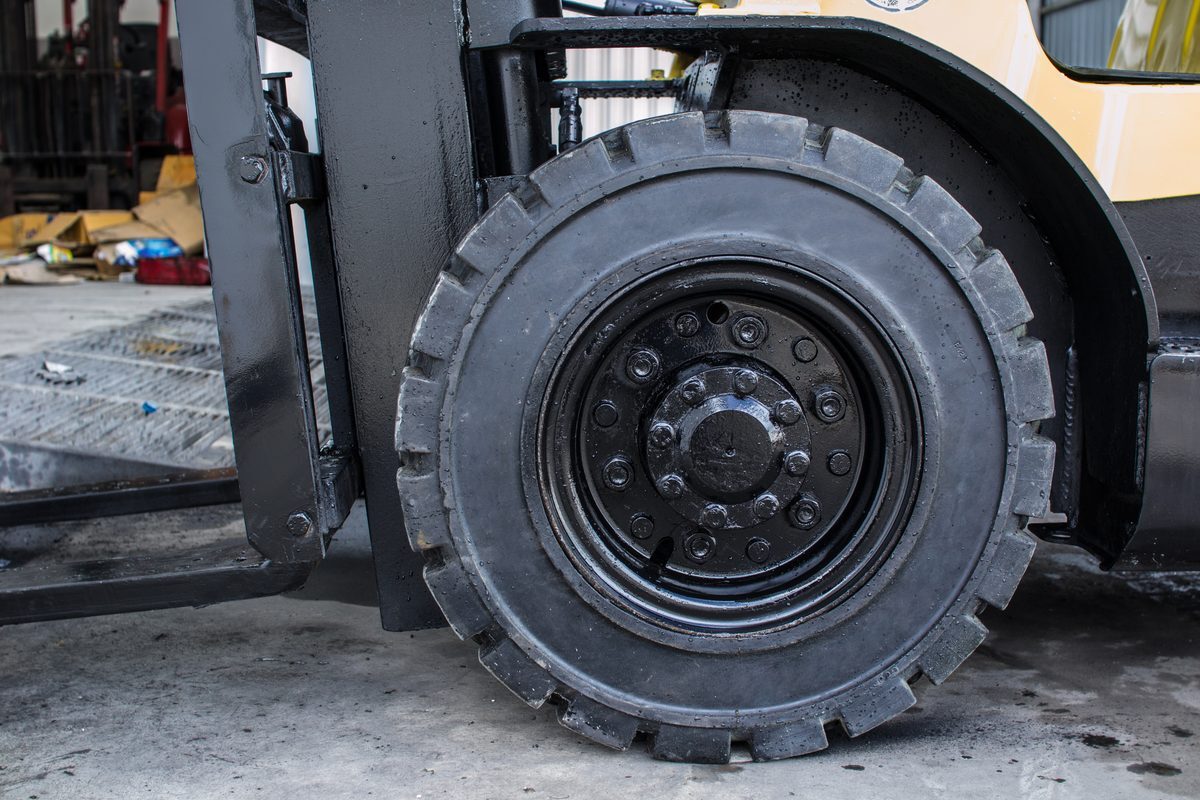
Mitsubishi's pneumatic-tire families run from 3,000 lb warehouse trucks to 40,000 lb heavy haulers, split across several spec sheets. FG models are dual fuel (LP gas/gasoline) and FD models are diesel. Replacement in these nominal sizes comes in air-filled pneumatic and solid resilient constructions — more on that choice below.
Small IC pneumatic: FG15N–FG35N and FD20N–FD35N
| Model | Capacity (lb) | Drive (front) | Steer (rear) |
|---|---|---|---|
| FG15N | 3,000 | 6.50x10 10PR | 5.00x8 10PR |
| FG18N | 3,500 | 6.50x10 10PR | 5.00x8 10PR |
| FG20N | 4,000 | 7.00x12 12PR | 6.00x9 10PR |
| FG25N | 5,000 | 7.00x12 12PR | 6.00x9 10PR |
| FG28N | 5,500 | 28x9-15 12PR | 6.50x10 10PR |
| FG30N | 6,000 | 28x9-15 12PR | 6.50x10 10PR |
| FG33N | 6,500 | 250x15 16PR | 6.50x10 12PR |
| FG35N | 7,000 | 250x15 16PR | 6.50x10 12PR |
| FD20N | 4,000 | 7.00x12 12PR | 6.00x9 10PR |
| FD25N | 5,000 | 7.00x12 12PR | 6.00x9 10PR |
| FD28N | 5,500 | 28x9-15 12PR | 6.50x10 10PR |
| FD30N | 6,000 | 28x9-15 12PR | 6.50x10 10PR |
| FD33N | 6,500 | 250x15 16PR | 6.50x10 12PR |
| FD35N | 7,000 | 250x15 16PR | 6.50x10 12PR |
On this brochure, FG and FD rows print identical tire sizes at every shared capacity — and note the diesel line starts at FD20N; there is no FD15N or FD18N on the sheet. The size ladder has two steps worth flagging: at 5,500 lb the front changes form entirely to 28x9-15 12PR (Mitsubishi prints this front in dimensional form with a ply rating), and at 6,500 lb it moves to the metric-style 250x15 16PR while the rear’s ply steps from 10PR to 12PR in the same 6.50x10 size.
A different build on the same sheet: the 4,000 lb FG20CN appears on this brochure not with pneumatic sizes but with solid-tire designations — 6.50x10 / 5.0 Solid front and 5.00x8 / 3.0 Solid rear, where the number after the slash is the rim width, not a tire size. That is a different factory build on different wheels than the FG20N’s pneumatics — check your data plate, and note this is one more case where the C-suffixed model is not the base model.
Mid IC pneumatic: FG40N–FG55N and FD40N–FD55N
| Model | Capacity | Front, single | Front, special duals | Rear |
|---|---|---|---|---|
| FG40N | 8,000 lb / 4,000 kg | 8.25x15 14PR | 8.25x15 12PR | 7.00x12 12PR |
| FD40N | 8,000 lb / 4,000 kg | 8.25x15 14PR | 8.25x15 12PR | 7.00x12 12PR |
| FG45N | 9,000 lb / 4,500 kg | 300x15 18PR | 8.25x15 12PR | 7.00x12 12PR |
| FD45N | 9,000 lb / 4,500 kg | 300x15 18PR | 8.25x15 12PR | 7.00x12 12PR |
| FG50CN | 10,000 lb / 5,000 kg | 300x15 18PR | 8.25x15 12PR | 7.00x12 12PR |
| FD50CN | 10,000 lb / 5,000 kg | 300x15 18PR | 8.25x15 12PR | 7.00x12 12PR |
| FG50N | 11,000 lb / 5,000 kg | 300x15 18PR | 8.25x15 12PR | 7.00x12 14PR |
| FD50N | 11,000 lb / 5,000 kg | 300x15 18PR | 8.25x15 12PR | 7.00x12 14PR |
| FG55N | 12,000 lb / 5,500 kg | 300x15 18PR | 8.25x15 12PR | 7.00x12 14PR |
| FD55N | 12,000 lb / 5,500 kg | 300x15 18PR | 8.25x15 12PR | 7.00x12 14PR |
Three things this sheet makes explicit. First, the “special duals” column is its own printed fitment — on FG45N and up, the duals value differs from the single-front value in both size and ply, so don’t treat either as a substitute for the other; the truck’s build determines which applies. Second, FG50CN is not FG50N: the C-suffixed truck is rated 10,000 lb with a 12PR rear, the FG50N is 11,000 lb with a 14PR rear — same front, different rear ply, and one more reason the suffix has to match. Third, on this sheet only the 8,000 lb FG40N/FD40N carry the 8.25x15 14PR single front; everything from 9,000 lb up runs 300x15 18PR.
Large IC pneumatic, P series: FD60P–FD100CP
| Model | Capacity | Front | Rear |
|---|---|---|---|
| FD60P | 13,000 lb / 6,000 kg | 8.25x15 14PR | 8.25x15 14PR |
| FD60HP | 13,000 lb / 6,000 kg | 8.25x15 14PR | 8.25x15 14PR |
| FD70P | 15,500 lb / 7,000 kg | 8.25x15 14PR | 8.25x15 14PR |
| FD70HP | 15,500 lb / 7,000 kg | 8.25x15 14PR | 8.25x15 14PR |
| FD80P | 17,500 lb / 8,000 kg | 9.00x20 14PR | 9.00x20 14PR |
| FD100CP | 22,000 lb / 8,000 kg (as printed) | 9.00x20 14PR | 9.00x20 14PR |
The HP variants print the same tire sizes as their non-HP siblings on this sheet — we keep them as separate rows anyway, because a suffix that changes nothing on one sheet can change plenty elsewhere in the lineup. The size step lands at the FD80P, from 8.25x15 14PR to 9.00x20 14PR. One oddity we reproduce rather than fix: the sheet prints the FD100CP’s capacity as 22,000 lb / 8,000 kg; the pound and kilogram figures don’t correspond, and we quote the document as printed rather than guessing which figure Mitsubishi intended.
Large IC pneumatic, NH series: FD60NH–FD100NH
| Model | Capacity | Front, standard duals | Rear |
|---|---|---|---|
| FD60NH | 13,000 lb / 6,000 kg | 8.25x15 14PR | 8.25x15 14PR |
| FD70NH | 15,500 lb / 7,000 kg | 8.25x15 14PR | 8.25x15 14PR |
| FD80NH | 17,500 lb / 8,000 kg | 9.00x20 14PR | 9.00x20 14PR |
| FD100NH | 22,000 lb / 10,000 kg | 9.00x20 14PR | 9.00x20 14PR |
The NH series and the P series are separate model families documented on separate sheets (2022 and 2026 respectively) that happen to print the same tire sizes at the same capacities. Neither document states whether the NH series is current, superseded, or sold alongside the P series, so we list both and describe neither as replacing the other. If your data plate says NH, use the NH row; if it says P or HP, use the P-series table.
Heavy IC pneumatic, L series: FD100L6P–FD180L6P
| Model | Rated capacity (lb/kg) | Front | Rear |
|---|---|---|---|
| FD100L6P | 22,000/10,000 | 12.00x20 20PR | 12.00x20 20PR |
| FD120L6P | 26,000/12,000 | 12.00x20 20PR | 12.00x20 20PR |
| FD127L6P | 28,000/12,700 | 12.00x20 20PR | 12.00x20 20PR |
| FD140L6P | 31,000/14,000 | 12.00x20 20PR | 12.00x20 20PR |
| FD150L6P | 33,000/15,000 | 12.00x20 20PR | 12.00x20 20PR |
| FD100L12P | 22,000/10,000 | 12.00x20 20PR | 12.00x20 20PR |
| FD120L12P | 26,000/12,000 | 12.00x20 20PR | 12.00x20 20PR |
| FD150L12P | 33,000/15,000 | 12.00x20 20PR | 12.00x20 20PR |
| FD160L6P | 36,000/16,000 | 12.00x20 20PR | 12.00x20 20PR |
| FD160L9P | 36,000/16,000 | 12.00x20 20PR | 12.00x20 20PR |
| FD160L12P | 36,000/16,000 | 12.00x20 20PR | 12.00x20 20PR |
| FD180L6P | 40,000/18,000 | 12.00x20 20PR HD | 12.00x20 20PR HD |
One size carries the whole family: 12.00x20 20PR front and rear from 22,000 through 36,000 lb, with the 40,000 lb FD180L6P alone printing an HD suffix on the size — that suffix is part of the printed cell on that one row only. The L6P, L9P and L12P designations are separate models that share this printed size — three of them sit at 36,000 lb — and the brochure does not define what the segments denote, so match the full designation on your data plate rather than decoding it. We show this size unlinked on purpose: our 12.00x20 range carries this nominal size in other ply ratings and constructions, not the 20PR build these sheets specify, and a matching nominal size does not by itself establish ply, construction or rim compatibility. If you run one of these trucks, send us your data plate and we will confirm what we can supply against your actual build. Note also that Mitsubishi’s own web page for this family lists mostly M-suffixed designations (FD100L6PM and similar) while the brochure’s specification table prints the non-M models above; the two rosters are not interchangeable, and this guide is keyed to the brochure’s designations.
Mitsubishi Electric Model Sizes
Mitsubishi’s electric counterbalance lineup spans three families with three different tire stories: a 3-wheel family on cushion tires, a 4-wheel family on solid pneumatic (SE) tires, and an electric cushion family for which no factory tire-size documentation was available when we compiled this guide.
3-wheel electric: FB16PNT–FB20PNT
| Model | Capacity | Drive (front) | Steer (rear) |
|---|---|---|---|
| FB16PNT | 3,000 lb / 1,600 kg | 18x7x12 1/8 | 15x5x11 1/4 |
| FB18PNT | 3,500 lb / 1,800 kg | 18x7x12 1/8 | 15x5x11 1/4 |
| FB20PNT | 4,000 lb / 2,000 kg | 18x7x12 1/8 | 15x5x11 1/4 |
One size pairing across the family: an 18 x 7 press-on with a 12 1/8 in bore up front, a 15 x 5 with an 11 1/4 in bore at the rear. (Written as decimals, those bores are 12.125 in and 11.25 in — that conversion is our gloss, not Mitsubishi’s print.)
4-wheel electric counterbalance: FB14N2T–FB20N2
| Model | Capacity (lb / kg) | Front | Rear |
|---|---|---|---|
| FB14N2T | 2,700 / 1,250 | 18x7-8 | 140/55-9 |
| FB16CN2T | 3,000 / 1,425 | 18x7-8 | 140/55-9 |
| FB18CN2T | 3,500 / 1,600 | 18x7-8 | 140/55-9 |
| FB16N2T | 3,000 / 1,425 | 18x7-8 | 140/55-9 |
| FB18N2T | 3,500 / 1,600 | 18x7-8 | 140/55-9 |
| FB20N2T | 4,000 / 1,800 | 200/50-10 | 140/55-9 |
| FB16CN2 | 3,000 / 1,425 | 18x7-8 | 16x6-8 |
| FB18CN2 | 3,500 / 1,600 | 18x7-8 | 16x6-8 |
| FB16N2 | 3,000 / 1,425 | 18x7-8 | 16x6-8 |
| FB18N2 | 3,500 / 1,600 | 18x7-8 | 16x6-8 |
| FB20N2 | 4,000 / 1,800 | 200/50-10 | 16x6-8 |
The T suffix changes the rear tire. N2T models list a 140/55-9 rear; N2 models list a 16x6-8 rear. The front is unchanged by the suffix — every model runs 18x7-8 up front except the two 4,000 lb FB20 models, which step to 200/50-10. The C in FB16CN2 and its siblings doesn’t change any tire size on this sheet, but as everywhere in this lineup, match the full designation anyway. Note the sheet mixes conventions inside a single row — an inch-style 18x7-8 front with a metric-style 140/55-9 rear — and we print both as-is.
Electric cushion: the FBC family
Mitsubishi’s pages also list an electric cushion family (model names shown include FBC23N, FBC25N2, FBC25EN2, FBC25LN2, FBC30N2, and FBC30LN, with some inconsistency between listings on Mitsubishi’s own page). No first-party document with tire sizes for this family was available when we compiled this guide — the brochure link on Mitsubishi’s site returned an error — so we don’t print sizes for these models. If you run an FBC truck, your data plate and current sidewalls carry the answer: send us both and we’ll help confirm the fitment.
Mitsubishi Tire Sizes by Capacity Band
If you know your truck’s rated capacity but are still hunting the exact model, these bands show which size pairings appear where in each family’s spec sheet. They are reading aids for the model tables above — the capacity is the truck’s rating, not a tire load rating, and the model row (suffix included) is always the authority.
Cushion bands
| Front size (in) | Rear size (in) | Capacity band (lb) | Models |
|---|---|---|---|
| 18x6x12 1/8 | 14x5x10 | 3,000 – 4,000 | FGC15N, FGC18N, FGC20CN |
| 21x7x15 | 16 1/4x6x11 1/4 | 4,000 – 5,000 | FGC20N, FGC25N |
| 21x8x15 | 16 1/4x6x11 1/4 | 5,500 – 6,500 | FGC28N, FGC30N, FGC33N |
| 22x8x16 | 18x6x12 1/8 | 6,000 | FGC30EN |
| 22x9x16 | 18x6x12 1/8 | 7,000 – 8,000 | FGC35CN, FGC40CN |
| Front size (in) | Rear size (in) | Capacity band (lb) | Models |
|---|---|---|---|
| 22x9x16 | 18x7x12 1/8 | 7,000 – 10,000 | FGC35K, FGC40K, FGC45K |
| 22x12x16 | 18x8x12 1/8 | 12,000 | FGC55K |
| 28x12x22 | 22x8x16 | 13,500 – 15,500 | FGC60K, FGC70K |
Pneumatic bands
| Front size | Rear size | Capacity band (lb) | Models |
|---|---|---|---|
| 6.50x10 10PR | 5.00x8 10PR | 3,000 – 3,500 | FG15N, FG18N |
| 7.00x12 12PR | 6.00x9 10PR | 4,000 – 5,000 | FG20N, FG25N, FD20N, FD25N |
| 28x9-15 12PR | 6.50x10 10PR | 5,500 – 6,000 | FG28N, FG30N, FD28N, FD30N |
| 250x15 16PR | 6.50x10 12PR | 6,500 – 7,000 | FG33N, FG35N, FD33N, FD35N |
| Front, single | Rear | Capacity band (lb) | Models |
|---|---|---|---|
| 8.25x15 14PR | 7.00x12 12PR | 8,000 | FG40N, FD40N |
| 300x15 18PR | 7.00x12 12PR | 9,000 – 10,000 | FG45N, FD45N, FG50CN, FD50CN |
| 300x15 18PR | 7.00x12 14PR | 11,000 – 12,000 | FG50N, FD50N, FG55N, FD55N |
| Size (front and rear alike) | Capacity band (lb) | Models | Sheet |
|---|---|---|---|
| 8.25x15 14PR | 13,000 – 15,500 | FD60P, FD60HP, FD70P, FD70HP, FD60NH, FD70NH | MECV0407, WESM1971 |
| 9.00x20 14PR | 17,500 – 22,000 | FD80P, FD100CP, FD80NH, FD100NH | MECV0407, WESM1971 |
| 12.00x20 20PR | 22,000 – 36,000 | FD100L6P, FD120L6P, FD127L6P, FD140L6P, FD150L6P, FD100L12P, FD120L12P, FD150L12P, FD160L6P, FD160L9P, FD160L12P | MECV0205 |
| 12.00x20 20PR HD | 40,000 | FD180L6P | MECV0205 |
Model-Code Lookalikes: Read the Whole Designation
Mitsubishi fitment rewards precision about model codes, for two reasons documented above and one broader caution:
- Mitsubishi collides with itself. FGC35CN vs FGC35K and FGC40CN vs FGC40K sit at the same capacities with different rear tires. FGC20CN vs FGC20N and FGC30EN vs FGC30N differ front and rear. FG50CN vs FG50N differ in capacity and rear ply. The suffix is never decoration.
- Mitsubishi’s current sheets print suffixed designations — FGC33N, FGC40CN, FGC40K — not bare codes like “FGC33” or “FGC40.” If your data plate shows a bare code, you may be looking at an older-generation truck that today’s sheets don’t cover — and even a code that matches a current designation can belong to an earlier generation with different published sizes. Verify from the truck’s own records — plate, serial, wheels, and mounted tires — rather than mapping a code onto the current sheet.
- Model codes repeat across brands. Industry fitment references list FGC-style codes under more than one manufacturer — Toyota’s cushion lineage uses FGC-badged designations too — so a model code alone, without the brand off the data plate, doesn’t identify a truck. Our Toyota fitment guide covers that side of the family tree.
How to Confirm Your Exact Mitsubishi Tire Size
The tables show the published configurations; verifying your individual truck takes a few steps:
- Start with the data plate. It carries the full model designation — suffix included — plus serial number and rated capacity, and it is the starting point for identifying the truck. With Mitsubishi’s lookalike codes, read every character, and keep the serial number with it — the code alone doesn’t settle the generation.
- Read the sidewall. The size is molded into your current tires — cushion reads like
21x7x15, pneumatic like7.00-12. Check both front and rear; on most models in the tables above they differ. Remember the mounted tires show what’s on the truck now, which can reflect a prior owner’s change — right or wrong. If the sidewall, the data plate, the wheels and the documentation don’t all agree, send us what you have before ordering — we’ll review the evidence with you, and conflicting records or a construction change should be resolved with Mitsubishi or an authorized service provider. - Have your serial number ready. For older trucks, MCFA-era designations, or anything not in the current sheets above, the serial number plus the plate is how the build gets pinned down.
- Check the whole wheel (for assemblies). If you’re buying mounted tire-and-wheel assemblies, bolt-hole count alone doesn’t establish compatibility. The bolt circle, pilot (center) bore, offset or backspacing, one-piece vs split/lock-ring construction, rim dimensions and load rating all have to match your truck, with clearance at the brakes, hub and chassis. Send photos and measurements of your current wheel and we’ll help review the match before you order.
If the size formats above look unfamiliar, the forklift tire size chart & conversion guide explains how cushion and pneumatic sizes are written and how to read them off a sidewall.
Compound or Construction: What You're Actually Choosing
Once the size is confirmed, what you choose depends on which kind of truck you have — and the two families present different choices:
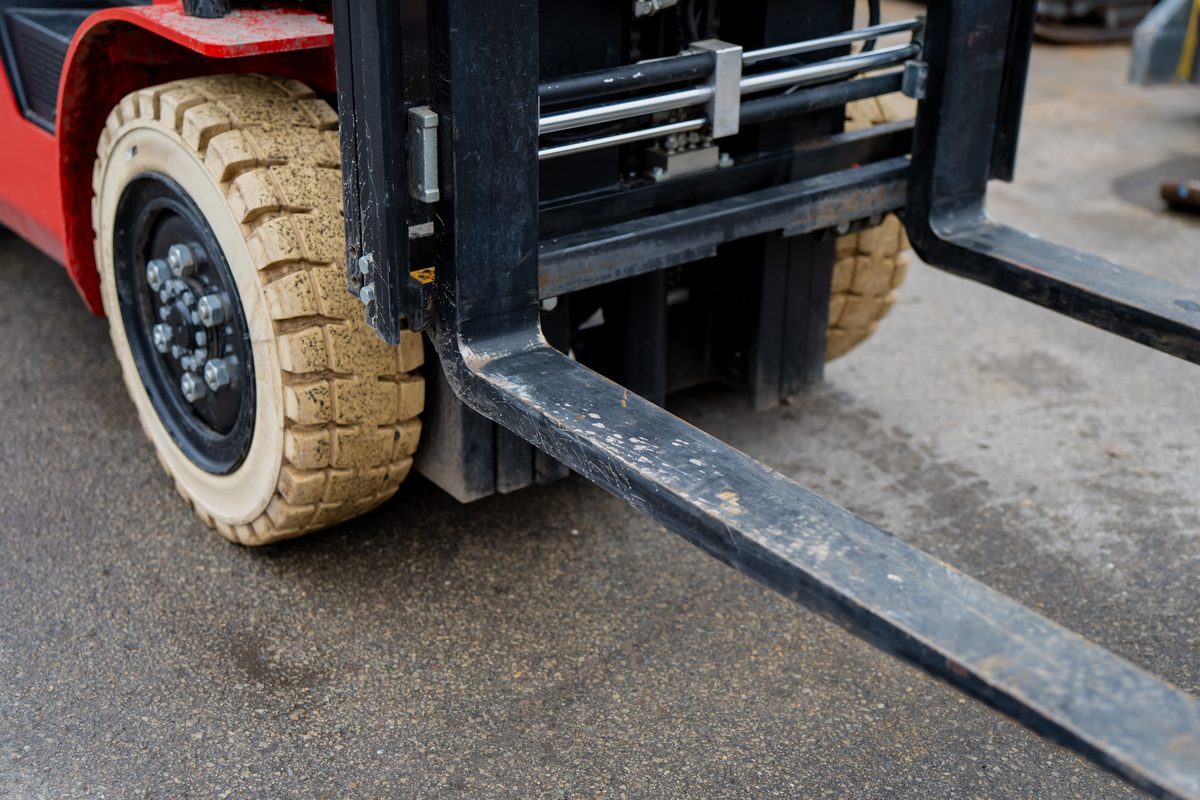
- Press-on (cushion) trucks — the choice is compound. On the FGC and cushion electric families, the replacement decision is standard black rubber vs non-marking rubber in the size your truck takes. Choose non-marking where floor marks are unacceptable — food, pharma, clean warehouse floors; otherwise standard black.
- Pneumatic-size trucks — the choice is construction. On the FG/FD families, the same nominal size typically comes as an air-filled pneumatic or a solid resilient — flat-proof, heavier, and the usual pick for debris-strewn yards, recycling, and scrap. But a matching nominal size alone doesn’t settle a switch between the two constructions: the approved rim, outside diameter, load and ply rating, and clearance all need checking for the specific truck. OSHA’s powered-industrial-truck rule requires the manufacturer’s prior written approval for modifications that affect capacity or safe operation, and requires replacement parts to be “equivalent as to safety” to those in the original design (29 CFR 1910.178(a)(4) and (q)(5)) — whether a particular tire change rises to that level depends on the change, so when in doubt, route the question through Mitsubishi or an authorized service provider. We’re glad to help you weigh the options for your application.
What is not a choice: cushion vs pneumatic itself. That was decided when the truck was built — the two run different wheels on different chassis — so the truck’s original configuration settles which family of tires you’re shopping. Check the model designation and records that come with the truck: the data plate and serial number, the wheels it runs, and what’s mounted now. For the full decision framework, see the forklift tire buying guide.
Not sure of your size? Send us your data plate.
Snap a photo of the plate (and the sidewalls if you can) and we’ll read it with you and help confirm both sizes before you order.
Frequently Asked Questions
What size tires fit my Mitsubishi forklift?
It depends on the exact model designation — suffix included — and the truck's generation. Mitsubishi's current spec sheets list, for example, a 21x7x15 front and 16 1/4x6x11 1/4 rear on the 5,000 lb cushion FGC25N, and a 7.00x12 front with a 6.00x9 rear on the 5,000 lb pneumatic FG25N — but near-identical codes like FGC35CN and FGC35K carry different rear tires, and the same code can carry different published sizes across generations. Find your full model designation on the data plate, match it in the tables in this guide, and check it against the sizes molded on your current sidewalls before ordering — or send us a photo of your data plate and we will help confirm both sizes.
Are Mitsubishi FGC35CN and FGC35K tires the same?
No. Both are 7,000 lb cushion forklifts, and both list a 22x9x16 front — but the rears differ: Mitsubishi's small-chassis sheet lists 18x6x12 1/8 for the FGC35CN, while the mid-size sheet lists 18x7x12 1/8 for the FGC35K — the same 12-1/8 in bore, but a 6 in wide band against a 7 in wide band. The same split repeats on the 8,000 lb FGC40CN and FGC40K. Read the full designation off your data plate before ordering a rear tire.
What tires does a Mitsubishi FGC25N use?
The FGC25N is a 5,000 lb capacity cushion-tire forklift, and Mitsubishi's current spec sheet (MECT0401) lists press-on cushion tires: 21x7x15 on the front (drive) and 16 1/4x6x11 1/4 on the rear (steer). Older generations of the same code can carry different published sizes, so check your truck's own records and the sizes molded on your current tires before ordering, and choose standard black or non-marking rubber based on your floors.
Do Mitsubishi FG and FD models take the same tires?
On Mitsubishi's small pneumatic brochure, FG (dual fuel) and FD (diesel) rows print identical tire sizes at every shared capacity — an FG25N and FD25N both list a 7.00x12 front and 6.00x9 rear — and the mid-size sheet pairs FG and FD models the same way. Note the diesel line starts at FD20N; there is no FD15N or FD18N on the sheet. As always, the suffix matters more than the fuel letter: an FG50CN and FG50N differ in capacity and rear ply rating.
Does my Mitsubishi forklift use cushion or pneumatic tires?
The truck's build decides, and the data plate is the place to start. On the current spec sheets, Mitsubishi's FGC families are cushion (press-on) trucks and the FG/FD families are pneumatic-tire trucks — but the sheets also hold exceptions worth respecting, like the FG20CN, which appears on the pneumatic brochure with solid-tire designations. Cushion and pneumatic builds run different wheels and are not interchangeable, so confirm the build from the truck's records and wheels rather than from the model code alone.
What if my data plate and sidewall disagree?
Investigate before you order — a prior owner may have changed the setup. The data plate shows what the truck was designed to run; the sidewall shows what is mounted now. Send us photos of both and we will review the evidence with you; where records conflict or you are considering a construction change, the approved configuration should be confirmed with Mitsubishi or an authorized service provider.
Sources
Every fitment figure in this guide comes from the following Mitsubishi Logisnext publications, accessed 2026-09-01. Documents are cited with their printed form numbers and revision dates; where a document's tire-size punctuation is unusual, we reproduce it as printed. (Obvious print slips elsewhere on a sheet — MECT0401, for instance, renders one capacity figure with a stray digit — are quoted in their plainly intended form.)
- FGC15N-FGC40CN: 3,000-8,000 LB Capacity Cushion Tire Forklift, form MECT0401, rev 04/26, ©2026 Logisnext Americas Inc. — logisnextdealers.com
- FGC35K-FGC70K 7,000-15,500 LB Capacity Cushion Tire Forklift, form MECT0400, rev 04/26, ©2026 — logisnextdealers.com
- Pneumatic Tire Forklift 3,000-7,000 LB Capacity Dual Fuel (LP Gas/Gasoline) and Diesel Models, form MECV0310, rev 01/24, ©2024 Logisnext Americas Inc. — logisnextdealers.com
- Pneumatic Tire Forklift (FG40N-FG55N / FD40N-FD55N), form MECV0302-02, rev 6/24, ©2024 Mitsubishi Logisnext Americas Inc. — logisnextamericas.com
- Pneumatic Tire Forklift 13,000-22,000 LB Capacity Diesel Models (FD60P-FD100CP), form MECV0407, rev 04/26, ©2026 Logisnext Americas Inc. — logisnextdealers.com
- IC Pneumatic Tire Forklifts FD60NH-FD100NH Series, form WESM1971, rev 09/22, ©2019, 2022 MLE — logisnextdealers.com
- Pneumatic Tire Forklift 22,000-40,000 LB Capacity Tier 4 Diesel Models (FD100L6P-FD180L6P), form MECV0205, rev 02/21, ©2021 Mitsubishi Logisnext Americas Inc. — logisnextamericas.com
- FB16PNT-FB20PNT 3,000-4,000 LB Capacity 3-Wheel Electric Forklift Truck, form MEHM0400, rev 04/26, ©2026 Logisnext Americas Inc. — logisnextdealers.com
- Electric Pneumatic Tire Forklift 2,700-4,000 LB Capacity (FB14N2T-FB20N2), form MECM0400, rev 04/26, ©2026 Logisnext Americas Inc. — logisnextdealers.com
- Archival note: the FG40N–FD55N brochure (rev 6/24), the FD60NH–FD100NH brochure (rev 09/22), and the FD100L6P–FD180L6P brochure (rev 02/21) are older publications — the latter two predate the 2026 sheets and are served from legacy paths on Mitsubishi’s sites. All were live at the URLs above when accessed 2026-09-01, but they may go out of print; treat them as reference documents for the families they cover and verify against your truck’s data plate, serial number and sidewalls before ordering. No tire sizes for the electric cushion (FBC) family appear in this guide because no first-party specification document for that family was available when checked.
Fitment references are drawn from the manufacturer documents listed above and reflect the published standard tire sizes in those documents’ cited revisions. Individual trucks vary — generations, options, retrofits, and prior tire changes all happen — so verify the full model, suffix, serial or generation, wheel/rim configuration, and existing tire markings before ordering. We are glad to help review fitment from your truck’s records; when the plate, documentation, wheels or sidewalls conflict, or a construction change is involved, the configuration should be resolved with Mitsubishi or an authorized service provider.