 1 (866) 313-2180
 SALES@FORKLIFTTIRE.COM

A forklift cushion tire is a press-on tire: one tire maker describes it as typically a single rubber compound bonded to a steel band and pressed onto the truck’s hub.[1] The idea is older than the forklift. Rubber that held up in heat and cold was patented in 1844,[2] many makers sold solid rubber band tires for road trucks by 1913,[3] and by 1919 an electric lift truck in the trade press ran on rubber tires on every wheel.[4]
This is that history, told from documents of the time: patents, trade journals and U.S. Bureau of Standards records. Where a date comes only from a company’s own history, we say so. It ends with what the history means when you buy tires for a cushion truck today.
In this article
- The timeline at a glance
- Rubber that could take the heat
- Solid band tires before the forklift
- Early lift trucks: rubber, and steel for hot ovens
- Where the name cushion tire came from
- Standard sizes: 1929 and 1934
- How carbon black came into tires
- Air tires reach the lift truck
- The hard wheels that stayed
- The cushion tire today
- FAQ
The timeline at a glance
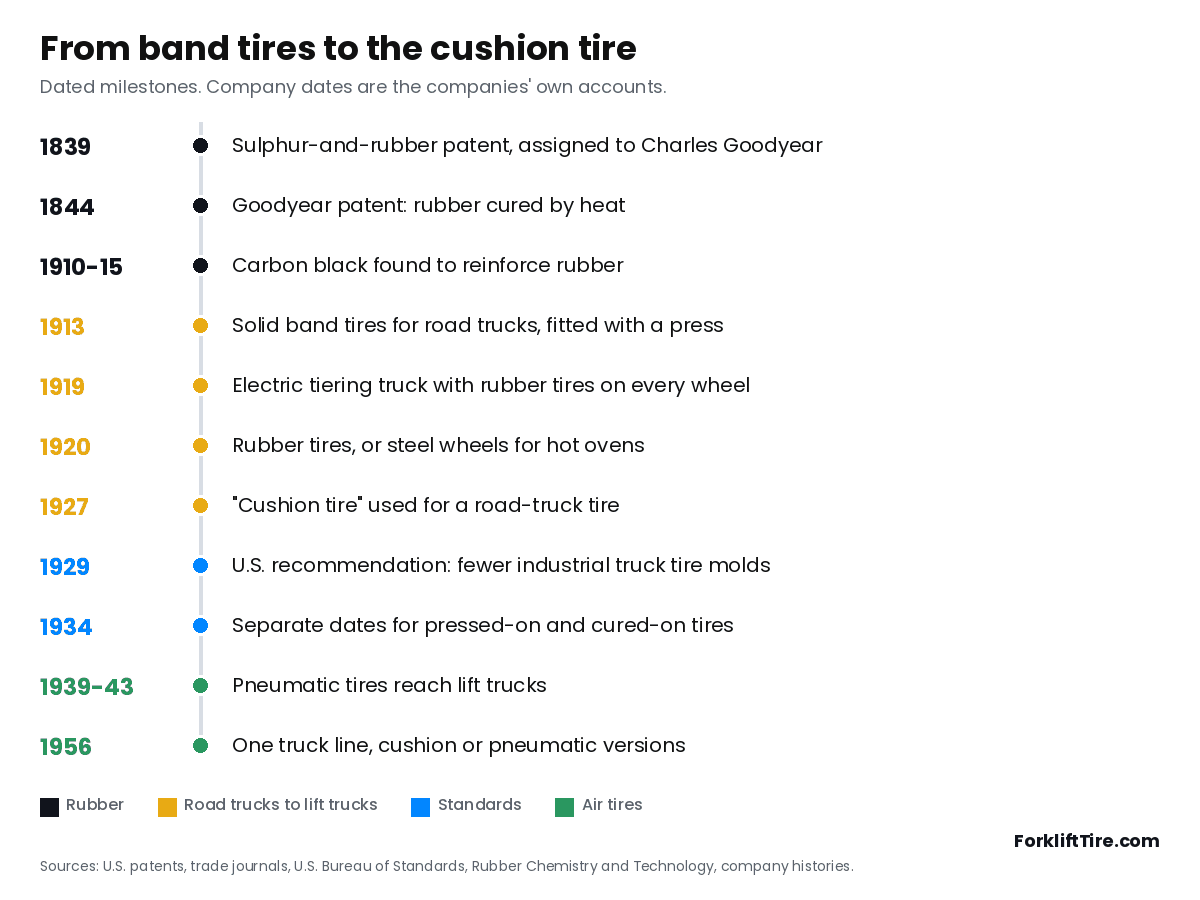
| Year | What happened |
|---|---|
| 1839 | U.S. patent granted to Nathaniel Hayward, assigned to Charles Goodyear, for combining sulphur with rubber[5] |
| 1844 | Goodyear’s patent: rubber with sulphur and white lead, cured by heat at a regulated temperature[2] |
| 1910–1915 | Carbon black found to reinforce rubber; Goodrich buys rights in 1912; general in good compounds by 1915[9][10] |
| 1913 | Show preview: solid band tires for 3-, 4- and 5-ton road vehicles, and makers selling ways to fit them without a hydraulic press[3] |
| 1917 | Clark builds its first Tructractor, a factory hauling truck (Clark’s account)[11] |
| 1919 | An Elwell-Parker electric tiering truck: “All the wheels have rubber tires”[4] |
| 1920 | Elwell-Parker battery truck: rubber tires, or steel wheels for hot ovens; industrial truck tyres in a show preview[6][12] |
| 1927 | U.S. Bureau of Standards describes the cushion tire as a road-truck tire between solid and pneumatic[7] |
| 1929 | Manufacturers propose fewer industrial truck tire molds and one 2-inch molded height; a national recommendation is adopted[13][14] |
| 1934 | Revised standard takes effect: June 1 for pressed-on tires, November 1 for cured-on tires[15] |
| 1939–1943 | Pneumatic tires on lift trucks: Hyster’s Jumbo (1939) and Clark’s Planeloader (1943), in their own accounts[16][11] |
| 1956 | Clark’s Clarklift line comes in both cushion and pneumatic-tired versions (Clark’s account)[11] |
Rubber that could take the heat: 1839 and 1844
The rubber side of the story starts with two patents. Charles Goodyear’s U.S. patent dated June 15, 1844 describes mixing rubber with sulphur and white lead, then heating the compound at a regulated temperature.[2] Treated that way, the patent says, the rubber would not soften in the sun or in heat below its curing temperature, and would not be harmed by cold.[2]
The sulphur step was patented earlier. U.S. Patent 1,090, granted February 24, 1839 to Nathaniel Hayward of Woburn, Massachusetts, and assigned to Goodyear, claims “the combining of sulphur with gum-elastic.”[5] Goodyear’s 1844 patent refers back to it as a patent granted to him.[2] So an 1839 date for Goodyear’s vulcanization patent blends two patents: sulphur in 1839, the heat cure in 1844.
Solid band tires before the forklift
Road trucks ran on solid rubber before lift trucks existed. In July 1913 The Commercial Motor previewed the tire and wheel stands at a commercial vehicle show and listed solid tires on many of them, including “solid band tires” for three-, four- and five-ton vehicles.[3]
A band tire is rubber on a steel band, and fitting one took a press. One maker’s selling point was a detachable band tire that “dispenses with the use of an hydraulic press,” and another promoted a fitting method for overseas customers where no press was available.[3] A third showed a band tire with a layer of very soft rubber between the hard tread and the steel band, which it claimed absorbed vibration.[3]
That was 1913, four years before Clark built its first Tructractor in Buchanan, Michigan, in its own account.[11] Who built the first lift truck is its own tangled story, sorted out in Who Invented the Forklift?
Early lift trucks: rubber, and steel for hot ovens
The two early lift trucks we found described with their tires in the trade press were Elwell-Parker factory machines, and both could run on rubber. In November 1919 American Machinist described an Elwell-Parker electric tiering truck rated for 1,000 lb. with a lifting height of 5 to 6 ft., and noted: “All the wheels have rubber tires.”[4]
In December 1920 The Iron Trade Review described an Elwell-Parker battery truck for handling annealing pots in foundries. All its wheels could have rubber tires where the oven was charged at low temperatures, or steel wheels when the ovens were hot: a smooth steel wheel at the steering end and a pair of herringbone steel drive wheels.[6] Even its steered wheel sat in a spring cradle so the shock was cushioned over obstructions on the floor.[6]
Tire makers were selling into this market. In The Commercial Motor’s October 1920 show preview, the Goodrich stand listed solid band tyres, and the magazine pointed out its industrial truck tyres to “progressive firms.”[12] We found no spec sheet showing what Clark’s first Tructractor, a hauling truck with no lift, rolled on, so this article does not say.
Where the name cushion tire came from
Today “cushion tire” means a forklift tire. In 1927 the U.S. Bureau of Standards used it for a road-truck tire, and described the cushion tire as “an intermediate step between the pneumatic and the solid.”[7] It was built with a hollow center, cavities in the sides or channels under the tread so it flexed more than solid rubber, while the rubber itself, not air, carried the load.[7] Like a solid tire, it was vulcanized on a steel base band.[7]
So the name and the steel band were both on road trucks before they reached lift trucks. We found no document that dates the move. The earliest lift-truck use we found is in Clark’s own history, which says its 1956 Clarklift line came in both cushion and pneumatic-tired versions.[11]
Standard sizes: 1929 and 1934
In 1929 the trade set out to cut the number of industrial truck tire molds. Manufacturers met in Akron, Ohio, on March 29, 1929, and their plan, approved by the Tire and Rim Association, would cut the number of molds by about two thirds and trim the number of wheel diameters and tire widths, and it recommended a single molded height of 2 inches for all industrial truck tires.[13]
A general conference at the U.S. Department of Commerce adopted the recommendation on June 6, 1929, to take effect September 1, 1929; Henry F. Schippel of the B.F. Goodrich Co. chaired its standing committee.[14] It was printed in 1930 as Simplified Practice Recommendation No. 103, “Industrial truck tires.”[17] A revision, R103-33, took effect on June 1, 1934 for pressed-on tires and on November 1, 1934 for cured-on tires.[15] By then pressed-on and cured-on tires had their own effective dates in the standard.
How carbon black came into tires
Early B.F. Goodrich tires were white, carbon black maker Birla Carbon’s company history says. It says a small amount of carbon black had given the Silvertown company’s tires their tint, that more of it made tires stronger, and that in 1911 Goodrich asked for a supplier of a million pounds of carbon black a year.[18]
A 1982 review in Rubber Chemistry and Technology credits the reinforcing effect to S. C. Mote of the India-Rubber, Gutta-Percha and Telegraph Works at Silvertown, near London, found in an effort to improve rubber beyond what zinc oxide could do. It says Goodrich bought manufacturing rights from the Silvertown company in 1912, and that by 1915 carbon black was general in high-quality rubber compounds.[10] A 1937 review in the same journal dates the discovery to 1910 and commercial use in Akron to 1912.[9] The most important effect the 1982 review reports is a vast improvement in abrasion resistance.[10]
For how a black compound and a non-marking compound behave on a warehouse floor today, see Black vs. Non-Marking Forklift Tires: Which Compound Is Right?
Air tires reach the lift truck
In the makers’ own histories, air-filled tires came to lift trucks later, and for rougher ground. Hyster-Yale’s history says Willamette Hyster’s 1939 Jumbo, used by lumbermen to load ships and rail cars, was the first lift truck with pneumatic tires and a telescoping mast.[16] Clark’s history calls its 1943 Planeloader Clark’s first pneumatic-tired forklift truck, designed mainly for off-road work at Allied air bases in World War II.[11] Both are the companies’ own accounts.
By 1956 Clark offered its Clarklift line in both cushion and pneumatic-tired versions.[11] OSHA’s forklift eTool draws a similar line for engine-powered trucks today: Class IV is internal combustion engine trucks on solid/cushion tires, and Class V is internal combustion engine trucks on pneumatic tires.[8] The eTool notes that its class list does not include every truck the OSHA standard covers.[8] More in Classes of Forklifts and Their Tires.
The hard wheels that stayed
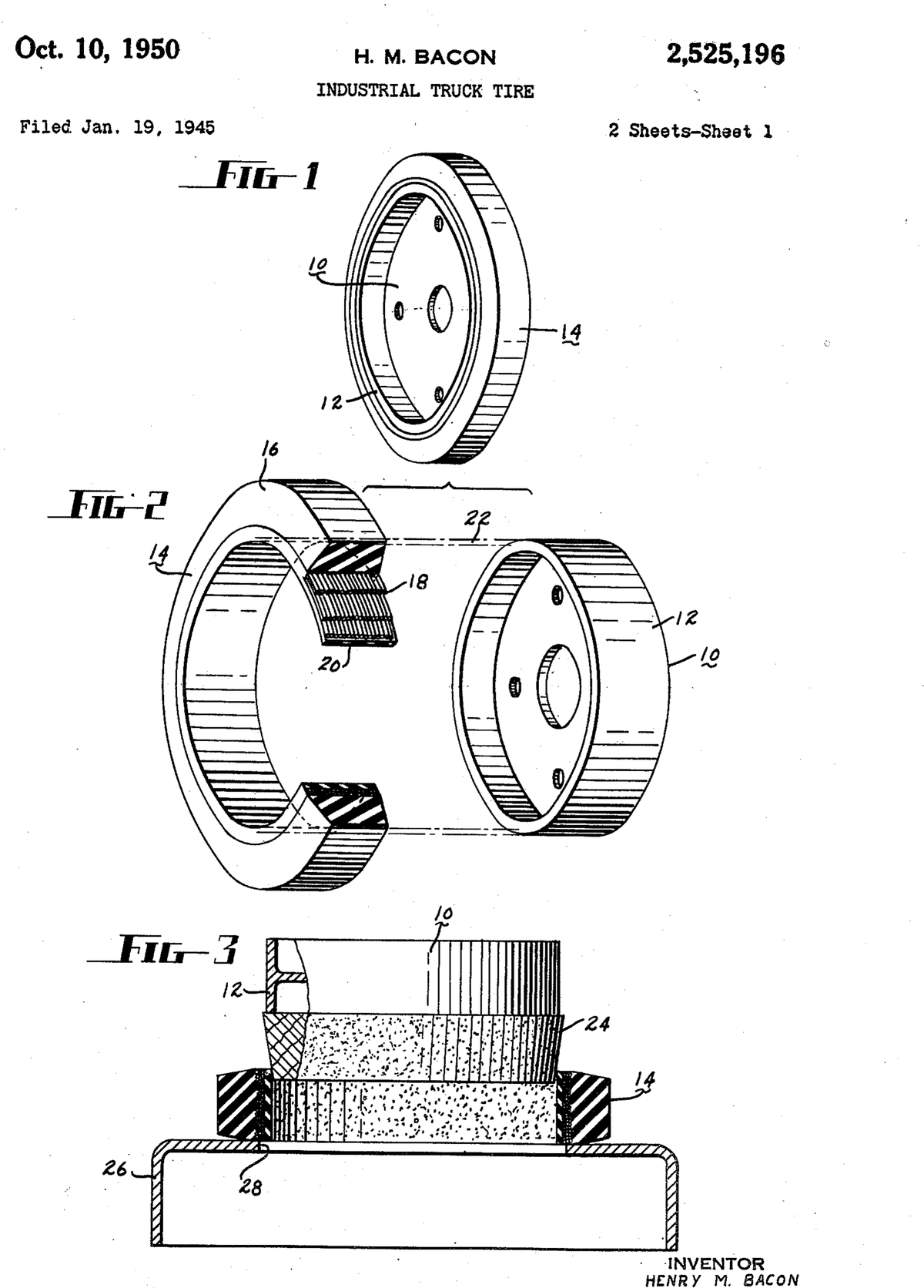
Hard wheels did not vanish when rubber arrived. In 1920 steel wheels were the hot-oven option on the Elwell-Parker truck.[6] In January 1945 a Dayton Rubber Company patent application said that in many factories, trucks and push carts were “often fitted with uncushioned wheels,” which put both the load and the factory flooring at risk.[19] It added that where industrial vehicles had cushioned wheels, the tire was usually mounted so that the wheel had to go back to its maker for re-tiring, and it proposed a tire users could fit themselves.[19]
The cushion tire today
Today’s cushion tire is a press-on. One tire maker describes press-on tires, which it says are also known as cushion tires or band tires, as typically a single rubber compound bonded to a steel band and pressed onto the hub with a hydraulic press; it says installing one can take up to 200 tons or more.[1] The same maker offers a smooth tread for dry, smooth floors and a traction tread for wet floors or uneven, loose surfaces.[1] Rubber on a steel band, pressed on: the same construction the 1913 road-truck band tires used.[3]
What that means when you buy: the truck decides the tire family. A cushion truck takes press-on tires; a pneumatic truck takes pneumatic-shaped tires, air-filled or solid. Start with the make, model and serial number on the data plate, then check the size molded on the old tire’s sidewall; How to Read a Forklift Data Plate shows where to look. For a press-on, the choice after the size is the compound and the tread.
When you have the size, shop Cushion Forklift tires or browse all Press-On Forklift Tires. If the plate on an older truck is gone, send FTC the size molded on the tire and a few photos, and FTC reviews the size with you before you order.
Frequently asked questions
What is a cushion tire on a forklift?
A press-on tire. One tire maker says press-on tires are also known as cushion tires or band tires, and describes them as typically a single rubber compound bonded to a steel band and pressed onto the truck’s hub with a hydraulic press. OSHA’s forklift eTool names one class for engine-powered trucks on them: Class IV, internal combustion engine trucks on solid/cushion tires.
Why is it called a cushion tire?
The name is older than the forklift tire. In 1927 the U.S. Bureau of Standards used it for a road-truck tire between a solid and a pneumatic, built with hollows or channels so the rubber could flex, and vulcanized on a steel base band. We found no record of when lift-truck makers took up the name; Clark’s history uses it for its 1956 Clarklift line.
When was heat-cured rubber patented?
An 1839 U.S. patent assigned to Charles Goodyear covers combining sulphur with rubber, and Goodyear’s 1844 patent adds heating the compound at a regulated temperature so it would not soften in the sun or be harmed by cold. By 1913 many makers sold solid rubber band tires for road trucks.
Did early forklifts have steel wheels?
The earliest lift-truck records we found show rubber. In 1919 an Elwell-Parker electric tiering truck had rubber tires on all wheels. In 1920 an Elwell-Parker battery truck could run on rubber tires, or on steel wheels for hot annealing ovens. We found no spec sheet showing what Clark’s first 1917 Tructractor, a hauling truck with no lift, rolled on.
Why are forklift tires black?
Carbon black. One carbon black maker’s history says early B.F. Goodrich tires were white, and that a small amount of carbon black gave the Silvertown company’s tires their tint. A 1937 review dates the discovery that carbon black reinforces rubber to 1910, and a 1982 review says that by 1915 it was general in high-quality rubber compounds; the main effect it reports is a vast improvement in abrasion resistance.
- Camso (Solideal), “Knowing the basics of Forklift Tires,” August 24, 2015, tire maker’s guide.
- U.S. Patent 3,633, Charles Goodyear, “Improvement in India-Rubber Fabrics,” dated June 15, 1844.
- “To Be Seen on the Tire and Wheel Stands,” The Commercial Motor, July 17, 1913, p. 29.
- American Machinist, November 6, 1919, Elwell-Parker tiering truck.
- U.S. Patent 1,090, Nathaniel Hayward, assignor to Charles Goodyear, granted February 24, 1839.
- “Charging Truck Is Driven by Storage Battery,” The Iron Trade Review, December 16, 1920, p. 1683.
- U.S. Bureau of Standards, Circular 341, “Use and Care of Automobile Tires,” September 29, 1927.
- OSHA, Powered Industrial Trucks eTool, “Types”.
- W. B. Wiegand, “The Carbon Reinforcement of Rubber,” Rubber Chemistry and Technology 10(3), 1937 (abstract).
- Z. Rigbi, “Reinforcement of Rubber by Carbon Black,” Rubber Chemistry and Technology 55(4), 1982 (abstract).
- Clark Material Handling Company, “History”, company history.
- “The Exhibits on the Tyre and Wheel Stands,” The Commercial Motor, October 5, 1920, p. 44.
- U.S. Bureau of Standards, Commercial Standards Monthly No. 50, May 15, 1929.
- U.S. Bureau of Standards, Commercial Standards Monthly Vol. 6, No. 2, August 1929.
- Simplified Practice Recommendation R103-33, Monthly Catalog of U.S. Government Publications (catalog record, University of North Texas Libraries).
- Hyster-Yale, “History”, company history.
- “Industrial truck tires,” Simplified Practice Recommendation No. 103, U.S. Government Printing Office, 1930 (library catalog record).
- Birla Carbon, “Compound Knowledge”, company history of a carbon black maker.
- U.S. Patent 2,525,196, Henry M. Bacon, “Industrial Truck Tire,” assignor to The Dayton Rubber Company, filed January 19, 1945, granted October 10, 1950.
Trademarks and affiliation: Clark, Hyster, Elwell-Parker, Goodrich, Camso, Solideal and all other brand names are trademarks of their respective owners. Forklift Tire Company is an independent supplier and is not affiliated with, sponsored by, or endorsed by any company named here. Names are used only to tell the history and identify the published sources.
Press-on tires for a cushion truck?
Send FTC the make, model and serial number from the data plate, the size molded on the old tire, and a photo. FTC reviews the size with you before you order. Verify exact tire size and fitment before ordering.
Email Your Truck Details Contact UsQuestions? Call 1 (866) 313-2180.