 1 (866) 313-2180
 SALES@FORKLIFTTIRE.COM


Posted by Forklift Tire Company on 5th Mar 2026
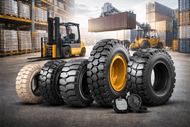
Continental (Continental AG, founded in Hanover, Germany in 1871) is one of the world's premier tire engineers, and its material-handling catalog covers far more than one product: CSEasy press-free superelastic solids, press-on bands, industrial pneumatics, port tires, and clean and antistatic compounds. This guide walks the full Continental forklift tire range the way fleets actually choose - vehicle type → construction → compound → product line - explains the signature CSEasy system in depth, and shows how to get the right solid tire fast, including comparable in-stock options from Forklift Tire Company when you need a tire today.
- The Continental material-handling lineup
- How CSEasy press-free mounting works (4 steps)
- Why CSEasy lasts - durability and cost per hour
- Press-free vs press-on vs pneumatic
- Compounds: black vs clean (non-marking) vs antistatic
- Industrial pneumatics: radial vs cross-ply
- Port tires: V.ply vs radial
- Common Continental CSEasy sizes
- Which solid forklift tire is right for you
- Ordering Continental: availability & in-stock alternatives
- Continental forklift tires FAQ
The Continental material-handling lineup
Continental's material-handling range centers on superelastic solid tires built around the CSEasy press-free adapter system, backed by press-on bands, industrial pneumatics, and dedicated port ranges. Here is the whole catalog at a glance:
| Line | What it is | Best for |
|---|---|---|
| CSEasy SC20 | Press-free superelastic solid (core line) | General indoor and outdoor material handling |
| CSEasy SC20+ | Press-free superelastic solid; up to ~20% more mileage (Plus Compound) | Multi-shift and high-hour operations chasing lower cost per hour |
| Solid Clean | Non-marking / clean compound variant | Food, pharma, paper and clean-floor environments |
| Solid Antistatic | Static-dissipating (ESD) compound variant | Electronics, flammable-goods and ESD-sensitive areas |
| Press-on bands (POB) | Rubber on a steel band, hydraulically pressed onto the wheel | Smooth indoor concrete; stability-first cushion forklifts |
| Industrial pneumatics | Air-filled tires in radial and cross-ply constructions | Rougher outdoor terrain needing traction and ride compliance |
| Port tires (V.ply / radial) | Heavy container-handling ranges | Reach stackers, terminal tractors and port equipment |
| Accessories & monitoring | Mounting/sealing solutions plus tire pressure and temperature monitoring (ContiPressureCheck, TSR) | High-duty fleets planning uptime and preventing surprise failures |
Continental markets CSEasy as a 'solid pneumatic' superelastic tire - it carries no air, so it cannot go flat, while keeping a pneumatic-style profile that fits standard material-handling rims.
How CSEasy press-free mounting works (4 steps)
Conventional solid and press-on tires are forced onto the rim with a hydraulic press - several tonnes of force, specialist equipment, and a trained technician. Continental's CSEasy removes that step. Here is the mounting sequence Continental specifies:
The practical payoff: faster changeovers and less downtime, because you are not waiting on a tire press or a mobile press service. Always follow Continental's official mounting instructions and torque values for your size.
Why CSEasy lasts - durability and cost per hour
Continental builds the CSEasy around three claims: user friendliness (the press-free change above), durability, and energy efficiency. The last two are where a premium solid earns its price back.
- Lower heat build-up. The Plus Compound combined with the CSEasy adapter keeps the tire interior cooler in use.
- More mileage. Lower running heat is what lets the SC20+ deliver up to about 20 percent more mileage than the original SC20.
- Lower rolling resistance. Cooler running also means less rolling resistance - which matters for energy use on electric trucks.
Press-free vs press-on vs pneumatic - the difference that matters
Knowing how a tire mounts tells you what equipment, labor, and downtime a change will require.
| Construction | How it mounts | Air? | Trade-off |
|---|---|---|---|
| CSEasy (press-free superelastic solid) | Reusable conical adapter, bolted to torque; no press | No (solid) | Fast bolt-up change, flat-proof; premium price |
| Press-on band / superelastic solid | Hydraulically pressed onto the rim (press + technician) | No (solid) | Flat-proof, stable; press required to change |
| Pneumatic (air) | Air-filled tire seated on a rim | Yes | Cushioned outdoor ride; can puncture |
Compounds: black vs clean (non-marking) vs antistatic
Continental's catalog treats compound choice as seriously as construction - and in operations with electronics, static concerns, or finished floors, it can matter as much as the tread. Do not treat 'non-marking' as a checkbox:
| Compound | What it does | Choose it when |
|---|---|---|
| Standard black (conductive) | Carbon-black rubber that manages static charge transfer in typical use | General duty; floor marking is not a concern |
| Solid Clean (non-marking) | Reduces visible marking and soiling on finished floors | Food, pharma, paper, retail and coated/sealed floors |
| Solid Antistatic (ESD) | Higher conductivity engineered to dissipate static where prevention is required | Electronics, flammable goods, ESD-sensitive areas |
Industrial pneumatics: radial vs cross-ply
Where terrain, traction, and ride compliance demand air, the Continental catalog offers industrial pneumatics in both radial and cross-ply constructions:
- Radial: often chosen for steadier running characteristics, tread life and lower heat in demanding duty cycles.
- Cross-ply: often chosen for robust sidewalls and impact resistance on rough ground.
If your trucks run outdoors over debris or uneven yards, also weigh a flat-proof resilient solid - it fits pneumatic rims, cannot puncture, and is FTC's most popular outdoor construction.
Port tires: V.ply vs radial (the key port decision)
For container handling, the catalog maps V.ply and radial ranges to high-load port applications. The fast takeaway: radial is often favored for tread life, heat management, traction and fuel economy over longer distances and higher speeds; V.ply is often favored for stability, sidewall robustness, repairability and rim-component life under heavy turning scrub. The catalog also covers monitoring tools (ContiPressureCheck pressure/temperature monitoring and TSR sealing/mounting solutions) used to plan uptime in high-duty operations. Our specialty is material handling rather than port equipment - but if you share your equipment type and sizes, we will help translate the catalog into a practical option set. Contact us.
Common Continental CSEasy sizes
CSEasy is offered in a broad range of forklift solid sizes, in both SC20 and SC20+ (and in Clean and Antistatic compounds for some sizes). A few common examples:
| Tire size | Adapter / rim | Notes |
|---|---|---|
| 5.00-8 | 3.00 | Also offered in a Solid Clean (non-marking) compound |
| 6.00-9 | 4.00 | Common counterbalance size |
| 6.50-10 | 5.00 | Available in SC20+ Plus Compound |
| 200/50-10 | 6.50 | Metric superelastic size |
These are examples, not the full range - Continental offers many more CSEasy sizes. Read the size off your current tire and confirm the rim and adapter before ordering. Need help matching a size to your truck? Use the forklift tire sizes by make and model guide.
Which solid forklift tire is right for you
Continental CSEasy is a premium, press-free option. Depending on your truck, budget, and how fast you need a tire, one of these in-stock constructions may be the better fit - and we stock all of them.
| Option | How it mounts | Best for | Shop |
|---|---|---|---|
| Continental CSEasy (premium, press-free) | Reusable adapter, no press | Fleets wanting press-free changes and premium mileage | Source or quote - contact us |
| Resilient solid / solid pneumatic | On a pneumatic rim | Flat-proof outdoor and yard duty | Shop resilient solids |
| Rubber press-on (cushion) | Pressed onto the wheel | Indoor cushion-tire forklifts | Shop rubber press-ons |
| Polyurethane press-on | Pressed onto the wheel | Light, low-rolling-resistance indoor work | Shop poly press-ons |
Ordering Continental: availability & in-stock alternatives
Continental material-handling tires are available to order from Forklift Tire Company and fulfilled sourced-to-order. Practical fulfillment depends on three factors: current availability of your size and compound, your shipping location, and whether the construction needs pressing or installation. If your timeline is tight, our Best Choice solid tires and Best Choice pneumatics are the in-stock, fastest-turnaround equivalents by construction - and we will tell you honestly which route gets you running sooner.
Continental forklift tires FAQ
Continental, CSEasy, SC20, SC20+ and ContiPressureCheck are trademarks of Continental AG. Forklift Tire Company is an independent supplier and is not affiliated with or endorsed by Continental AG. Product references indicate compatibility and educational context only. Always verify exact size, mounting torque and fitment before ordering.