 1 (866) 313-2180
 SALES@FORKLIFTTIRE.COM


Posted by Forklift Tire Company on 8th Jul 2026
A forklift parked because the wrong tire showed up is one of the most avoidable costs in a warehouse. Most bad tire orders aren't bad luck — they come from a short list of predictable mistakes: guessing the size, mixing up the wheel type, or replacing one tire when the truck needed a matched set. Each one ends the same way — downtime, a return, or a tire that wears out long before it should.
Below are the seven forklift tire buying mistakes we see most often, what each one actually costs you, and how to order the right tire the first time. Get these right and you avoid the two outcomes nobody wants: a forklift down waiting on tires, and a tire that never fit the job.
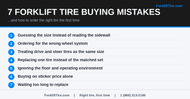
The 7 mistakes
Mistake 1: Guessing the Size Instead of Reading It
The single most common wrong-order starts here. The size is printed right on the sidewall, but buyers eyeball the old tire, measure it roughly with a tape, or read a worn number wrong — and order a tire that won't mount. Forklift sizes use specific formats: press-on tires use a three-number format like 21x8x15 (outside diameter x width x wheel/rim), while pneumatic tires read like 7.00-12 (section width - rim diameter). Miss one number and it's the wrong tire.
The fix is simple: read the size off the sidewall, not off your memory. If the numbers are worn away or you're not sure how to read them, our guide to reading forklift tire sizes walks through each format, the forklift tire size chart & conversion guide decodes every size format, and the sizes by make & model guide lists common sizes for your specific truck. One catch most people miss: your drive and steer tires are often different sizes — more on that in Mistake 3.
Mistake 2: Ordering the Wrong Wheel System
The second-most-expensive mistake is ordering a tire that fits a different kind of wheel. Forklifts run one of two systems, and they are not interchangeable:
| System | How it mounts | Typical tires |
|---|---|---|
| Press-on | Tire is pressed onto a smooth steel band/wheel | Cushion rubber (black and non-marking) plus polyurethane press-ons |
| Pneumatic / solid | Tire mounts on a multi-piece rim (air or solid resilient) | Air pneumatic and solid resilient tires |
This is why "can I put pneumatic tires on a cushion forklift?" comes up so often — and the answer is no, not without changing the truck's wheels and configuration. A press-on (cushion) truck takes press-on tires; a pneumatic-tire truck takes tires on a rim. Order across systems and the tire is unusable. Identify your truck's system first, then shop the matching category: cushion rubber press-ons or polyurethane press-ons for press-on trucks, and solid resilient and pneumatic tires for rim-mounted trucks. If you're unsure which is which, the forklift tire types guide shows them side by side.
Mistake 3: Assuming Drive and Steer Tires Are the Same
On most forklifts the drive tires (front, under the mast, carrying the load) and the steer tires (rear, doing the steering) are different sizes. Buyers who order four of the same size end up with two tires that don't fit — and a half-finished job. The two positions also wear at different rates, so they rarely need replacing in equal numbers at the same time.
Read both sizes before you order — they're printed separately on each tire. Our drive tires vs. steer tires guide explains why they differ and how to spot each one. When you do need everything at once, a matched forklift tire set covers both positions in one order.
Mistake 4: Replacing One Tire Instead of the Set
Replacing a single worn tire feels cheaper, but it usually isn't. A new tire next to worn mates means mismatched diameters on the drive axle, uneven handling, faster wear on the odd tire out — and a second round of downtime when the others give out a few weeks later. Forklift tires are built to work as a set for a reason.
Why buying the set wins
A 4-piece set is 2 drive + 2 steer tires, matched and replaced together. You get even wear, predictable handling, one freight charge instead of several, and one service event instead of two. The cart discount stacks on top: save 7.5% on 2–3 items or 15% on 4+ items, applied automatically. Browse matched options on the forklift tire bundles page. For the full cost math behind matched sets — the 15% tier, one freight shipment, one service event — see our guide to why forklift tire sets save money.
If only one position is genuinely worn, replace that pair — not a single tire. Matching the pair keeps the axle balanced and the truck handling the way the operator expects.
Mistake 5: Ignoring the Floor and the Operating Environment
Right size, wrong tire for the surface. Compound matters as much as fit, and getting it wrong shows up as marked floors, scratched concrete, or a tire that wears out fast. Match the tire to where the truck actually works:
| Where the truck runs | Right choice | Common mistake |
|---|---|---|
| Finished, sealed, or coated indoor floors | Non-marking rubber or polyurethane | Black rubber leaving streaks on clean concrete |
| Bare indoor concrete (marks don't matter) | Black rubber — costs less, works fine | Paying extra for non-marking you don't need |
| Outdoor yards, docks, rough or mixed surfaces | Pneumatic or solid resilient | Running smooth press-ons outdoors |
The classic version of this mistake is black tires marking a finished floor — an easy fix with non-marking rubber, covered in our black vs. non-marking tires guide. For matching tires to a specific operation, see warehouse forklift tire selection. Pick the compound for the floor and you stop buying tires that look right but behave wrong.
Mistake 6: Buying on Sticker Price Alone
The cheapest tire on the page is rarely the cheapest tire to own. Three costs hide behind a low sticker price:
- ✓ What's not included. Many pneumatic tires are sold without the inner tube and liner flap, then those get added on per tire. FTC pneumatic listings include the tube and flap, so the price you see is the price for a ready-to-run tire.
- ✓ The set discount you skipped. Buying tires one at a time leaves the 7.5%/15% volume discount and the single freight charge on the table.
- ✓ Short tire life and downtime. A bargain tire that wears out early — or sits the truck down sooner — costs more than the right tire that lasts.
Compare total cost, not the sticker: what's included, set pricing, and how long the tire should last on your surface. Our forklift tire cost guide breaks down what actually drives price so you can compare like for like.
Mistake 7: Waiting Too Long to Replace
Running tires past their wear line is the mistake that costs the most beyond the tire itself. Worn solid and press-on tires lose their cushioning and start hammering the floor and the truck; the rougher ride stresses the mast, the load, and the operator; and a tire that chunks or fails takes the forklift out of service with no warning. A worn-out tire also gouges floors no matter how good the compound is.
Not sure where your tires stand or which option fits? The forklift tire buying guide walks you through choosing by machine, wheel system, environment, and budget.
How to Order the Right Tire the First Time
Every mistake above comes down to the same fix — confirm a few things before you buy. Run this checklist and wrong orders mostly disappear:
- ✓ Identify the wheel system — press-on (cushion) or pneumatic/solid on a rim
- ✓ Read both sizes off the sidewall — drive and steer are usually different
- ✓ Match the compound to the floor — non-marking or poly indoors, pneumatic/solid outdoors
- ✓ Replace in matched pairs or full sets — not a single tire
- ✓ Compare total cost — what's included, the set discount, expected life
- ✓ Replace before the wear line — order ahead so the truck isn't down
- ✓ Verify fitment if anything is unclear — a two-minute call beats a return
Before You Order
Confirm the three things that decide whether a tire fits: your wheel system, your drive and steer sizes, and the compound for your floor. Verify exact tire size and fitment before ordering. If you're not certain, call 1 (866) 313-2180 with your forklift make, model, and the sizes on your current tires, and we'll point you to the right tire.
Save 7.5% on 2–3 items or save 15% on 4+ items, automatic in cart. Free ground freight to commercial addresses in the contiguous U.S.
Frequently Asked Questions
Can you put pneumatic tires on a cushion-tire forklift?
No — not without changing the truck's wheels and configuration. Cushion forklifts use press-on tires pressed onto a smooth wheel, while pneumatic tires mount on a multi-piece rim. They're two different systems. Identify your forklift's wheel system first, then shop the matching tire type. Our tire types guide shows both side by side.
How do I know what size forklift tire to buy?
Read the size off the sidewall of your current tire rather than measuring or guessing. Press-on tires use a three-number format (like 21x8x15) and pneumatics read like 7.00-12. Check both your drive and steer tires — they're often different sizes. The size-reading guide and size chart & conversion guide walk through it.
Should I replace all four forklift tires at once?
Replace in matched sets or pairs, not one tire at a time. A single new tire next to worn ones causes mismatched diameters, uneven handling, and faster wear — plus a second downtime event soon after. A 4-piece set (2 drive + 2 steer) keeps the truck balanced and earns the volume discount and single freight charge. See the forklift tire sets page.
How long do forklift tires last?
It depends on hours run, the surface, load weight, and the tire construction, so there's no single number. The practical answer: replace at the wear indicator line rather than running to failure — the when-to-replace guide covers the signs. Waiting too long gouges floors, stresses the truck, and risks an unplanned breakdown. Plan replacements ahead so you can buy the matched set on your schedule.
What's the most common forklift tire buying mistake?
Ordering the wrong size by guessing instead of reading the sidewall, closely followed by ordering for the wrong wheel system (press-on vs. pneumatic). Both lead to a tire that won't mount and a return. Confirming your wheel system and both sizes before ordering prevents the large majority of wrong orders.
Want a second set of eyes before you buy? Call 1 (866) 313-2180 with your forklift make, model, and current tire sizes and we'll help you order the right tire the first time. Verify exact tire size and fitment before ordering.
Guidance is general and intended to help you order with confidence. Tire fit depends on your specific forklift, wheel system, and operating surface. Always verify exact tire size, type, and both drive and steer dimensions before ordering.