 1 (866) 313-2180
 SALES@FORKLIFTTIRE.COM


Posted by Forklift Tire Company on 26th May 2026
The floor your forklift operates on determines which warehouse forklift tires will last longest, perform best, and cost the least over time. Get this decision wrong, and you'll deal with premature wear, floor damage, reduced traction, or all three.
This guide matches forklift tire types to common warehouse floor surfaces so you can choose the right tire for your specific environment — whether you're running cushion-tire forklifts on smooth concrete or solid resilient tires across dock areas.

Why Floor Surface Matters
Forklift tires interact with your floor thousands of times per shift. The wrong combination creates problems that compound quickly:
- Pneumatic tires on smooth indoor concrete — aggressive tread chews up sealed floors and leaves marks. Rides rough. Wears unevenly.
- Cushion press-ons on rough outdoor surfaces — insufficient tread and ground clearance. Accelerated wear. Reduced stability under load.
- Black rubber tires in clean-room environments — visible tire marks on light-colored floors, contamination risk in food and pharmaceutical operations.
The right tire for your warehouse depends on answering two questions: What's your primary floor surface? and Does your forklift ever go outside?
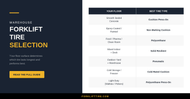
Tire Type by Warehouse Floor Type
| Floor Type | Best Tire Type | Why | Watch Out For |
|---|---|---|---|
| Smooth sealed concrete | Cushion press-on (rubber) | Maximum contact patch on smooth surfaces. Low rolling resistance. Tight turning radius. | Not suitable if forklift regularly goes outside or crosses dock plates with debris. |
| Epoxy-coated or painted floors | Cushion press-on (non-marking rubber) | Non-marking compound (silica-based instead of carbon black) prevents tire marks on coated surfaces. Comparable traction on smooth floors. | Non-marking costs 10–25% more and may wear faster than standard black rubber due to softer compound. Only needed if floor marking is actually a concern. |
| Food processing / pharmaceutical | Cushion press-on (non-marking) or polyurethane press-on | Non-marking eliminates contamination risk from black rubber residue. Polyurethane for lighter-duty applications. | Verify compound is truly non-marking — not all "white" tires are non-marking rated. |
| Mixed indoor/outdoor (dock areas) | Solid resilient | Handles rough dock plates, gravel approaches, and uneven transitions. No flats from debris. | Rides harder than cushion or pneumatic. Higher upfront cost. Requires more forklift battery power on smooth floors. |
| Outdoor yard with covered warehouse | Pneumatic (air-filled) | Deep tread handles gravel, packed dirt, cracked asphalt. Air cushion absorbs impacts. | Requires inner tubes and liner flaps. Puncture risk in debris-heavy environments — consider solid resilient instead. |
| Cold storage / freezer | Polyurethane press-on, solid resilient, or cushion press-on (cold-environment compound) | Polyurethane maintains flexibility in cold and freezer environments where standard rubber compounds harden and crack. Specialized cold-rated rubber compounds are also available for solid resilient and cushion tires. | Not all tires are rated for cold storage. Call 1 (866) 313-2180 to confirm compound suitability before ordering for freezer or cold-chain operations. |
| Light-duty, low-speed (order pickers, walkies) | Polyurethane press-on | Lowest cost per tire, longest wear life on smooth floors — up to 2x the service life of rubber in light-duty applications. Non-marking by default. Common on order pickers, walkie stackers, and pallet jacks. | Not for rough surfaces or heavy loads. Cracks on outdoor surfaces. Limited to smooth, flat, indoor floors. |
The Indoor-Only Warehouse: Why Cushion Tires Win
If your forklifts never leave the building and your floors are smooth concrete, cushion press-on tires are almost always the right choice. Here's why:
Lower cost per hour. Cushion tires cost less than solid resilient and last comparably on smooth surfaces. There are no tubes or flaps to replace. Installation is straightforward with a tire press.
Better handling. The flat, wide contact patch of a cushion tire gives better traction and stability on smooth floors than a treaded pneumatic tire. Turning radius is tighter — critical in narrow aisle operations.
Better battery life on electric forklifts. Cushion tires have lower rolling resistance on smooth concrete, which means less energy per trip. For electric fleets, this translates to longer run times between charges.
Less floor damage. Smooth cushion compounds are gentler on sealed concrete than aggressive pneumatic tread patterns. If your floors are epoxy-coated, non-marking cushion tires eliminate marking entirely.
The only scenario where cushion tires don't work indoors is if your forklift crosses rough dock plates, hits gravel approaches, or operates on cracked or uneven concrete. In those cases, a solid resilient tire handles the mixed conditions better.
The Mixed-Use Problem: Indoor + Dock + Outdoor
Many warehouses aren't purely indoor. If your forklifts cross loading docks, trailer yards, or gravel approaches, you need a tire that handles both environments.
Solid resilient tires are the standard answer for mixed-use operations. They combine the flat-resistance of a solid tire with enough tread depth to handle rough surfaces. They're heavier than cushion tires and ride harder on smooth floors, but they won't go flat when they hit a nail in the yard.
If your outdoor exposure is minimal — just crossing a dock plate to load trailers — you may be able to run cushion tires and accept slightly faster wear on the rough transitions. This depends on how frequently the forklift goes outside and how rough the surface is.
If your forklift spends most of its shift outside — on gravel, packed dirt, or broken asphalt — see our rough terrain forklift tire guide for choosing between air-filled pneumatic and flat-proof solid resilient.
Non-Marking: When You Need It and When You Don't
Non-marking tires replace the carbon black in standard rubber with silica, eliminating the dark residue that causes floor marking. They cost more than standard black rubber — typically 10–25% more in the same size — and the silica-based compound is softer, which means non-marking tires may wear faster under heavy use.
You need non-marking tires if:
- You operate in food processing, pharmaceutical, or clean-room environments
- Your floors are light-colored epoxy, sealed concrete, or painted surfaces where marks are unacceptable
- Your facility has contractual or regulatory requirements for mark-free floors
You don't need non-marking if:
- Your warehouse has standard gray concrete with no cosmetic requirements
- Your floors are already marked from other equipment or traffic
- Cost is the primary concern and floor appearance is secondary
Don't pay the premium unless the application requires it.
How To Choose: 3-Step Decision Process
Step 1: Define your floor. Is it smooth sealed concrete, coated/painted, rough concrete, or mixed indoor/outdoor? This narrows your tire type immediately.
Step 2: Check for special requirements. Non-marking? Cold storage? Food-grade? These override the default tire type recommendation.
Step 3: Match tire to forklift. Your forklift was designed for a specific tire type — cushion-tire forklifts have a different chassis geometry than pneumatic-tire forklifts. You can't put cushion tires on a pneumatic forklift or vice versa. The buying guide explains how to verify what your equipment takes.
If you're replacing existing tires, the simplest approach is matching what's already on the truck. The size is printed on the sidewall. The tire size chart covers the 50 most common models if you need to cross-reference.
What About Cost?
Warehouse forklift tire costs vary significantly by type. Polyurethane press-ons are cheapest per tire but only work for light-duty applications. Solid resilient tires cost the most upfront but often deliver the lowest cost per operating hour in heavy-use environments because they last longer under abuse.
For a detailed price breakdown by tire type and size, see the forklift tire cost guide.
At ForkliftTire.com, matched tire sets — 2 drive + 2 steer — are available through Shop By Equipment. Save 7.5% on 2–3 items or save 15% on 4+ items. Free ground freight to commercial addresses in the contiguous U.S.
Frequently Asked Questions
What type of tires do warehouse forklifts use?
Most warehouse forklifts that operate exclusively indoors on smooth concrete use cushion press-on tires — either standard black rubber or non-marking rubber for clean environments. Forklifts that also go outside or cross rough dock areas typically use solid resilient tires. Light-duty equipment like order pickers and walkie stackers often use polyurethane press-on tires, which offer longer wear life on smooth floors.
Can I use pneumatic tires in a warehouse?
You can, but it's usually not the best choice. Pneumatic tires are designed for outdoor use — their aggressive tread patterns can scuff sealed or coated warehouse floors and deliver a rougher ride than cushion tires on smooth surfaces. If your forklift was built as a pneumatic-tire model but operates mostly indoors, solid resilient tires are a better compromise — they fit the same rims but offer a smoother ride and no flat risk.
Do I need non-marking tires for my warehouse?
Only if your facility requires mark-free floors. Food processing, pharmaceutical, clean-room, and facilities with light-colored coated floors typically require non-marking tires. Standard warehouses with gray concrete generally don't need them.
Not sure which tires match your warehouse setup? Call 1 (866) 313-2180 — we'll help you match the right tire to your equipment and floor type. Verify exact tire size and fitment before ordering.