 1 (866) 313-2180
 SALES@FORKLIFTTIRE.COM



Posted by Forklift Tire Company on 23rd Mar 2026
A complete guide to measuring pneumatic, solid pneumatic, cushion press-on, polyurethane press-on, and low-profile resilient forklift tires, with size formats, wear guidance, and replacement tips.
How to Measure a Forklift Tire
Knowing how to measure a forklift tire correctly helps you avoid ordering mistakes, downtime, and fitment problems. The right tire size affects stability, ride height, load handling, steering response, and overall forklift performance.
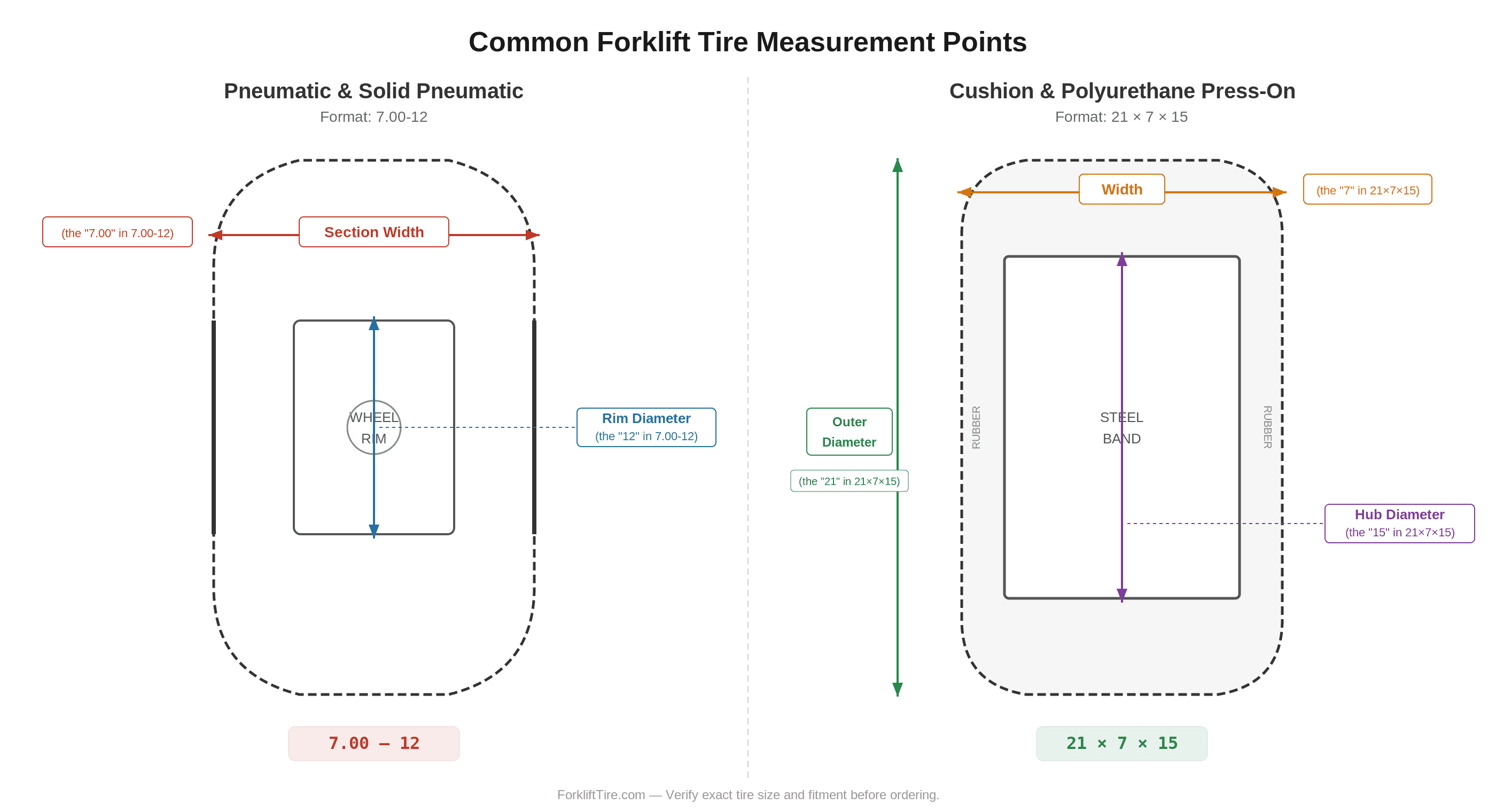
This guide explains how to measure pneumatic tires, solid pneumatic tires, cushion press-on tires, polyurethane press-ons, and low-profile resilient tires. You’ll also find common size formats, conversion help, wear guidelines, and practical replacement tips so you can identify the correct tire with confidence.
Why Accurate Tire Measurement Matters
Measuring a forklift tire correctly is about more than ordering something that fits. Tire dimensions affect ride height, stability, load handling, steering response, traction, and overall equipment performance.
An incorrectly sized tire can change mast clearance, alter the truck’s geometry, increase drivetrain stress, and create avoidable safety issues. That is why the best replacement process starts with the right size, the right construction, and the right application match.
Tools You’ll Need
You do not need specialty equipment to measure most forklift tires accurately. A few basic shop tools are enough.
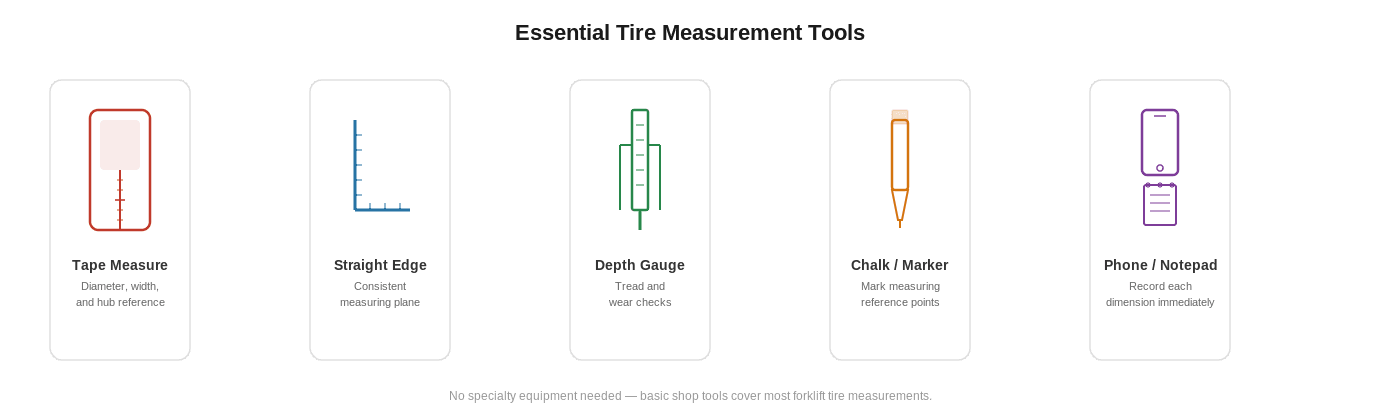
- Standard tape measure for diameter, width, and hub or rim reference.
- Straight edge or square to help establish a consistent measuring plane.
- Tread depth gauge or caliper for wear checks.
- Chalk or marker to mark measuring points.
- Phone or notepad to record each dimension immediately.
Where to Find Your Current Tire Size
Before measuring, check the places where the original tire size may already be listed.
On the Tire Sidewall
The sidewall is usually the first place to look. Pneumatic sizes, press-on sizes, ply ratings, and other markings are often molded or stamped directly into the tire.
Forklift Data Plate
The data plate is often the most reliable reference for the truck’s original tire specifications, especially if the old tire is worn smooth or may have been replaced incorrectly in the past.
Operator’s Manual
Many manuals list approved tire sizes, tire types, and inflation requirements for the original truck setup.
Supplier Records
If the truck has been serviced before, your prior order history may already show the correct size and construction.
Understanding Forklift Tire Size Formats
Forklift tires use different size systems depending on the tire family. Understanding the format first makes the measuring process much easier.
Pneumatic & Solid Pneumatic Format

Pneumatic-style tires usually use a two-number size, such as 7.00-12. The first number is the section width and the second is the rim diameter.
Press-On Cushion Format

Press-on tires typically use a three-number format, such as 21 × 7 × 15. This means outer diameter, tire width, and hub diameter.
Low-Profile Resilient Format

Low-profile resilient tires often use a mixed metric and imperial format, such as 200/50-10. That means section width in millimeters, aspect ratio as a percentage, and rim diameter in inches.
How to Measure Pneumatic & Solid Pneumatic Tires
Pneumatic tires — both air-filled and their solid rubber equivalents — are commonly used in outdoor and mixed-surface applications. They are measured with two main dimensions.
Dimension 1: Section Width
- Place the tape measure at the widest point of the tire.
- Measure from one sidewall edge to the other across the tread face.
- Record the width to the nearest practical fraction or marking value.
Dimension 2: Rim Diameter
- Measure the wheel rim diameter, not the overall tire diameter.
- Measure across the wheel through the center from bead seat to bead seat.
- Confirm against wheel stampings if they are visible.
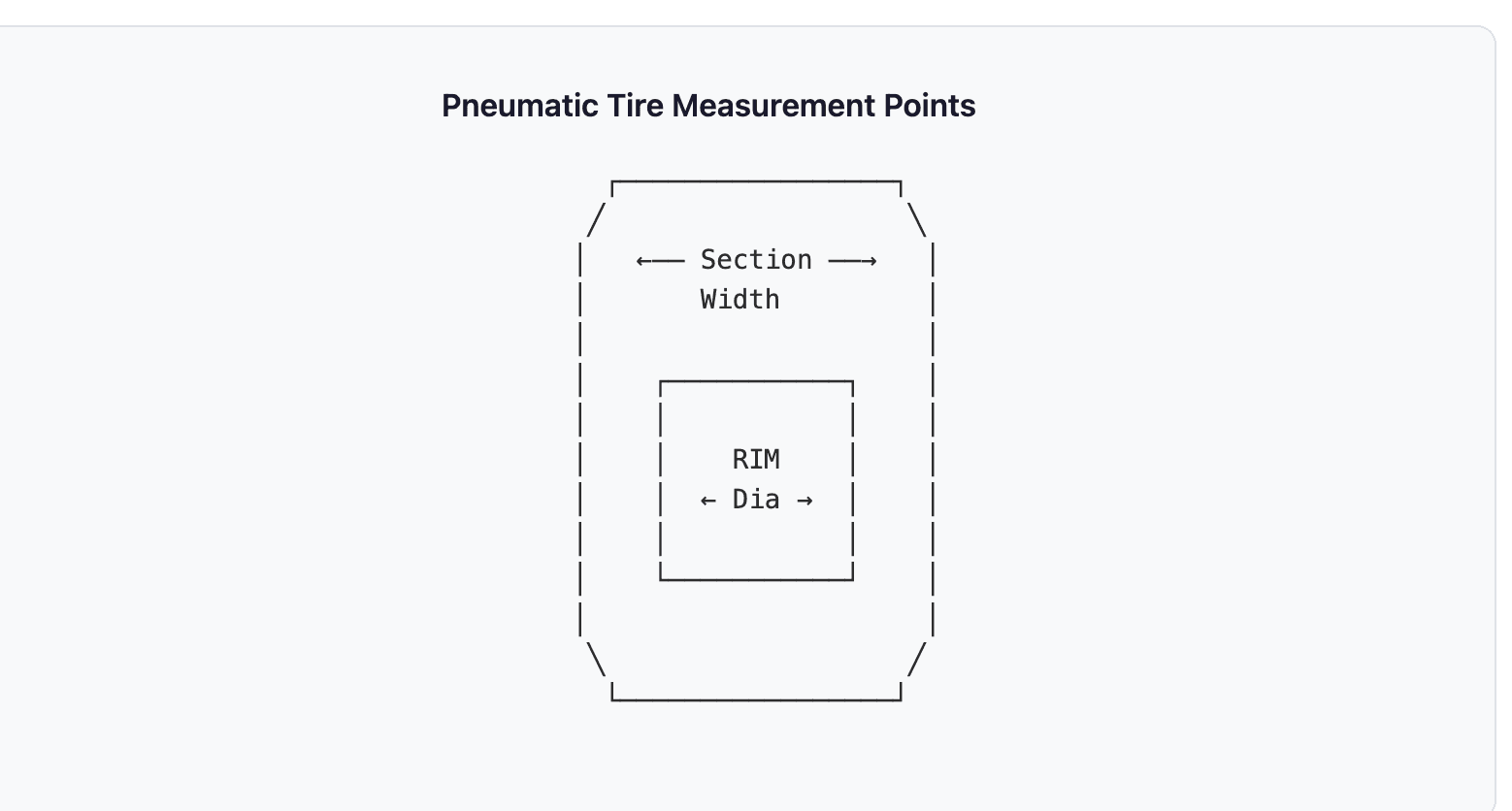
Your final size is written as width and rim diameter, such as 7.00-12.
How to Measure Cushion Press-On Tires
Cushion press-on tires are rubber tires bonded to a steel band that presses onto a flat hub. They are common on electric forklifts running on smooth indoor floors. These tires require three measurements.
Dimension 1: Outer Diameter
- Measure straight across the tire through the center from outer edge to outer edge.
- If the tire is mounted and loaded, measure from the floor to the top of the tire and multiply by two.
Dimension 2: Tire Width
- Measure across the face of the rubber only.
- Do not include any steel band overhang.
Dimension 3: Hub Diameter
- Measure the inside diameter of the steel band if the tire is off the truck.
- If still mounted, use the exposed hub reference and verify against wheel or data-plate information.
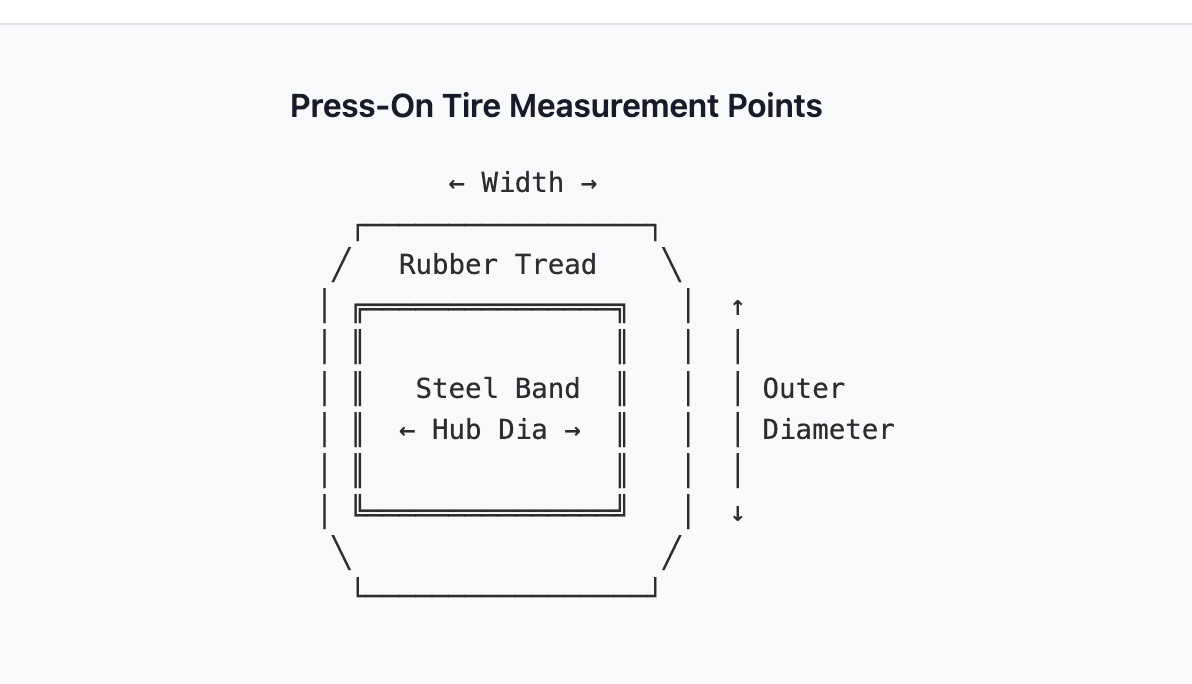
The final size is written as OD × Width × Hub, such as 21 × 7 × 15.
How to Measure Polyurethane Press-On Tires
Polyurethane press-on tires use the same three-number format as rubber press-ons and are measured the same way: outer diameter, width, and hub diameter.
What Makes Polyurethane Different
Polyurethane is denser and more wear-resistant than standard rubber in the right environment. It is often chosen for indoor equipment on smooth floors where long wear and low rolling resistance matter.
Measurement Procedure
Follow the same three-step process used for cushion press-ons and record the size in the same format, such as 16 × 6 × 10½.
Verifying Compound Thickness
After measuring the three main dimensions, you can estimate compound thickness with this formula:
This helps you understand wear over time and compare current condition to new-tire specifications.
How to Measure Low-Profile Resilient Tires
Low-profile resilient tires are common on reach trucks, order pickers, and other narrow-aisle equipment. Their notation combines metric section width, aspect ratio, and rim diameter.
Dimension 1: Section Width
Measure the tire’s width in millimeters across the tread face.
Dimension 2: Aspect Ratio
This is usually read from the sidewall marking rather than measured directly.
Dimension 3: Rim Diameter
Measure the wheel rim diameter as you would on a pneumatic tire.
A size such as 200/50-10 means 200 mm section width, 50% aspect ratio, and a 10-inch rim.
Metric-to-Imperial Conversion Chart
If your sidewall or data plate uses metric dimensions but your ordering reference is imperial, use 1 inch = 25.4 mm.
| Imperial Size | Metric Equivalent | Typical Application |
|---|---|---|
| 10 × 4 × 6½ | 254 × 102 × 165 | Walkie pallet jacks |
| 14 × 4½ × 8 | 356 × 114 × 203 | 3-wheel electric forklifts |
| 16 × 6 × 10½ | 406 × 152 × 267 | 3,000–5,000 lb electrics |
| 18 × 7 × 12⅛ | 457 × 178 × 308 | 5,000–6,500 lb electrics |
| 21 × 7 × 15 | 533 × 178 × 381 | 6,000–8,000 lb forklifts |
Common Forklift Tire Sizes by Type
Pneumatic & Solid Pneumatic
| Tire Size | Common Ply Ratings | Typical Capacity Range |
|---|---|---|
| 5.00-8 | 10PR | 2,000–3,000 lb |
| 6.00-9 | 10PR, 12PR | 3,000–4,000 lb |
| 6.50-10 | 10PR, 12PR | 4,000–5,000 lb |
| 7.00-12 | 12PR, 14PR | 5,000–6,500 lb |
| 8.15-15 | 14PR | 8,000–10,000 lb |
Cushion & Polyurethane Press-On
| Tire Size | Compound Options | Typical Application |
|---|---|---|
| 10 × 4 × 6½ | Rubber, Polyurethane | Walkie equipment |
| 14 × 4½ × 8 | Rubber, Polyurethane | 3-wheel steer tires |
| 16 × 6 × 10½ | Rubber, Polyurethane | 3,000–5,000 lb forklifts |
| 18 × 7 × 12⅛ | Rubber, Polyurethane | 5,000–6,500 lb forklifts |
| 21 × 7 × 15 | Rubber, Polyurethane | 6,000–8,000 lb forklifts |
Find Your Exact Forklift Tire Size
Shop forklift tires by construction type, size, and application. We stock pneumatic and solid pneumatic tires, cushion rubber press-ons, and polyurethane press-ons for a wide range of forklift models.
Shop Forklift Tires NowLoad Capacity & Ply Ratings
Tire size alone is not enough. Load capacity and ply rating also need to match the application and the truck’s requirements.
On pneumatic tires, the ply rating or load range helps indicate the load the tire is built to support. On solid constructions, the equivalent load suitability still matters even though the tire is not air-filled.
| Ply Rating | Load Range | Relative Duty Level |
|---|---|---|
| 6PR | C | Light duty |
| 8PR | D | Medium duty |
| 10PR | E | Heavy duty |
| 12PR | F | Extra heavy duty |
| 14PR | G | Severe duty |
| 16PR | H | Maximum duty |
How to Measure Tire Wear & When to Replace
Measuring tire wear is just as important as measuring size. Worn tires reduce stability, traction, and overall performance.
Cushion / Press-On Tire Wear
Cushion and press-on tires wear by losing outer diameter as the rubber compound wears away.
| Indicator | Method | Replace When |
|---|---|---|
| Wear Line | Inspect tread surface | Colored wear line becomes visible |
| OD Reduction | Compare current OD to original | About 2 inches or more lost |
| Rubber Depth | Calculate remaining compound | Remaining thickness is too low for safe service |
Pneumatic Tire Wear
Pneumatic forklift tires are typically replaced based on tread wear, damage, air-loss issues, or solid-pneumatic wear indicators.
| Indicator | Method | Replace When |
|---|---|---|
| Tread Depth | Use a tread gauge | Tread is worn to bars or service threshold |
| 60-J Line | Inspect sidewall on solid pneumatic | Wear reaches the molded line |
| Sidewall Damage | Visual inspection | Cuts, bulges, or exposed cord appear |
| Air Loss | Pressure check | Tire will not hold rated pressure |
Common Measurement Mistakes
Mistake 1: Measuring a worn tire and ordering that worn size
Always compare against the original tire specification when possible.
Mistake 2: Confusing outer diameter with rim diameter
This is one of the most common ordering mistakes, especially with pneumatic tires.
Mistake 3: Mixing metric and imperial sizes
A metric press-on size may represent the same tire as an imperial size, so convert carefully before ordering.
Mistake 4: Ignoring drive vs. steer differences
Front and rear tires are often different sizes on the same truck. Measure each axle separately.
Mistake 5: Mixing tire constructions on the same axle
Keep both tires on the same axle the same type, size, and ideally wear level.
Need Help Matching the Right Tire?
Send us your forklift model, current tire size, or a photo of the data plate. We can help confirm the correct size and tire type for your application.
Contact Our Tire ExpertsFrequently Asked Questions
Can I replace an air-filled pneumatic tire with a solid pneumatic tire?
Yes. This is one of the most common upgrades. Solid pneumatic tires use the same size notation and mount on the same rim when matched correctly.
How do I know if my forklift uses pneumatic or cushion tires?
Check the wheel design. Pneumatic tires mount on a rim with bead seats, while press-on cushion tires have a bonded steel band and a flatter hub-style mounting arrangement.
Can I put a larger tire on my forklift for more ground clearance?
Not without checking the manufacturer’s specifications. A larger tire changes ride height, geometry, and capacity assumptions. If you need a tougher setup, a construction change may be better than a size change.
What if my sidewall markings are worn away?
Start with the forklift data plate. If that is unavailable, use the measuring procedures on this page and compare them against known size formats.
How often should forklift tires be inspected?
Inspect tire condition as part of regular pre-shift checks, and measure wear more thoroughly on a scheduled basis depending on usage intensity.