 1 (866) 313-2180
 SALES@FORKLIFTTIRE.COM


Posted by Forklift Tire Company on 5th Mar 2026
Need polyurethane press-on tires (and load wheels) that run cooler, carry heavier loads, and last longer? This guide summarizes the Falcon USA Polyurethane Brochure and breaks down the key compounds—Hyload, SPS, Megaload, HL4, and Falconium—so you can match the right wheel to your job conditions (heat, speed, long runs, debris, wet floors, freezer work, and more).
Download the PDF: Falcon USA Polyurethane Brochure 2025
Jump to: Why polyurethane | Compound lineup | Best-fit applications | How to choose | Tread patterns | Get help | FAQ
Why polyurethane press-on tires (what this brochure emphasizes)
The brochure positions Falcon/Millennium as a long-time manufacturer focused on quality and innovation, with proprietary polyurethane compounds engineered for materials handling—specifically to improve performance and reduce failures tied to internal heat buildup.
- Hyload urethane: described as reducing premature failures caused by internal heat buildup in tires and wheels.
- SPS compound: described as a softer ride option without shortening battery life.
- Megaload: positioned as the choice for extreme applications “where nothing else works.”
Browse: Request a quote / fitment help
Falcon polyurethane compound lineup (what each one is built for)
HL3 (Hyload 3)
HL3 is shown as an SPS Hyload option in the lineup, with a performance chart format used throughout the brochure to compare load-at-failure characteristics.
Superthane (SPS Hyload Superthane)
Superthane is presented as part of the SPS Hyload family in the same load-at-failure comparison style used across the brochure.
Megaload (our “extreme conditions” wheel)
Megaload is described as being built from a premium curative for heavy industrial applications with extremely overloaded operating conditions. The brochure highlights two practical benefits:
- Resists flat spotting
- Can carry up to 25% more weight than standard urethanes
HLS (Hyload Soft)
Hyload Soft (HLS) is positioned as a hybrid compound based on the Hyload chemical backbone but modified to yield a softer tread compound with enhanced traction—paired with “softer tread / softer ride” messaging.
XD60 (SPS Hyload XD60)
XD60 is presented as an SPS Hyload option (60D) in the lineup, shown within the same comparative performance framework.
HL4 (Born to run: long runs, high speeds, continuous operation)
HL4 is described as optimized for dynamics—long runs, high speeds, and continuous operation. The brochure calls HL4 “more than just a load wheel compound,” emphasizing grip on concrete floors while still being resilient enough to go the distance, and positions it as a preferred solution for idler and drive tires in modern distribution-style operations.
Falconium (runs cooler)
Falconium is presented around heat-management and run-time benefits, with headline claims including:
- Runs 35% cooler
- Lowers heat
- Longer run times
- Reduces heat fatigue
Best-fit applications (quick matching)
- Extreme loads / overloaded conditions: Megaload (flat-spot resistance + higher weight capacity)
- Long distance + higher speed + continuous duty: HL4
- Heat-sensitive operations: Falconium (cooler-running / heat fatigue focus)
- Need a softer ride with traction focus: HLS (Hyload Soft)
How to choose the right polyurethane wheel (use the brochure’s “job & environment” logic)
The brochure includes a “select the right tire for your job and environment” section, comparing how compound families tend to fit common problem conditions such as freezer work, wet floors, metal chips/debris, heavy loads, extreme heat, long runs, dock boards, chunking, flat spotting, noise, battery drain, and wide joints.
Simple selection rule:
- If you’re fighting flat-spotting and overloads, start with Megaload.
- If your trucks run long distances at higher speeds with minimal cool-down time, start with HL4.
- If your main issue is heat (hot floors, long shifts, high duty), start with Falconium.
- If you want a softer ride but still need traction, consider HLS.
Tread patterns (what the brochure shows)
The brochure illustrates multiple tread options (for both tire and wheel applications), including smooth and grooved-style patterns—useful when you need to tune traction vs. floor contact vs. wear behavior.
Want help selecting the right Falcon polyurethane setup?
- Equipment type (reach truck, pallet jack, stacker, etc.)
- Wheel location (drive / load / idler)
- Current wheel/tire size (and bearing/axle details if applicable)
- Operating conditions: heat, long runs, speed, wet floors, debris/metal chips, freezer work
- Priority problem: flat-spotting, chunking, battery drain, noise, premature wear
FAQ
What products are covered in this Falcon polyurethane brochure?
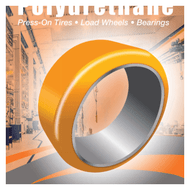
The cover indicates the catalog focuses on polyurethane press-on tires, load wheels, and bearings.
What’s the main advantage the brochure highlights for Hyload?
Hyload is described as reducing premature failures associated with internal heat buildup in tires and wheels.
Which compound is highlighted for extreme overloaded conditions?
Megaload is described for extremely overloaded operating conditions, including flat-spot resistance and higher weight-carrying capability.
Which compound is positioned for long runs and high speeds?
HL4 is described as optimized for dynamics: long runs, high speeds, and continuous operation.
Which compound emphasizes cooler running and reduced heat fatigue?
Falconium is presented with cooler-running and heat-fatigue reduction claims.