 1 (866) 313-2180
 SALES@FORKLIFTTIRE.COM


Posted by Forklift Tire Company on 7th Nov 2024
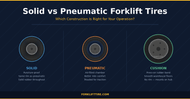
The key difference between a solid forklift tire and a pneumatic (air-filled) forklift tire is the construction. Solid tires are rubber through and through — no air, no tubes, no flats. Pneumatic tires use compressed air inside an outer casing, similar to a truck tire, and require an inner tube and liner flap. A third option — the cushion press-on tire — mounts directly onto a steel band and is pressed onto the wheel, designed specifically for smooth indoor surfaces.
Each construction serves a different operation. Choosing wrong means premature wear, reduced stability, or unnecessary downtime. This guide breaks down how solid, pneumatic, and cushion forklift tires differ — and where each one performs best.
What Are Pneumatic Forklift Tires?
Pneumatic forklift tires are air-filled tires built with a rubber casing, inner tube, and liner flap. The air cushion absorbs shock and provides traction on uneven ground — gravel, broken concrete, dirt, and outdoor loading docks.
Nearly all pneumatic forklift tires are bias-ply construction (not radial like highway tires), because bias-ply handles the heavy side-loading and slow-speed turning that forklifts demand. The inner tube holds the air pressure, typically between 90 and 120 PSI depending on tire size. The liner flap sits between the tube and the wheel rim to prevent the tube from being pinched or abraded.
Pneumatic tires are the standard choice for outdoor and mixed-surface operations — construction sites, lumber yards, recycling facilities, and any yard with rough or uneven terrain. They are commonly used on certain Toyota, Hyster, Caterpillar, and Komatsu forklifts in outdoor configurations.
Shop pneumatic forklift tires by equipment
What Are Solid Forklift Tires?
Solid forklift tires are exactly what they sound like: solid rubber, no air cavity, no tube. They cannot go flat, which makes them the standard for operations where puncture hazards — metal shavings, nails, glass, pallets — are a daily reality.
Two main sub-types exist:
- Solid resilient tires — shaped like a pneumatic tire and mounted on the same style of rim. They replace pneumatic tires on forklifts that need puncture-proof operation. Sometimes called "solid pneumatic" or "solid pneumatic-shaped" tires.
- Mold-on solid tires — molded directly onto a steel wheel or hub. Common on scissor lifts and boom lifts from brands like Genie, JLG, Snorkel, and Skyjack.
Solid tires can also come in specialized compounds. Non-marking (grey or white) rubber prevents black scuff marks on warehouse floors, which matters in food processing, pharmaceutical, and clean-room environments. Polyurethane compounds offer even harder durometers (88A to 95A) with lower rolling resistance — an advantage for electric forklifts where energy efficiency extends battery runtime.
Shop solid and pneumatic forklift tires
What Are Cushion Press-On Forklift Tires?
Cushion press-on tires are the third major forklift tire construction — and the most common type on indoor warehouse forklifts. A cushion tire is a thick rubber tire bonded to a steel band that gets hydraulically pressed onto the forklift's wheel. There is no air, no tube, and no traditional rim.
Cushion tires are available in two compounds:
- Black rubber — standard compound for general warehouse and manufacturing use
- Non-marking rubber — grey or white compound that prevents black scuff marks on floors, required in food, beverage, pharmaceutical, and retail distribution environments
Because cushion tires mount directly to the wheel, they create a smaller overall footprint than a pneumatic-equipped forklift. This gives cushion-tire forklifts a tighter turning radius — a real advantage in narrow-aisle warehousing. The tradeoff: cushion tires provide minimal shock absorption and are not built for uneven ground.
Cushion press-on sets are sold as 4-piece sets: 2 drive tires + 2 steer tires, since the drive and steer positions use different sizes on nearly every counterbalanced forklift. They are commonly used on certain Toyota, Hyster, Yale, Clark, Crown, Mitsubishi, Caterpillar, and Komatsu forklifts.
Browse cushion press-on forklift tires by size
Solid vs Pneumatic vs Cushion: Side-by-Side Comparison
| Feature | Solid Resilient | Pneumatic (Air-Filled) | Cushion Press-On |
|---|---|---|---|
| Construction | Solid rubber, no air | Rubber casing + inner tube + liner flap | Rubber bonded to steel band, pressed onto wheel |
| Flat risk | None | Yes — punctures and leaks possible | None |
| Best surface | Indoor smooth + debris-heavy environments | Outdoor rough terrain, gravel, dirt, docks | Indoor smooth concrete or asphalt only |
| Shock absorption | Moderate | Best — air cushion absorbs impact | Minimal |
| Maintenance | Lowest — no pressure checks, no tube replacement | Highest — requires regular pressure checks, tube and flap replacement | Low — no pressure checks, but requires a tire press for installation |
| Turning radius | Standard | Standard | Tightest — smaller profile allows better maneuverability |
| Typical equipment | Indoor/outdoor forklifts in recycling, lumber, manufacturing | Construction, lumberyards, outdoor loading docks | Indoor warehouse, distribution, manufacturing |
| Non-marking available? | Yes | No | Yes |
| Shop | Solid & Pneumatic Tires | Pneumatic by Equipment | Cushion by Size |
How to Choose the Right Forklift Tire Construction
Start with the surface and environment, not the price.
Choose pneumatic if: Your forklift operates outdoors on gravel, dirt, broken pavement, or uneven loading docks. The air cushion protects the operator and the forklift from constant impact. You will need to budget for inner tubes and liner flaps as replacement parts.
Choose solid resilient if: Your operation faces puncture hazards — metal debris, scrap, nails, broken pallets — but you still need the pneumatic tire shape for your wheel rims. Solid resilient tires drop into the same rim as pneumatic tires but eliminate flat-tire downtime entirely.
Choose cushion press-on if: Your forklift runs exclusively on smooth indoor floors. Cushion tires give you the tightest turning radius, lowest per-tire cost, and longest wear life on smooth concrete. They require a tire press for installation — most dealers and larger operations have one on-site.
If you are running an electric forklift indoors, also consider polyurethane press-on tires, which offer harder compounds (88A–95A durometer) and lower rolling resistance that extends battery runtime in clean warehouse applications.
Not sure which construction fits your equipment? Use our forklift tire buying guide or look up your forklift model in the tire size chart to find the correct tire size and type.
Need multi-tire pricing? Shop forklift tire sets by equipment — save 7.5% on 2–3 tires or 15% on 4+ tires, with free ground freight to commercial addresses in the contiguous U.S.
Frequently Asked Questions
Can you put pneumatic tires on a solid tire forklift?
Solid resilient tires and pneumatic tires use the same wheel rim, so you can switch between them. However, cushion press-on tires use an entirely different mounting system (pressed onto a steel band) and cannot be swapped with pneumatic or solid resilient tires. The forklift frame and wheel design must match the tire construction. Verify exact tire size and fitment before ordering.
What are solid pneumatic forklift tires?
A "solid pneumatic" tire is a solid resilient tire that is shaped like a pneumatic tire and fits the same wheel rim — but has no air inside. It is made of solid rubber through and through. The name can cause confusion because it sounds like a contradiction. The "pneumatic" in the name refers to the shape and mounting style, not the construction. Solid pneumatic tires give you the rim compatibility of a pneumatic tire with the puncture-proof durability of a solid tire.
When should I replace solid forklift tires?
Replace solid tires when the rubber wears down to the safety line (also called the "50% wear line" or "J-line") molded into the sidewall. Operating past this line reduces stability, increases chunking and tearing risk, and can damage the wheel. If you notice flat spots, excessive vibration, or uneven wear, those also indicate replacement is needed.
Do solid forklift tires require a tube?
No. Solid forklift tires — whether solid resilient or cushion press-on — do not use inner tubes or liner flaps. Only pneumatic (air-filled) forklift tires require an inner tube and liner flap.
Verify exact tire size and fitment before ordering. If you are unsure which construction fits your forklift, contact our team at 1 (866) 313-2180 or sales@forklifttire.com.
Got your tires installed? Show us your machine in the Operator Gallery.