 1 (866) 313-2180
 SALES@FORKLIFTTIRE.COM


Posted by Forklift Tire Company on 21st Mar 2026
Need forklift tires built for load capacity and low total cost of ownership? This guide summarizes the Royal Tyres catalog covering two core categories—Royal Solid Resilient Tyres and Royal Press-On Tyres—and shows how to use the brochure’s specification tables to match size, rim, and load rating to your equipment.
Download the PDF: Royal Tyres Catalog (Solid Resilient + Press-On)
Jump to: Overview | Solid resilient tires | Press-on band tires | How to read the load tables | How to choose | Get help | FAQ
Royal Tyres catalog overview
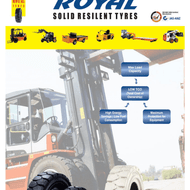
The Royal Tyres brochure focuses on two forklift tire types designed to reduce downtime and operating cost: solid resilient tires (pneumatic-shaped, flat-proof) and press-on band tires (rubber bonded to a steel band). The brochure highlights themes like max load capacity, low TCO, energy savings / low fuel consumption, and maximum protection for equipment.
Royal Solid Resilient Tyres (flat-proof, pneumatic-shaped)
Royal’s solid resilient section includes a detailed size table with wheel diameters commonly used in forklifts (including 8", 9", 10", 12", 13", 15", and 20" families). The table lists tire designations (inch + metric equivalents), approved rims, tread patterns, and multiple load capacity columns—helpful for fleets that want flat-proof uptime while keeping pneumatic-like form factor.
What to verify before ordering:
- Exact tire size designation (inch and/or metric equivalent)
- Approved rim size
- Drive vs steer position (load wheels vs steering wheels)
- Required load capacity based on your duty cycle
Browse similar tire types: Resilient Solids & Pneumatics
Royal Press-On Tyres (press-on band / cushion tires)
The brochure also includes press-on band tire specifications with imperial and metric sizing side-by-side. This is the right category when your forklift uses cushion/press-on tires mounted to a steel hub using a press (common in indoor warehouses and manufacturing environments).
What the press-on table includes:
- Imperial size and metric size conversions
- Load capacity for counterbalanced lift trucks at multiple speed ratings
- An additional load column for other vehicles (where applicable)
Browse press-on tire types: Press-On Forklift Tires
How to read the load tables (fast and correctly)
Both tables are designed to help you confirm fitment and load handling without guessing.
- Start with your size: match your current tire size (or sidewall marking) to the table.
- Confirm the rim: check the approved rim (solid resilient section) or the metric/imperial cross reference (press-on section).
- Match the load to your real use: choose the load capacity column that aligns with your equipment type and typical operating speed (the tables show multiple speed ratings).
- Drive vs steer matters: the solid resilient table separates load wheels vs steering wheels for counterbalanced forklifts—use the correct column for the position.
How to choose between solid resilient vs press-on
- If you need pneumatic-shaped, flat-proof tires: start with Royal Solid Resilient Tyres.
- If your forklift uses cushion/press-on band tires: use the Royal Press-On Tyres specification table.
- If you’re unsure: send your current tire sizes (drive + steer) and we’ll identify whether you’re in resilient solid or press-on—and match the right load rating.
Want help matching the correct Royal tyre size and load rating?
- Forklift make/model (or capacity class)
- Current drive and steer tire sizes (photo of sidewalls helps)
- Tire type: resilient solid vs press-on band (cushion)
- Typical use: indoor/outdoor, distance, speed, and load
FAQ
What tire types are included in the Royal Tyres catalog?
The brochure covers Royal Solid Resilient Tyres and Royal Press-On Tyres (press-on band / cushion).
Does the catalog include load ratings?
Yes—both the solid resilient and press-on sections include load capacity tables with multiple speed-rating columns.
How do I know if I need press-on band tires?
If your forklift uses cushion/press-on tires mounted to a hub with a press (common indoor setups), use the Press-On Band Tire Specifications section and match the imperial/metric size to your current tire.