 1 (866) 313-2180
 SALES@FORKLIFTTIRE.COM


20th Aug 2025
Black tire marks on a warehouse floor are more than a housekeeping nuisance. In food, pharmaceutical, and electronics facilities they can be an audit finding, and on coated or polished floors they mean recurring scrubbing costs that never end. Non-marking forklift tires exist to solve exactly this problem. This guide covers what makes a tire non-marking, what the compound trade-offs are — including the two nobody warns you about — which tire constructions offer non-marking options, and how to order the right one the first time.
QUICK ANSWER
If your facility requires mark-free or dust-free floors — food, pharma, electronics, clean rooms, coated concrete — you need non-marking tires. Expect a 15–25% price premium and somewhat shorter tread life — and plan for static grounding. If clean floors aren’t a requirement, standard black rubber is the better value.
On this page: The compound · Who needs them · Options by tire type · Black vs. non-marking · Static & heat · Cost · How to order · FAQ
What Makes a Tire "Non-Marking"?
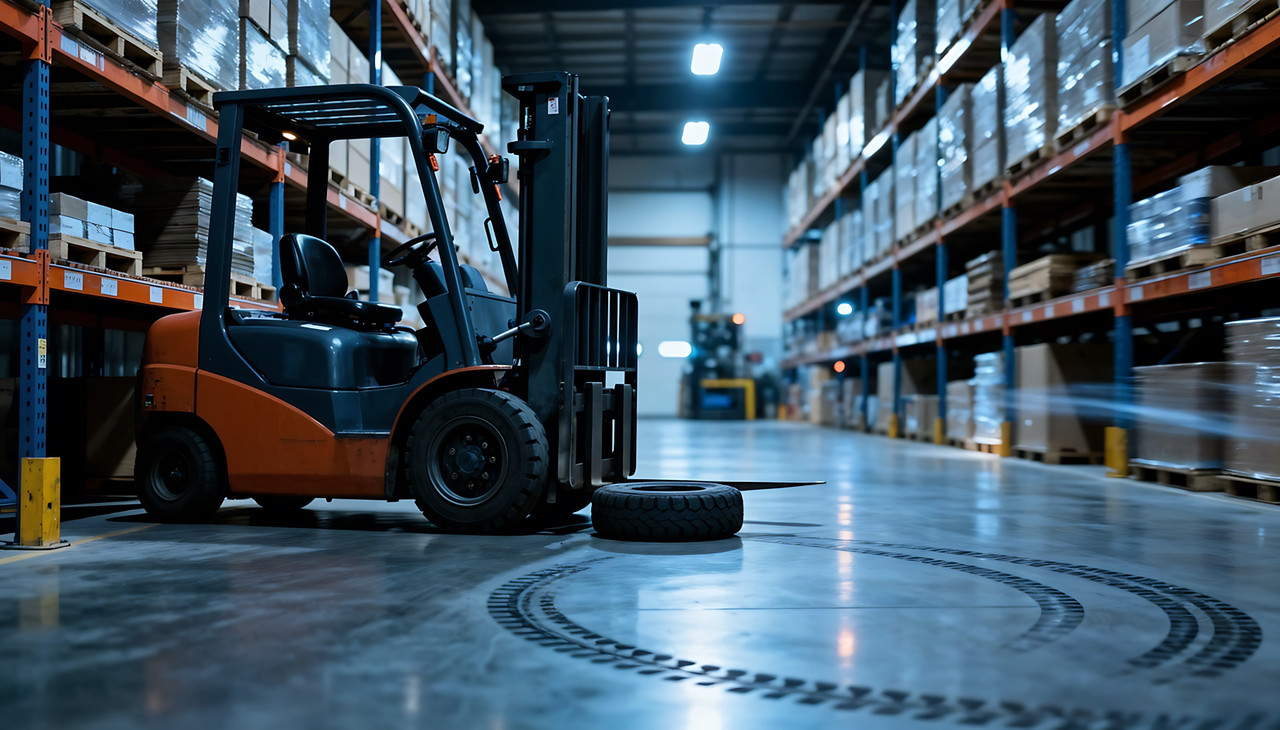
Standard forklift tires are black because the rubber is reinforced with carbon black — a filler that boosts abrasion resistance and tread life. Carbon black is also why black tires mark: under load and scrub, trace amounts of the compound transfer to the floor as dark streaks.
Non-marking tires replace carbon black with hydrated silica and similar light fillers. The result leaves no dark residue on concrete, epoxy, or polished floors — and just as important for sensitive facilities, it sheds no black carbon dust as it wears. Standard tires release fine carbon particles throughout their life; in food, paper, printing, and electronics environments, that dust is a contamination issue even before a visible mark appears.
A note on color, because it confuses buyers: non-marking refers to what the tire leaves behind, not what color it is. White, gray, and green-tinted non-marking compounds all exist. Bright white compounds rely on heavier chemical processing and tend to yellow and show grime; gray compounds (some stabilized with a trace of carbon black, on the order of 0.1% — far too little to mark) hold their color and hide dust better. Judge the tire by its compound and the words “non-marking” on the listing, never by shade.
The classic trade-off is wear: most non-marking compounds run softer than carbon-black rubber, so under the same duty cycle they generally wear faster — how much faster depends heavily on compound quality, and premium non-marking formulations have closed much of the historical gap. You are trading some tread life for a clean floor — a trade that makes sense when your facility requires it, and not when it doesn’t.
Who Actually Needs Non-Marking Tires
Non-marking is usually the right call if:
- You operate in food or beverage processing or storage, where floor cleanliness is audited
- You run a pharmaceutical, medical, or clean-room environment
- You handle electronics, paper, or print product where carbon dust is a contamination risk
- Your floors are epoxy-coated, polished, or light-colored and marks show immediately
- Customers or auditors walk your floor and presentation matters — retail DCs, airports, trade-show venues
You probably don’t need non-marking if your forklifts run on standard gray concrete, spend time outdoors in the yard, or your facility has no floor-appearance or contamination requirement. Standard black rubber does the same work, lasts longer, and costs less. Our warehouse tire selection guide walks through matching tire type to floor surface in more detail.
Cold storage and freezer operations are a common borderline case: many run non-marking compounds for hygiene compliance while also fighting condensation, stiffening rubber, and reduced traction at temperature. If that’s your environment, pair this guide with our cold storage forklift guide and tell us the operating temperature when you order — compound choice matters more in the cold.
Non-Marking Options by Tire Type
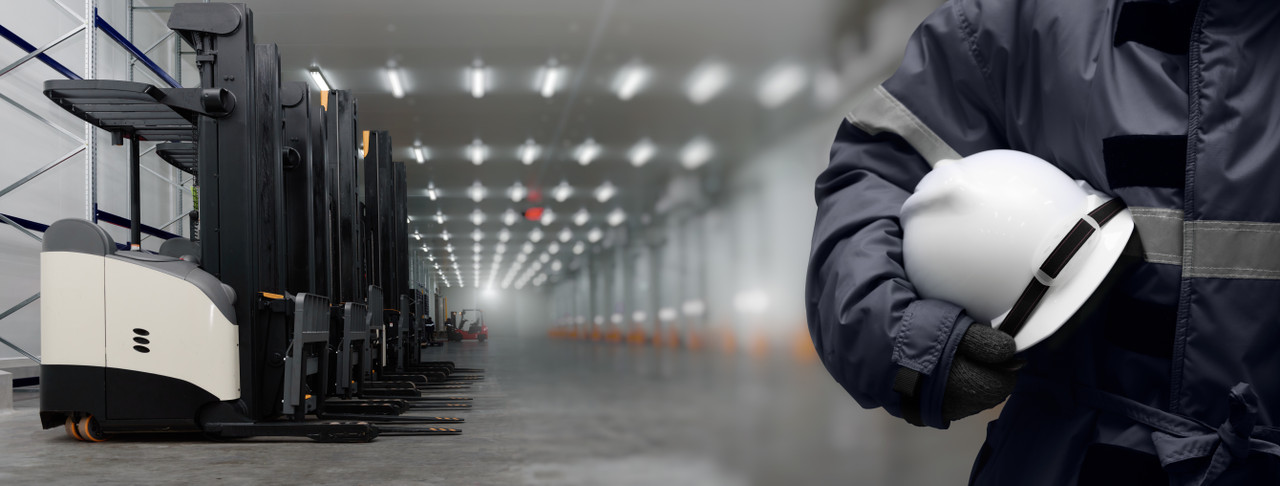
There is no single “non-marking tire.” Non-marking is a compound option that exists across several tire constructions — and your forklift’s wheel type decides which construction you need before color ever enters the picture.
| Construction | Where it runs | Non-marking availability |
|---|---|---|
| Cushion press-on tires | Sit-down cushion forklifts on smooth indoor floors | Offered in both black rubber and non-marking rubber across common sizes |
| Solid resilient tires | Pneumatic-type wheels; indoor/outdoor mix, dock work, debris-prone areas | Non-marking versions available in common sizes; flat-proof like any solid |
| Polyurethane press-on tires | Electric walkies, order pickers, reach trucks on smooth floors | Non-marking by nature — polyurethane contains no carbon black |
| Air-filled pneumatic tires | Outdoor yards, rough surfaces | Non-marking air pneumatics are rare; for clean floors plus outdoor exposure, non-marking solid resilients are the practical route |
Cushion trucks: if your forklift runs press-on cushion tires today, the non-marking decision is a straight compound swap in the same size — browse cushion press-on tires by size, or order a complete cushion forklift tire set (4-piece set with 2 drive + 2 steer) with non-marking as the material option.
Pneumatic-type trucks: non-marking comes as a solid resilient — same flat-proof construction, light compound. Shop individual solid resilient tires or pneumatic-type forklift tire sets, where non-marking 4-piece deals are listed alongside black rubber.
Electric light-duty equipment: polyurethane press-ons and forklift load wheels won’t leave dark marks at all, and poly’s low rolling resistance and long wear on smooth floors are why it’s the default on order pickers and walkie stackers.
Black vs. Non-Marking: The Short Version
| Factor | Black rubber | Non-marking |
|---|---|---|
| Traction | Strong on smooth, dry floors | Comparable to black on smooth, dry floors |
| Tread life | Generally longer | Compound quality decides the gap |
| Price | Baseline | Typically 15–25% more in the same size |
| Floor impact | Dark marks + fine carbon dust | No dark marking, no carbon dust |
| Static | Self-grounding (conductive) | Needs a grounding plan (see below) |
Choose by requirement, not appearance: if nothing in your operation demands mark-free floors, black rubber is the better value. For the full compound comparison, see black vs. non-marking forklift tires.
The Two Tradeoffs Nobody Tells You About: Static and Heat
Safety note — static buildup is the one that surprises facilities. Carbon black isn’t just a colorant — it’s electrically conductive, so a standard black tire continuously drains static charge from the truck into the floor. Silica is an insulator. Swap every tire on a forklift to non-marking and the truck loses its ground path: tire manufacturers have documented static accumulation as high as 50,000 volts over a shift of fast travel and heavy loads. That shows up as operators getting zapped at the controls, interference or damage in electronics-heavy facilities, and a genuine ignition risk anywhere flammable vapors or fine dust are present.
Two fixes, used together or alone:
- Anti-static ground strap — a cheap drag strap or chain that restores the ground path. One maintenance note: a strap only works while it touches the floor and stays reasonably clean. Dust-caked straps quietly stop working, so put them on an inspection schedule.
- Conductive non-marking compounds — premium manufacturers now build non-marking tires with a built-in ground path (for example, Trelleborg’s ProTex non-marking compound in the XP1000 line we carry). You get the clean floor and the static control in one tire. Availability is size-dependent — ask us before assuming your size is offered.
Heat is the quieter tradeoff. Silica compounds historically dissipate heat less efficiently than carbon-black rubber, and heat is what kills solid tires in high-intensity operations — long runs, high speeds, short cooldowns. If your trucks run hard all shift, say so when you order: premium non-marking compounds are engineered specifically for heat dissipation, and matching compound to duty cycle matters more with non-marking than with black rubber.
What Non-Marking Costs — and When the Premium Pays
Expect to pay roughly 15–25% more than the equivalent black-rubber tire. On tread life, plan conservatively: quality non-marking compounds typically run on the order of 1,500–2,500 hours in steady indoor service, against the 2,000–3,000-hour window common for comparable black rubber — with duty cycle and compound quality driving where you land in that range. Looked at per-tire, that’s a real premium. Looked at per-facility, it’s usually small money against what it offsets: recurring floor scrubbing labor, re-coating marked epoxy, or a failed hygiene audit. Facilities that require clean floors generally find the premium pays for itself; facilities that don’t require it shouldn’t pay it. Our forklift tire cost guide breaks down pricing across all tire types.
Two buying notes that reduce total cost: replace tires in matched drive/steer positions rather than one corner at a time, and use quantity pricing — Save 7.5% on 2–3 items | Save 15% on 4+ items. Automatic discount in cart. Free ground freight to commercial addresses in the contiguous U.S.
Ordering the Right Non-Marking Tire the First Time
0Know what you’re replacing. If the current compound is light-colored, you’re already on non-marking; match it unless the floor requirement changed. On our site, every non-marking product says so in the product name, and category filters let you narrow by Tire Material to non-marking rubber.
1Confirm your size. Pull it from the sidewall of the tire you’re replacing. Our forklift tire size chart covers the most common sizes by truck, and the sidewall reading guide explains every number.
2Match the construction to your wheel type. Press-on hubs take cushion or polyurethane press-ons. Pneumatic-type wheels take air-filled pneumatics or solid resilients. The construction must match before the compound matters.
3Decide tires-only vs. mounted. If you don’t have access to a tire press, mounted tire and wheel assemblies arrive ready to bolt on.
4When in doubt, ask. Send us the size off your current tire and your floor requirement and we’ll confirm the right option — call 1 (866) 313-2180 or use our contact form. The full forklift tire buying guide covers the whole decision end to end.
Verify exact tire size and fitment before ordering.
Non-Marking Forklift Tire FAQ
What are non-marking forklift tires made of?
They’re made of rubber or polyurethane compounds that use silica-based fillers instead of carbon black. Without carbon black, the compound is light-colored and leaves no dark residue on the floor.
Do non-marking tires wear faster than black tires?
Generally yes. Silica compounds are softer than carbon-black rubber, so expect somewhat shorter tread life under the same workload — though premium non-marking compounds have narrowed the gap. Facilities accept that trade-off in exchange for mark-free floors.
How much more do non-marking forklift tires cost?
Typically 15–25% more than the same tire in standard black rubber. The premium is usually minor compared to the floor-cleaning, re-coating, or compliance costs they prevent in facilities that require clean floors.
Which industries require non-marking tires?
Food and beverage processing and storage, pharmaceutical and medical production, clean rooms, and electronics handling are the most common. Many facilities with epoxy-coated or polished floors also spec them for appearance and floor protection.
Are polyurethane forklift tires non-marking?
Yes — polyurethane contains no carbon black, so it doesn’t leave dark marks. That’s one reason poly press-ons and load wheels are standard on electric order pickers, walkie stackers, and reach trucks that live on smooth indoor floors.
Do non-marking tires cause static electricity problems?
They can. Carbon black makes standard tires conductive, which grounds the truck as it drives. Silica-based non-marking compounds are insulating, so static can build up on the forklift instead. The fix is an anti-static ground strap kept clean and touching the floor, or a conductive non-marking compound that grounds the truck through the tire itself.
What color are non-marking forklift tires?
Usually white, gray, or a light green tint — but color is a byproduct, not the spec. Gray compounds tend to hold their appearance better than bright white ones, which can yellow with heat and grime. Always confirm “non-marking” in the product name rather than judging by color.
Are non-marking tires required for food-grade facilities?
Many food, beverage, and pharmaceutical facilities specify non-marking tires as part of their hygiene and audit programs, because they eliminate black marks and carbon dust. “Food-grade” certification itself applies to specific compounds and standards, though — if your auditor requires documented compliance, tell us and we’ll confirm what the manufacturer certifies for that tire.
Need the right non-marking tire, first time?
Send us your size and floor requirement — we’ll confirm the right option before you order.
Call 1 (866) 313-2180 Shop Non-Marking Cushion Shop Solid Resilient